
English classroom review games should do more than help students remember a definition. The best review activities invite learners to retrieve information, explain their thinking, apply concepts to unfamiliar examples, and notice what they still need to practise. This guide brings together practical, low-prep English Language Arts (ELA) review games for Grades 6–12—covering literature, literary devices, grammar, vocabulary, reading comprehension, and writing.
Use the ideas as ten-minute warm-ups, small-group challenges, or a full review period. Most work with a whiteboard and scrap paper; several can also become a digital team competition. Each activity includes ways to make the thinking deeper without making the preparation harder.
What makes an English review game worth class time?
A great review game has a clear learning target, meaningful participation, and an opportunity for feedback. Students should leave knowing why an answer is defensible, not simply which team was fastest. For a literary-device question, ask for the device, a quoted clue, and its effect on a reader. For a grammar question, ask students to correct the sentence and explain the rule.
The Institute of Education Sciences practice guide on organizing instruction and study recommends spaced practice, quizzing that brings earlier learning back to mind, and deep explanatory questions. In an English classroom, review games can use all three: revisit a previously taught idea, ask students to retrieve it, and follow up with an interpretation or explanation.
Quick-start review games for English teachers
1. Literary-device detectives
Best for: figurative language, sound devices, irony, symbolism, and author’s craft. Display a short original sentence such as “The hallway swallowed the last footsteps.” Teams identify personification and explain how that wording creates an unsettling atmosphere. Award one point for the identification and another for a plausible explanation supported by the words.
2. Quote, context, significance
Best for: short stories, plays, and novels. Show a brief quotation from a text students have read. Ask each team to identify who speaks or narrates, recall the moment, and explain why the passage matters for character, conflict, theme, or tone. Accept different interpretations when students can justify them with the text.
3. Grammar repair relay
Best for: commas, semicolons, colons, fragments, run-ons, and sentence structure. Give each team an intentionally flawed sentence. Students rewrite it correctly, then defend the change using a grammar rule. A correct punctuation mark without a sound explanation earns partial credit.
4. Theme-or-topic showdown
Best for: Grades 7–12 literature. Present statements such as “friendship,” “power can isolate people,” and “ambition.” Teams sort topics from theme statements, improve vague statements, and find story moments that could support a theme. Resist treating every plausible theme as automatically correct: ask for evidence.
5. Vocabulary evidence hunt
Best for: academic vocabulary and words in context. Display a sentence from a reading passage with a challenging word. Teams infer meaning, identify context clues, and write a new sentence that uses the word correctly. Include vocabulary from earlier units to provide spaced review.
6. Plot or argument reconstruction
Best for: narrative structure and persuasive writing. Give groups scrambled event cards or parts of an argument. Students put them in a defensible sequence, identify turning points or reasoning gaps, and explain the choices. For advanced students, include distractors that sound plausible but are irrelevant.
7. Claim–evidence challenge
Best for: close reading and analytical paragraphs. State a claim about a character or text. Teams must find a supporting detail, explain the connection, and consider a competing interpretation. This converts a quick review into a rehearsal for academic writing.
8. Rapid-fire mixed retrieval
Best for: end-of-unit review. Mix three question levels: recall (“Define dramatic irony”), application (“Identify the irony in this scenario”), and reasoning (“How does the irony change the audience’s response?”). Build in wait time and allow students to talk before reporting an answer.
Which game should you choose? Start with the learning goal
If the goal is terminology: choose matching, examples-and-nonexamples, or detective rounds. If the goal is interpreting literature: choose quote significance, theme defense, or claim–evidence challenges. If the goal is editing: choose a grammar repair relay. If the goal is exam readiness: mix content from several units and add explanation questions. One activity does not have to do everything.
A useful principle is to spend less time on elaborate rules than on student thinking. Two-minute instructions and three rounds with clear feedback are often more valuable than a complicated game that spends most of the lesson on setup.
Digital English review games versus no-tech activities
No-tech activities are easy to adapt when internet access is unreliable or when students need to annotate a shared text. Whiteboards and paper cards work especially well for close-reading evidence, longer written reasoning, and individual accountability. Digital games can provide faster pacing, more varied prompts, and a shared focus for the class, but teachers still need to verify question quality.
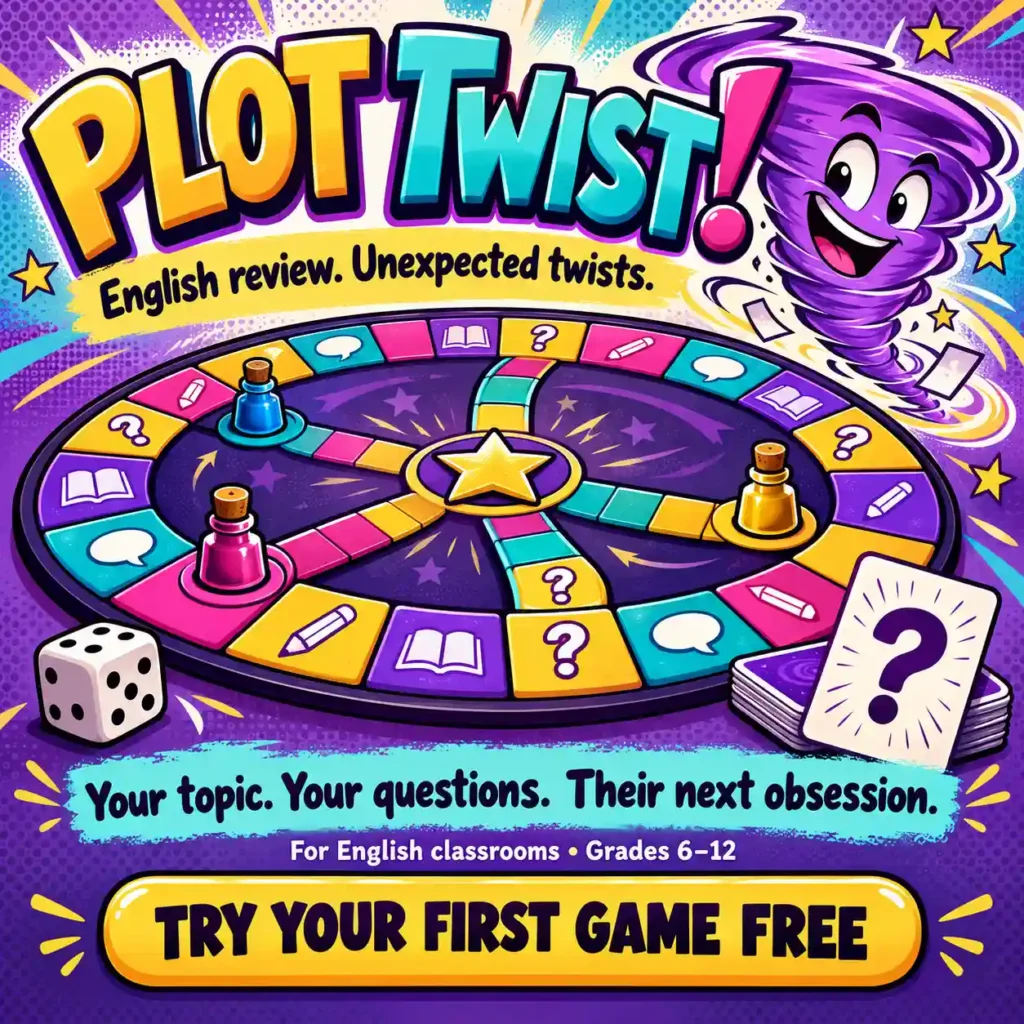
For a one-screen team format, Plot Twist! is a browser-based classroom review game built around teacher-selected topics and uploaded materials. Students work in teams, answer a variety of AI-generated questions, collect ink, and progress toward a final challenge. Teachers operate the game; students do not need individual accounts. The first game is available free, making it possible to test the format before choosing a membership.
A 40-minute English review lesson you can use tomorrow
Minutes 0–5 — Individual retrieval. Ask every student to write a literary-device definition, one example, and a question they still have. Do not grade this warm-up; use it to identify misconceptions.
Minutes 5–10 — Review the rules. Form small teams, explain how turns work, and model a complete answer with evidence or a reasoning step. Make clear that speed alone does not win.
Minutes 10–30 — Three rounds. Round 1 checks recall, round 2 asks students to apply ideas to fresh examples, and round 3 asks them to defend an interpretation. Pause briefly to correct common misconceptions.
Minutes 30–35 — Reteach the trouble spot. Choose one concept students missed repeatedly. Show a new worked example and ask a second, similar question.
Minutes 35–40 — Individual exit ticket. Ask students to respond independently to one fresh question: “Name the device and explain its effect,” or “Correct the sentence and explain why.” Team success is not a substitute for evidence of each learner’s understanding.
How to differentiate review games across Grades 6–12
Grades 6–7: limit the number of target skills, give short excerpts, provide a vocabulary bank when appropriate, and offer sentence frames such as “The word ___ suggests ___ because ___.” Keep rounds short and build in paired discussion.
Grades 8–9: ask students to compare devices, identify effect as well as technique, connect evidence to a claim, and work across previously taught texts. Mix foundational grammar with short analytical responses.
Grades 10–12: introduce competing interpretations, ambiguous examples, rhetorical effects, counterclaims, and multi-step questions. Reward explanation and quality of evidence rather than only quick recognition.
For multilingual learners and students with reading or processing needs, read prompts aloud when useful, display the question long enough for rereading, provide private think time, and allow a team spokesperson to change across rounds. A speaking role should not be the only way to contribute.
How to keep team games fair and academically useful
Choose teams intentionally and rotate roles: reader, evidence finder, spokesperson, and checker. Require a brief team conversation before answers are locked in, particularly on interpretive questions. If you use a points system, reward evidence or correction, not just speed. After a wrong answer, ask “Which part was right?” and model the missing reasoning.
For sensitive passages, controversial themes, and texts involving personal experiences, avoid competitive scoring about students’ identities or disclosures. Compete over textual analysis, not who can reveal the most personal information.
Use review games as retrieval practice, not a substitute for reading
A review game works best after students have learned the material and then again after some time has passed. Bring a few old concepts into each new round so students have to retrieve ideas rather than merely recognize yesterday’s notes. The Education Endowment Foundation also highlights the importance of discussion and explanatory feedback during retrieval practice.
This matters for English: knowing the definition of a metaphor is useful, but the larger goal is recognizing how a metaphor shapes meaning. Recognizing a grammar rule is useful, but the larger goal is editing writing effectively. Keep asking, “What does this help students do with a text?”
Build a digital review game from your own English content
Begin with a focused unit, not the entire year: literary devices, a short story, sentence punctuation, a novel’s first chapters, or a particular writing skill. Prepare a small selection of notes, examples, and learning goals. Test several questions before class, check any AI-generated answers against your materials, and decide which responses need teacher judgment.
In Plot Twist!, teachers can provide a topic with specific instructions or upload materials, choose two to seven teams, select an ink target, and run a shared-screen board game. Questions include multiple challenge styles, and the teacher can choose how responses are evaluated. For interpretive English questions, keep your own professional judgment involved.
Explore the English Review Games resource library
This hub is part of The Teachers’ Blog’s growing collection of practical review activities for middle and high school English. As new articles publish, they will automatically appear below.

You can also use the established Grade 9 English complete course, our retrieval practice ideas for ELA, the literary devices glossary, and the 45 poetry games collection for additional lesson-ready material.
Frequently asked questions
What are the best review games for middle school English?
Short rounds of literary-device detective work, vocabulary-in-context challenges, grammar repair, and quote-context games are practical starting points. Grades 6–8 usually benefit from clear models, visible prompts, and time to discuss before answering.
How can I make English review games more challenging for high school?
Require supporting quotations, explanation of authorial effect, competing interpretations, and a written response after team discussion. More advanced tasks do not need complicated game mechanics; they need better questions.
Do English classroom review games have to be digital?
No. Paper cards, mini-whiteboards, and oral questioning all work. Digital games are an optional format when you want varied questions and a shared competitive structure.
Can students play Plot Twist! without individual devices?
Yes. Plot Twist! is designed as a teacher-led shared-screen game with two to seven teams. Students can collaborate without each creating an account.
Can I try Plot Twist! before subscribing?
Yes. Teachers can play one game free. Paid memberships are listed at US$5 per month or US$25 per year; the current game limits and details are shown on the product’s billing page.
Ready to try a fresh kind of English review?
Start with one of the activities above or turn a familiar lesson topic into a digital team competition. Keep the learning goal in the foreground, check student understanding at the end, and make the game the memorable part of a genuinely useful review lesson.