
10 Writing and Editing Review Games for English Class
Writing and editing review games can make revision practice more engaging without reducing good writing to a list of punctuation mistakes. Middle and high school students need to understand the difference between planning ideas, shaping paragraphs, improving clarity, and proofreading surface errors. The ten games below deliberately address those different stages, with ready-to-use examples and a 45-minute lesson you can teach tomorrow.
These activities suit Grades 6–12 English classes, especially after students have written their first essay or paragraph draft. They also fit the broader English Classroom Review Games collection. Unlike our grammar review games, this lesson emphasizes the writer’s decisions: what to add, cut, rearrange, clarify, or support.
A practical distinction: revise first, edit second
Revision changes meaning or structure: developing a claim, selecting better evidence, removing repetition, and improving paragraph flow. Editing improves sentence clarity, grammar, punctuation, consistency, and conventions. Proofreading is a final check for remaining surface errors. A student can fix every comma yet still have a weak argument; that’s why a review game needs more than an error hunt.
Write a success criterion on the board: “I can explain why a change makes writing clearer, more accurate, or more convincing.” Require that explanation with every game answer. Points for justification turn random guessing into practice with transferable writing strategies.
10 writing and editing review games for English class
1. Revision or Editing? The Sorting Challenge
Time: 10 minutes. Write action cards: “Add evidence supporting the claim,” “Correct a comma splice,” “Reorder two paragraphs,” “Fix an apostrophe,” and “Clarify who they refers to.” Students sort each action into revision, editing, or potentially both. Ask groups to defend disputed choices.
Teaching answer: Adding evidence and reorganizing paragraphs generally count as revision. An apostrophe error is editing. Clarifying an ambiguous pronoun could be either, depending on how extensively the idea must change. Emphasize the reason behind the classification rather than a rigid label.
2. Stronger Topic Sentence Showdown
Time: 12 minutes. Show a topic sentence such as “There are many things about the story.” Teams rewrite it for a paragraph analyzing a character’s choices. A more useful version might be “The protagonist’s refusal to ask for help reveals how pride intensifies the central conflict.”
Award one point for a specific claim and one for identifying what the paragraph would need to prove. A sentence that sounds impressive but cannot be supported by the assigned story does not win.
3. Evidence or Explanation? Paragraph Surgery
Time: 15 minutes. Give teams a model paragraph with a clear claim and a quotation, but missing analysis. For example: “The character is anxious. The narrator notes that her hands tremble.” Students add one or two sentences explaining how the detail supports the interpretation.
Possible revision: “The physical reaction suggests fear that the character has not admitted aloud, creating a contrast between her outward confidence and private anxiety.” Ask groups what assumption they would need to verify in the full passage.
4. Cut the Clutter Challenge
Time: 8–12 minutes. Project: “Due to the fact that the speaker was extremely very frustrated, the speaker made a decision to leave the room at that particular time.” Teams produce a concise version without deleting essential meaning.
Suggested answer: “Because the speaker was frustrated, they decided to leave the room.” Discuss when a longer sentence is warranted for rhythm or emphasis and when it only hides an idea.
5. Sentence Variety Remix
Time: 12 minutes. Display four short sentences: “The alarm sounded. Students stopped. The teacher opened the door. Everyone waited.” Teams combine them into two clear, varied sentences without inventing events.
Sample answer: “When the alarm sounded, students stopped and waited as the teacher opened the door.” Note that this combines all four facts but also compresses the sequence. Challenge students to offer another version that preserves the exact order more explicitly.
6. Transition Match: Show the Relationship
Time: 10 minutes. Provide two ideas: “The story is told from one character’s perspective. Readers cannot know what the other character truly intends.” Teams choose and justify a connector such as therefore, however, for example, or no connector.
A defensible response is “The story is told from one character’s perspective; therefore, readers cannot know what the other character truly intends.” Discuss whether the relationship really follows and whether a transition can make a weak logical connection seem stronger.
7. Ambiguous Pronoun Detective
Time: 10 minutes. Show: “When Jordan spoke to Avery, they looked disappointed.” Ask what is ambiguous and how to fix it without guessing who feels disappointed.
Teaching point: A student must request context or rewrite to identify the intended person: “Jordan looked disappointed while speaking to Avery” is accurate only if Jordan was meant. Being unable to resolve the ambiguity is a valid observation.
8. Punctuation Court: Defend Your Choice
Time: 15 minutes. Present “The evidence was compelling however the conclusion was weak.” Teams choose a correct revision and name the relationship between clauses. One answer is “The evidence was compelling; however, the conclusion was weak.” Another is to split it into two sentences.
Have the group explain why a comma alone would be insufficient. For more focused punctuation practice, connect this game to the grammar review activities.
9. Peer Feedback That Helps
Time: 15 minutes. Display three peer comments: “Good job,” “This is confusing,” and “Your example is interesting, but explain how it proves your claim about the character.” Teams rank the comments by usefulness and rewrite the vague ones as actionable suggestions.
A strong feedback comment names a particular location, describes the reader’s difficulty or strength, and suggests a next step. Students should critique the writing rather than the writer.
10. The Revision Auction
Time: 15–20 minutes. Give teams ten paper tokens and a brief flawed paragraph. Offer potential changes for auction: improve a claim, add evidence, remove a repeated sentence, correct a minor typo, or change a transition. Teams spend tokens on the revisions they believe will most improve the paragraph.
Reveal a model rationale after each bid. This is not about a universal value for every mistake: the importance of any change depends on the writing task and the paragraph’s most significant weakness. The game develops prioritization, not simply proofreading speed.
Ready-to-use editing practice: six mini-prompts
Prompt 1: “The novel was interesting it had a surprising ending.” Answer: “The novel was interesting; it had a surprising ending.” A period or appropriate conjunction also works.
Prompt 2: “Its clear that the narrator is unreliable.” Answer: “It’s clear that the narrator is unreliable.” Explain that it’s means it is.
Prompt 3: “The author uses symbolism to show stuff.” Possible revision: “The author uses the broken watch to suggest how the character struggles with lost time.” This model requires actual story evidence before students use it.
Prompt 4: “Although the argument was persuasive.” Answer: This is a dependent-clause fragment. One correction is “Although the argument was persuasive, its evidence was incomplete.”
Prompt 5: “The characters motives were different.” Answer: “The characters’ motives were different,” if multiple characters are intended. Use “character’s” for one.
Prompt 6: “First the narrator introduces the problem. In conclusion the conflict develops.” Possible revision: “First, the narrator introduces the problem. Later, the conflict develops.” The original transition implies a conclusion without establishing one.
A complete 45-minute writing revision lesson
0–5 minutes: Students privately identify one revision and one editing change they made recently. Ask which change improved meaning most.
5–12 minutes: Model the difference between revising ideas and correcting errors. Use a weak paragraph to think aloud about the greatest obstacle to reader understanding.
12–25 minutes: Play Stronger Topic Sentence Showdown and Paragraph Surgery in teams. Require each student to explain one improvement.
25–37 minutes: Run Revision Auction. Discuss why the strongest changes are not always the quickest or most visible.
37–45 minutes: Exit ticket. Students revise two sentences from a sample paragraph and annotate one choice: “I changed ___ because ___.” Collect these as independent evidence of learning.
Differentiation, assessment, and curriculum links
Grades 6–7: Provide sentence frames, shorter passages, colour-coded claims and evidence, and a choice between two useful revisions. Avoid penalizing a student for spelling when the target is idea development.
Grades 8–9: Ask for explicit reasoning, accurate punctuation choices, and comments that explain a reader’s experience. Students might use a draft from their Grade 9 English course.
Grades 10–12: Introduce counterarguments, nuanced transitions, sentence rhythm, and style choices for audience. Ask which revision best improves reasoning and why.
The Common Core writing anchor standards include developing and strengthening writing through planning, revising, editing, rewriting, and trying new approaches (W.5). Pair the game with your Ontario English or local curriculum expectations as needed.
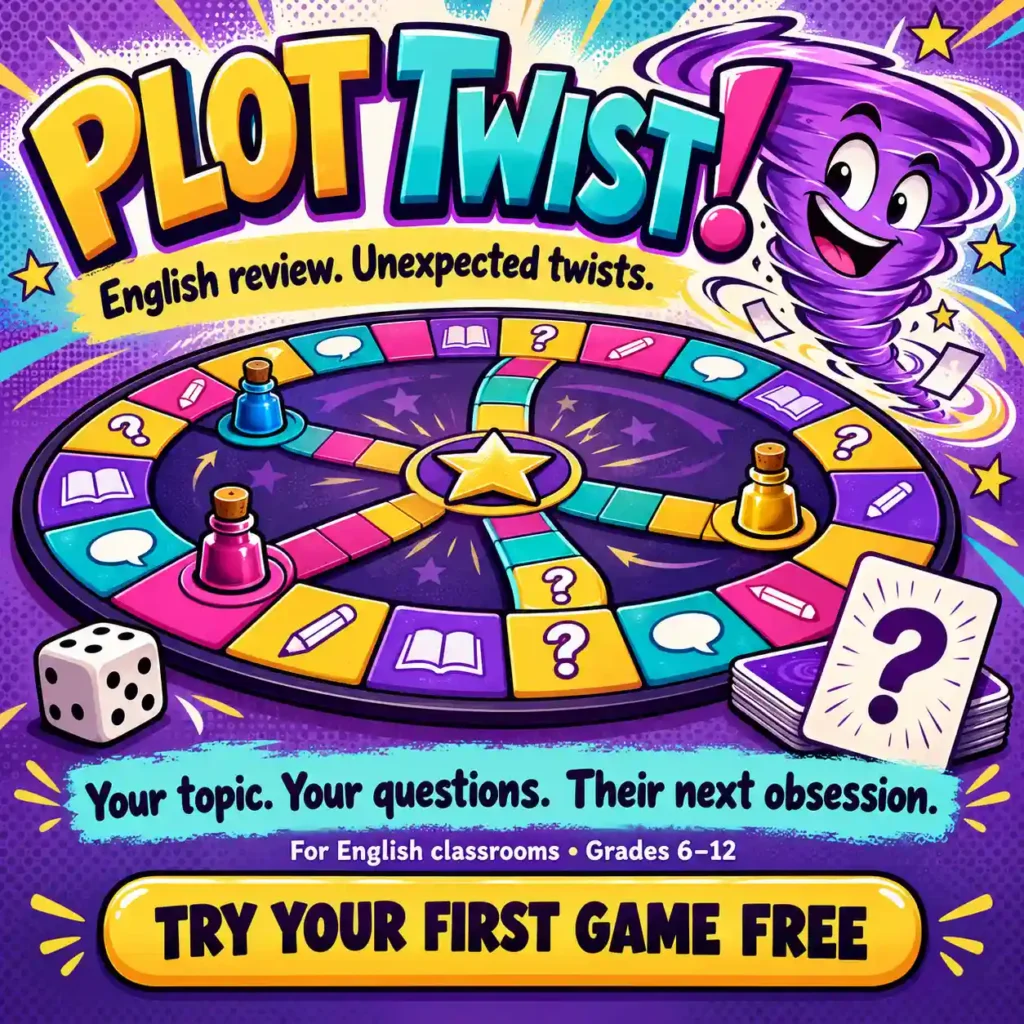
Make writing practice playful with Plot Twist!
For a shared-screen team review, you can use Plot Twist! to revisit editing decisions, paragraph organization, and evidence-based reasoning. Enter your topic or permitted lesson notes, select two to seven teams, and use teacher marking for prompts with more than one defensible rewrite.
Suggested setup: “Grade 9 English. Generate original short examples about transitions, argument structure, sentence clarity, punctuation, and revision priorities. Avoid answers based solely on speed. For open-ended writing, accept multiple well-reasoned solutions and explain what makes them effective.” Check AI-generated items before class. The first game is free.
Frequently asked questions
What is the best game for teaching writing revision?
Paragraph Surgery is a strong starting point because students must improve a claim, connect evidence, or clarify reasoning rather than merely correct mechanics. The Revision Auction is especially useful once students understand several revision strategies.
Should students revise their own work during a game?
They can, but anonymous teacher-created examples reduce anxiety and avoid exposing a classmate’s private draft. End the lesson by asking students to transfer one skill to their own work.
How can I assess individual improvement during team games?
Have students record an initial revision independently and complete a fresh exit-ticket example after team discussion. Compare the quality of their explanations, not just the team’s score.
Are grammar corrections enough for a full writing review?
No. Good writing also relies on a meaningful purpose, coherent structure, appropriate evidence, and attention to audience. Use surface editing as one part of a broader review.
A better sentence is only the beginning
The most valuable outcome is students learning to say why one version communicates more effectively. That habit leads to stronger revisions long after the game ends. For adjacent activities, explore argumentative writing review games and the full English Review Games hub.