
Get a full year of Grade 9 English lesson plans for free. This comprehensive curriculum follows a de-streamed approach (aligned with Ontario ENL1W/NBE1W and global ELA standards). Whether you need a single unit on short stories or a day-by-day 18-week schedule, these resources are classroom-tested and ready to use.
Teaching grammar in Grade 9? Use our complete Grammar Lessons hub to find punctuation, sentence structure, conjunctions, verb forms, phrases, and review activities, all organized by skill.
Looking for a lively way to review the skills in this course? Explore our English classroom review games for Grades 6–12, including low-prep literature, grammar, and vocabulary activities and a teacher-led digital team game.
English is one of the most important subjects students study because reading and writing are the tools that make learning possible across every discipline. Research consistently shows that strong literacy skills improve achievement not only in English but in subjects like math, science, and history, while also supporting critical thinking, communication, and long-term success beyond school
Unit 1: Literacy Foundations & Literary Devices
This unit focuses on establishing a Growth Mindset and building the essential vocabulary needed for literary analysis in Grade 9 English. Students will create a comprehensive glossary of terms and practice identifying devices in various contexts.
Grit, Mindset & Starting Strong – This lesson introduces students to the course through community-building activities and Angela Lee Duckworth’s TED Talk on grit, helping them begin the year by developing a growth mindset and setting expectations for persistence and learning.
Literary Devices Glossary – Students explore a structured glossary of literary devices through guided definitions, examples, discussion, and reference-building activities that establish a shared analytical vocabulary teachers can draw on throughout the course for reading, writing, and class discussion tasks.
Teaching Plot – Students learn the structure of plot by identifying and diagramming exposition, rising action, climax, falling action, and resolution through guided examples and short text analysis, giving teachers a foundation for later short story study and literary interpretation activities.
Practice Identifying Plot – Students apply their understanding of plot structure by identifying exposition, rising action, climax, falling action, and resolution in a complete short text using a guided plot diagram activity that reinforces story sequencing and prepares them for later short story analysis tasks.
Literary Terms Quiz and Irony – Students complete a formative literary terms quiz that checks understanding of key vocabulary introduced in earlier lessons while introducing irony as a new concept, helping teachers identify gaps in comprehension before students begin deeper short story analysis.
Mood and Setting in Literature – Students examine how authors use time, place, and descriptive detail to shape atmosphere by learning the relationship between mood and setting, recording new literary terms in their glossary, and responding to guided journaling and discussion prompts that connect these concepts to their independent reading texts.
Learning About Character – Students examine how authors create believable and meaningful characters by learning key characterization techniques, adding new literary terms to their glossary, and applying these ideas to their independent reading through guided reflection and discussion activities that prepare them for deeper short story analysis.
Conflict in Fiction – Students learn how conflict drives plot by identifying internal and external conflicts, recording key conflict types in their literary glossary, and applying the concept to their independent reading through discussion and short written reflection on how tension shapes story development.
Literary Terms Quiz and POV – Students complete a second formative literary terms quiz that reinforces recently introduced vocabulary while reviewing earlier concepts from the literary devices glossary, allowing teachers to monitor retention and prepare students for upcoming short story analysis work.
Creating a Literary Devices Poster – Students consolidate their understanding of literary devices by designing a visual poster that includes a definition, original example, and illustration of an assigned device, reinforcing analytical vocabulary while creating classroom reference materials that support ongoing literary study throughout the course.
Finding Theme in Literature – Students learn how to identify theme as the central message of a story by recording structured notes, applying guiding questions to their independent reading, and continuing their literary devices poster project to reinforce analytical vocabulary alongside deeper interpretation skills.
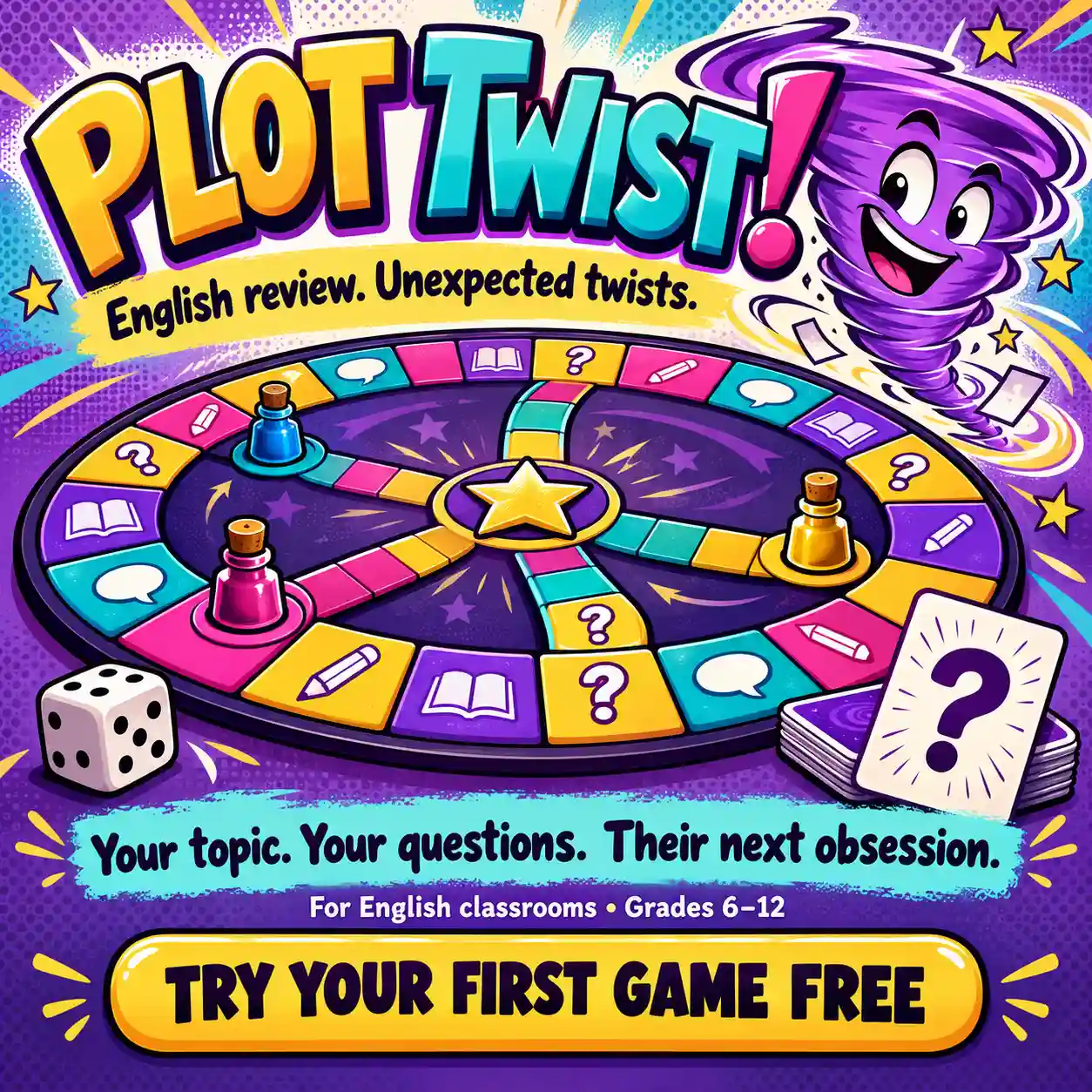
A FREE CLASSROOM GAME FOR ENGLISH TEACHERS
Make your next English review a Plot Twist!
Bring some unexpected fun to your next lesson. Get a free game of Plot Twist!, the ultimate classroom review game, and discover fresh ideas for teaching English.
Subscribe for English teaching ideas and occasional resource updates, plus your free Plot Twist! game. You can unsubscribe from emails at any time.
Unit 2: The Elements of Fiction & Short Story Study
In this unit, students apply their foundational skills to classic and contemporary short stories in Grade 9 English. The focus shifts toward grammar integration (capitalization, commas, colons) and creative storytelling through storyboards and scripts.
Practice the Elements of Fiction – Students review and apply their understanding of key elements of fiction—such as character, setting, plot, conflict, point of view, and theme—through structured practice questions that help teachers reinforce core literary concepts before students begin extended short story analysis.
Capitalization and Fiction Review – Students review key capitalization rules through guided notes and practice sentences, then apply their understanding of the elements of fiction by continuing structured analysis of “Eleven,” helping reinforce both writing accuracy and literary interpretation skills in the same lesson block.
Finding Literary Devices in Fiction – Students reinforce their understanding of literary devices by identifying examples such as symbolism, irony, and foreshadowing in their independent reading and class texts, while completing a capitalization review quiz that supports ongoing grammar development alongside close reading practice.
Commas and Literary Devices – Students review essential comma rules through guided instruction and practice exercises, then apply those rules while continuing structured analysis of “Eleven”, helping teachers reinforce sentence clarity alongside ongoing elements-of-fiction work.
Short Story Storyboard Activity – Students transform a key scene from “Lamb to the Slaughter” into a short script and visual storyboard after reading the story together, strengthening comprehension by analyzing dialogue, action, and tone while developing visual literacy and creative interpretation skills through a multi-day adaptation project.
Scripting & Storyboarding Continued – Students continue developing their adaptation of “Lamb to the Slaughter” by expanding and refining their scripts from the storyboard activity, strengthening their understanding of dialogue, pacing, and narrative structure while practicing how stories change when translated from prose into dramatic form.
Colons, Last Day for Scripting and Storyboarding – Students learn how to use colons correctly to introduce lists, explanations, and emphasis through guided grammar instruction and practice exercises, then continue refining their Lamb to the Slaughter scripts and storyboards as the storytelling unit moves toward completion.
Silent Reading, Colons Quiz, and “The Curio Shop” – Students complete a short formative quiz on colon usage to reinforce punctuation rules from the previous lesson, then read “The Curio Shop” and respond to comprehension questions that deepen interpretation of tone, imagery, and perspective while preparing for the upcoming short story unit test.
Mysteries of “The Curio Shop” – Students read “The Curio Shop” and respond to structured comprehension and interpretation questions that focus on tone, imagery, and narrative perspective, helping teachers guide close reading practice while preparing students for the short story unit test.
“The Interlopers” and Semicolons – Students read “The Interlopers” and respond to structured comprehension and interpretation questions that focus on conflict, irony, and theme, helping teachers guide close reading while preparing students for the short story unit test.
Semicolons Quiz and “The Interlopers” Questions – Students begin with sustained silent reading, complete a short formative semicolons quiz to reinforce punctuation skills, and then finish structured comprehension and analysis questions for “The Interlopers”, consolidating their understanding of conflict, irony, and theme before moving into the next elements-of-fiction review lesson.
Elements of Fiction Review Using “Gore” – Students review key elements of fiction by reading “Gore” and responding to structured analysis questions on character, conflict, theme, and plot, helping consolidate short story unit concepts before moving toward the literary devices review and final assessment.
Literary Device Review With a Taskmaster-Style Classroom Challenge – Students review major literary devices such as symbolism, foreshadowing, imagery, and irony through structured practice and guided examples, consolidating key analytical vocabulary in preparation for the short story unit test and helping teachers reinforce device recognition before formal assessment.
Short Story Test – Assessing Student Understanding of Fiction – Students complete a formal short story unit test that assesses their ability to identify and apply key elements of fiction—such as plot, character, conflict, setting, point of view, and theme—using a new text, giving teachers a clear measure of how well students can transfer their analytical skills independently.
Book Presentation: Sharing Your Reading Journey – Students begin with a coordinating conjunctions grammar warm-up and are then introduced to a culminating book presentation project in which they create and deliver a structured slideshow demonstrating their understanding of their independent novel through themes, quotes, plot insights, and personal interpretation.
Coordinating Conjunctions Quiz and Book Presentation Work Period – Students complete a short formative quiz on coordinating conjunctions (FANBOYS) to reinforce how equal ideas are joined in sentences, then continue developing their book presentation slides and speaking notes as they prepare for the culminating independent novel presentation.
Subordinating Conjunctions and Book Presentation Work Period – Students learn how subordinating conjunctions connect dependent and independent clauses to form complex sentences, practice combining ideas to show relationships such as cause, time, condition, and contrast, and apply punctuation rules that support clearer and more sophisticated sentence structure in their writing.
Book Presentations, Celebrating Reading and Communication Skills – Students deliver their independent novel presentations to demonstrate understanding of plot, character development, and theme while practicing structured speaking skills, responding to peer questions, and reflecting on how different books generate different interpretations and connections across the class.
Unit 3: The Opinion Essay & Academic Writing
A rigorous dive into formal academic writing in Grade 9 English. In this unit, we have shifted our approach to scaffold the writing process more deeply: first, teachers and students will co-create an essay together, a collaborative method that has shown to significantly improve students’ ability to structure and write better essays independently. Following this shared practice, students will tackle their second essay completely on their own as a timed, in-class assignment (dedicating one day to crafting the outline and one day to writing the full essay). Finally, their third and ultimate essay will be seamlessly integrated into the Unit 4 novel study culminating activity. Throughout this progression, students will master the mechanics of MLA Formatting, evidence-based arguments, and the importance of the peer-editing process.
Grade 9 Essay Exemplar and Outline – Students transition into the opinion essay unit by analyzing a model Grade 9 essay to identify key structural features—such as thesis statements, topic sentences, supporting evidence, and conclusions—before beginning their own outline planning and topic development for persuasive writing.
PEEL Paragraphs and Correlative Conjunctions – Students learn how to structure analytical body paragraphs using the PEEL method—Point, Evidence, Explain, and Link—while reviewing correlative conjunctions and drafting their first practice paragraph on a choice-based topic to build confidence before applying the structure to literary essay writing later in the unit.
Refining Writing with the AI PEEL Paragraph Helper – Students use the AI PEEL Paragraph Helper to draft and refine structured body paragraphs with targeted feedback on their Point, Evidence, Explanation, and Link components, allowing teachers to support independent writing practice while strengthening paragraph organization ahead of full essay drafting.
How to Use MLA Formatting – Students learn the fundamentals of MLA formatting by setting up a correctly formatted academic document in a word processor and applying standard layout conventions—such as headers, spacing, titles, and identifying information—so their essays meet expectations for formal high school writing.
Teaching Introductory Paragraphs – Students study how effective introductions are built by analyzing hooks, background context, and thesis statements, then plan and draft their own opening paragraphs using guided organizers that prepare them to anchor a full opinion essay with a clear controlling idea.
How to Write Strong Concluding Paragraphs – Students strengthen their essay-writing skills by studying how effective conclusions restate the thesis in fresh language, synthesize key arguments, and leave readers with a purposeful final insight, while continuing to develop their outlines or rough drafts with attention to how introductions and conclusions work together
MLA Works Cited and Simple Past Tense Quiz – Students learn how to construct a properly formatted MLA Works Cited page by identifying required source details, alphabetizing entries, and applying formatting conventions such as hanging indents and spacing, while reinforcing academic integrity through citation practice and continued progress on their essay drafts.
MLA In-Text Citations and Linking Verbs – Students practice integrating quotations and paraphrased evidence using correct MLA in-text citation format, learning how author names and page numbers connect sources to a Works Cited page while strengthening academic credibility and avoiding plagiarism in formal essays.
Essay Checklist, Rough Draft Completion, and Linking Verbs Quiz – Students use a structured essay checklist to review MLA formatting, thesis clarity, paragraph organization, evidence integration, and conclusions before peer editing, while completing a linking verbs quiz and polishing rough drafts to ensure all required components are in place for revision.
Peer Editing, Interrogative and Imperative Verbs – Students exchange essay drafts and use a structured peer-editing checklist to provide constructive feedback on organization, evidence, clarity, grammar, and MLA formatting, helping them refine their arguments and revise their work from a reader’s perspective before submitting final copies.
Unit 4: Novel Study & Literature Circles
The culminating unit of Grade 9 English. Students participate in Literature Circles to explore complex themes, symbolism, and character growth.
Novel Study Introduction – Students begin the novel study unit with an introduction to literature circles, receiving their novels, setting reading goals, and establishing expectations for tracking character development, conflict, and theme as they prepare for sustained independent reading and discussion throughout the unit.
Lit Circle Goals, Setting Purpose and Direction – Students organize their literature circle experience by dividing their novel into scheduled reading sections, setting shared discussion goals, and beginning independent reading, while a short grammar mini-lesson on direct and indirect objects reinforces sentence clarity alongside the launch of the book club unit.
A Pre-Reading Project That Builds Curiosity and Context – Students work in literature circle groups to research the historical, cultural, and social context surrounding their assigned novel and create a short presentation predicting how these forces may shape the characters’ identities, conflicts, and themes before reading begins.
Using the First Three Lines to Spark Deeper Reading – Students analyze the opening three lines of their literature circle novels to generate predictions about tone, conflict, and theme, using discussion and written responses to activate prior knowledge and establish interpretive questions that guide their reading through the novel study unit.
Exploring Setting, Character, and Gerunds – Students strengthen independent reading habits through sustained silent reading, complete a short gerunds quiz to reinforce grammar accuracy, and analyze how setting influences character decisions by gathering textual evidence, tracking vocabulary, and responding to a focused interpretive paragraph prompt.
Types of Conflict Lesson Plan — Helping Students Track Story Tension – Students revisit the major types of conflict through a brief refresher mini-lesson and then work in literature circle groups to identify emerging conflicts in their novels, classify them by type, support their ideas with evidence, and make predictions about how those tensions may shape future plot developments and themes.
Emerging Themes in Literature Lesson and Active vs. Passive Voice – Students identify emerging themes in their literature circle novels by tracking recurring ideas, gathering supporting evidence from their reading, and discussing how character decisions and conflicts reveal larger messages developing across the text.
Gathering Text Evidence While Reading – Students continue independent reading with a focus on collecting meaningful quotations that reveal setting, character traits, conflict, mood, and emerging themes, recording page numbers and explanations to strengthen evidence-based thinking while updating reading logs and reinforcing the habit of reading with purpose.
Analyzing Character Change – Students track how characters evolve during their literature circle novels by identifying shifts in attitude, decisions, or relationships, supporting their ideas with specific textual evidence, and using participles to describe transformation while connecting character change to emerging themes in the text.
Understanding Narrative Point of View – Students explore how narrative point of view shapes a reader’s understanding of events by distinguishing between first-person and third-person perspectives, identifying textual clues that signal each viewpoint, and applying the concept to their literature circle novels to deepen interpretation of character knowledge and story development.
Climax Prediction Lesson Plan That Helps Understand the Turning Point – Students anticipate the turning point of their literature circle novels by tracking rising tension, identifying conflicts nearing resolution, and completing a structured climax prediction chart supported with textual evidence, followed by a short journal reflection warning a character about an upcoming mistake or danger.
Teaching Political Cartoons Through Literature – Students examine how political cartoons function as visual arguments by analyzing symbolism, exaggeration, and satire in sample cartoons, then create their own single-panel cartoon based on a key issue from their novel, supported by a short written explanation of the message and symbols used.
Teaching Symbolism in Literature – Students shift from literal plot understanding to deeper interpretation by reviewing how symbolism and imagery reveal theme, character motivation, and author intent, then create thoughtful universal symbolism questions that can be applied to any novel during sustained independent reading and discussion.
Unanswered Questions and Surprises in the Novel – Students reflect on moments of confusion, surprise, or unresolved questions in their literature circle novels by identifying passages that feel unexpected or unclear and discussing how authors use uncertainty to encourage prediction, interpretation, and deeper engagement with the story’s meaning.
Novel Reflection: What Will Students Remember a Year From Now? – Students step back from plot details to reflect on the lasting message of their literature circle novels by responding to structured reflection questions about key ideas, memorable moments, and personal insights, while practicing compound-complex sentences to support thoughtful written responses about the novel’s impact.
Sample Exam and Study Materials
Grade 9 English Exam Review and Sample Exam – Students complete a structured final review that revisits major literary terms, grammar concepts, and fiction analysis skills using a sample exam and review package designed to mirror the format of the Grade 9 English final assessment and build confidence before exam writing.
Grade 9 English FAQ
Is this Grade 9 English curriculum suitable for students outside of Ontario? Yes. While aligned with Ontario’s de-streamed (ENL1W) standards, the course focuses on universal ELA skills such as literary analysis, structured essay writing (MLA), and grammar. It is highly compatible with US Common Core, British Key Stage 4, and other international secondary English frameworks.
What materials are required to teach this course? All core lesson plans, glossaries, and writing templates are provided for free on this site. You will only need access to the specific short stories (many of which are public domain) and a novel of your choice for the final unit.
Does this course support differentiated learning and ESL/ELL students? Absolutely. The curriculum includes scaffolds like the PEEL paragraph structure and tiered text strategies to support diverse learners and English language learners in a mainstream classroom.