
Day 3: Teaching Plot Lesson Plan for English
Introduce the skeleton of storytelling with a deep dive into narrative plot. In Day 3 of the Grade 9 English course, students balance independent choice reading with the technical study of plot diagrams (Exposition to Resolution). This lesson bridges the gap between enjoying a story and analyzing its construction.
Time: 75 Minutes | Key Concepts: Plot Diagram, Exposition, Climax, Resolution, Choice Reading.
Learning Goals and Standards
By the end of this lesson, students will be able to:
- Define plot as the sequence of cause-and-effect events in a story
- Identify the five stages of a plot diagram (exposition, rising action, climax, falling action, resolution)
- Explain how conflict drives plot development
- Analyze how events build toward a turning point in a narrative
- Apply plot structure when discussing or mapping a text
Aligned Global Competencies / Standards / ELA Curriculum
This lesson supports international secondary English expectations such as:
Ontario Curriculum Alignment (ENL1W)
Ontario (ENL1W/NBE1W): Strand C2.1 – Analyze narrative structure and plot elements (Exposition, Rising Action, Climax, Resolution) to understand how they contribute to meaning and impact.
Common Core (Grades 9–10 Reading Literature)
Analyze how complex characters and events develop over the course of a text and interact to shape the plot (RL.9–10.3)
IB Language & Literature (ATL Skills)
Develop interpretive strategies for understanding narrative structure and authorial choices
Cambridge IGCSE English Literature
Recognize how writers structure narratives to shape meaning and reader engagement
OECD Global Competence Framework
Interpret structured narratives across cultural and textual contexts
UNESCO Literacy Framework
Strengthen comprehension through understanding narrative sequencing and text organization
Resources for Teaching Plot
Teaching Plot Bell Ringer
“What Comes First?” (5 minutes)
Write this short sequence on the board:
A girl runs out of a house.
A loud crash is heard.
Smoke fills the street.
Ask students:
- What happened first?
- What probably caused the crash?
- What might happen next?
Then ask:
Are stories just events — or events connected by cause and effect?
This helps students realize immediately that plot is not just what happens, but why things happen in that order, which is the key concept behind the plot diagram.
Lesson Flow
Step 1: Library Visit and Reading
Start class by taking students to the library. Allow them to choose any level-appropriate book they want to read—it can be fiction or non-fiction. Choice is essential here because when students select books that interest them, they’re more engaged and motivated.
When you return to class, give students 10–15 minutes of quiet reading time. This small but consistent reading block not only builds fluency but also encourages lifelong reading habits.
Step 2: Literary Devices Glossary Work
After reading, students continue building their literary devices glossary. Today’s focus is on:
Cacophony
Caricature
Cliche
Diction
Ethos
Teachers can decide whether students should copy definitions you provide or look them up independently. Either way, the glossary is designed to serve as a reference tool for the rest of the course.
Step 3: Teaching Plot
Finally, introduce today’s main concept: Plot.
A FREE CLASSROOM GAME FOR ENGLISH TEACHERS
Make your next English review a Plot Twist!
Bring some unexpected fun to your next lesson. Get a free game of Plot Twist!, the ultimate classroom review game, and discover fresh ideas for teaching English.
Subscribe for English teaching ideas and occasional resource updates, plus your free Plot Twist! game. You can unsubscribe from emails at any time.
Content & Activity
Note on Plot:
Plot – An Element of Fiction
Plot is the sequence of events that make up a story. It’s not just what happens but also how and why it happens. A good plot is driven by cause and effect, meaning one event leads to another, building toward the story’s resolution.
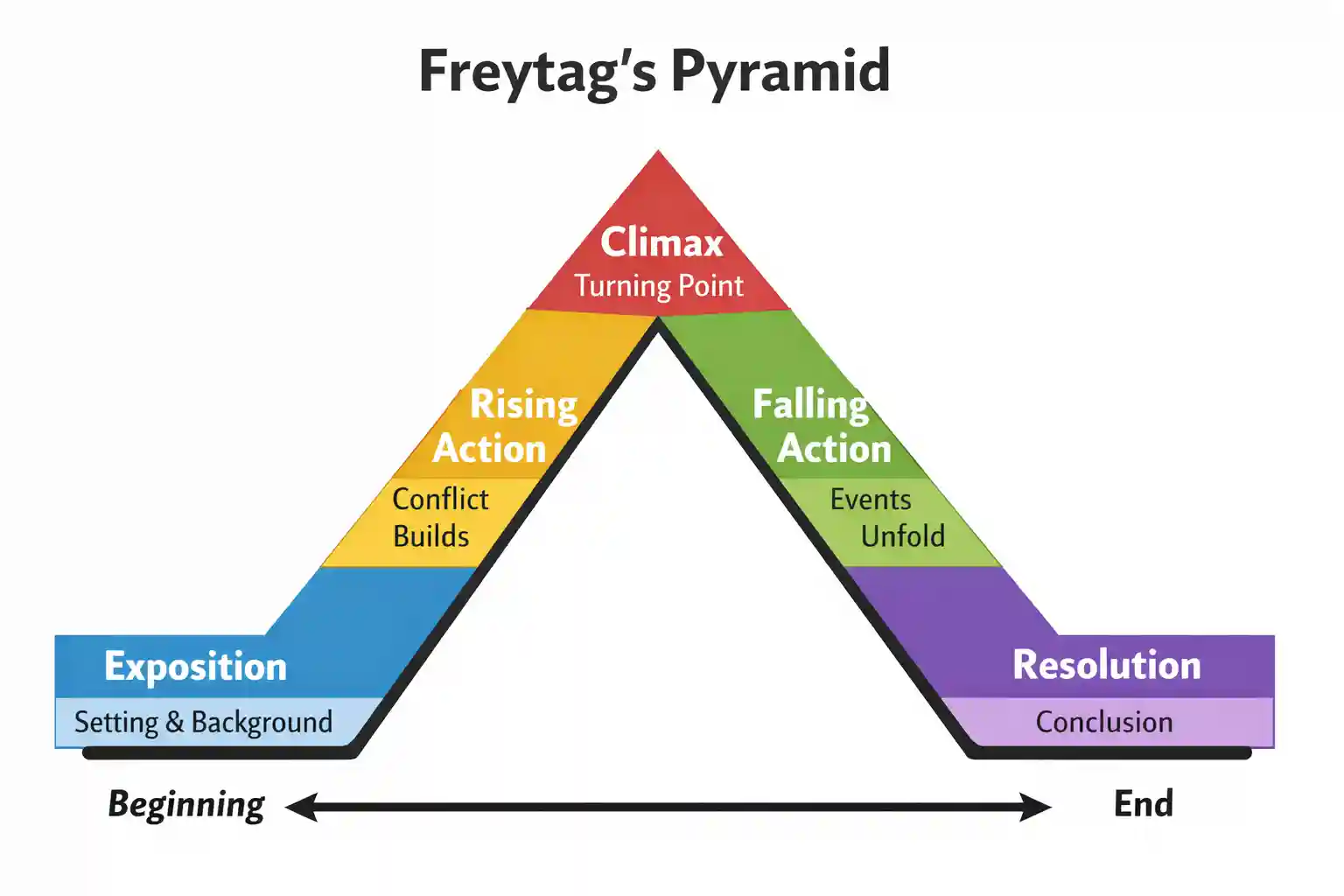
Most plots follow a general structure often called the plot diagram:
| Plot Stage | Description |
| Exposition | The introduction of setting, characters, and the “status quo.” |
| Inciting Incident | The spark that starts the conflict. |
| Rising Action | A series of events that build tension and develop conflict. |
| Climax | The turning point; the moment of highest emotional intensity. |
| Falling Action | The consequences of the climax start to unfold. |
| Resolution | The “New Normal” where loose ends are tied up. |
When analyzing plot, always ask:
What conflict drives the story?
How do events connect and build upon each other?
What turning point changes everything?
Understanding plot helps readers see how stories are constructed and why they keep us hooked from beginning to end.
First-Hand Suggestions for Teaching Plot
When I teach plot, I try to move students away from thinking of it as a thing they memorize and toward seeing it as a pattern they recognize in every story they read. I’ve found that asking simple cause-and-effect questions like “What changed here?” or “Why is this the turning point?” helps students understand plot much more deeply.
Differentiation
For Students with IEPs
- Provide a partially completed plot diagram instead of a blank one
- Use color coding for each stage of plot structure
- Model one example together before independent practice
- Allow oral explanations of plot stages instead of written responses
- Use familiar texts (movies or short stories) before independent reading books
For English Language Learners
Pre-teach core vocabulary:
| Term | Student-Friendly Meaning |
|---|---|
| exposition | the beginning of the story |
| rising action | the problem grows |
| climax | the biggest moment |
| falling action | things start resolving |
| resolution | the ending |
Strategies:
- Use visual plot diagrams instead of text-only explanations
- Provide sentence frames:
- “The climax happens when…”
- “The conflict begins when…”
- Let students map plot using drawings
- Model with a familiar story before applying to independent reading
Teaching Plot FAQ
How do you explain the difference between plot and story? A ‘story’ is the chronological sequence of events, while the ‘plot’ is the causal link between those events. This Day 3 lesson helps students understand the ‘why’ and ‘how’ behind the narrative structure.
Is a library visit necessary for the Grade 9 English plot lesson? While not strictly required, starting with a library visit encourages ‘Choice Reading,’ which makes the subsequent plot analysis more relevant as students can apply the plot diagram to a book they actually enjoy.
What are the 5 parts of a plot diagram taught in this lesson? The five parts covered are Exposition, Rising Action, Climax, Falling Action, and Resolution (Denouement).