
Day 2: Building a Literary Devices Glossary
Establish the foundation for literary analysis with a student-led glossary. In Day 2 of the Grade 9 English course, students transition from mindset to mechanics by defining and illustrating core literary devices. This lesson includes a free blank literary devices glossary worksheet and a completed teacher reference guide.
Learning Goals and Standards
By using this glossary, students will be able to:
- Define common literary devices in their own words
- Recognize literary devices in poems, short stories, and novels
- Explain how literary devices shape meaning and tone
- Use literary devices intentionally in their own writing
- Apply correct terminology during literary discussion and analysis
Aligned Global Competencies / Standards / ELA Curriculum
This glossary supports international secondary English expectations such as:
Ontario Curriculum Alignment (ENL1W)
Strand B: Foundations of Language — Demonstrating an understanding of specialized terminology and figurative language (B2.1) to interpret and create texts
Strand A: Literacy Connections and Applications — Applying knowledge of literary terminology to support comprehension and communication in a variety of contexts (A2.1)
Common Core (Grades 9–10 Reading: Craft and Structure)
Analyze how authors use figurative language and rhetorical devices to shape meaning and tone (RL.9–10.4)
IB Language & Literature (ATL Skills)
Develop analytical vocabulary and interpret how language choices influence audience understanding
Cambridge IGCSE English Literature
Recognize writers’ methods and explain how language creates effects and meaning in texts
OECD Global Competence Framework
Interpret communication across texts and contexts using disciplinary language
UNESCO Literacy Framework
Strengthen interpretive reading and expressive writing through the use of figurative and symbolic language
Resources
Bell Ringer
“Spot the Device” (5 minutes)
Write this sentence on the board:
The classroom was a zoo.
Ask students:
- Is this literal or figurative?
- What device is being used?
- What does it suggest about the classroom?
Then follow with:
She ran like lightning.
Ask again:
What changed? (We added ‘like’)
Students quickly realize literary devices are meaning shortcuts, not decoration. This insight makes the glossary feel useful rather than memorization-based.
Lesson Flow
1. Welcome and Quick Review (5 minutes)
Greet students and remind them about yesterday’s focus on growth mindset.
Briefly explain how literary devices help us understand and enjoy texts on a deeper level.
2. Introduction to Literary Devices (10 minutes)
Give a short explanation of what literary devices are and why authors use them.
Provide examples students are likely familiar with (e.g., simile: “Her smile was like sunshine.”).
Emphasize that today they’ll start their own literary devices glossary.
3. Building the Glossary (20 minutes)
Hand out the Literary Devices Glossary worksheet (or display digitally).
Students will fill in the first five today: alliteration, allusion, analogy, anaphora, and antithesis.
Teachers can choose to:
Have students look up definitions in dictionaries or online resources, OR
Have students copy provided definitions from the completed glossary you provide.
5. Growth Mindset Connection (10 minutes)
Return to the growth mindset work from yesterday.
Ask students to reflect: How might approaching challenges in English class with a growth mindset help us learn new concepts, like literary devices, more effectively?
Allow students to add a short reflection in their journals or share with a partner.
6. Wrap-Up (5 minutes)
Collect or review the glossary sheets.
Remind students that they’ll continue building this glossary throughout the course.
Preview tomorrow’s lesson: applying these devices when reading short texts.
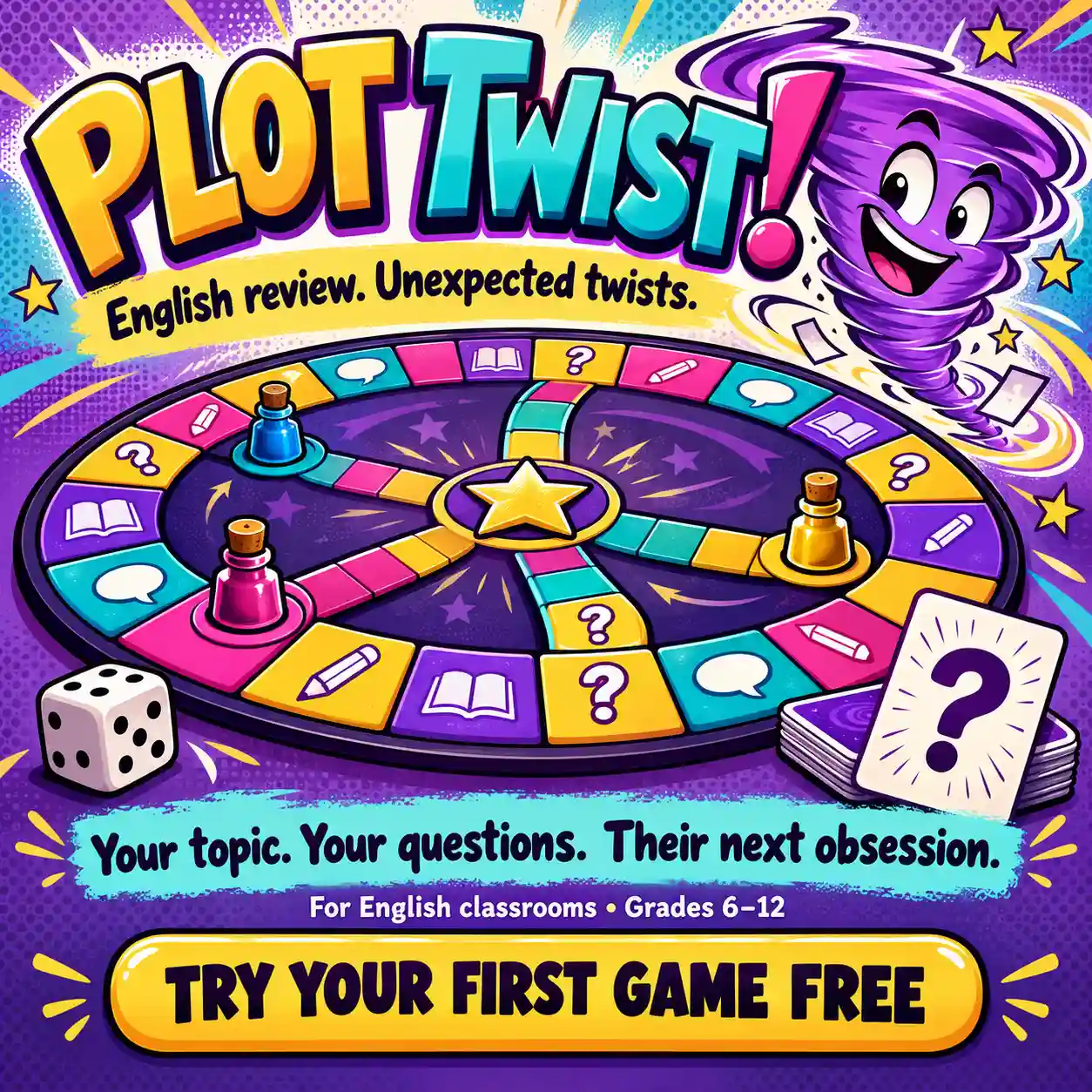
A FREE CLASSROOM GAME FOR ENGLISH TEACHERS
Make your next English review a Plot Twist!
Bring some unexpected fun to your next lesson. Get a free game of Plot Twist!, the ultimate classroom review game, and discover fresh ideas for teaching English.
Subscribe for English teaching ideas and occasional resource updates, plus your free Plot Twist! game. You can unsubscribe from emails at any time.
First-Hand Suggestions
When I introduce literary devices, I avoid presenting them as vocabulary lists to memorize. Instead, I treat them as tools students already recognize from everyday speech—metaphors, exaggerations, comparisons, and sound patterns they hear all the time. Once students realize they already use literary devices naturally, they become much more confident identifying them in texts and applying them in their own writing.
Differentiation
For Students with IEPs
- Introduce 3–5 devices at a time instead of the full glossary
- Use visual anchors (icons for metaphor, simile, imagery, etc.)
- Provide matching activities instead of definition copying
- Allow oral explanations instead of written responses
- Offer examples before definitions
For English Language Learners
Pre-teach high-frequency devices first:
| Device | Student-Friendly Meaning |
|---|---|
| simile | comparing using like or as |
| metaphor | saying something is something else |
| imagery | describing using senses |
| personification | giving human traits to objects |
| hyperbole | exaggeration for effect |
Strategies:
- Provide example sentences before definitions
- Encourage drawing the device instead of writing it
- Use sentence frames:
- “This device compares…”
- “This creates the feeling of…”
- Allow bilingual glossary support
Lesson FAQ
How many literary devices should Grade 9 students learn at once? It is best to introduce them in small ‘chunks.’ This Day 2 lesson focuses on the first five (A-terms). By building the glossary incrementally, students retain the definitions better than through a single massive list.
Are the glossary worksheets compatible with Google Classroom? Yes. The provided literary devices glossary worksheets can be printed for physical binders or uploaded as digital PDFs for students to complete on devices.
Does this lesson support the Ontario ENL1W de-streamed curriculum? Yes, this lesson plan is specifically designed for the de-streamed Ontario Grade 9 English framework, ensuring all students build a common vocabulary for literary analysis.