
9 Reading Comprehension Games for Middle and High School
Reading comprehension games for middle and high school should make students do more than find a word on a page. Strong readers identify important ideas, connect details, draw careful inferences, notice how a text is organized, and check whether an explanation is supported by evidence. These nine games turn those skills into teachable, low-prep activities for Grades 6–12.
The games work with informational articles, literary nonfiction, short fiction, and classroom texts. Most can be used with printed passages and highlighters. A digital team game is optional, but in every format the aim is the same: each student should finish able to explain how they reached a conclusion. For related literature, language, and writing activities, start with our English Classroom Review Games hub.
Decide which comprehension skill the game will measure
Students can struggle with reading for very different reasons. A student might understand individual words but miss the central idea; another might summarize accurately but make unsupported inferences. Choose a single learning target for each round: main idea, inference, evidence, summarizing, text structure, viewpoint, or evaluating claims.
Then match the response to the target. To assess inference, require the student to name a specific clue and explain what it suggests. To assess summarizing, ask for the most important information without adding opinion. To assess an argument, distinguish an author’s claim from the evidence offered for it.
Use this original mini-passage for practice
You can use this short informational passage to demonstrate several games before substituting your current class reading.
Every autumn, the student council at Cedar Hill School collected reusable water bottles left behind in classrooms. During one collection, volunteers found more than sixty bottles, most marked with students’ initials. Instead of discarding them, the council created a clearly labelled collection shelf outside the office. After a month, about half of the bottles had been claimed. Council members then placed reminders beside classroom doors. They hoped the signs would reduce the number of forgotten bottles, but they had not yet counted whether the reminders made a difference.
Because the passage names both an action and a limitation, it supports questions about summary, inference, evidence, and what a reader can and cannot conclude. The council hopes to reduce lost bottles; the passage does not yet prove that the signs worked.
9 reading comprehension games with classroom directions
1. Evidence Detective: fact, inference, or unsupported?
Time: 10–15 minutes. Show three statements based on the passage: “The council created a collection shelf,” “Students may be more likely to reclaim bottles when there is a clear place to look,” and “The reminders reduced bottle losses by 50%.” Teams label the statements: directly supported fact, possible inference, or unsupported claim. Require them to underline the exact detail they used.
Answer check: The shelf is explicit; the likelihood of reclaiming is a plausible but unproven inference; a 50% reduction in losses is not supported. The approximately half of bottles claimed is a different measure.
2. Main Idea Championship
Time: 10 minutes. Give teams three possible main-idea statements: one too narrow, one too broad, and one that captures the passage. Students choose the strongest and explain why the other options fail. A suitable answer is: “A student council tried practical ways to return forgotten bottles and prevent future losses.”
Invite students to revise a weak answer rather than simply announcing the correct letter. For longer informational texts, add a second round where teams select two supporting details.
3. Two-Sentence Summary Sprint
Time: 12 minutes. Each team writes an objective summary in no more than two sentences, including the problem, response, and outcome or unresolved question. Compare summaries for accuracy, completeness, and unnecessary opinion. Do not make sheer speed the main scoring factor.
Possible response: “The school council collected lost water bottles and created a place where students could reclaim them. About half were reclaimed, and the council added reminders but had not yet measured their effect.”
4. Claim–Evidence Match-Up
Time: 15 minutes. Write three claims on cards and three pieces of text evidence on separate cards. Teams pair relevant evidence with a claim, then explain whether the detail actually supports it. Example: “Students reclaimed some bottles” pairs with “about half of the bottles had been claimed,” not with the untested reminder signs.
For advanced groups, include a statement that no available evidence can yet support. Students score a point for recognizing an evidence gap.
5. What Is Missing? Inquiry Challenge
Time: 12 minutes. Teams write a question that the passage cannot answer but that would help evaluate the council’s plan. Good questions include “How many bottles were forgotten after the reminders?” and “Was that fewer than during a comparable period?” Reward questions that would produce relevant evidence.
This is particularly useful for media literacy: students learn that a confident claim often needs information the text has not supplied.
6. Text Structure Switch
Time: 15 minutes. Ask students to identify how the mini-passage is organized: it presents a problem, a response, and subsequent results or limits. Teams rewrite a few lines as a cause-and-effect chain or as a short chronological account, then explain what changes in emphasis.
Stretch: Compare two possible titles—“School Bottle Collection Project” and “Reminders Cut Waste in Half”—and ask which is accurate. The second title makes a claim that the passage does not establish.
7. Inference Ladder
Time: 12 minutes. Give groups a text clue, an inference, and a further conclusion, mixed out of order. Students build a ladder that shows which steps are supported and where speculation begins. Clue: many bottles were marked with initials. Inference: some could be returned to owners. Unsupported leap: every marked bottle was returned.
Ask teams to attach confidence words such as may, suggests, appears, and does not establish where the evidence is incomplete.
8. Viewpoint and Purpose Panel
Time: 15 minutes. Students imagine that the same events appear in three texts: a school newsletter, a student council report, and a skeptical editorial. Their task is to identify what each author might emphasize, then compare those possibilities against the actual text. Keep a clear distinction between a plausible change in emphasis and a claim that the original author definitely intended it.
For older students, bring two real, permitted articles on the same issue and compare language, selection of detail, and the evidence each provides.
9. Question Writer’s Workshop
Time: 15–20 minutes. Teams must create one literal comprehension question, one inferential question, and one evaluation question about the passage. Exchange questions with another team; the answering group must cite evidence and challenge questions that are ambiguous or cannot be answered.
Examples: Literal—Where was the collection shelf? Inferential—Why might labels help students reclaim bottles? Evaluation—What additional data would help judge the reminders’ effectiveness?
An easy assessment rubric for all nine games
Use a simple three-part check without turning the activity into a formal test. Accuracy: Does the response match what the passage says? Evidence: Can the student identify the words or details used? Reasoning: Does the explanation connect the evidence to the response without making an unsupported leap?
For a quick scoring system, award one point per criterion. For an objective summary, replace reasoning with selection of the most important information; for a literal question, a concise accurate answer may be sufficient. Explain the rules before students play so the rubric measures the intended skill.
A 45-minute reading comprehension review lesson
Minutes 0–5 — Independent reading: Give students the mini-passage or a brief text from your current unit. Ask them to underline one key detail and write a one-sentence summary before discussion.
Minutes 5–12 — Model the process: Project an inference and distinguish the text detail, reasonable conclusion, and unsupported assumption. Think aloud about why the evidence matters.
Minutes 12–25 — Evidence Detective: Groups sort claims and defend their labels. Require every student to identify at least one clue before the group responds.
Minutes 25–37 — Main Idea or Claim–Evidence Match-Up: Teams select supporting details, revise weak explanations, and discuss differences. Pause when a common misconception appears.
Minutes 37–45 — Individual exit ticket: Present a new two- or three-sentence paragraph and ask for its main idea plus one inference supported by a quoted or paraphrased clue. Use these responses to plan the next reading lesson.
Differentiating comprehension games across Grades 6–12
Grades 6–7: Begin with short texts and visible evidence. Offer a limited selection of claims and use colour coding for fact, inference, and unsupported opinion. Read aloud when decoding is not the target being assessed.
Grades 8–9: Add central idea, author’s purpose, text structure, and questions that demand more than one relevant detail. Make students identify why plausible distractors are less accurate.
Grades 10–12: Compare sources, evaluate missing information and rhetorical choices, and ask whether a conclusion is warranted by the evidence. Require students to qualify uncertain claims and address counterexamples.
Students learning English may benefit from a quick preview of essential vocabulary, a rereading window, and sentence frames such as “The phrase ___ suggests ___ because ___.” Distinguish a reading-comprehension difficulty from an unfamiliar word or unnecessarily complex question.
Common Core and curriculum connections
Reading-comprehension review can support the Common Core informational reading standards, including RI.8.1 (evidence), RI.8.2 (central idea and summary), and RI.8.3 (connections between ideas). Literature reading standards make parallel demands for evidence, theme, and analysis. Choose a grade-appropriate expectation rather than treating this activity as a replacement for the full reading curriculum.
Why retrieval and feedback still matter
The What Works Clearinghouse practice guide recommends revisiting important information through quizzes and asking deep explanatory questions. A classroom comprehension game can incorporate those principles by prompting students to retrieve a strategy, use it on a new passage, and receive immediate feedback about their reasoning.
For additional instruction beyond games, consult How to Teach Reading Comprehension and Reading Comprehension Strategies for Teachers. These are instructional guides; the games here provide a structured way to practise and check learning.
Making a digital reading comprehension review with Plot Twist!
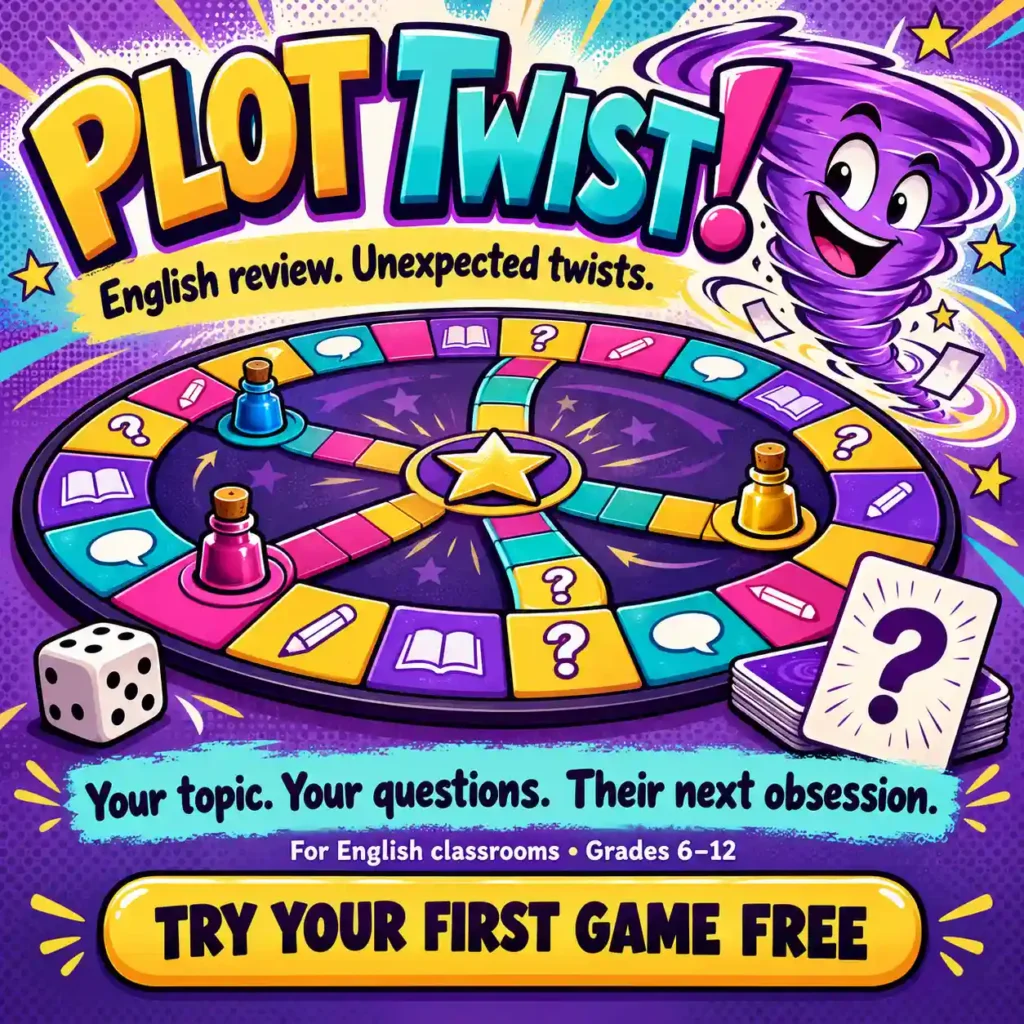
A digital team game can work particularly well when the teacher reads or displays a short passage and teams discuss what the evidence supports. Plot Twist! allows a teacher to specify learning goals and notes or upload permitted materials, select two to seven teams, and run a shared-screen board game.
Suggested game instructions: “Grades 8–9 ELA. Use the passage and teacher notes provided. Mix literal comprehension, main idea, vocabulary in context, inference, and evidence-evaluation questions. Never invent source quotations. Include unsupported-claim distractors and require an explanation for interpretive answers.”
Use teacher evaluation when a text supports multiple defensible answers. Verify AI-generated prompts before class, and do not upload private student data or materials without permission. The first game is available free.
Frequently asked questions
How are reading comprehension games different from trivia games?
Comprehension games ask students to interpret and justify what a text means. Trivia often assesses isolated facts. Both can have a place, but a comprehension task should include evidence or reasoning when that is part of the learning goal.
Can reading comprehension games work without devices?
Yes. Every activity above works with paper passages, cards, coloured pencils, and a board. The goal is the thinking process; software is optional.
How can I assess individual reading skills during a team game?
Give each student a short independent response before discussion and finish with an unseen passage or question. Evaluate that response separately from the team’s score.
Should students have the text in front of them?
Often yes. When you assess close reading, locating evidence is part of the task. A brief no-notes retrieval warm-up can precede the open-text analysis if you also want to check memory.
The goal: readers who can defend their answers
The most useful comprehension game gives students a reason to reread, distinguish evidence from assumption, and revise an explanation. That skill transfers beyond the classroom game into literature discussions, media literacy, and academic writing.
Find more lesson-ready activities in our English Classroom Review Games collection, including short story review games and vocabulary review games.