
10 Reading Comprehension Strategies for Teachers That Work
You taught the lesson. Students read the text. Then you asked a question, and the room went quiet, not the good kind of quiet. The kind where everyone suddenly finds their pencil fascinating. If that moment feels familiar, you’re not alone. Most teachers have watched students decode words perfectly while absorbing almost nothing, and it’s one of the most frustrating gaps in everyday instruction. Finding reading comprehension strategies for teachers that actually move the needle can feel like searching for a needle in a haystack of Pinterest boards and PD slideshows.
The good news? Decades of reading research point to a handful of approaches that consistently help students understand, retain, and think critically about what they read. These aren’t gimmicks or one-off activities, they’re instructional techniques you can build into your existing routines without overhauling your curriculum. That’s exactly the kind of practical, classroom-tested support we focus on here at The Cautiously Optimistic Teacher: strategies that respect your time and actually work with real students.
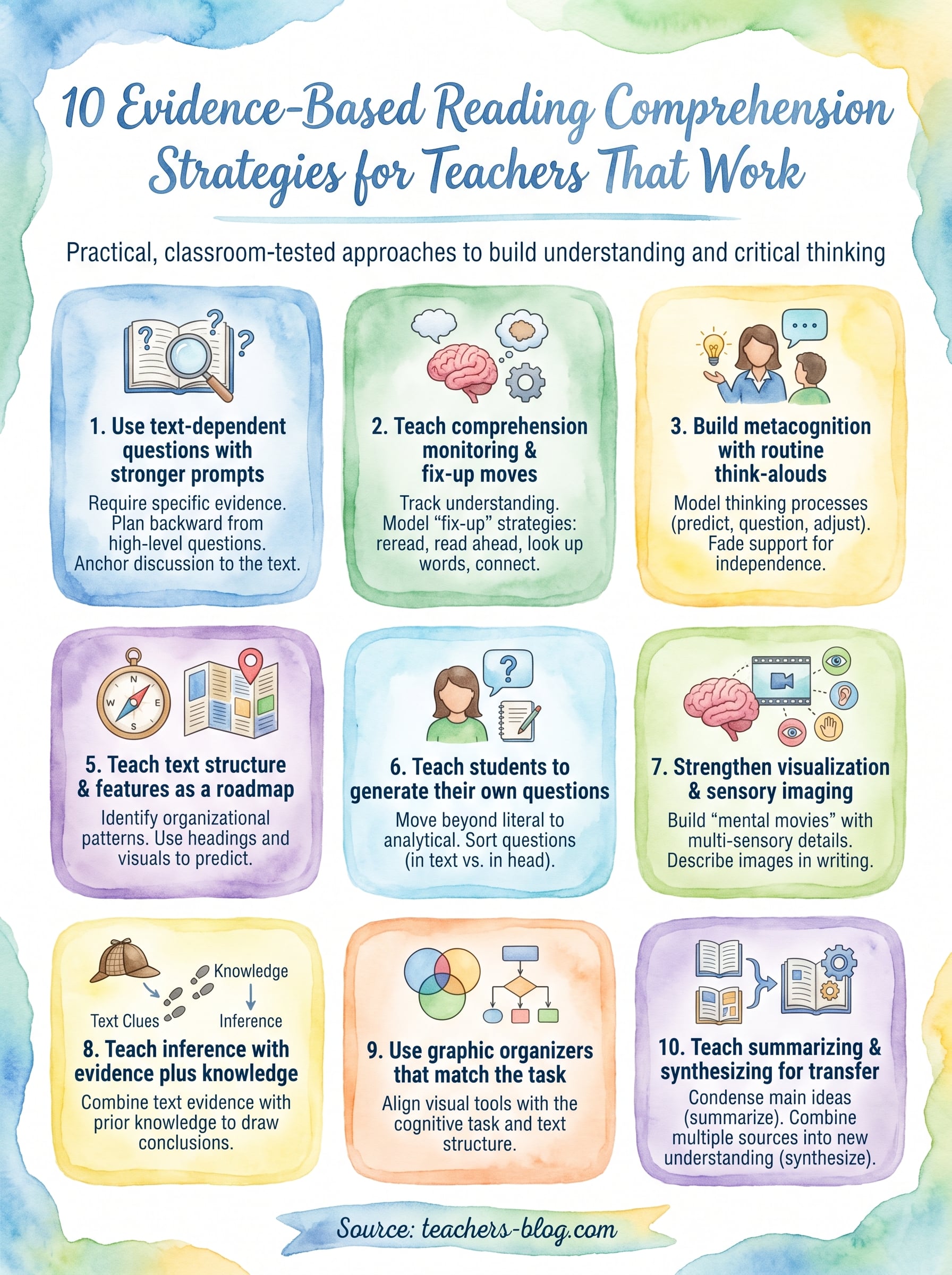
Below, you’ll find ten evidence-based strategies broken down with clear explanations and ways to put them into practice tomorrow. Whether you teach eighth-grade ELA or high school history, each method targets a specific comprehension skill, from activating prior knowledge to synthesizing across texts. Pick one to try this week, or read through all ten to build a more complete toolkit.
1. Use text-dependent questions with stronger prompts
Text-dependent questions require students to return to the text for evidence rather than rely on memory or personal opinion. This approach is one of the most effective reading comprehension strategies for teachers to build into daily instruction because it trains students to read closely and grounds every discussion in specific textual evidence rather than vague impressions.
What this strategy improves
Strong text-dependent questions push students beyond surface-level recall. They build evidence-based reasoning, sharpen close reading habits, and force students to process meaning at a deeper level rather than skim for the first answer that sounds right. Over time, students stop waiting for permission to reread and start doing it automatically.
How to plan questions that drive thinking
Start with the highest-level question you want students to answer by the end of the lesson, then work backwards to build the scaffolded questions that support it. Each question should require students to cite specific lines, phrases, or details from the text rather than speak in general terms. If a student can answer it without opening the book, the question needs more specificity.
Plan your sequence of questions before the lesson, not during it, because improvised questions tend to drift toward recall rather than analysis.
How to run whole-class and small-group discussion
In whole-class discussion, anchor every response back to the text by consistently asking "Where does the text say that?" In small groups, give students a written question and require them to find two pieces of supporting evidence before sharing with the group, so discussion starts from the text rather than from their first instinct.
Prompts that work across fiction and nonfiction
These stems work regardless of genre or subject area:
- "What does the author’s word choice in paragraph __ suggest about…?"
- "What evidence in the text supports the idea that…?"
- "How does [this detail] connect to [that detail] from earlier in the text?"
- "What does this section reveal about the author’s purpose?"
How to differentiate questions by readiness
Assign the same core question to all students, then adjust the support level rather than the rigor. Struggling readers might receive a page number or paragraph reference to narrow their search. Advanced readers tackle the question without scaffolding and then extend by analyzing how the author constructed meaning across the full text.
2. Teach comprehension monitoring and fix-up moves
Comprehension monitoring means students track their own understanding while reading and know what to do the moment meaning breaks down. Without this skill, many students keep moving forward passively after losing the thread. Teaching fix-up moves gives them a concrete toolkit to recover rather than rereading the same confusing sentence on a loop.
What students do when meaning breaks down
Most students do nothing when comprehension stalls. They push forward and hope context eventually saves them, which it rarely does. Skilled readers notice confusion immediately and make a deliberate move to repair it. Your job is to make that noticing and responding process visible and teachable.
Fix-up moves to teach explicitly
Give students a short, posted menu of repair strategies they can apply whenever comprehension slips:
- Reread the confusing passage at a slower pace
- Read ahead to see if clarity arrives naturally
- Look up an unfamiliar word before continuing
- Connect the text to background knowledge
How to model monitoring with a think-aloud
Read aloud and narrate your confusion out loud: "I lost track of who is speaking, so I’m going back to reread that paragraph." Students need to watch a competent reader hit a wall and fix it, not just perform flawless reading.
Modeling confusion is just as important as modeling fluency.
What to do when students say they understand but do not
Ask students to paraphrase a specific sentence rather than just nodding. This is one of the most practical reading comprehension strategies for teachers because it surfaces gaps without putting anyone on the spot publicly.
Quick ways to check for real understanding
Use targeted exit slips tied to one specific paragraph from the reading. A student who genuinely understood can answer it; one who coasted through cannot. Keep them brief and routine so they feel like a habit, not a test.
3. Build metacognition with routine think-alouds
Metacognition means students think about their own thinking while they read, and it is one of the most transferable reading comprehension strategies for teachers to build into daily instruction. When students monitor their understanding and adjust their approach intentionally, they stop depending on you to catch every breakdown for them.
What metacognition looks like in reading
Metacognitive readers pause, question, and adjust as they move through a text. They notice when a passage clicks and when it does not, then choose a strategy deliberately rather than powering through confusion and hoping something lands.
What to model before, during, and after reading
Before reading, set a purpose aloud. During reading, narrate your predictions and confusion. After reading, verbalize what you understood and what still needs clarifying. Each phase gives students a concrete model to borrow until they internalize the process on their own.
The goal of a think-aloud is to make your invisible reading process visible, not to perform a perfect reading.
How to fade support so students self-regulate
Start with full teacher modeling, then shift to guided practice where students think aloud with a partner, and finally ask them to complete the process silently and independently. Each stage reduces scaffolding while keeping the expectation consistent.
Sentence stems students can use independently
Give students a reference card with stems like "I’m confused because…" and "This connects to…" so they have language to anchor self-monitoring before the habit becomes automatic.
How to track growth without overtesting
Ask students to annotate one paragraph with a metacognitive note each week. These brief annotations reveal growth over time without adding another formal assessment to your grading pile.
4. Activate and build background knowledge fast
Background knowledge is the prior knowledge students bring to a text, and it directly shapes how much they understand. Students with strong schema for a topic read faster and retain more because they spend less mental energy decoding context and more on processing new ideas.
When activating schema helps and when it backfires
Activating background knowledge works best when students actually have relevant schema to draw on. When they do not, prompting them to "think about what you know" can generate misconceptions or irrelevant associations that compete with the text rather than support it.
Activating wrong prior knowledge can be more harmful than activating none at all, so assess before you assume.
Simple routines to surface what students already know
A quick two-minute brainstorm or a KWL chart (Know, Want to know, Learned) surfaces existing knowledge without eating up instruction time. These routines also give you real-time data about where gaps exist before the lesson begins.
How to fill gaps without derailing the lesson
Build a brief anchor text or image into your pre-reading phase when students clearly lack the context the main text assumes. A short video clip or one-paragraph summary fills gaps in under five minutes and prevents confusion that would otherwise compound throughout the lesson.
How to handle sensitive or uneven prior knowledge
Some students carry personal experiences tied to a topic, and others carry none. Acknowledge that prior knowledge varies across the room so every student feels safe contributing without comparison or judgment.
Ways to connect background knowledge to the text
One of the most practical reading comprehension strategies for teachers is to pause at a key passage and ask students to identify where their background knowledge connects directly to what the author states. This move bridges schema and text evidence in a way students can replicate on their own.
5. Teach text structure and features as a roadmap
Students who recognize how a text is organized before they start reading process information faster and retain it longer. Teaching text structure is one of the most transferable reading comprehension strategies for teachers because it applies across every subject, not just ELA.
Why structure drives comprehension in every subject
Text structure gives students a predictive framework they can apply before reading a single sentence. When a student recognizes a cause-and-effect pattern in a science article, they already know to look for relationships between events rather than a simple list of facts.
Structure awareness reduces cognitive load because students spend less energy figuring out how a text works and more energy on what it means.
Key narrative structures to teach
Fiction typically follows chronological order, flashback structure, or circular narrative. Teach students to identify the sequence of conflict, rising action, and resolution so they can track meaning rather than just plot.
Key informational structures to teach
Nonfiction relies on five core organizational patterns: description, sequence, compare and contrast, cause and effect, and problem and solution. Post these patterns with signal words attached, such as "however" for contrast or "as a result" for cause and effect.
How to use headings, captions, and visuals on purpose
Train students to read every heading and caption before engaging with body text. These features preview the author’s organization and prime students to connect visuals directly to the written argument.
How to assess structure knowledge in minutes
Ask students to label the structure of one paragraph and explain which signal words tipped them off. This quick formative check takes under three minutes and reveals exactly where understanding breaks down.
6. Teach students to generate their own questions
When students generate their own questions about a text, they engage with it at a fundamentally deeper level than when they simply answer yours. This is one of the most underused reading comprehension strategies for teachers because it transfers ownership of meaning-making directly to students, which is where it needs to be.
Why student questions beat teacher-only questions
Teacher questions guide comprehension, but student-generated questions reveal it. When a student produces a thoughtful question, you immediately see what they noticed, what confused them, and what they want to understand. That information is far more useful than a raised hand in response to a question you already know the answer to.
How to move from literal to analytical questions
Start by showing students the difference between questions the text answers directly and questions that require them to draw conclusions. A literal question asks what happened; an analytical question asks why it matters or what it reveals.
Teach students to revise their own literal questions by adding "Why" or "What does this suggest about" to the front.
How to use QAR style thinking without jargon
Skip the acronym and simply teach students to sort their questions into two categories: "the answer is in the text" and "the answer requires me to think and connect." This sorting habit trains students to locate where they need to look before they start searching.
Structures for partner and group questioning
Pair students and have each person write two questions before discussing. This prevents one partner from dominating and ensures every student arrives at conversation with something to contribute.
What to do with student questions after reading
Collect student questions and sort them visibly on the board by question type. This shows the class which ideas generated the most curiosity and gives you a natural entry point for the next lesson’s focus.
7. Strengthen visualization and sensory imaging
Visualization is one of the most effective reading comprehension strategies for teachers to develop because it builds a mental movie of the text that supports both memory and meaning-making. When your students create sensory images while reading, they process language more deeply and recall details more accurately.
Why mental imagery supports memory and meaning
Mental imagery activates multiple areas of the brain simultaneously, which strengthens retention and engagement. Students who visualize while reading are less likely to drift and more likely to notice when their mental picture stops making sense.
When students can picture what they read, they have a second way to retrieve the information beyond the words themselves.
How to teach visualization beyond drawing
Move past having students sketch scenes. Instead, ask them to describe their mental image in writing by naming specific colors, sounds, and spatial relationships. This forces richer engagement with the text than a quick illustration allows.
Prompts that cue the five senses
Use prompts like "What do you hear in this scene?" and "What does the setting smell or feel like?" to push beyond visual details alone. Sensory variety deepens comprehension because your students have to slow down and inhabit the text rather than skim past it.
How to support students who struggle to visualize
Pair the text with a brief anchor image before reading so students have a starting point for independent imagery. Some readers need a concrete visual reference before they can construct their own.
Quick products that show comprehension
Ask your students to write a two-sentence sensory description of a key scene immediately after reading. These brief responses reveal whether students processed the text at the surface level or built genuine meaning from it.
8. Teach inference with evidence plus knowledge
Inference is one of the most critical skills in any reading comprehension strategies for teachers toolkit because texts never spell out everything explicitly. Students who can infer fill the gap between what the author states and what the author means, and that gap is where real comprehension lives.
How inference differs from guessing
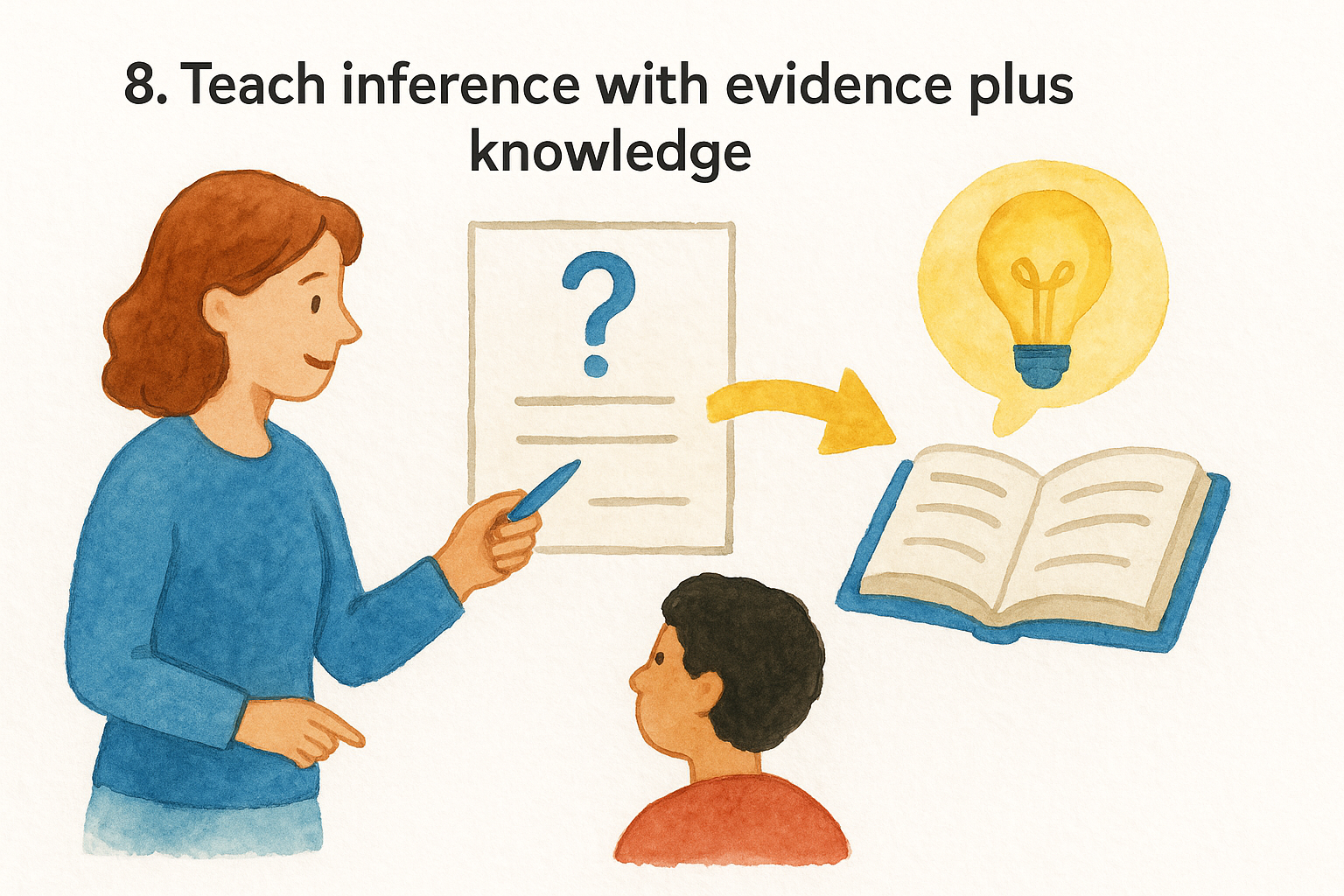
Guessing pulls an answer from nowhere; inference pulls from two places: the text and the reader’s background knowledge working together. When students understand this distinction, they stop treating inference as a creativity exercise and start treating it as a disciplined reasoning process.
A clear routine for evidence-based inference
Teach students three steps every time: find specific text evidence, identify what they already know that connects to it, and state the conclusion explicitly. This routine prevents unsupported claims and builds the habit of anchoring every inference to the page.
The cleaner the routine, the faster students internalize inference as a default reading behavior rather than a special task.
How to handle multiple valid inferences
Some passages support more than one reasonable inference, and that is not a problem. Show students how to evaluate competing inferences by asking which one carries the strongest textual support rather than which feels most intuitive.
Common inference errors and how to correct them
The two most frequent errors are over-inferring beyond the text and restating surface details without drawing a conclusion. Correct both by returning students to their evidence and asking what the text tells them that it does not say directly.
Short tasks that reveal inference skill
Give students one sentence from the text and ask them to write the inference it supports, citing the exact words that drove the conclusion. These brief micro-tasks reveal inference skill more efficiently than any full-passage quiz.
9. Use graphic organizers that match the task
Graphic organizers work when they match the structure of the text and the thinking task you are asking students to do. When you choose the wrong organizer for the text type, students fill boxes mechanically without building real understanding. This is one of the most practical reading comprehension strategies for teachers because the right visual tool reduces cognitive load and helps students see relationships they would otherwise miss.
How to pick the right organizer for the text
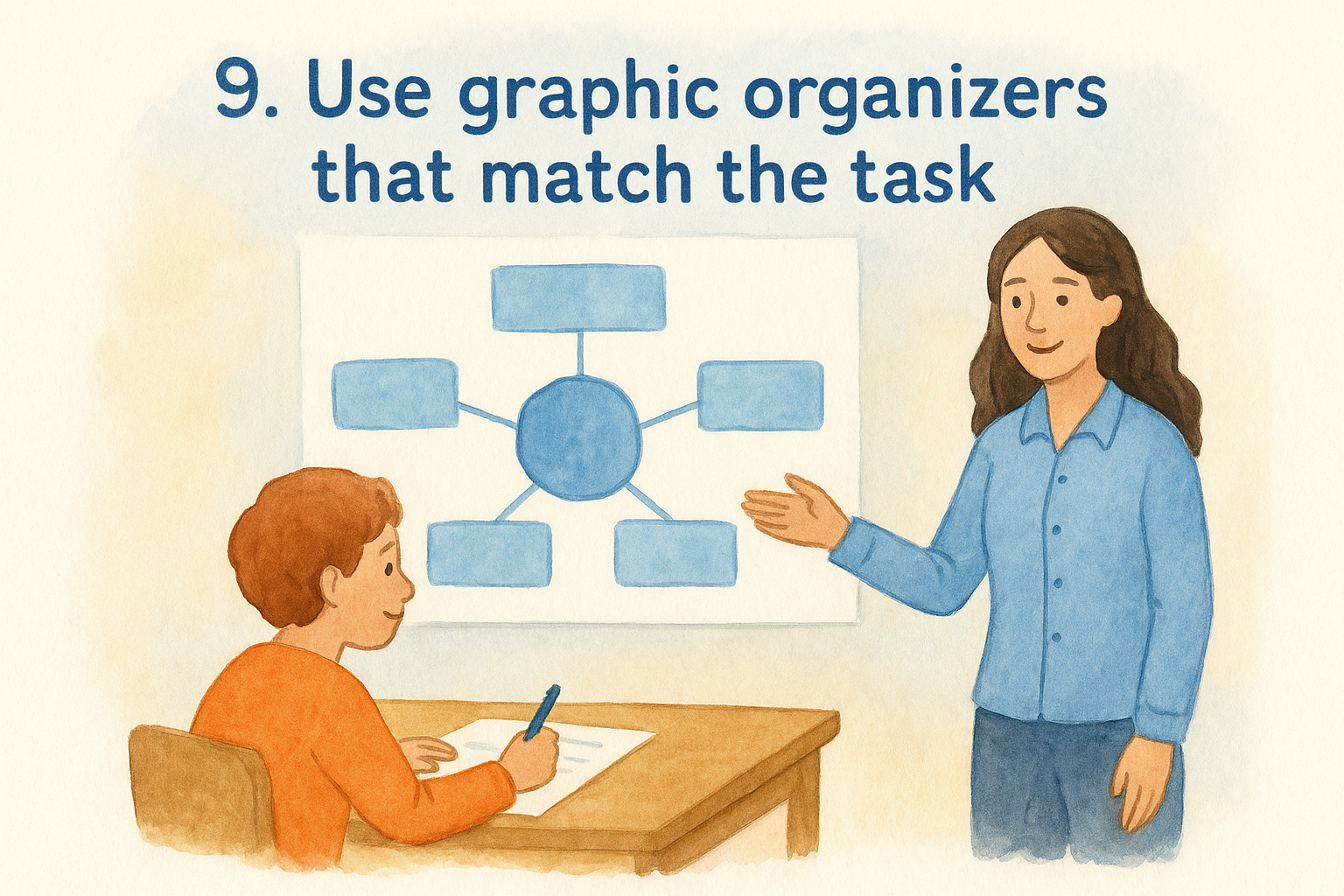
Start by identifying what the text asks students to do: track a sequence, compare two things, find support for a claim, or follow cause and effect. Match the organizer to that cognitive task, not to your personal preference or what prints well. An organizer that mirrors the text’s logic becomes a thinking scaffold; one that does not becomes busywork.
Choose the organizer after you have read the text, not before you select it from a folder.
Organizers for main idea and supporting details
Use a simple hub-and-spoke layout where the main idea sits in the center and details branch outward. This format works for informational paragraphs, textbook sections, and any text where students need to distinguish what matters most from what supports it.
Organizers for compare and contrast, cause and effect
A Venn diagram or T-chart handles comparison efficiently. For cause and effect, use a two-column table or a chain diagram that shows how one event produces the next so students track relationships across the full text.
Organizers for character, theme, and argument
Map character traits to specific text evidence in a two-column chart. For theme, use a three-box sequence that connects event to lesson to theme statement. Argument analysis fits a claim-evidence-reasoning column format that keeps students honest about what the text actually proves.
How to avoid busywork and keep organizers tight
Limit every organizer to one page maximum and remove any box that does not require students to think. If a cell can be completed without reading, cut it. The organizer should create productive struggle, not clerical copying.
10. Teach summarizing and synthesizing for transfer
Summarizing and synthesizing are two of the most powerful reading comprehension strategies for teachers to explicitly teach because they push students beyond simple recall into genuine, transferable understanding of what they read.
The difference between summarize and synthesize
Summarizing means condensing the text’s main ideas in your own words without adding interpretation. Synthesizing means pulling ideas from multiple sources or passages and building a new understanding that goes beyond any single text.
Students who confuse the two tend to either retell everything or leap to conclusions without grounding their thinking in the text.
A repeatable routine for strong summaries
Teach students a three-step sequence: identify the topic, state what the author says about it, and cut every detail that does not support the main point directly. Practicing this routine with short paragraphs first builds the skill before students apply it to longer texts.
How to teach determining importance
Students struggle to summarize because everything feels equally important to them. Show them how to sort ideas by function: what the whole text depends on versus what merely supports or illustrates it. A quick two-column sort labeled "must keep" and "could cut" builds this evaluative habit fast.
Synthesis moves that push deeper understanding
Ask students to connect two texts by identifying where the authors agree, disagree, or build on each other. This move requires students to hold multiple ideas in mind simultaneously and construct a new claim that neither text states outright.
Exit tickets that capture lasting learning
End with a one-sentence synthesis prompt such as "What idea from today’s reading changes how you think about something you already knew?" Brief responses like these reveal whether students have moved from surface comprehension to genuine integration of new knowledge.
Put these strategies into practice
Ten reading comprehension strategies for teachers sounds like a lot to implement at once, but you do not need to overhaul your instruction overnight. Pick one strategy that targets the gap you see most often in your students’ reading, run it consistently for two weeks, and then add another. Small, repeatable changes build stronger readers far more reliably than attempting everything simultaneously.
Each strategy here fits into your existing lessons without requiring new materials or extra planning periods. Your students will not become skilled readers from a single activity, but they will build real, lasting comprehension when you teach these approaches with intention and consistency. Start with what resonates most, track what changes in your students’ reading, and grow from there.
Want to make those comprehension strategies active in a short review period? Try our English Classroom Review Games hub for inference, vocabulary, literature, and evidence-based team activities.
For more classroom-tested resources and practical tools designed to save you time and strengthen outcomes for every student in your room, The Cautiously Optimistic Teacher is a strong place to keep building your toolkit.