
9 Short Story Review Games for Middle and High School English
Short story review games for English class can help students revisit plot, conflict, point of view, theme, and literary techniques without turning the lesson into another worksheet. Because short stories are compact, they are ideal for questions that require students to return to a particular sentence and defend an interpretation. The nine games below work in Grades 6–12 and can fit into a single class period or a series of short review sessions.
The focus is on what an author does with the story, not simply whether a student remembers which character entered a room. If you are building a broader sequence of English lessons, you can also draw from our English Classroom Review Games hub and complete Grade 9 English course.
Start with a simple but important rule
Give points for a reasonable claim supported by a relevant detail. One teacher-friendly system awards one point for correctly identifying a literary element and up to two additional points for explaining how evidence from the story supports the answer. Do not reward speed so heavily that thoughtful readers lose every round.
A brief independent retrieval prompt at the beginning and an individual exit ticket at the end make it easier to distinguish team enthusiasm from actual learning. These choices fit the Institute of Education Sciences guidance on reviewing content and asking deep explanatory questions.
A short original story to use for review games
If you need a quick text, use this original classroom example. It is intentionally short enough to project or print, but rich enough to support differing interpretations.
At 4:57, the school library’s lost-and-found box sat empty beside the exit. Mara had spent the afternoon searching for her father’s old fountain pen. The librarian offered to help, but Mara shook her head. “It’s just a pen,” she said. Outside, the first rain of the week darkened the steps. Mara opened her bag to find the pen tucked into the lining, where she must have placed it that morning. She stared at it for a moment, then returned to the library. At the desk, she picked up the phone and dialled her father’s number. When he answered, Mara said, “I found something of yours.”
This micro-story offers an external search that points toward a possible internal conflict, a potentially symbolic object, a change in Mara’s behaviour, and an ending that invites inference. Students can legitimately disagree about why she calls, provided they connect their reasoning to what the story actually states.
9 short story review games with directions and examples
1. Evidence Hunt: prove or revise the claim
Time: 12 minutes. Give teams a claim such as “Mara does not care about the pen.” They must decide whether the story supports, weakens, or complicates the claim and point to two details. A strong group may note that she says “It’s just a pen” but spent the afternoon looking for it. Reward the team for noticing the tension and revising the claim rather than simply choosing true or false.
Adaptation: For an assigned story, provide a short quotation or paragraph reference as a starting point, especially for students who need reading support.
2. Conflict Map Race
Time: 10–15 minutes. Draw two boxes labelled external and internal. Teams place events or concerns into the boxes, then discuss which conflict seems central. In the micro-story, searching for a missing object is an external problem; the reluctance to contact her father suggests a possible internal struggle. It remains an inference, not an established fact.
Stretch: Ask how the external problem might help reveal the internal conflict. This moves the game toward analysis rather than sorting labels.
3. Narrator Switch
Time: 15 minutes. Assign each group a different viewpoint from which to retell a brief moment: Mara, the librarian, or an objective observer. Students write four lines, avoiding details their assigned narrator could not know. Then they identify what information the original narration allows readers to infer and what would change with a different point of view.
Teacher checkpoint: A narrator should not suddenly know a character’s thoughts unless the perspective makes that information available.
4. Ending on Trial
Time: 15–20 minutes. Present two possible interpretations of the ending: Mara calls to return the pen, or the pen gives her a reason to reconnect with her father. Assign teams to defend an interpretation using the story’s language. Encourage students to qualify conclusions: “The ending may suggest reconciliation because…”
Scoring: Give credit for textual support, consideration of ambiguity, and respectful response to counterevidence. Do not insist that the author has confirmed one motive.
5. Symbol or Significant Detail?
Time: 12 minutes. List a fountain pen, the rain, the empty lost-and-found box, and the school library. Teams rank which details could reasonably function symbolically and explain what narrative patterns would strengthen the reading. A pen might suggest memory or connection, but the story offers limited evidence for assigning a fixed symbolic meaning.
The best response recognizes the difference between a plausible interpretation and an unsupported claim that every object contains a hidden message.
6. Character Change Timeline
Time: 10 minutes. Provide three moments from a story and ask teams to describe the protagonist’s initial attitude, a possible turning point, and a final action. In the example, the spoken dismissal of the pen, the discovery, and the phone call may be useful anchors. Ask teams to name a change they can support rather than invent a complete psychological history.
7. Literary Device Debugger
Time: 12–15 minutes. Display a deliberately flawed analysis, such as “The rain is definitely personification, because it appears at the end.” Teams identify the problem and replace it with an accurate observation. The rain contributes to setting or mood; it is not personified in the passage as written. If a group argues that the rain is symbolic, require a grounded explanation.
This pairs well with the literary devices review games lesson.
8. Best Question Wins
Time: 15 minutes. Rather than answering questions, teams write the strongest possible analytical question about the text. An acceptable question must not have a simple yes-or-no answer and must require a reference to the story. Compare “Who owns the pen?” with “How does the pen change what Mara chooses to do?”
Students exchange questions and answer another group’s prompt. Award points for clarity, appropriate challenge, and the quality of the answer.
9. Theme Statement Showdown
Time: 12–15 minutes. Display three candidate themes: “Family,” “Sometimes ordinary objects prompt people to reconnect,” and “A student finds a pen.” Students sort topic, theme statement, and plot event, then write their own defensible theme. Ask for the story detail that strengthens the claim and a detail that might complicate it.
Six discussion and assessment questions for any short story
Character: Which single choice reveals the most about the protagonist, and why? Identify the exact action or dialogue.
Setting: Which detail of place or time shapes expectations, mood, or a character’s options? What would change without it?
Conflict: What is the difference between the immediate problem and the deeper tension, if any?
Point of view: What does the narrator let the reader know, and what remains outside the reader’s access?
Structure: Which moment is the turning point? Compare your choice to an alternative moment.
Theme: What larger idea develops through the ending? Explain it without confusing it with a one-word topic.
A complete 45-minute short story review lesson
Minutes 0–6 — Independent starter: Ask students to identify a conflict and one detail that supports it in the story they have read. Let students attempt the answer before consulting the text.
Minutes 6–12 — Mini-lesson: Model the difference between a plot-recall answer and a supported interpretation. Explain the scoring criteria for claim, evidence, and reasoning.
Minutes 12–27 — Games 1 and 2: Groups complete Evidence Hunt and Conflict Map Race. Ask each member to contribute one text detail or an explanation before the team submits.
Minutes 27–39 — Game 4 or 9: Move to Ending on Trial or Theme Statement Showdown. Permit multiple readings, but insist that each is anchored in the same actual story.
Minutes 39–45 — Individual exit ticket: “Which sentence or action best reveals a change in the protagonist? Explain your selection using the text.” Collect responses and use them to plan follow-up.
How to differentiate these games for Grades 6–12
Grades 6–7: Use very short narratives, colour-code dialogue and description, provide sentence starters (“I think ___ because the text says ___”), and choose three literary elements at a time. Allow pairs to rehearse a response before presenting.
Grades 8–9: Ask students to compare evidence, explain irony or foreshadowing where actually present, and write theme statements. Extend the game with more than one possible interpretation.
Grades 10–12: Focus on narrator reliability, omission, ambiguity, tonal shifts, and counterarguments. Credit an answer’s precision and strength of evidence, not whether it matches an unspoken teacher interpretation.
For multilingual learners or students who require additional processing time, display written prompts while speaking them, allow access to the text, and rotate team roles. Reading fluency and literary reasoning are connected but not identical assessment targets.
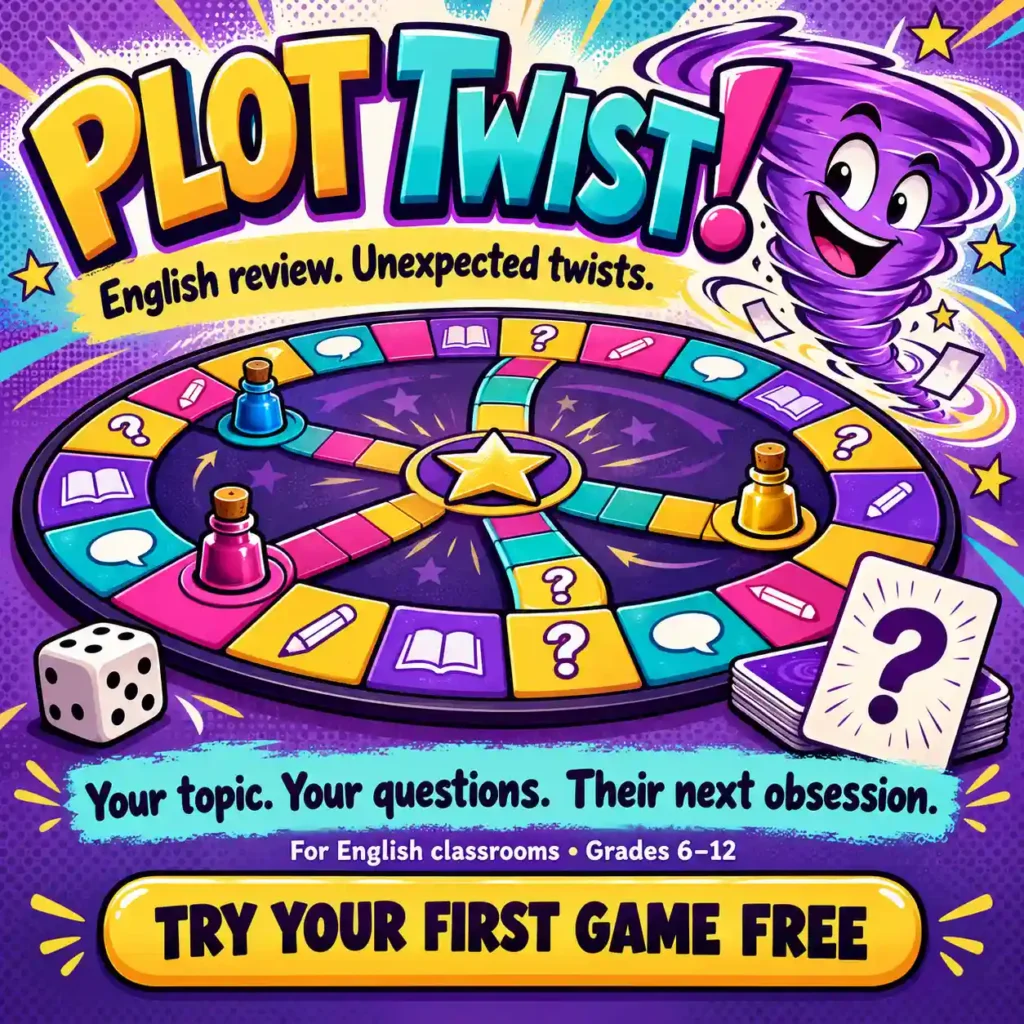
Use Plot Twist! for a team-based short story review
To turn an existing short story lesson into a digital review, open Plot Twist!. Enter your learning objectives and teacher-created notes, or upload teaching materials you have permission to use. Select two to seven teams and choose how responses will be evaluated.
Suggested instructions: “Grade 9 English. Review conflict, characterization, point of view, theme, and accurate literary-device recognition. Base questions only on the summary and examples provided. Require a text-supported explanation for interpretive prompts. Avoid inventing quotations. Allow teacher marking when more than one answer is defensible.”
The game is designed for a shared classroom screen, so students can collaborate in teams without individual accounts. The first game is free; verify generated questions before relying on them. Do not upload identifiable student information or copyrighted readings without the appropriate permissions.
Curriculum connections for short story games
The Common Core literature standards include citing textual evidence, analysing theme, and explaining how dialogue and incidents influence character and action (for example RL.8.1–RL.8.3). Across higher grades, the expectation for thorough evidence becomes more demanding. Adapt these learning goals to the Ontario English curriculum or your local expectations as appropriate.
Resources that work well with these games
For a ready sequence of fiction lessons, visit Practice the Elements of Fiction, the elements of fiction review, and the Grade 9 English course hub. If your students are studying a full novel rather than a short text, try our novel study review games instead.
Frequently asked questions
Can short story review games work after only one reading?
Yes, but adjust the task. Ask students to identify an initial inference, revisit the most relevant section, and revise it. A second reading often changes how students interpret the ending.
Do students need to memorize quotations to play?
No. When the goal is close reading, let students return to the text to select evidence. Require accurate description or quotation and a clear explanation.
What if teams disagree about the story’s theme?
Ask each team to write a full theme statement, identify supporting evidence, and explain how it addresses a counterexample. A thoughtful disagreement can be more valuable than quick consensus.
How can I adapt this lesson for independent reading?
Use the generic question stems above. Students can refer to different short stories and provide the relevant passages for their claims. Evaluate the reasoning using a shared rubric.
Review is a second chance to read more closely
The best short story game does not end when a team identifies a literary element. It ends when students can point to the language that created meaning, change a weak answer into a stronger one, and carry that skill into their next text.