
10 Novel Study Review Games That Go Beyond Plot Questions
Novel study review games are at their best when students have to support an interpretation, not simply recall who went where in Chapter 7. Plot questions have a place: students need the story’s basic events before they can analyse it. But if every round asks for names, places, and details, a lively activity may measure memory more than understanding.
These ten novel study review games for middle and high school English focus on character motivation, conflict, theme, narrative perspective, symbols, and evidence. They work with almost any class novel, whether students are halfway through a book or preparing for a culminating assessment. For a larger collection of literature and language review activities, visit the English Classroom Review Games hub.
A better question: from what happened to why it matters
Compare two questions: “Who makes the decision at the end of the chapter?” and “What does that decision reveal about the character’s competing loyalties?” The first establishes a fact; the second asks students to interpret. Strong novel review often uses both in sequence: establish the event, identify the textual evidence, then explain its significance.
Use a consistent answer routine: claim → text detail → explanation. Allow more than one credible answer when students can point to the novel. For teacher scoring, two points for relevant evidence and explanation can be worth more than one for recalling a detail.
10 novel study review games that build deeper thinking
1. Evidence Auction
Best for: character analysis and theme. Time: 15 minutes. Give each team ten imaginary tokens and a debatable claim, such as “The protagonist becomes less trusting.” Display several possible pieces of evidence from the class text. Teams bid on the details they believe best support the claim.
The winning bidder must explain the connection between evidence and claim. A dramatic quotation may be weaker than a quiet decision that shows lasting change. Reward reasoning instead of merely the highest bid.
2. Theme on Trial
Best for: theme and argument. Time: 15–20 minutes. Put a theme statement on trial: “Fear can make people abandon their values.” One team gathers supporting passages, another gathers counterevidence or qualifications, and a third weighs the arguments. The final verdict is a refined claim, not simply guilty or innocent.
Teacher prompt: “Which event most clearly supports the statement? What would someone who disagrees point out?” This prepares students for an analytical paragraph or essay.
3. Character Motivation Cross-Examination
Best for: inference and characterization. Time: 10–15 minutes. Assign a team the role of a character at a decision point. Other groups ask evidence-focused questions: “What do you fear losing?” and “Which earlier action supports that explanation?” The character team must answer from established events, while distinguishing what the text confirms from their own inference.
A useful scoring rule: one point for a plausible motivation, one for a concrete text detail, and one for acknowledging uncertainty when the text leaves room for interpretation.
4. Turning-Point Ranking
Best for: plot as structure rather than trivia. Time: 15 minutes. Give teams four important events from the novel. They rank them according to how much each changes the character, conflict, or direction of the story. Each ranking must include a short explanation. Teams compare lists and defend why an apparently small choice may be more consequential than a dramatic scene.
5. Narrator Reliability Detective
Best for: point of view and inference. Time: 15 minutes. Select a passage in which a narrator describes another character or explains an event. Teams identify what the narrator knows, what they assume, and what they might have a reason to hide or misunderstand. Ask, “What detail elsewhere in the text supports or complicates this account?”
Do not assume first-person narrators are unreliable by default. Students should identify a textual reason to question an account, such as contradiction, limited knowledge, or self-interest.
6. Symbol or Ordinary Detail?
Best for: symbolism and close reading. Time: 12 minutes. Offer several recurring objects, locations, or images from the novel. Students argue which details might carry additional meaning and explain how repetition, context, or character reactions support that reading. A team can earn full credit by saying the evidence is insufficient.
This matters because not every colour, object, or weather event is a hidden symbol. The strongest answer is the one that explains how the pattern works in the actual text.
7. Chapter Title Challenge
Best for: synthesis and structure. Time: 10 minutes. Give teams an untitled chapter or section. Each group proposes a meaningful title of no more than seven words. They must defend the title by connecting it to an important shift, tension, image, or question. After listening, classmates vote on the most defensible title and explain why.
Extension: Ask groups to create both a plot-focused title and a theme-focused title, then compare what each emphasizes.
8. Quote, Context, Consequence
Best for: quotation analysis. Time: 15 minutes. Show a brief passage that your students have already read and are allowed to quote. Teams explain who is speaking or observing, what is happening, and why the words matter beyond the immediate moment. Ask them to connect the quotation to a relationship, later choice, or emerging theme.
A strong response moves from “This happens during the argument” to “The dismissive phrasing reveals how the conflict is becoming personal.”
9. Counterclaim Showdown
Best for: preparing literary essays. Time: 15–20 minutes. Present a claim, such as “The character’s change is mainly caused by guilt.” One team finds supporting evidence; the other proposes a reasonable alternative such as fear or loyalty. Each side must acknowledge the strongest part of the opposing view before presenting a response.
Award points for fair engagement with counterevidence, not for aggressive debate. The goal is a more precise argument.
10. The One-Sentence Synthesis
Best for: end-of-unit review. Time: 10 minutes. Students finish a sentence frame: “By showing ___, the novel suggests ___.” Give teams one minute to agree on a claim, then another minute to select one piece of evidence that makes it defensible. Other groups can ask clarifying questions. This creates an efficient bridge to a thesis statement.
Ten adaptable novel study questions for any book
Character: Which decision most clearly marks a change in the protagonist? Explain what the character did before and after, and what caused the shift.
Conflict: Is the central conflict driven more by an external obstacle or an internal belief? Support your position with two moments from the text.
Theme: What statement about loyalty, power, belonging, or fear does the novel develop? Explain why your statement is more than a topic.
Point of view: How would a particular scene change if another character narrated it? Which information would become more or less reliable?
Motivation: Identify a choice that could be explained by two different motives. Which interpretation has stronger textual support?
Setting: Where does the setting influence an actual decision, limitation, or mood? Explain the link.
Structure: Which scene is the most consequential turning point, and what changes after it?
Symbolism: Choose a repeated object or image. What meaning might it carry, and what evidence prevents the interpretation from being mere guesswork?
Relationships: How does one relationship change across the novel? Find an early and later example to compare.
Evaluation: What is one action the novel encourages readers to judge differently after they learn more about the character? Explain what new context matters.
A 50-minute novel study review lesson
0–5 minutes — Individual recall: Students list two key decisions and one unresolved question from the assigned reading. Let them consult the novel only after making an initial attempt.
5–12 minutes — Mini-lesson: Model a weak answer (“He changes because the book says so”) and a stronger one that names a decision, gives a text detail, and explains the effect.
12–28 minutes — Play Turning-Point Ranking: Small groups rank four events and present brief defenses. Require every group member to contribute one piece of evidence or a reason.
28–42 minutes — Play Theme on Trial: Groups make and challenge claims, using accessible copies of the novel and teacher-selected passages where needed. Pause to correct a common confusion between topic and theme.
42–50 minutes — Individual synthesis: Students write a short answer to “Which decision most shapes the protagonist’s development, and why?” Require a specific moment from the text, not merely a remembered fact.
How to differentiate novel review games
Grades 6–7: Offer a shortlist of events, short passages, and clear sentence frames: “This shows ___ because ___.” Use character relationship diagrams or chapter summaries for orientation. Keep the reasoning goal, but reduce memory demands when those are not the target.
Grades 8–9: Emphasize conflicts, emerging themes, and character change, including direct references to dialogue, actions, and narrative details. Give practice distinguishing an inference from a confirmed fact.
Grades 10–12: Require counterclaims, attention to narrative reliability, shifts in tone, and nuanced discussion of how literary techniques shape meaning. Reward well-supported differences of interpretation.
For students who need additional reading support, provide brief, teacher-selected excerpts, time to reread, and alternative ways to contribute evidence. Do not turn a competition into a contest about who can recall quotations word-for-word.
Using AI and Plot Twist! for novel study review
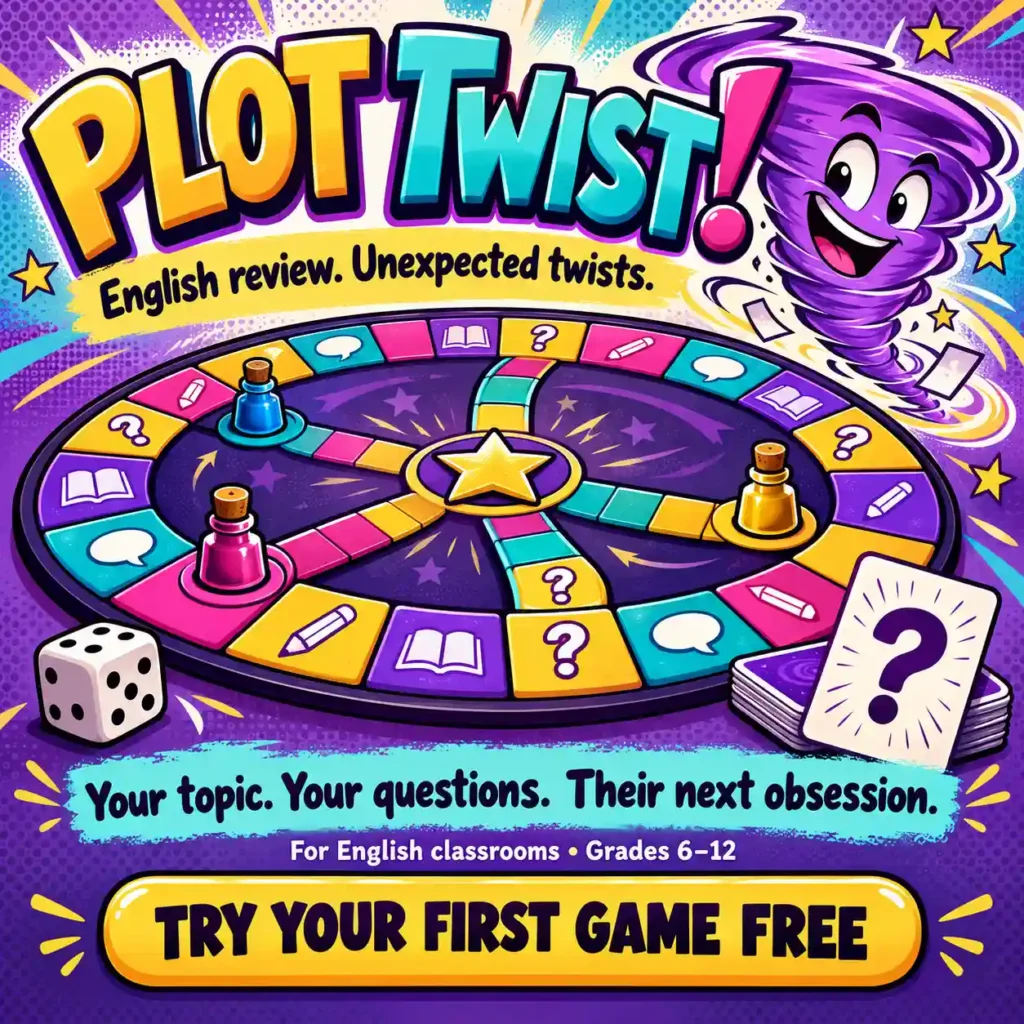
A digital board game can make the final review lively, provided the questions remain anchored in the actual novel. Plot Twist! lets teachers specify a topic and instructions or upload permitted study materials, then run a teacher-led shared-screen game for two to seven teams. Students answer different challenge types while teams collect ink toward a final challenge.
Suggested teacher instructions: “Grade 9 English novel review. Use only the chapter summaries and teaching notes I provide. Ask questions about character motives, conflict, narrative perspective, and theme. Avoid unverified quotations or facts from outside these notes. Include explanation and evidence questions. Allow more than one defensible interpretation when it is justified.”
Use teacher evaluation for questions that require close literary interpretation. AI-generated questions can be useful preparation aids, but verify every factual answer and do not upload restricted books or identifiable student work without permission. The first Plot Twist! game is free.
Avoid three common mistakes
Mistake 1: An endless plot quiz. A few recall questions help establish shared understanding. Follow each with “Why does this event matter?” or “What does it reveal?”
Mistake 2: Scoring interpretations as automatically right or wrong. A strong reader can defend an unexpected answer. Set a rubric based on accuracy, relevance, and explanation, then invite revision.
Mistake 3: Letting the loudest team member do all the work. Assign rotating roles—reader, evidence finder, claim builder, and spokesperson—and end with an independent response.
Keep reading and review connected
Ask students to mark a passage or record a page reference during each game. Then, after the competition, have them turn one spoken answer into a paragraph with a claim, supporting detail, and explanation. For additional resources, explore the Grade 9 English course, the Lord of the Flies unit plan, our To Kill a Mockingbird unit plan, and the English Review Games collection.
Frequently asked questions
How can I review a novel without giving away later plot events?
Use only chapters students have already read. Phrase questions around current interpretations and unresolved issues rather than answers from the ending. Avoid uploading future chapters into a generated quiz if you want to protect the reading experience.
Can these games work for independent reading novels?
Yes. Ask adaptable questions about motivation, turning points, conflict, or narrative perspective and require each student to cite their own book. A teacher does not need to know every title to evaluate the quality of the reasoning, but may ask to see a supporting passage.
How do I award points when students disagree about theme?
Score the specificity of the claim, the accuracy and relevance of the evidence, and the explanation that connects them. More than one theme statement can be defensible.
Should students be allowed to use their books during review?
Often yes, especially when the objective is locating and analyzing evidence. A brief closed-notes retrieval starter followed by open-text analytical work can assess two useful skills.
The takeaway
The best novel study review game ends with students seeing the story more clearly—not just remembering more of the storyline. When teams justify, compare, and revise their ideas, review becomes rehearsal for discussion and literary analysis.