
10 English Exam Review Games for Middle and High School
English exam review games can replace the familiar end-of-term ritual of reading a huge study guide aloud and hoping students remember it. A useful game does more: it reveals misconceptions, gives students practice with the kinds of thinking their assessment requires, and ends with an independent check. These ten activities are designed for middle and high school English classes, including Grade 9 exam preparation.
The key is to match the game to your actual assessment. If an exam includes unseen reading, writing a supported paragraph, and revising sentences, a review consisting only of literary-term definitions is not enough. Use our existing Grade 9 English exam review alongside the English Classroom Review Games hub to identify the concepts students have studied.
Build an exam review around skills, not just topics
Before choosing a game, list the assessment’s task types: recalling terms, interpreting literature, reading an unfamiliar passage, using textual evidence, editing grammar, and planning or composing an argument. Prepare two or three questions of each relevant type. Do not promise that a game predicts test questions or reproduces a particular jurisdiction’s exam; it is a classroom practice activity.
A simple target for the day is: “I can identify what a question is asking, choose an appropriate strategy, and explain or correct my answer.” Give students a way to mark confidence—sure, unsure, or guessed—so they can prioritize their next study session.
10 English exam review games
1. Question-Type Detective
Time: 10 minutes. Display four exam-style prompts: “Define dramatic irony,” “Explain how the narrator influences reader sympathy,” “Edit this comma splice,” and “Evaluate which evidence best supports the claim.” Teams name the skill and explain what a successful answer must contain.
Students who identify that explain requires reasoning, not a single word, are practising a valuable exam habit. Ask learners to underline instruction verbs before answering.
2. Retrieve, Reveal, Repair
Time: 12 minutes. Every student answers five questions from memory. After revealing model responses, pairs diagnose errors and write corrected explanations. Award a bonus point for fixing a misconception rather than hiding it.
Example: A student says theme is “what happens in the story.” The repaired answer distinguishes plot events from a broader idea developed through those events. Use topics from the current course rather than a random online quiz.
3. Literary Devices Evidence Hunt
Time: 15 minutes. Provide short original sentences and ask students to identify the technique only when a clear example exists. For instance, “The hallway swallowed our footsteps” can suggest personification; “The hallway was long” does not automatically contain a literary device.
Award points for locating the words that create the effect and explaining why the term fits. Connect to literary devices review games for additional formats.
4. Unseen Passage Challenge
Time: 15–20 minutes. Give a short text students have not studied, followed by one literal, one inferential, and one analysis question. Students first answer independently, then teams compare text evidence. Avoid a race to read fastest; reading time should be sufficient.
Sample original passage: “When the announcements ended, the auditorium stayed unusually quiet. Noor glanced at the empty chair beside her and folded the programme into a narrow strip. As the applause began, she kept her eyes on the stage.” Students can support the inference that Noor is distracted or emotionally affected, but the passage does not identify who was expected in the chair.
5. Evidence Pairing
Time: 12 minutes. List three interpretation claims and four text details. Teams match the strongest detail to each claim; one detail is a distractor. They must add a sentence connecting evidence to claim.
Example: If a character repeatedly checks a locked door, that behaviour may support an inference of fear, caution, or impatience depending on context. Teach students to qualify an interpretation rather than treating one action as conclusive proof.
6. Grammar Error Court
Time: 15 minutes. Write sentences with comma splices, pronoun ambiguity, missing apostrophes, and fragments. Each team acts as an editing panel: identify the issue, correct the full sentence, and explain the rule.
Example: “The test was challenging, the students revised carefully.” Correct with a semicolon, a period, or an appropriate conjunction. For more practice, see grammar review games for Grades 6–12.
7. Outline an Answer in 90 Seconds
Time: 10 minutes. Provide an essay or paragraph prompt from an old classroom task, not a confidential exam. Students quickly write a claim, two supporting ideas, and the evidence they would need. Discuss which plans are specific enough to develop into a coherent response.
Then give another two minutes for revision. A well-chosen reason with relevant evidence beats three vague ideas listed under pressure.
8. Distractor Detective
Time: 12 minutes. Write one multiple-choice question with four plausible answers. Teams explain not only why the strongest answer works but why the alternatives fail. Ask them to identify when an option is partly true but not supported by the passage.
This is a useful antidote to selecting an answer merely because it includes a familiar keyword. Students practise returning to the actual wording and eliminating answers for a reason.
9. The Study Priority Auction
Time: 15 minutes. Teams receive ten tokens and six hypothetical study needs: definitions, unseen reading, citation, grammar, essay planning, and text interpretation. They allocate time to the skills that most clearly need attention based on a short diagnostic.
There is no single correct allocation. The goal is to explain a plan: why should a student who can recall terms but cannot support an inference spend more time on close reading? Students then write an individual plan for the next two study sessions.
10. Teach-Back Tournament
Time: 15 minutes. In pairs, one student teaches a skill from the unit—such as identifying irony or integrating evidence—while the partner asks for an example and checks accuracy against notes. Switch roles and invite corrections.
A correct explanation with a working example earns more than reciting a definition. This lets teachers hear misconceptions and provides a calm end to a demanding review lesson.
Exam-style mini-practice with answers
Prompt 1 — Inference: In the auditorium passage, what detail suggests Noor’s attention is elsewhere? Model answer: Her repeated folding of the programme and focus on the stage while others applaud may suggest distraction or anxiety. The passage does not state the cause.
Prompt 2 — Literature: Why is “fear” a topic rather than a complete theme statement? Answer: It names a subject. A theme statement expresses a developed idea about that subject, such as “Fear can lead characters to hide the truth,” if supported by the text.
Prompt 3 — Writing: Improve “The author uses good evidence.” Possible response: “The author supports the claim with a concrete example that demonstrates the policy’s impact.” Students should identify the real example before using such a sentence in a paper.
Prompt 4 — Grammar: Correct “Because the character was confused.” Possible answer: “Because the character was confused, she asked for clarification.” The original is a fragment unless intentionally used as a fragment for effect.
Prompt 5 — Literary technique: Which sentence clearly shows personification: “The rain fell heavily” or “The rain tapped impatiently at the window”? Answer: The second assigns a human-like quality to rain.
Prompt 6 — Evidence: Is it enough to quote a line in a literary analysis paragraph? Answer: No. The writer generally needs to explain how the quoted detail supports the claim.
A 50-minute English exam review lesson plan
Minutes 0–6 — Diagnostic: Ask students five quick questions representing the exam’s skills. Students independently note which answers they feel uncertain about.
Minutes 6–13 — Strategy model: Demonstrate reading an instruction verb, identifying the required answer type, and selecting text evidence where relevant.
Minutes 13–28 — Skill stations: Run a literary-device round, grammar error round, and interpretation round. Each team records its rationale, not only the final answer.
Minutes 28–40 — Unseen passage: Students read the original mini-passage privately before discussing one inferential question and one evidence question as a team.
Minutes 40–50 — Individual transfer: Students outline a short analytical paragraph and name their two highest-priority areas for independent study.
How to differentiate a review without lowering expectations
Grades 6–7: Use brief passages and clear command verbs. Provide answer frames when the assessment target is inference or explanation rather than free writing speed.
Grades 8–9: Mix literature, reading, paragraph analysis, and editing. Ask for text support and grammatical explanations; our Grade 9 English course materials provide a useful scope.
Grades 10–12: Introduce more ambiguous passages, nuanced thesis statements, evidence limits, rhetorical analysis, and timed outlines. Continue to give adequate time when evaluating complex reasoning.
For students who require accommodations, keep game logistics separate from permitted exam accommodations. A timed competitive practice activity should not override extra time, assistive tools, or other supports specified in an individual learning plan.
How to use Plot Twist! for whole-class exam review
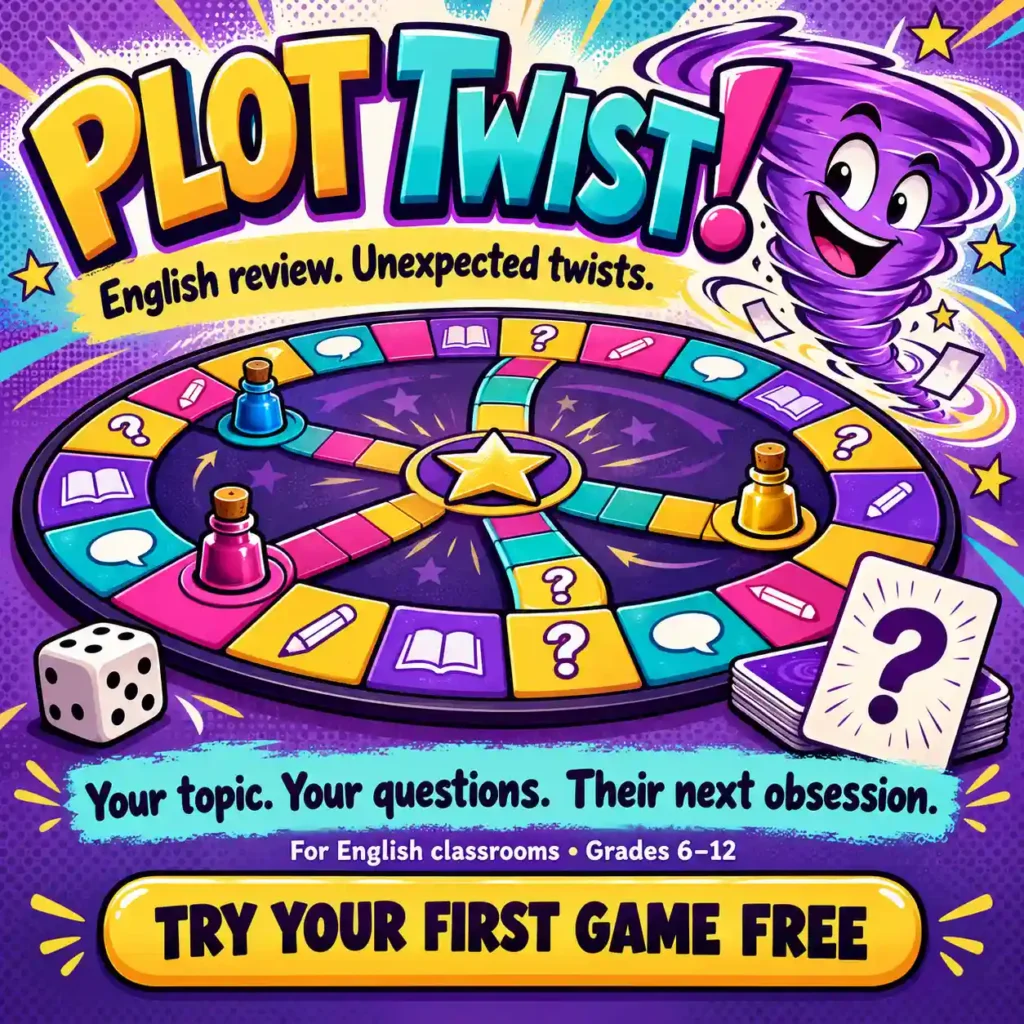
Plot Twist! can provide a lively team-based practice round when students need to revisit familiar topics. Enter your unit outline or permitted teacher notes, select two to seven teams, and ask the game to mix grammar, literature, reading, and vocabulary. Use manual teacher checks for interpretation questions with several defensible answers.
Suggested instructions: “Grades 8–9 English end-of-unit review. Mix precise literary terminology, short original passages, sentence editing, and evidence-based interpretation. Avoid repetition and avoid assuming students have read texts not supplied. Never fabricate quotations.” Review every generated item before playing. The first game is free.
Curriculum connections
Match review questions to the actual assessed outcomes. The Common Core reading anchor standards, writing anchor standards, and corresponding language expectations offer a broad framework; the precise grade-level expectations and your school’s exam format should drive the lesson.
Frequently asked questions
How many review games should teachers use before an English exam?
Two or three well-selected game formats are usually enough in one class period. Spend more time on feedback and independent practice than on explaining new game rules.
Do games help students prepare for essay questions?
They can help students practise recognizing a prompt, developing a focused claim, selecting evidence, and outlining reasoning. Students should still write at least one full response under appropriately supported practice conditions.
Should exam review games include questions from the real test?
Use public exemplars, original prompts, and earlier classroom material; do not expose confidential or secure assessment items. Match the thinking demands rather than revealing the test.
How do I know which topics students need to review?
Use a short diagnostic, collect individual answers, and look for patterns. Team scores alone can conceal which learners are unsure or relying on stronger teammates.
Leave students with a study plan, not just a score
A strong English exam review game helps students explain what they know, correct what they misunderstand, and decide what to practise next. Students should walk away with more confidence because their preparation is specific, not because they won a round of trivia.