100 Report Card Comments for Teachers to Use and Adapt
It’s Sunday night, you have forty report cards left to write, and the cursor is blinking on a blank comment box. Every teacher knows this exact moment. Searching for report card comments for teachers usually means one thing: you need solid phrasing right now, not another article about the philosophy of feedback.
This list gives you exactly that. You’ll find 100 ready-to-use comments covering academic performance, behavior, effort, and attitude, organized so you can scan for the right tone in seconds. Whether you’re writing about a student who’s excelling, one who’s struggling, or one who’s somewhere in between, there’s a specific phrase here you can copy or tweak to fit your classroom and your voice.
Below, you’ll find comments grouped by category, along with more report card comment examples you can copy and paste, plus a few tips on adapting generic language so it still sounds like you wrote it. And if you’re staring down a stack of thirty or more report cards, our Report Card Commentor tool can help you generate individualized comments even faster once you know the style you’re going for.
1. AI-generated comments you can customize instantly
Sometimes the fastest way to beat a blank comment box is to use AI to write report card comments and let a tool draft the first version for you. Free online report card comment generator tools take a student’s name, a subject, and a performance level, then spit out a grammatically clean paragraph in seconds. This isn’t cheating on report cards, it’s just outsourcing the boring part so you can spend your time on the details that actually matter, like what this particular kid did in your class this term.
A good AI draft isn’t the finished comment, it’s the first draft you edit into your own voice.
Our own Report Card Commentor was built for exactly this workflow. Type in a student’s strengths, growth areas, and subject, and it generates a comment that sounds professional right away, ready for you to personalize before it goes home.
Example comments
Here’s what raw AI output typically looks like before you touch it:
- "[Student] has shown consistent effort in mathematics this term, particularly in problem-solving tasks. Continued practice with multi-step word problems will support further growth."
- "[Student] demonstrates strong reading comprehension skills and contributes thoughtful insights during class discussions."
- "[Student] would benefit from reviewing homework instructions more carefully to reduce careless errors on assignments."
- "[Student] has made noticeable progress in written expression, with clearer organization and more varied sentence structure."
How to adapt them
Treat every generated comment as a rough draft, not a final product. Swap in a specific classroom moment, like the science fair project or the debate performance, so the comment reads as something you actually witnessed rather than something a computer assembled. Names matter too: double-check pronouns and spelling every single time, since a wrong name or pronoun undermines trust with parents faster than almost anything else.
Keep an eye on tone consistency across a whole class set. AI tools can drift toward overly formal or repetitive phrasing if you generate dozens back to back, so read a handful in sequence before sending them out. Finally, always add one sentence of your own, a quick note about a specific skill, habit, or moment, so the comment doesn’t read as generic. That single personal sentence is usually what parents remember, and it’s the piece no AI tool can generate for you.
2. Academic achievement and performance comments
Academic comments carry the most weight on any report card because parents scan for them first. These lines cover the full range, from a student acing every quiz to one who is falling behind and needs intervention, and they work for report card comments for elementary students just as well as for middle or high schoolers with a small vocabulary swap.
The clearest academic comment names the skill, not just the grade.
Example comments
- "[Student] consistently demonstrates a strong grasp of grade-level math concepts and applies them confidently to new problems."
- "[Student] has mastered the reading skills covered this term and reads with strong fluency and comprehension."
- "[Student] is working below grade level in writing and would benefit from extra practice with sentence structure."
- "[Student] shows real strength in science, especially when analyzing data and drawing conclusions."
- "[Student] has made steady progress in spelling this term, moving up several levels on our weekly assessments."
- "[Student] struggles to retain multiplication facts and needs continued at-home practice to build fluency."
- "[Student] produces high-quality written work but should work on proofreading before submitting assignments."
How to adapt them
Swap the vague grade reference for the actual skill or standard the student worked on that term. Instead of "doing well in reading," name the specific competency, like decoding multisyllabic words or identifying theme. Pair every growth area comment with a concrete next step a parent can act on at home, such as flashcards for math facts or fifteen minutes of nightly reading. That pairing turns a flat progress report into something a family can actually use, and it’s the same logic behind our ready-to-use student progress report comments, which is usually what separates a comment parents appreciate from one they skim past.
3. Work habits and effort comments
Work habits comments matter because effort and outcome don’t always line up. A student can ace every test while turning in sloppy homework, or struggle on quizzes while showing the most consistent effort in the room. Report card comments about effort give parents the fuller picture that grades alone miss, and they’re often what motivates a kid more than the letter grade itself.
Effort comments should reward the process, not just the outcome.
Example comments
- "[Student] consistently completes assignments on time and puts thoughtful effort into every task."
- "[Student] shows a strong work ethic and rarely needs reminders to stay on task."
- "[Student] would benefit from budgeting more time for longer assignments instead of rushing through them."
- "[Student] has improved significantly in staying organized and submitting homework consistently."
- "[Student] tends to give up quickly when a task feels difficult and needs encouragement to persevere."
- "[Student] takes pride in their work and it shows in the neatness and care of every assignment."
- "[Student] needs to work on following multi-step directions without frequent reminders."
How to adapt them
Anchor every comment to a specific routine you’ve actually observed, like homework completion rates, test prep habits, or how a student handles a tough assignment. If effort has changed over the term, say so directly, since a comment noting real improvement carries more weight than a static description. Consider pairing an effort comment with one actionable habit the student or family can build on, such as a homework checklist, a set study time, or a goal setting worksheet for students, so the feedback points toward next term instead of just describing this one.
4. Behavior and classroom conduct comments
Behavior comments are often the trickiest to write because parents can be sensitive to anything that sounds like a complaint, which is why negative comments that stay professional take extra care. Behavior report card comments organized by category need to be honest without being harsh, and specific enough that a parent understands exactly what’s happening in the classroom, not just that something is wrong. Good behavior deserves just as much airtime here as problem behavior, so keep a bank of comments that celebrate what a student does well handy, since a student who’s consistently respectful and easy to teach rarely hears that named out loud.
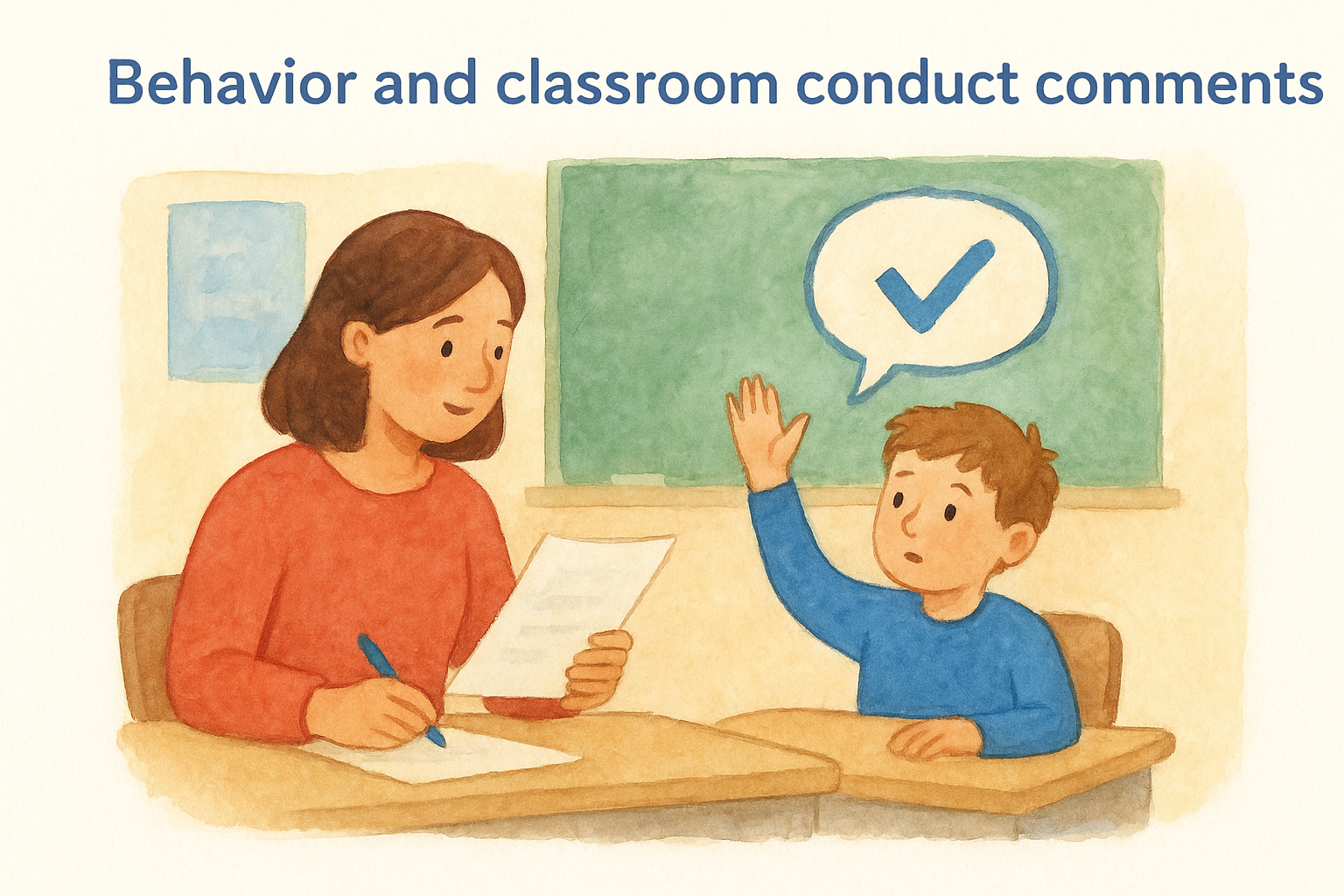
A behavior comment should describe the pattern, not label the child.
Example comments
- "[Student] is respectful toward classmates and staff and consistently follows classroom expectations."
- "[Student] has difficulty staying seated during instructional time and often distracts nearby classmates."
- "[Student] handles conflict calmly and is quick to apologize when a mistake is made."
- "[Student] has shown great improvement in following classroom routines this term."
- "[Student] frequently interrupts during lessons and needs reminders to raise a hand before speaking."
- "[Student] models excellent classroom conduct and is a positive influence on peers nearby."
- "[Student] struggles with transitions between activities and benefits from extra time and clear warnings."
How to adapt them
Whenever possible, describe the specific trigger or context for a behavior instead of just the behavior itself, since "struggles during unstructured time" tells a parent far more than "has behavior issues." Frame challenging patterns around what support looks like going forward: mention a strategy you’re already using, like a visual timer or a seating change, so the comment feels collaborative rather than accusatory. Lead with a genuine positive whenever you’re addressing a concern, and end on a forward-looking note about what you and the family can do together next term.
5. Attitude and motivation comments
Attitude comments capture something grades can’t: whether a student actually wants to be in your room. Report card comments about attitude tell parents if their kid approaches learning with curiosity or dread, and developing a positive attitude toward learning often matters more to families than a single test score. A student with a great attitude but shaky grades still has momentum; a student with strong grades but a poor attitude toward learning is a warning sign worth naming early.
Attitude comments should describe how a student meets challenges, not just how they perform.
Example comments
- "[Student] approaches new material with genuine curiosity and asks thoughtful questions."
- "[Student] maintains a positive attitude even when facing a challenging assignment."
- "[Student] often shows frustration when work feels difficult and needs encouragement to keep trying."
- "[Student] has developed a much more confident attitude toward math this term."
- "[Student] shows little interest in classroom activities and rarely seems motivated to participate."
- "[Student] takes on new challenges eagerly and encourages classmates to do the same."
- "[Student] needs support building resilience when an assignment doesn’t go as planned."
How to adapt them
Name the specific mindset shift you’ve noticed, since "more confident" or "less frustrated" tells parents more than a blanket "good attitude." Connect the comment to a growth mindset routine you already teach, like praising effort over outcome, so families understand the language and can echo it at home. Reserve the strongest motivation language for real, observed change rather than generic encouragement, because specific praise sticks with a student far longer than a vague compliment ever will.
6. Participation and engagement comments
Participation comments tell parents something attendance and grades never will: whether their kid actually leans into class discussions or hangs back. Report card comments about participation matter most for the quiet kids who do fine on paper but rarely speak up, and for the eager ones whose hands are always raised first, which is why it helps to know ways to improve classroom participation before you write them. Naming this pattern explicitly gives families a clearer picture of how their child shows up day to day, not just how they perform on a test.
Participation comments should capture how a student shows up, not just how often they speak.
Example comments
- "[Student] participates actively in class discussions and offers well-reasoned opinions."
- "[Student] is attentive during lessons but rarely volunteers to share ideas aloud."
- "[Student] engages enthusiastically in group projects and encourages quieter teammates to contribute."
- "[Student] has grown more comfortable speaking up in class this term."
- "[Student] tends to become distracted during whole-group instruction and needs redirection to stay engaged."
- "[Student] asks insightful questions that push classroom discussions further."
- "[Student] would benefit from contributing more often during small-group work."
How to adapt them
Mention the setting where engagement shows up most, since a student who freezes during whole-class discussion might thrive in small groups or one-on-one conversations. Offer a low-stakes suggestion families can try at home, like practicing an answer together before class, so a shy student has a concrete path toward more comfortable participation. Praise the quality of contributions, not just the quantity, because a single sharp comment from a quiet student deserves the same recognition as ten quick answers from someone who talks often.
7. Social skills and peer relationship comments
Social skills comments round out the picture that grades and behavior notes can miss entirely. Peer relationships shape how a student learns to collaborate, resolve small conflicts, and support classmates, and parents often care about this dimension as much as academics, especially in elementary and middle school. Search report card comments for teachers and you’ll find plenty on grades, but this category deserves its own space because friendship struggles or leadership strengths rarely show up anywhere else on the page.
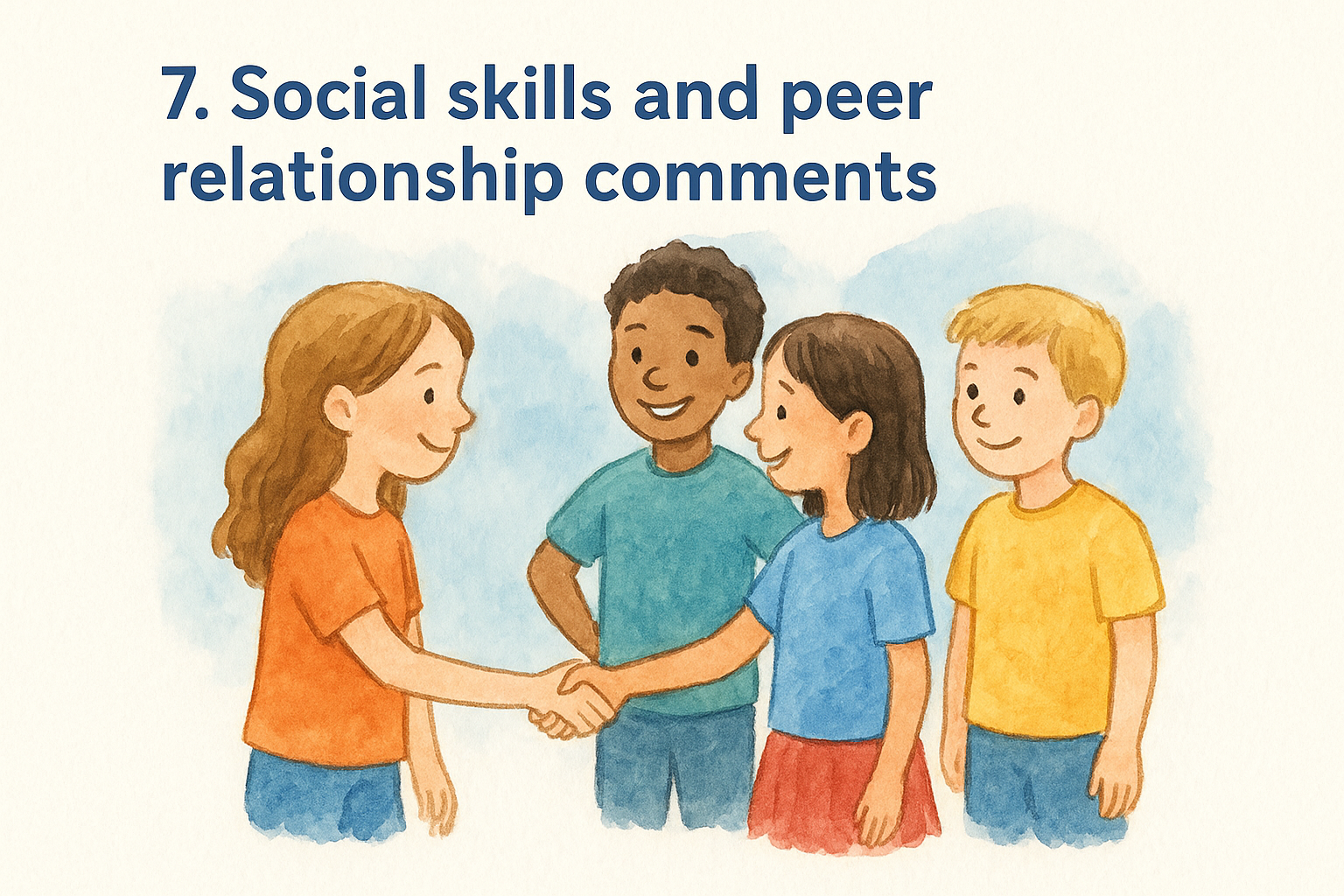
A peer relationship comment should show how a student treats others, not just how others treat them.
Example comments
- "[Student] builds friendships easily and is welcoming to new classmates."
- "[Student] works well with a wide range of peers and adapts smoothly to different group dynamics."
- "[Student] sometimes struggles to share materials or take turns during group activities."
- "[Student] is a natural leader in group settings and helps keep peers focused on the task."
- "[Student] has difficulty resolving disagreements with classmates without adult support."
- "[Student] shows genuine kindness toward peers who are having a difficult day."
- "[Student] prefers working independently and could benefit from more collaborative practice."
How to adapt them
Ground every comment in a specific interaction you’ve witnessed, since "gets along with others" says far less than a note about how a student mediated a disagreement at recess or welcomed a new kid at lunch. When you’re addressing a peer conflict pattern, describe the situation where it happens most, like unstructured group work or transitions, so parents understand the context instead of assuming a character flaw. Frame the note around a skill still developing, not a permanent trait.
Celebrate quiet kindness as readily as visible leadership, because the student who checks in on a struggling classmate rarely gets recognized unless you name it here. If you’re flagging a collaboration challenge, pair it with one strategy already in place, like assigned partner roles, a cool-down signal, or activities that build classroom community, so the comment reads as a plan in progress rather than a complaint parents can’t act on.
8. Character and citizenship comments
Character comments speak to something no rubric captures: whether a student is honest, fair, and willing to do the right thing when nobody’s watching. Report card comments about character matter to parents who want to know their kid is growing into a decent person, not just a competent student, and schools increasingly expect teachers to name this explicitly as part of citizenship standards. Naming integrity, responsibility, and respect for rules gives families a fuller sense of who their child is becoming in your classroom.
A citizenship comment should point to a value in action, not just a value in theory.
Example comments
- "[Student] takes responsibility for mistakes and follows through on making things right."
- "[Student] treats classroom materials and shared spaces with genuine respect and care."
- "[Student] is quick to include classmates who are often left out of group activities."
- "[Student] demonstrates honesty even when it means admitting a difficult mistake."
- "[Student] needs reminders to follow through on classroom responsibilities like cleanup duties."
- "[Student] stands up for fairness and speaks up when a classmate is treated unkindly."
- "[Student] shows strong respect for school rules and models this consistently for peers."
How to adapt them
Point to a real moment, like returning a lost item or owning up to an unfinished assignment, so the comment reads as evidence rather than a character judgment. Frame any growth area around a specific responsibility the student is still building, such as classroom jobs or homework accountability, and lean on strategies for teaching responsibility and empathy rather than a vague reference to attitude. Reserve the strongest praise for students who show integrity without being asked, since that’s the behavior families most want to hear celebrated.
9. Communication skills comments
Communication comments cover how a student expresses ideas out loud and on paper, which is a different skill than raw academic ability. Report card comments about communication help parents understand whether their kid can explain their thinking clearly, listen well, and get a point across without frustration, something that matters just as much in math class as in English. Strong communicators often fly under the radar because their skill doesn’t show up on a test score, so naming it directly gives credit where it’s due.
A communication comment should describe how clearly a student gets an idea across, not just how much they talk.
Example comments
- "[Student] explains their thinking clearly, both in writing and during class discussions."
- "[Student] listens attentively and responds thoughtfully to classmates’ ideas."
- "[Student] struggles to organize thoughts when speaking and would benefit from practicing short, structured responses."
- "[Student] writes with a clear voice and communicates ideas in a way that’s easy for readers to follow."
- "[Student] has difficulty asking for help when confused and often falls behind before speaking up."
- "[Student] presents ideas confidently during group presentations and speaks at an appropriate pace."
- "[Student] needs continued practice using complete sentences when answering questions aloud."
How to adapt them
Separate the two channels when you write, since a student’s spoken communication and written communication rarely move at the same pace. Target the actual gap you’ve observed, whether that’s organizing a paragraph or finding words during a class discussion, rather than a broad label like "needs to communicate better." Suggest one concrete practice, like rehearsing an answer before raising a hand, so families have something specific to work on before the next report card.
10. Creativity and critical thinking comments
Creativity comments highlight a different kind of intelligence than test scores measure: the ability to generate original ideas, ask unexpected questions, or solve a problem in a way nobody taught directly. Report card comments about critical thinking matter because standardized grades rarely capture whether a student can analyze, question, or invent, yet these are the skills that carry students furthest after they leave your classroom, and critical thinking activities for any subject are how you build them. Naming this strength explicitly tells parents their kid isn’t just following instructions well, they’re actually thinking.
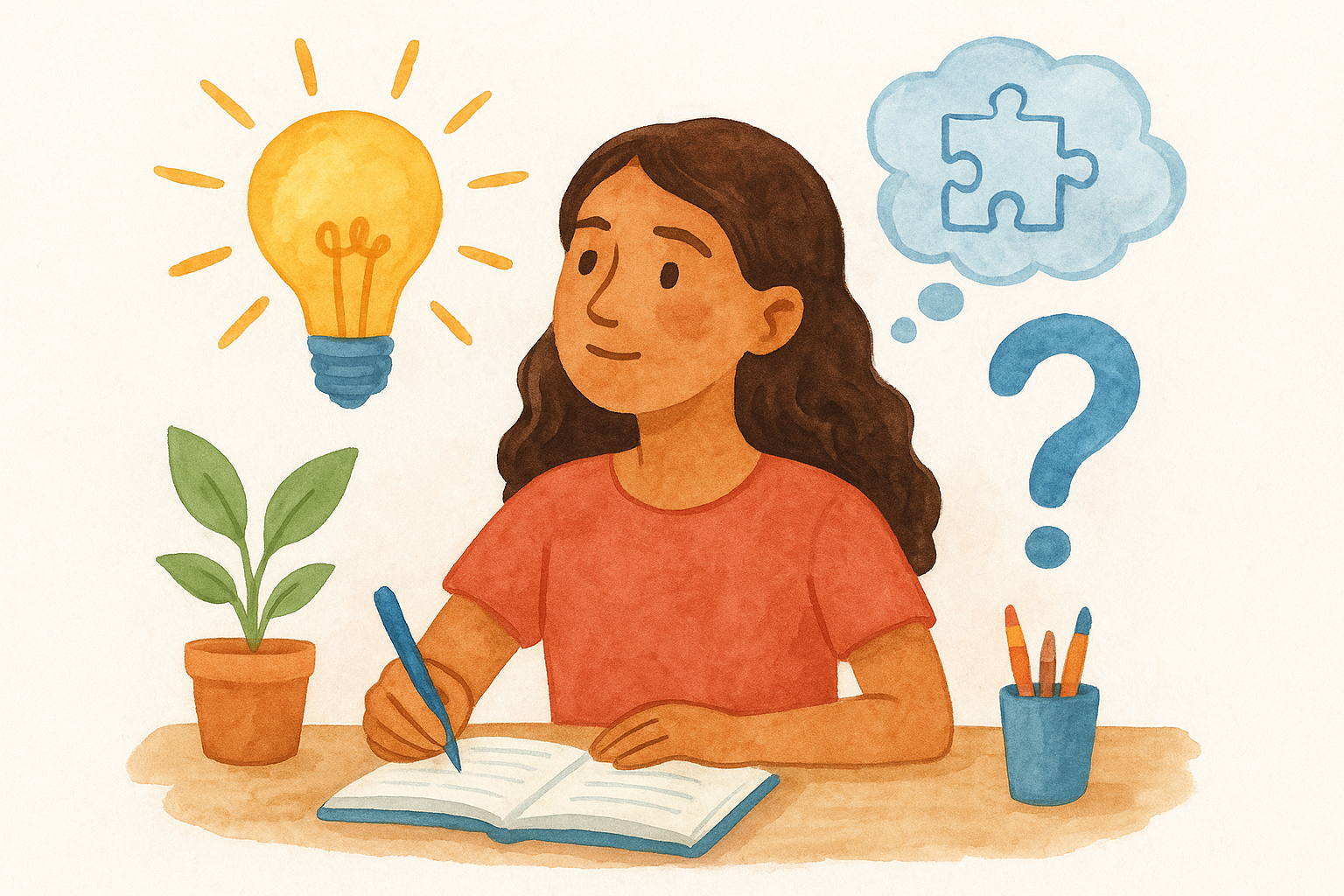
Creativity comments should describe original thinking in action, not just an artistic hobby.
Example comments
- "[Student] approaches problems from unexpected angles and often finds solutions other students overlook."
- "[Student] shows strong creative thinking in writing, with original ideas and vivid detail."
- "[Student] asks probing questions that push classroom discussions into deeper territory."
- "[Student] tends to rely on familiar strategies and would benefit from experimenting with new approaches."
- "[Student] connects ideas across subjects in ways that show genuine analytical thinking."
- "[Student] struggles to move beyond the first idea and needs encouragement to brainstorm alternatives."
- "[Student] evaluates evidence carefully before drawing conclusions in science and social studies."
How to adapt them
Describe the actual problem or project where the thinking showed up, since "creative" on its own tells a parent almost nothing concrete. Note whether the strength appears in open-ended tasks, like art or design, or in analytical ones, like debate or lab work, because the two skills develop differently and deserve separate mention. When a student defaults to safe answers, suggest one low-risk way to practice divergent thinking, such as a brainstorming warm-up before assignments, so the comment points toward a habit rather than just a trait.
11. Time management and organization comments
Time management comments round out the picture because they explain the gap between what a student knows and what actually makes it onto the page on time. Report card comments about organization tell parents whether missed deadlines come from confusion, distraction, or just a messy backpack, and because self-regulation is a skill, not a choice, that distinction changes what kind of help actually works at home. These comments matter most for older students juggling multiple classes, where a planner habit or lack of one can swing a grade a full letter either direction.
An organization comment should point to a fixable habit, not just a missing skill.
Example comments
- "[Student] manages time effectively and consistently submits assignments before the deadline."
- "[Student] keeps a well-organized binder and can locate materials quickly during class."
- "[Student] frequently misplaces homework and would benefit from a consistent system for tracking assignments."
- "[Student] has improved significantly at breaking long-term projects into manageable steps."
- "[Student] struggles to budget time during tests and often leaves questions unanswered."
- "[Student] uses a planner independently and rarely needs reminders about due dates."
- "[Student] needs support prioritizing tasks when juggling multiple assignments at once."
How to adapt them
Name the specific organizational tool already in play, whether that’s a shared class planner, a folder system, or a digital calendar, so parents know exactly what to reinforce at home. Quantify progress when you can, since "turned in three late assignments this term instead of ten" lands harder than a vague "has improved." Pair any concern with one realistic next step, like a weekly binder check or a checklist for long-term projects, so the family walks away with something concrete to try before the next report card.
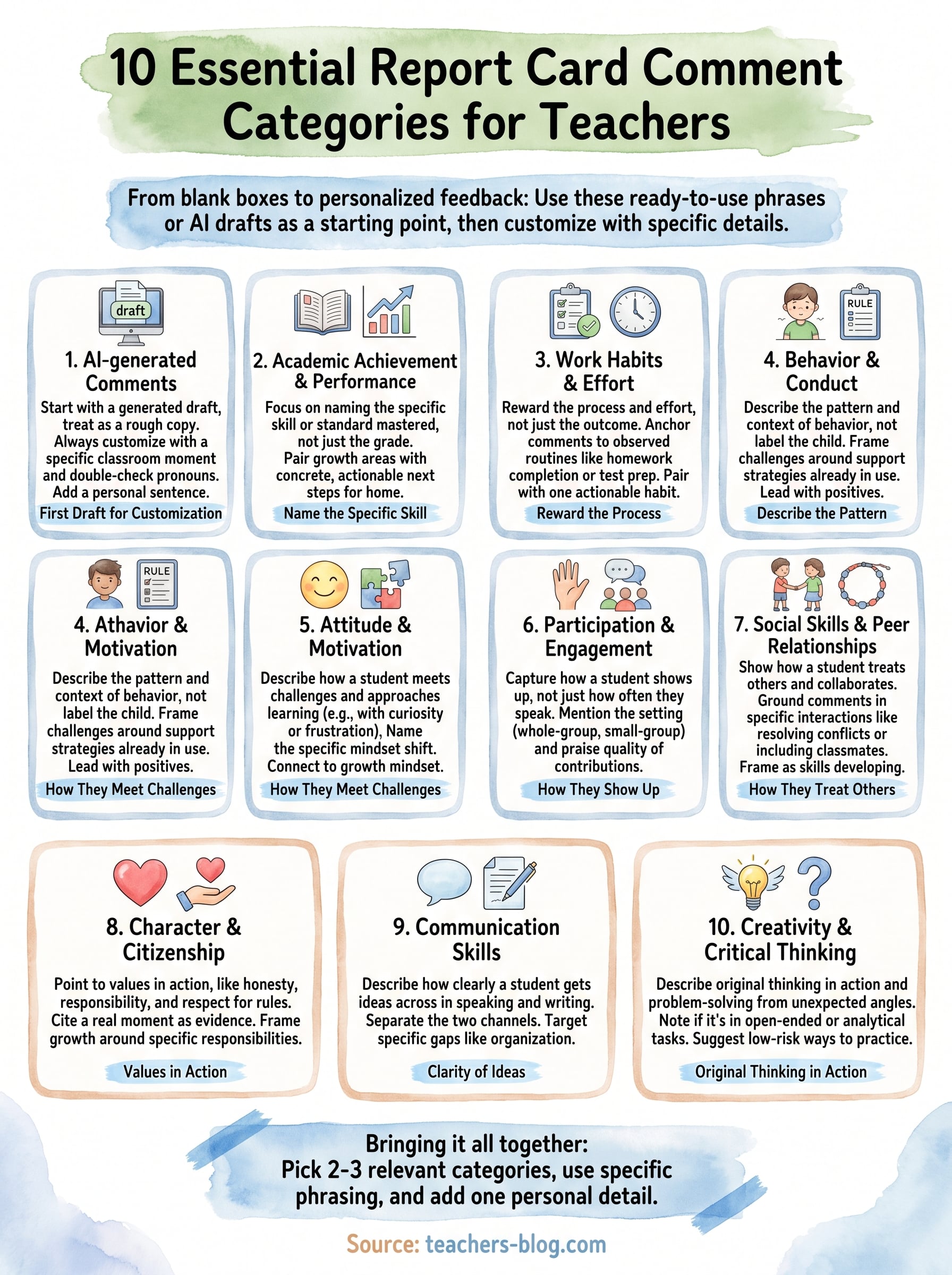
Bringing it all together for report card season
You don’t need all 100 comments for every student. Pick the two or three categories that actually matter for the kid in front of you, swap in a real detail from your classroom, and move to the next name on the list. That’s the whole trick to surviving report card season without losing your Sunday night: start from a strong template, then make it personal in one sentence.
The categories above cover academics, effort, behavior, and everything in between, so you’ve got a starting point no matter what kind of student you’re describing. Keep this list bookmarked for next term, because the same specific phrasing that saves you time now will save you time again in January and June.
If you want that same time saved without sacrificing quality, try our AI report card comments generator and turn your notes on each student into personalized feedback in seconds.