Self-Regulation in Students: Why Behavior Is a Skill We Must Teach
Self-regulation in students is the cognitive ability to manage emotions and impulses to achieve a goal. It is a developmental skill, not a character trait. When we treat behavioral outbursts as “bad choices” rather than “skill gaps,” we miss the opportunity to teach. Effective classroom management requires moving from a punitive “compliance” model to a supportive “coaching” model that builds a student’s internal thermostat.
This is Lesson 2 of Module 2: The Science Behind Student Behavior | Full Course Outline
Mindset Shift Chart: Skill vs. Choice
| The Old Lens (Behavior as Choice) | The New Lens (Behavior as Skill) |
| View: The student is being defiant or “lazy.” | View: The student is lacking the tools to regulate. |
| Response: Consequences and punishment. | Response: Scaffolding and instruction. |
| Goal: Immediate compliance. | Goal: Long-term self-management. |
| Tone: Frustrated, personal, or authoritative. | Tone: Clinical, curious, and supportive. |
| Result: Power struggles and resentment. | Result: Skill acquisition and stronger relationships. |
We often talk about self-regulation in students as if it’s a character trait.
“They should know better.”
“They’re old enough by now.”
“They just need to make better choices.”
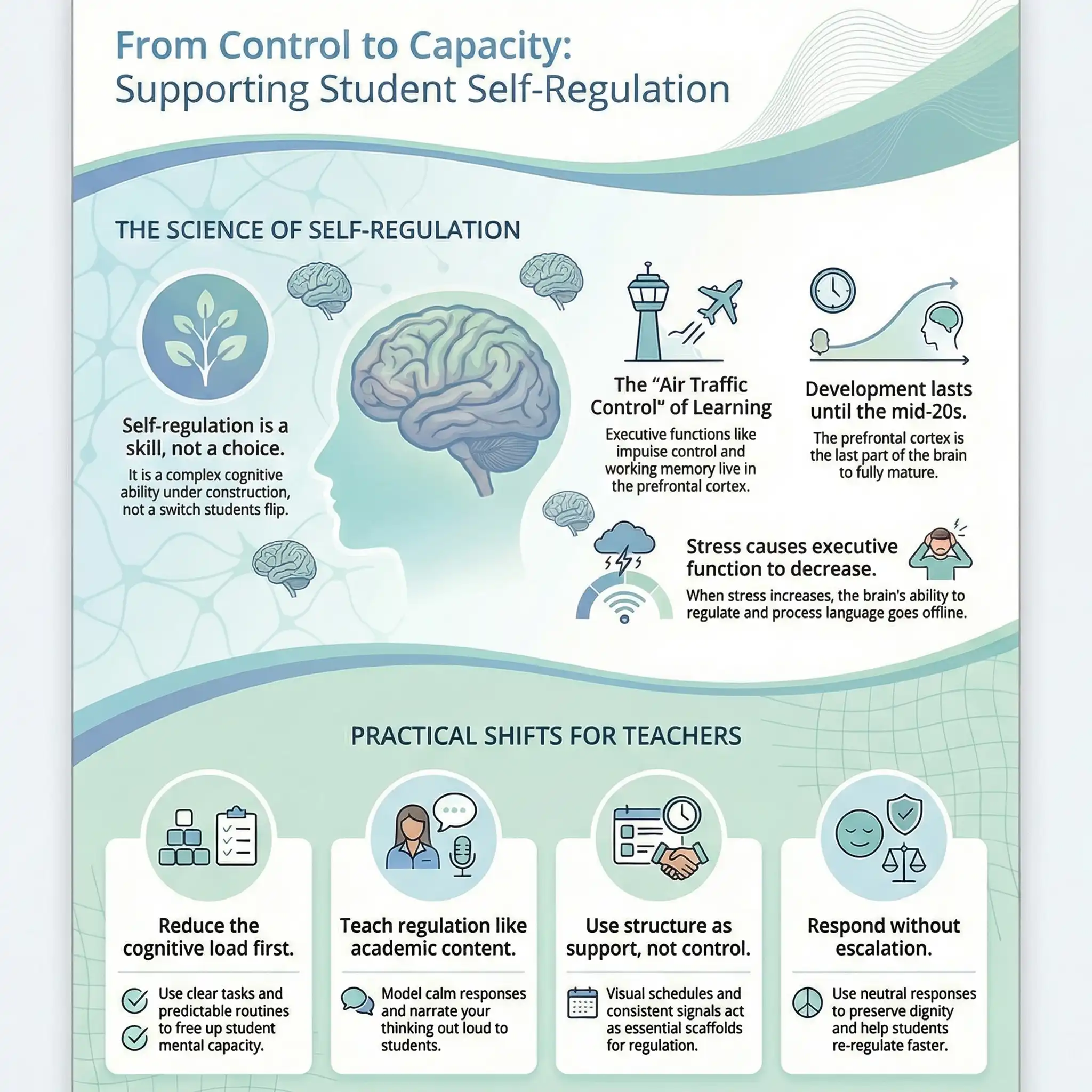
But self-regulation is not a switch students flip on when they feel like it. It’s a complex cognitive skill set—and for many students, it’s still under construction.
When we treat self-regulation as a moral failing instead of a developmental process, we respond with consequences instead of support. And that’s where classroom management quietly breaks down.
What is Self-Regulation in Students?
Self-regulation refers to a student’s ability to:
Manage emotions
Control impulses
Shift attention
Persist through difficulty
Pause before reacting
Recover after mistakes
These abilities live under the umbrella of executive function—the brain’s management system.
And here’s the key idea:
Executive function skills are learned, fragile under stress, and unevenly developed.
Executive Function: The “Air Traffic Controller” of Learning
Executive function includes skills such as:
Inhibitory control (stopping yourself from reacting)
Working memory (holding instructions in mind)
Cognitive flexibility (shifting strategies or perspectives)
Task initiation
Emotional regulation
These skills are primarily governed by the prefrontal cortex—an area of the brain that:
Develops slowly
Is highly sensitive to stress
Is often not fully mature until the mid-20s
So when a student blurts out, shuts down, avoids work, or escalates quickly, it’s often not defiance.
It’s a temporary executive function failure.
Why Self-Regulation in Students Breaks Down at School
Even students who can self-regulate in one setting may struggle in another.
Common classroom stressors include:
Unclear expectations
Frequent transitions
Social pressure
Public correction
Cognitive overload
Time pressure
Sensory noise
When stress increases, executive function decreases.
That’s why self-regulation in students looks inconsistent—and why “they can do it sometimes” isn’t proof they can always do it.
A Critical Shift: From Expecting to Supporting
Traditional classroom management often assumes:
“Students already have self-regulation skills. They just need motivation.”
A more accurate assumption is:
“Students are still developing self-regulation—and the classroom can either support or overload that process.”
This shift changes everything.
How Classrooms Can Support Self-Regulation in Students
Self-regulation in students does not improve through reminders to “try harder.”
It improves when classrooms are intentionally designed to carry some of the regulatory load for students.
Think of effective classroom management not as controlling behavior—but as building external supports until students can internalize them.
1. Reduce the Cognitive Load First
Before responding to behavior, pause and ask:
Is the task clear?
Is the routine familiar?
Is the environment predictable?
When students are overwhelmed, the brain prioritizes survival and emotion, not reasoning or self-control. If students must constantly figure out what they’re supposed to be doing, how long it will take, or what success looks like, their executive function is already under strain before behavior becomes an issue.
Reducing cognitive load means:
Giving clear, chunked instructions (one step at a time)
Avoiding last-minute changes when possible
Making routines automatic so they don’t require decision-making
Ensuring tasks are appropriately scaffolded—not cognitively overloaded
What this looks like in practice:
A predictable entry routine every day, even when the lesson changes
Written instructions that stay visible while students work
Consistent task formats so students don’t have to decode expectations each time
Clear time frames (“You have 7 minutes for this”) instead of vague pacing
When students don’t have to spend mental energy figuring out what’s happening, they have more capacity to regulate emotions, attention, and behavior.
2. Teach Self-Regulation in Students the Way You Teach Content
Self-regulation is not absorbed through osmosis.
It must be taught, modeled, practiced, and revisited—just like reading, writing, or problem-solving.
Students improve their ability to self-regulate when teachers:
Model calm, regulated responses—especially under pressure
Narrate their thinking (“I’m feeling frustrated, so I’m going to pause before responding.”)
Practice routines repeatedly until they become automatic
Pre-teach what to do when things go wrong
This might feel slow at first, but it saves enormous time later.
What this looks like in practice:
Explicitly teaching how to ask for help without calling out
Practicing transitions as a class (and re-practicing when needed)
Naming emotions neutrally (“It looks like this is frustrating right now.”)
Teaching students what to do if they feel overwhelmed, stuck, or upset
If we never teach regulation skills directly, we shouldn’t expect students to magically use them—especially under stress.
3. Use Structure as Support, Not Control
Structure is often misunderstood as rigidity or control.
In reality, structure is one of the strongest supports for self-regulation in students.
Predictable structures allow students to regulate without consciously thinking about it.
Examples include:
Consistent entry and exit routines
Clear, predictable transitions
Visual schedules or agendas
Familiar attention signals
Posted expectations using student-friendly language
These systems reduce uncertainty—and uncertainty is a major trigger for dysregulation.
What this looks like in practice:
Students know exactly how class starts, even if they’re anxious or tired
Transitions are signaled the same way every time
Expectations are stable across days and activities
Visual reminders reduce the need for repeated verbal corrections
These structures are not about compliance.
They are regulation scaffolds that quietly support students’ nervous systems throughout the day.
4. Respond to Dysregulation Without Escalation
When a student is dysregulated:
Reasoning is offline
Threat detection is heightened
Language processing is reduced
In this state, students are not being willfully difficult—they are neurologically unavailable for learning or reasoning.
This is the worst possible moment for:
Lectures
Public corrections
Power struggles
“We need to talk about your choices” conversations
Instead, effective responses focus on de-escalation first.
What this looks like in practice:
Using calm, neutral language
Keeping directions brief and concrete
Offering space or time to cool down
Addressing the issue privately once the student is regulated
Preserving dignity matters.
Students re-regulate faster when they feel safe, respected, and not publicly shamed.
Only after regulation is restored does reflection, accountability, or problem-solving become productive.
The Bid Idea for Teachers
Supporting self-regulation in students is not about lowering expectations.
It’s about recognizing that:
Regulation is developmental
Stress disrupts executive function
Classrooms can either overload or support students’ capacity to cope
When we design classrooms that reduce cognitive load, explicitly teach regulation, rely on supportive structures, and respond calmly to dysregulation, we don’t just manage behavior—we build skills that last.
Self-Regulation in Students FAQ
- Why is self-regulation considered a skill rather than a choice? Self-regulation relies on executive functions like impulse control and emotional processing. If a student’s brain is under-developed or under stress, they physically cannot ‘choose’ to be calm any more than a student can ‘choose’ to read a language they haven’t learned yet.
- How do I teach self-regulation in a busy classroom? It starts with modeling. Use ‘think-alouds’ to show students how you handle frustration. Additionally, incorporate ‘Peace Corners,’ breathing exercises, and visual anchors to give students the tools they need to reset before they escalate.
- Does viewing behavior as a skill mean there are no consequences? No. It means using logical consequences that focus on repair and learning rather than punitive measures that focus on shame. The goal is to ensure the consequence matches the skill the student needs to build.
Reflection
The “Skill Gap” Audit: Think of a student who frequently displays “defiant” behavior. If you look at their actions through the lens of a skill gap (executive function) rather than a moral choice, what specific regulatory skill might they be missing? (e.g., impulse control, cognitive flexibility, or task initiation).
Scaffold Check: Identify one high-stress transition or routine in your current school day. How could you add a “scaffold” (like a visual timer, a consistent verbal cue, or a pre-correction) to carry some of the regulatory load for your students?
Continue the Classroom Management Course
In the next lesson, learn how psychological safety in the classroom helps students take academic risks, ask questions, participate more openly, and engage more deeply in learning because they are no longer distracted by fear of judgment or humiliation.
Next Lesson: The Role of Belonging and Psychological Safety
Module 2 Progress:
Executive Function and Self-Regulation in Students
Back to Module 2 Overview
Return to Full Course Outline