
How To Teach Growth Mindset With Routines, Feedback & Goals
A student stares at a math problem, whispers "I’m just not a math person," and shuts down. You’ve seen it. Every teacher has. The question isn’t whether students struggle, it’s whether they believe struggle means something is wrong with them, or whether it’s just part of learning. That belief is exactly what separates a fixed mindset from a growth one, and figuring out how to teach growth mindset effectively is one of the most impactful things you can do in your classroom. But here’s the catch: posters and pep talks aren’t enough.
Growth mindset has to be built into the structure of your teaching, your daily routines, the way you give feedback, and how students set and track goals. That’s the kind of practical, embedded approach we focus on here at The Cautiously Optimistic Teacher, where our resources are designed to help educators actually shift student thinking, not just talk about it. Our Brain Builders Workshop and Learning to Learn materials exist because mindset work belongs inside real instruction, not beside it.
This guide breaks down a clear, actionable framework for teaching growth mindset through three pillars: classroom routines, strategic feedback, and meaningful goal-setting. You’ll walk away with specific activities and language you can put to work this week, no vague inspiration required, just methods that stick.
What growth mindset is and what it is not
Before you can teach growth mindset effectively, you need a precise picture of what the term actually means, because it gets misused regularly in schools. Carol Dweck, a psychologist at Stanford University, developed the concept after decades of research into how students respond to challenge and failure. Her core finding: students who believe their abilities can grow through effort outperform those who believe intelligence is fixed, even when their starting ability levels are the same. That insight has enormous implications for how you structure your classroom.
The actual definition
Dweck’s research, summarized in her book Mindset, defines a growth mindset as the belief that intelligence and talent are not fixed characteristics but qualities that develop through hard work, effective strategies, and support from others. A student with a genuine growth mindset doesn’t just try harder when they hit a wall. They try differently: adjusting their approach, seeking feedback, and treating errors as useful information rather than evidence of incompetence.
That shift in interpretation sits at the core of how to teach growth mindset in practice. You’re not trying to make students feel better about struggle. You’re changing what struggle means to them so they respond with a new strategy instead of shutting down entirely.
The goal isn’t to convince students they can do anything. It’s to help them see that their current ability is just their starting point, not their ceiling.
What it is not
Growth mindset is not praising effort for its own sake, and it is definitely not telling kids to just believe harder. Dweck herself has pushed back against these distortions publicly, calling the phenomenon "false growth mindset." Here is a breakdown of the most common confusions teachers run into:
| What people think it is | What it actually is |
|---|---|
| Telling kids to "try harder" | Teaching kids to try differently |
| Praising effort regardless of outcome | Praising effort linked to strategy and progress |
| A motivational poster on the wall | A shift in how feedback and tasks are structured |
| Believing anyone can do anything | Believing skills grow through process and support |
| A one-time lesson or assembly | An ongoing, embedded classroom practice |
Empty affirmations don’t change behavior over time. What actually shifts how students think is when the classroom structure itself consistently signals that struggle is expected, strategy is taught, and incremental progress is noticed and named. Mindset work that stays at the inspirational-quote level produces students who say the right things but still shut down the moment work gets genuinely hard.
Why the distinction matters for your teaching
If you are fuzzy on the definition, you end up doing mindset work that feels productive in the moment but has no lasting effect on student behavior. Students learn to say the right phrases without actually changing how they approach difficulty. That gap between language and behavior is exactly where most growth mindset programs fall apart. Your job is not to teach students a vocabulary.
Building the right conditions means making deliberate structural choices about how you give feedback, design tasks, and respond to student mistakes every single day. That is what the rest of this guide is about. Each step that follows is designed to help you embed growth mindset into the actual fabric of your classroom, so it works even when you are not explicitly talking about it.
Step 1. Build routines that normalize struggle
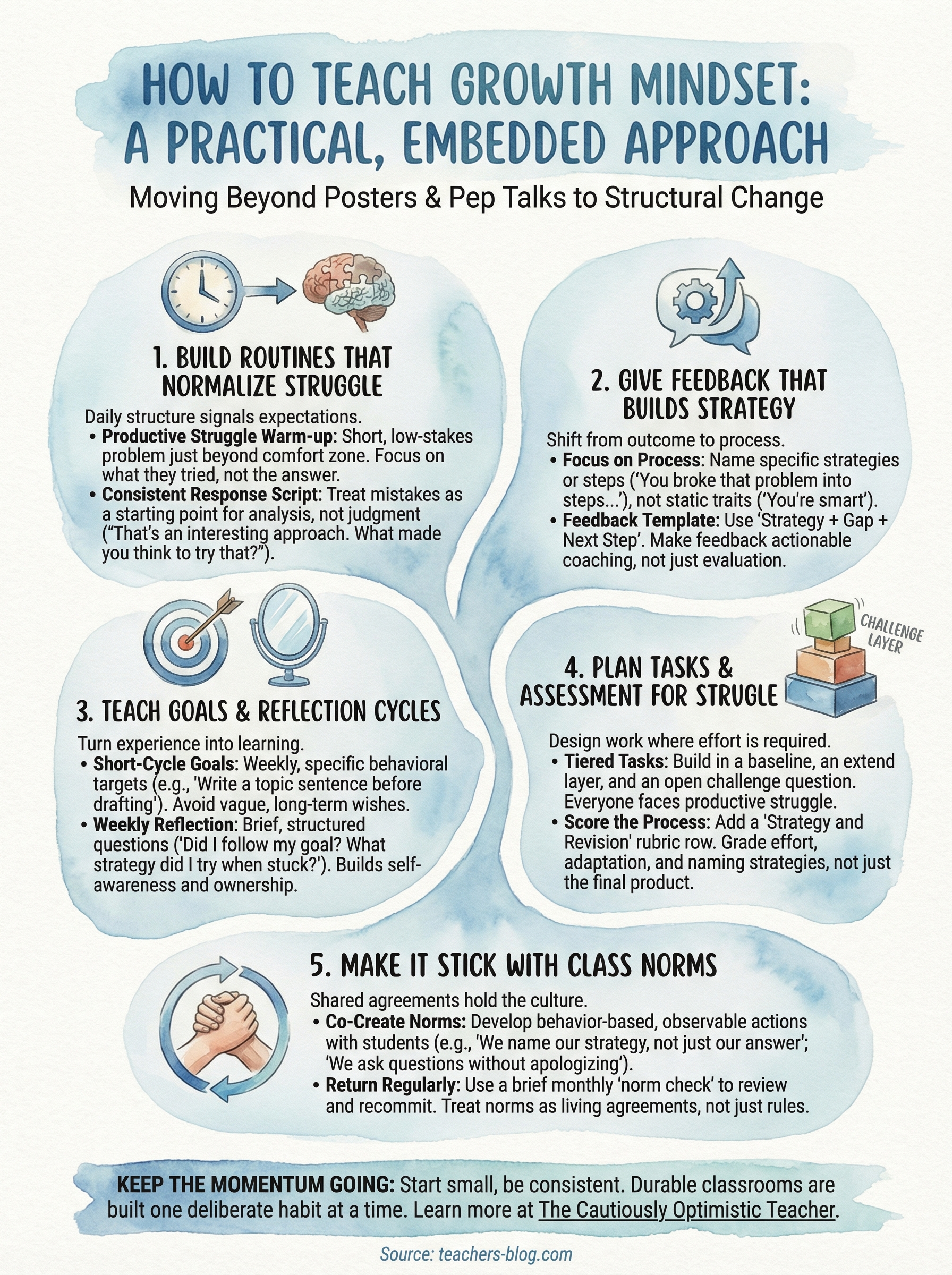
Routines are powerful because they communicate expectations without you having to say anything. When students walk into a classroom where struggle is a daily, expected part of the schedule, they stop treating difficulty as a sign they’re failing. The secret to how to teach growth mindset isn’t a single lesson. It’s the accumulated signal of consistent daily structure that tells students: this is what learning looks like here, and being stuck is just a step in the process.
Start class with a "productive struggle" warm-up
One of the most effective routines you can build is a short, low-stakes warm-up that students aren’t expected to solve perfectly. Give them a problem slightly beyond what they’ve mastered, ask them to try for three minutes, then share what they tried, not what they got right. This separates effort and strategy from correctness, which is exactly the shift growth mindset requires.
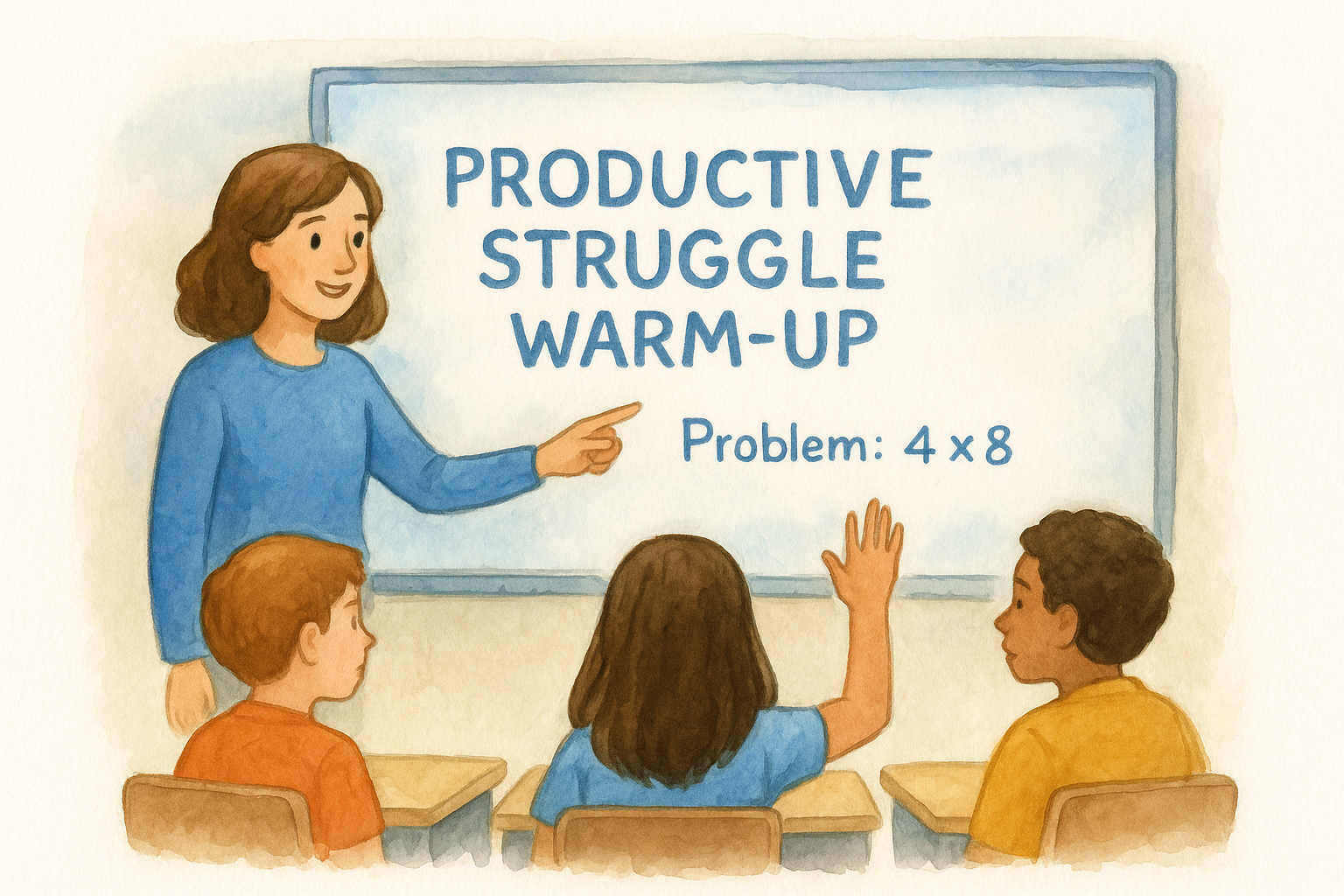
Here’s a reusable template you can adapt for any subject:
Productive Struggle Warm-Up Template
- Problem/Prompt: Something just outside their current comfort zone
- What did you try? Students write or say their approach, no matter how partial
- Where did you get stuck? Name the sticking point specifically
- What’s one thing you could try next? Focus on strategy, not the answer
Naming the sticking point out loud removes the shame from not knowing and turns it into a starting coordinate for learning.
Respond to mistakes with a consistent script
Your verbal response to student errors is itself a routine, and students pick up on your patterns faster than you might expect. When a student answers incorrectly, resist the impulse to immediately redirect to someone else. Instead, use a predictable, calm script that treats the mistake as the beginning of a conversation rather than the end of one.
Try this exact language: "That’s an interesting approach. What made you think to try that?" Then ask a follow-up question that moves them closer to the right path. Repeating this pattern consistently trains students to expect analysis instead of judgment when they get something wrong, and that shift in expectation is what slowly, deliberately changes the culture of your room.
Step 2. Give feedback that builds strategy
Feedback is the most direct lever you have for shaping how students think about their own learning. When you understand how to teach growth mindset, you quickly realize that most standard feedback reinforces a fixed mindset without anyone intending it. Praise like "you’re so smart" ties a student’s identity to an outcome rather than a process, and that connection is exactly what you need to break.
Focus on process, not outcome
The shift from outcome-based to process-based feedback is concrete and immediately usable. Process feedback names the specific thing a student did: the strategy they chose, the step they took, or the adjustment they made when things got hard. It gives students actionable information they can repeat or refine, rather than a label they can’t do anything with.
Feedback that names a strategy gives students something to do next time. Feedback that names a trait gives them nothing to act on.
Here’s a side-by-side comparison so you can hear the difference clearly:
| Outcome-based feedback | Process-based feedback |
|---|---|
| "You’re a natural at this." | "You broke that problem into steps, and that’s what got you through it." |
| "Great essay." | "Your opening paragraph made a specific claim, which made the whole argument easier to follow." |
| "You didn’t try hard enough." | "Let’s look at which step tripped you up and try a different approach there." |
| "Wrong answer." | "Your reasoning got you partway there. What would happen if you changed this part?" |
Use a feedback template that moves students forward
Written feedback on student work tends to be vague or purely evaluative, and students often read only the grade. A structured template fixes that by requiring you to name the strategy, the gap, and a next step. Use this format on any written assignment:
Strategy + Gap + Next Step Feedback Template
- What worked: Name one specific thing the student did that moved their work forward
- Where it stalled: Identify the exact point where the thinking or execution broke down
- What to try next: Offer one concrete action, not a general reminder to "be more careful"
Applying this consistently shifts feedback from a judgment into a coaching conversation, and students start reading your comments differently because they know a clear next move is always inside them.
Step 3. Teach goals and reflection cycles
Goals without reflection are just wishes, and reflection without goals is just journaling. When you understand how to teach growth mindset, you recognize that students need both: a specific target to aim at and a structured habit of looking back at what worked and what didn’t. That cycle turns experience into learning, and you can build it into your classroom with a short weekly routine that takes almost no extra time.
Set short-cycle goals, not long-term wishes
Long-term goals feel abstract to most students, especially younger ones. What actually builds momentum is short-cycle goal setting: weekly or even daily targets that are specific, strategy-focused, and small enough to check off. Instead of "I want to do better in writing," a student writes "This week I will write a topic sentence before I draft any paragraph." The goal names a behavior, not an outcome.
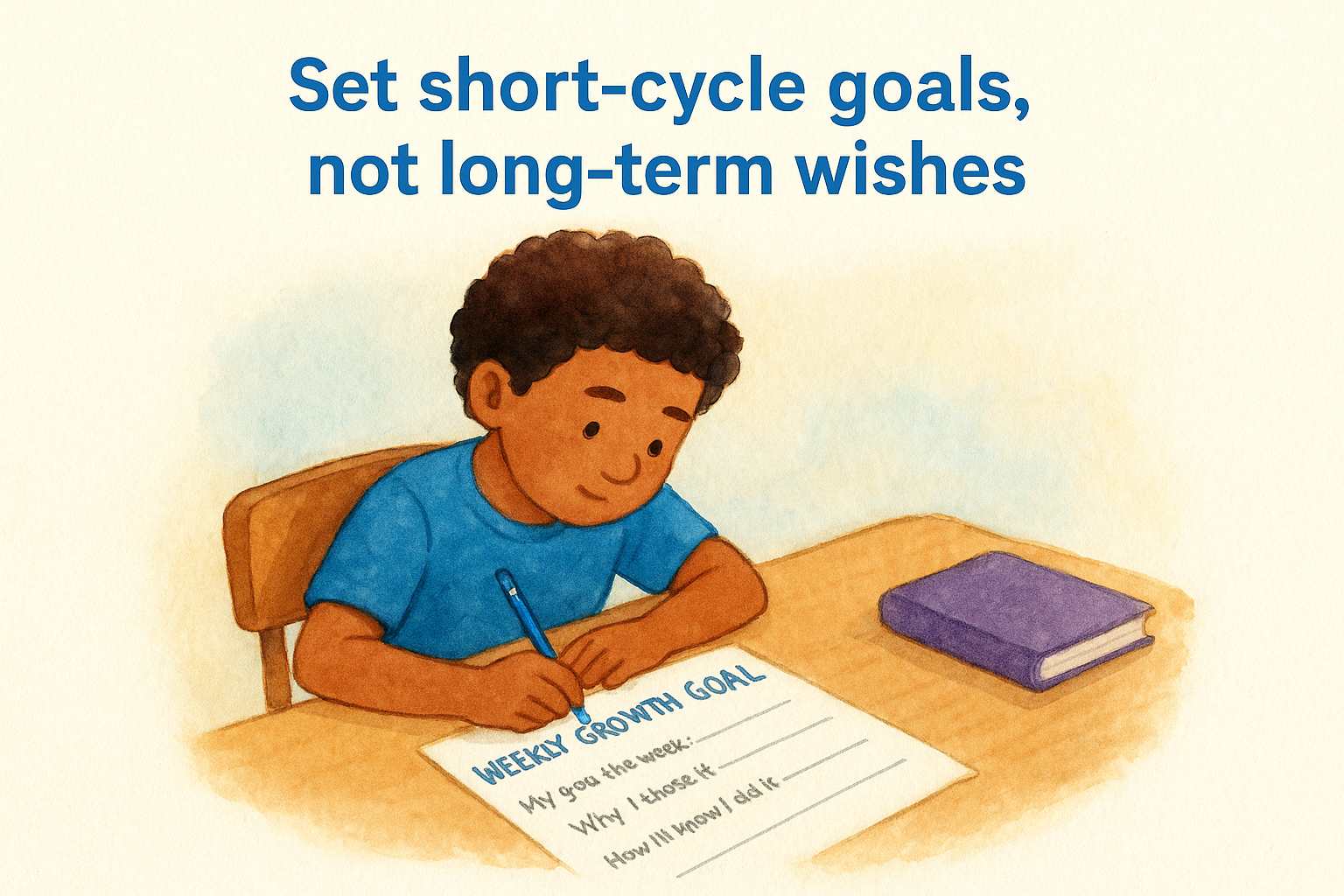
A goal that describes a strategy gives students something to practice. A goal that describes a result gives them nothing to act on.
Use this simple template at the start of each week:
Weekly Growth Goal Template
- My goal this week: One specific strategy or behavior to focus on
- Why I chose it: What last week showed me I need to work on
- How I’ll know I did it: A concrete, observable action I can check
Run weekly reflection that builds self-awareness
Reflection closes the loop. Without it, students set goals and forget them entirely by Tuesday. A brief, structured reflection at the end of each week trains students to evaluate their own process rather than just their results. That self-assessment habit is exactly what separates students who grow from students who simply get older.
A three-question exit slip works well here and takes under five minutes:
- Did I follow my goal this week? Yes, partly, or no, and explain why.
- What did I try when I got stuck? Name one specific strategy you used.
- What will I adjust next week? One concrete change, not a vague promise.
Running this cycle consistently builds students who monitor their own thinking rather than waiting for you to tell them how they’re doing. That shift in ownership and self-awareness is the real long-term payoff of embedding goals and reflection into your weekly classroom rhythm.
Step 4. Plan tasks and assessment for struggle
The tasks you assign send a louder message than anything you say out loud. If every assignment has one right answer and a clean, predictable path to reach it, students absorb a quiet lesson: school rewards certainty, not thinking. Knowing how to teach growth mindset means deliberately designing work where productive struggle is built into the task itself, not treated as evidence that a student is falling behind or a lesson went wrong.
Design tasks with a built-in challenge layer
A practical method is building tasks in tiers. Start with a baseline level that every student can access using what they already know, then add a layer that requires applying or extending the same concept in a context they haven’t seen before. That second layer is where the productive struggle lives. Students who move through the baseline quickly enter genuine thinking territory, and students still working through the baseline face meaningful effort rather than busywork. Both groups are challenged, and neither group spends time waiting.
A tiered task sends every student the same message: there is more to explore here, and exploring it is the point.
Use this template as a starting framework for any subject:
Tiered Task Template
- Access level: A task students can attempt using current knowledge
- Extend level: The same concept applied in a new or more complex context
- Open layer: A question with no single right answer, designed to push thinking further
Score the process, not just the product
Most grading systems measure outcomes, which quietly signals to students that the struggle itself carries no real academic weight. You can shift that message directly by adding a process row to your rubric that gives students credit for how they worked, not just what they produced at the finish line.
Include a "strategy and revision" row that students self-assess before submitting. Ask them to name one specific thing they tried when they got stuck and one concrete adjustment they made when their first approach stopped working. Two sentences is enough. This structure makes the learning process visible, named, and gradeable, which tells students every single time that effort and adaptation matter as much as the final answer.
Step 5. Make it stick with class norms
All the routines, feedback structures, and goal cycles you’ve built collapse quickly if the underlying classroom culture doesn’t support them. Class norms are the shared agreements that hold everything together. When students co-create and own those norms, they hold each other accountable to a standard that goes beyond what any poster or teacher speech can establish. Learning how to teach growth mindset at a structural level means treating norms not as a list of rules you post in September but as a living agreement the class returns to regularly.
Co-create norms with students
Norms students write themselves carry far more weight than norms handed down from above. In the first week of class, give students a short prompt: "What does it look like when our class is a place where everyone is willing to try hard things?" Collect their responses, cluster the ideas on the board, and narrow them down to four or five clear, behavior-based statements. The norms should describe observable actions, not vague values.
Here is a sample set to show what behavior-based norms look like in practice:
- We name our strategy, not just our answer.
- We ask questions without apologizing for not knowing.
- We treat a wrong answer as a starting point, not a finish line.
- We give feedback that names something specific.
- We revise our work when we learn something new.
Return to norms when the culture drifts
Norms fade unless you actively revisit them at key moments. When a student shuts down after a hard problem, that is your signal to reference the norm out loud, not as a correction, but as a reminder of the shared agreement the class made together. A brief monthly "norm check" where students rate how well the class is living each norm on a simple scale keeps the agreements alive and gives you data on where the culture needs your attention.
Norms only work when returning to them is a regular habit, not a consequence for when things go wrong.
Treat the norm check as a short class discussion: what is working, what is slipping, and what one adjustment the class agrees to make. That cycle of review and recommitment is what keeps growth mindset embedded in your classroom culture long after the initial excitement of a new unit wears off.
Keep the momentum going
Teaching growth mindset is not a unit you finish and move on from. The routines, feedback habits, goal cycles, and class norms you’ve built only compound over time when you keep returning to them consistently and adjusting what isn’t landing. Some weeks a warm-up routine will feel flat, a reflection cycle will produce thin answers, and a norm will drift. That is not failure; that is the same productive struggle you are teaching your students to work through.
Start small if the full framework feels like too much at once. Pick one routine from Step 1 and run it every day for two weeks before adding anything else. Notice what shifts in your students’ language and behavior, then build from there. The most durable classrooms are built one deliberate habit at a time. For more practical tools and strategies designed to help you do exactly that, visit The Cautiously Optimistic Teacher and explore the full range of resources waiting for you there.