7 Classroom Activities for Critical Thinking in Any Subject
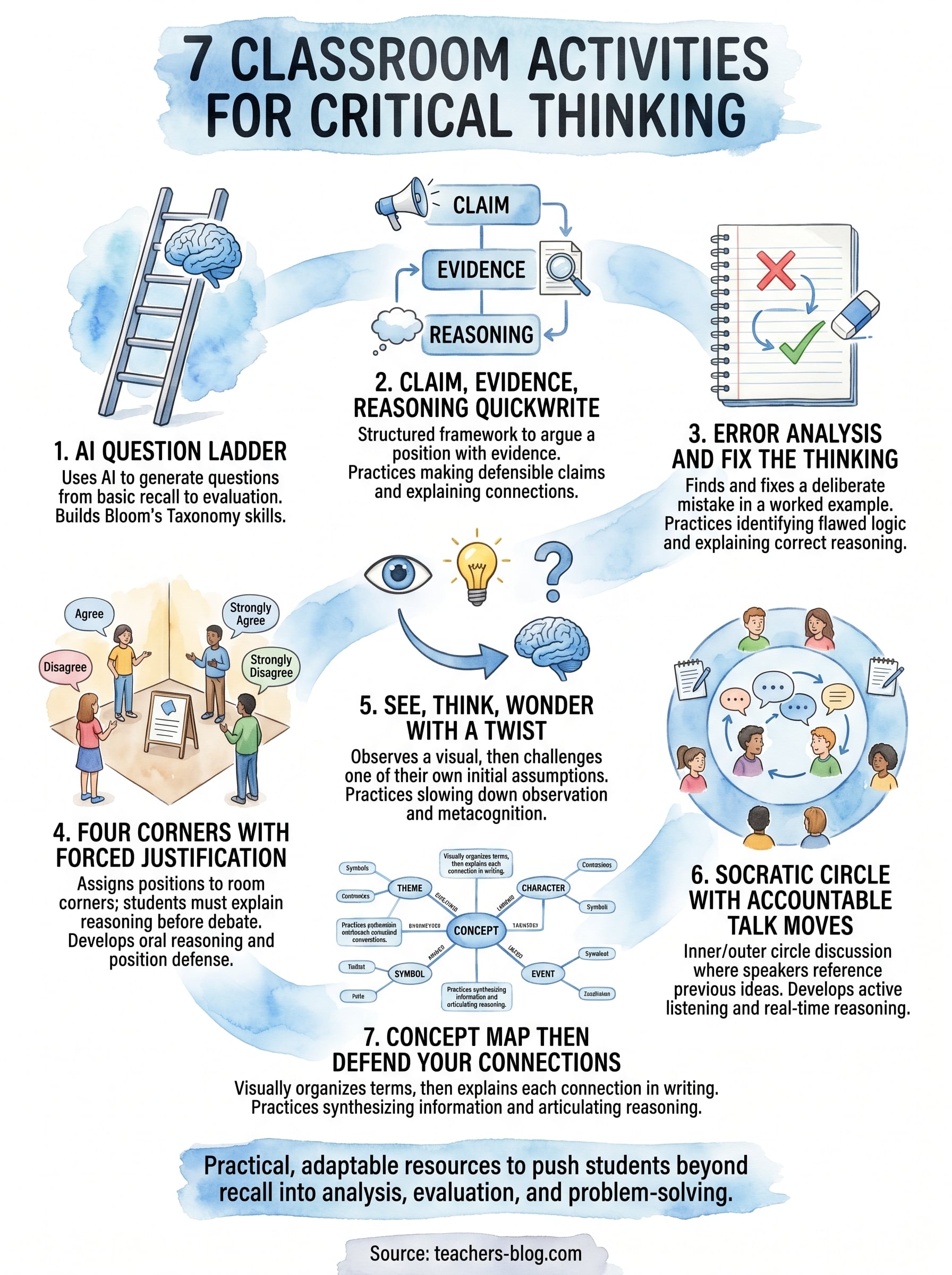
You’ve probably watched a student ace a test and then struggle to apply that same knowledge to a real problem. That gap between memorization and actual thinking is exactly where classroom activities for critical thinking come in. They push students beyond recall and into analysis, evaluation, and problem-solving, the skills that stick long after the unit exam is over.
The challenge most teachers face isn’t convincing anyone that critical thinking matters. It’s finding activities that work across subjects without requiring hours of prep or a complete curriculum overhaul. You need strategies you can pick up and use this week, whether you teach English, science, math, or social studies.
That’s what we focus on here at The Cautiously Optimistic Teacher, practical, adaptable resources that make your teaching sharper without burning you out. Below, you’ll find seven activities designed to build critical thinking in any classroom, along with tips for making each one your own.
1. AI question ladder
The AI question ladder uses an AI tool to generate a sequence of questions that climb from basic recall all the way up to evaluation and synthesis. Students work through the ladder answering each question before moving to the next, so they build understanding in layers rather than jumping to opinion without the supporting knowledge underneath. It’s one of the most flexible classroom activities for critical thinking because you can build it from any text, problem, or source in minutes.
What it builds
This activity develops Bloom’s Taxonomy skills in a structured, visible way. Students practice identifying facts, making connections, applying concepts, and finally defending a position, all within one task. Because the questions come from your actual lesson content, students engage with the material directly rather than working through generic prompts.
How to run it step by step
Start by pasting a short text, problem, or source into an AI question generator. Ask it to create five to six questions that move from knowledge-level to evaluation-level. Display or print the ladder, then have students work through it individually or in pairs before opening up a whole-class discussion on the top rungs.
The discussion after the ladder is often where the deepest thinking happens, so protect that time on your schedule.
Prompts that work in any subject
You can use this across any content area. In English, try: "What is the author’s central argument, and do you find it convincing?" In science, try: "What would change about the outcome if one variable were different?" In social studies, ask students to evaluate a primary source for bias. The ladder structure travels even when the content shifts completely.
Differentiate without watering it down
Give struggling students a partially completed ladder with sentence starters on the lower rungs. Challenge advanced learners by asking them to generate their own top-rung questions after finishing the provided ones. Both groups work with the same content, but the entry point and ceiling adjust to where each student actually is.
Quick ways to check thinking
Collect the written responses on the top two rungs only. Those evaluation-level answers show you quickly who is reasoning and who is still summarizing. You can also do a quick turn-and-talk on the final question and listen for specific evidence rather than vague opinion.
2. Claim, evidence, reasoning quickwrite
The claim, evidence, reasoning (CER) quickwrite gives students a structured framework to argue a position using specific evidence from the content they’ve studied. It’s one of the fastest classroom activities for critical thinking because students practice the full arc of a written argument in under ten minutes, without needing an entire essay prompt.
What it builds
Students practice making defensible claims, selecting relevant evidence, and then explaining how the two actually connect. That final step, the reasoning, is where most students fall short, and it’s exactly where this activity forces them to slow down and think carefully.
How to run it step by step
Give students a debatable prompt tied to your lesson and set a timer for eight to ten minutes. Ask them to write one claim, two pieces of supporting evidence, and one reasoning sentence that connects the evidence to the claim. No more, no less. That constraint keeps students focused on the quality of their thinking rather than the length of their response.
The reasoning sentence is the hardest part, so model one example before students write independently.
Prompts that work in any subject
In science, try: "Claim whether the data supports the hypothesis." In English, ask students to argue whether a character made the right choice. In history, have them identify the most significant cause of an event and defend it with evidence.
Differentiate without watering it down
Provide sentence frames for students who need support: "My claim is… The evidence shows… This matters because…" Advanced students can add a counterargument and a rebuttal sentence to push their thinking further.
Quick ways to check thinking
Scan the reasoning sentences only. Weak reasoning restates the evidence. Strong reasoning explains the connection, and that difference tells you exactly who is thinking critically and who still needs a push.
3. Error analysis and fix the thinking
Error analysis gives students a worked example that contains a deliberate mistake and asks them to find it, explain why it’s wrong, and correct it. Instead of solving a new problem from scratch, students evaluate someone else’s reasoning, which shifts them from production mode into critical examination mode. This makes it one of the most underused classroom activities for critical thinking across every subject.
What it builds
Students practice identifying flawed logic, spotting incorrect assumptions, and constructing accurate explanations in their own words. That process of diagnosing what went wrong and then fixing it builds a more durable understanding than simply getting the right answer the first time.
How to run it step by step
Prepare a short worked example with one clear reasoning error buried inside it. Present it to students without telling them where the mistake lives. Ask them to find the error, explain it in writing, and rewrite the flawed section correctly before sharing with a partner.
Choosing errors that reflect actual mistakes your students make turns this into targeted reteaching without singling anyone out.
Prompts that work in any subject
In math, show a multi-step problem where the student applies the wrong operation. In English, present a paragraph with a weak inference drawn from a text. In science, show data interpreted with faulty logic.
Differentiate without watering it down
Point struggling students toward the paragraph or step where the error lives. Ask advanced learners to write a short explanation of why someone might make that mistake in the first place.
Quick ways to check thinking
Read the correction sentences students write. A surface-level fix shows you the student spotted the error but not why it matters. A strong correction names the rule, principle, or reasoning that was violated.
4. Four corners with forced justification
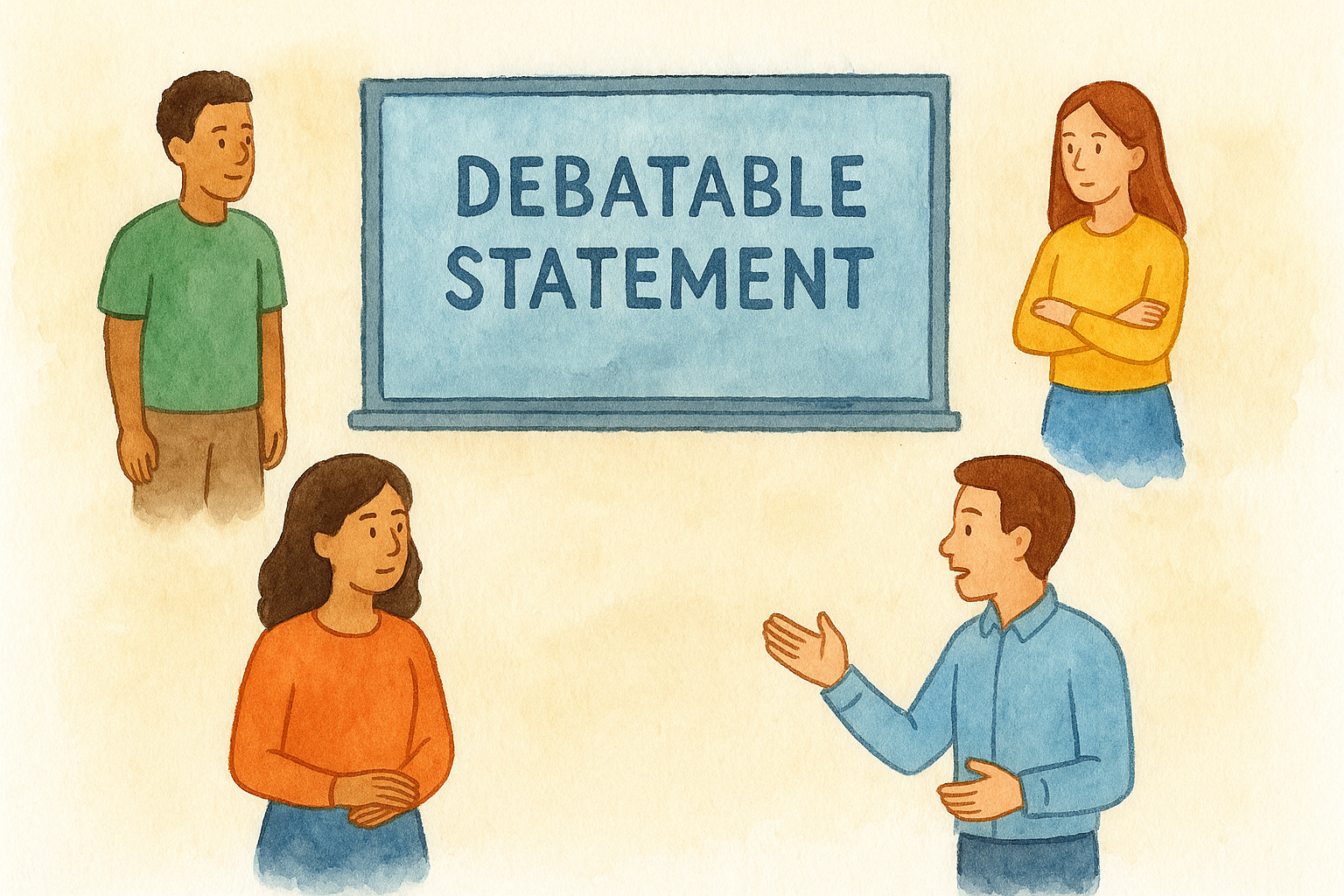
Four corners assigns a position to each corner of your room and asks students to physically move to the corner that matches their stance on a debatable statement. The "forced justification" piece is critical: students must explain their reasoning out loud or in writing before any discussion begins.
What it builds
This activity develops oral reasoning and position defense in a highly visible, low-stakes setting. Students practice committing to a claim and then supporting it with evidence when their peers push back.
How to run it step by step
Post one debatable statement on the board and read it aloud. Students move to their corner silently, then each group takes 60 seconds to build a shared justification. Call on one student per corner to defend the group’s position before opening the floor for cross-corner debate.
Give students 30 seconds of silent thinking time before they move, so the physical choice reflects actual reasoning rather than social pressure.
Prompts that work in any subject
These classroom activities for critical thinking travel across content areas. In English, try: "The antagonist is more responsible for the conflict than the protagonist." In science: "The benefits of this technology outweigh the risks."
Differentiate without watering it down
Give struggling students a sentence frame to start their justification. Ask advanced learners to challenge one argument from the opposing corner before the round closes.
Quick ways to check thinking
Have each student write their justification sentence on a sticky note before moving. Collect them at the end to quickly identify whose reasoning goes beyond personal opinion.
5. See, think, wonder with a twist
The original See, Think, Wonder routine asks students to observe, interpret, and question a visual or artifact. The twist adds a fourth step: students must challenge one of their own initial assumptions before the activity closes. That small addition transforms a solid observation routine into one of the most engaging classroom activities for critical thinking you can run in under fifteen minutes.
What it builds
Students practice slowing down their observation, separating fact from interpretation, and questioning their own conclusions. The self-challenge step is where metacognition kicks in, pushing students to examine not just what they see but why they jumped to that interpretation.
How to run it step by step
Display an image, data set, diagram, or artifact connected to your current unit. Students write their See, Think, and Wonder responses independently. Then ask each student to look back at their "Think" column and write one sentence that questions or revises their initial interpretation.
That revision step is where you’ll see the most honest critical thinking of the day.
Prompts that work in any subject
In science, show a graph with an unexpected trend. In English, display the cover of an unfamiliar text. In history, share a political cartoon or photograph from the period you’re studying.
Differentiate without watering it down
Give struggling students a sentence starter for the challenge step: "I assumed this, but it could also mean…" Ask advanced learners to write two competing interpretations and argue which one the evidence better supports.
Quick ways to check thinking
Collect the revision sentences only. Students who write genuine challenges to their own thinking are reasoning critically. Students who simply restate their original interpretation need a direct prompt to push further.
6. Socratic circle with accountable talk moves
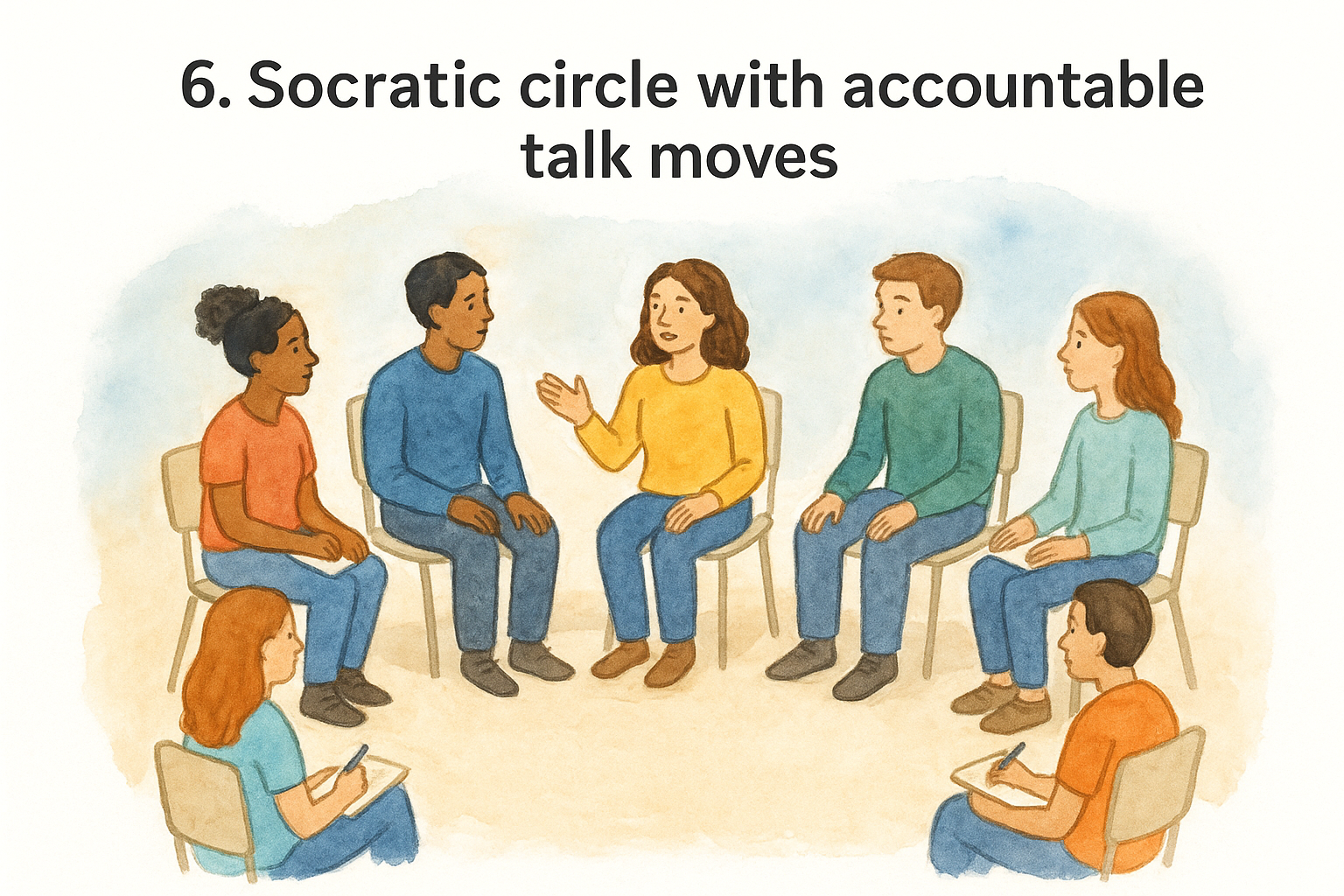
A Socratic circle puts two groups of students in concentric rings: an inner circle discusses a prompt while an outer circle observes and takes notes. The accountable talk moves piece adds a layer of rigor, requiring students to reference a previous speaker’s idea before adding their own contribution. This structure makes it one of the most discussion-rich classroom activities for critical thinking available to you.
What it builds
Students develop active listening, evidence-based speaking, and real-time reasoning as they connect their own thinking to what peers just said. That direct referencing requirement stops students from simply waiting for their turn to talk.
When students have to build on each other’s ideas out loud, you see exactly who is tracking the argument and who is just reacting.
How to run it step by step
Arrange the room in two circles and give students a discussion prompt tied to your current unit. The inner circle discusses for eight to ten minutes while the outer circle uses a listening guide to track reasoning and evidence use. Then groups swap and the discussion continues.
Prompts that work in any subject
In English, ask: "Does the author’s tone strengthen or weaken the argument?" In science, try: "Should this technology be regulated, and what evidence supports your position?"
Differentiate without watering it down
Give struggling students two or three sentence stems they can use to reference a peer. Challenge advanced learners to identify the strongest counterargument raised during their time in the outer circle.
Quick ways to check thinking
Collect the outer circle listening guides at the end. Students who record specific quotes and explain their significance are tracking the argument far more carefully than students who only write general summaries.
7. Concept map then defend your connections
A concept map asks students to visually organize how ideas, terms, or events connect to each other across a topic. The "defend your connections" step is what turns a standard graphic organizer into one of the most rigorous classroom activities for critical thinking: students must explain each link they drew in writing before the class reviews the maps together.
What it builds
Students practice synthesizing information across multiple concepts rather than treating each piece of knowledge as isolated. Explaining each connection in their own words forces them to articulate their reasoning rather than just draw arrows and move on.
How to run it step by step
Give students six to eight key terms from your unit and ask them to arrange and connect them on paper or a digital tool. Once the map is complete, students write one sentence per connection explaining why those two concepts are linked.
That justification step is where surface-level understanding breaks down quickly, so look for it first when you review student work.
Prompts that work in any subject
In English, give students character names, themes, and symbols from a text. In science, provide vocabulary terms from a current unit. In history, offer events, causes, and figures from a period you’ve covered.
Differentiate without watering it down
Give struggling students a partially completed map with two or three connections already labeled. Ask advanced learners to add one concept from outside the unit and justify how it connects.
Quick ways to check thinking
Read the connection sentences rather than the visual layout. A strong sentence names a specific relationship, while a weak one just repeats that two things are related.
Next steps for stronger thinking
You don’t need to run all seven of these activities at once. Pick one that fits your next unit and try it this week. Pay close attention to the moments where students surprise you with their reasoning, because those moments tell you the activity is working and actual critical thinking is happening in your room. Start small, notice what works, and build from there.
Once you find two or three classroom activities for critical thinking that consistently click with your students, the work gets easier. You build a shared language around reasoning, and students start applying those habits without being prompted each time. That transfer is the real goal, and these activities build toward it one lesson at a time.
For more practical tools and strategies that save you time without cutting corners on quality, visit The Cautiously Optimistic Teacher and explore everything from AI-powered lesson tools to ready-to-use unit plans built for today’s classroom.