16 Brainstorming Classroom Activities for Any Grade
You ask students to brainstorm, and what do you get? Three kids dominating the conversation, five staring at the ceiling, and one drawing a dragon in the margin. It’s not that students lack ideas, it’s that "just brainstorm" isn’t specific enough to unlock them. Structured brainstorming classroom activities give every student a clear path into the thinking process, whether they’re the first-hand-up type or the quiet processors who need a different entry point.
Here at The Cautiously Optimistic Teacher, we build resources that help educators turn good intentions into actual engagement, and brainstorming is one of those areas where the right activity makes all the difference. A well-chosen technique can shift a room from passive silence to genuine creative energy in minutes. It can also build the collaborative thinking skills students carry far beyond a single assignment.
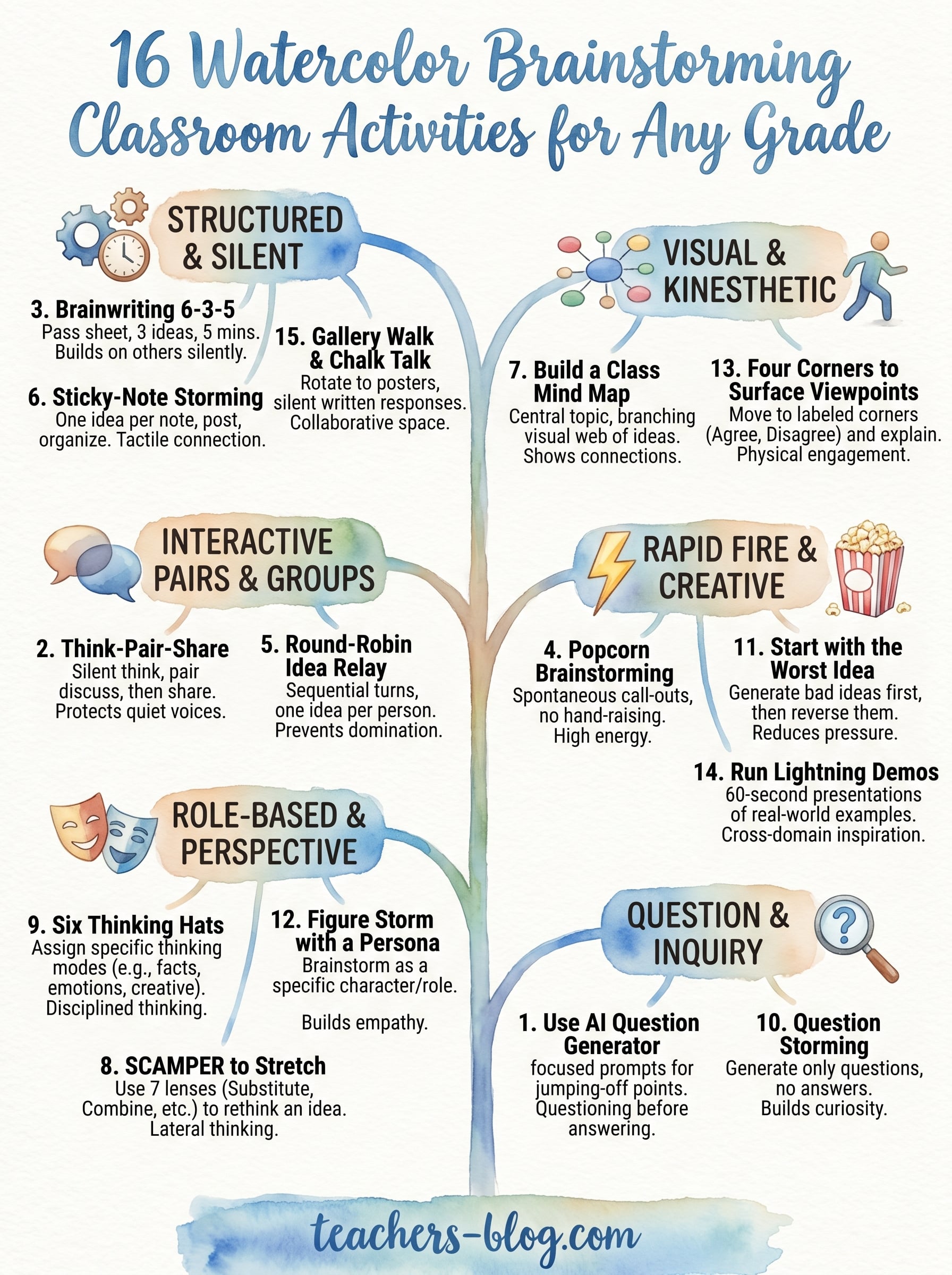
This article breaks down 16 brainstorming activities you can use across grade levels and subjects. Some are quick warmups, others are full-class sessions. Each one gives you a concrete structure so students stop guessing what "come up with ideas" means and start actually doing it. You’ll find options for solo thinkers, small groups, and whole-class collaboration, pick what fits your students and run with it.
1. Use an AI question generator for prompts
An AI question generator takes your topic and produces a set of focused, diverse prompts that students can use as jumping-off points. Rather than facing an open-ended topic with no clear direction, students get specific angles to explore, which lowers the resistance to getting started and raises the quality of ideas that follow.
What it teaches students
This activity builds the habit of questioning before answering. Students learn that strong ideas usually start with strong questions, and they practice evaluating which prompts are worth pursuing. It also introduces critical thinking skills around how questions shape the direction of an argument or a creative project.
How to run it step by step
Start by entering your topic into an AI question generator and producing 8 to 12 questions. Share the list with students on the board or as a handout. Give students three to five minutes to read through the questions silently and mark the ones that spark their interest. Then open a brief class discussion where students share their picks and explain why a particular question grabbed them. That reasoning step is where the real thinking happens.
The moment students defend why a question interests them, they’ve already started brainstorming.
Materials and setup
You need a device with internet access and a projector or screen to display the generated questions. Print the list if your students work better on paper. No other prep is required, which makes this one of the most efficient brainstorming classroom activities you can add to a lesson on short notice.
Variations by grade level
With younger students in grades 3 to 5, limit the list to five questions and read them aloud together before students choose. With middle and high schoolers, push further by asking students to generate their own follow-up questions based on the AI prompts, which adds a layer of independent thinking to the activity.
Classroom management tips
Display the question list where everyone can see it and set a visible timer so students know exactly how long they have. Students who finish early can rank their top three questions rather than sitting idle. Keep the discussion phase tight, two to three minutes per student response keeps the energy moving.
How to capture and assess ideas
Have students write their chosen question and two to three initial ideas it sparked in a journal or on an exit slip. This gives you a quick formative snapshot of where each student’s thinking started, which is useful when you circle back to the topic later in the unit.
2. Run a think-pair-share brainstorm
Think-pair-share is one of the most reliable brainstorming classroom activities because it gives every student structured time to think before speaking. Instead of a handful of confident students dominating, the format guarantees that everyone processes the prompt independently first.
What it teaches students
Students build both independent reasoning and active listening in the same exercise. They form ideas without outside influence, then test and sharpen those ideas against a peer’s perspective before sharing with a larger group.
How to run it step by step
Pose a focused, specific prompt and give students two silent minutes to write their thoughts. Then pair them with a neighbor for two minutes of discussion. Finally, ask selected pairs to share one strong idea with the whole class.
The silent phase is what separates this from a regular discussion – it protects quiet thinkers before louder voices take over.
Materials and setup
You need a written prompt on the board and something for students to write on. No handouts or technology required, which makes this one of the fastest activities to launch mid-lesson.
Variations by grade level
- Grades 3-5: Add a visual prompt alongside the written one to support younger thinkers.
- Grades 6-12: Ask partners to identify one shared idea and one difference before reporting back to the class.
Classroom management tips
Set a visible countdown timer for each phase so transitions stay clean. Students who finish the think phase early should keep adding to their notes rather than turning to their partner ahead of time.
How to capture and assess ideas
Ask each student to write their single best idea on an index card after the share phase ends. Collect the cards to track how thinking developed from solo reflection to paired discussion.
3. Use brainwriting 6-3-5
Brainwriting 6-3-5 is a silent, structured brainstorming classroom activity where six students each write three ideas in five minutes, then pass their sheet to the next person. That person builds on or adds to what they read before writing three more. You end the round with 108 ideas generated in about 30 minutes, without a single raised hand or dominant voice.
What it teaches students
This format trains students to build on others’ ideas rather than compete with them. It also develops independent thinking under time pressure, since each student writes without verbal back-and-forth pulling them toward the loudest opinion in the room.
How to run it step by step
Hand each student a brainwriting template with rows for recording ideas. Set a timer for five minutes, students write three ideas, then pass the sheet clockwise. Repeat until each sheet travels through all six group members and returns to its original owner.
The passing mechanic is what makes this powerful. Reading a peer’s idea often unlocks a direction students never would have reached on their own.
Materials and setup
You need a printed template or blank paper divided into labeled rows and columns. Groups of six work best, though groups of four or five function fine with adjusted rounds and fewer total passes.
Variations by grade level
With younger students in grades 4 and 5, reduce the requirement to two ideas per round instead of three. With high schoolers, require that each new idea connects directly to one idea already written on the sheet.
Classroom management tips
Keep the room completely silent during writing rounds. Students who finish early should scan the existing ideas on their current sheet and note any patterns or gaps before the timer runs out.
How to capture and assess ideas
Collect all sheets and have each group circle their top three ideas before handing them in. This gives you a clear record of both volume and the quality of thinking that emerged from each group.
4. Try popcorn brainstorming
Popcorn brainstorming is one of the most energizing brainstorming classroom activities you can run because it mimics the unpredictable, rapid-fire rhythm of popcorn popping. Students call out ideas voluntarily and spontaneously, without waiting to be called on, which creates momentum and keeps the energy in the room high.
What it teaches students
This activity builds verbal confidence and quick thinking. Students practice generating ideas under light social pressure, which trains them to trust their instincts rather than overanalyze before speaking.
How to run it step by step
Pose a clear prompt and tell students to call out ideas whenever they’re ready, no hand-raising required. Record every idea on the board as students shout them out. Run the activity for three to five minutes, then pause and review what the class produced together.
The no-hand-raising rule is the whole point. It removes the bottleneck and lets ideas flow faster.
Materials and setup
You only need a whiteboard or shared screen to capture ideas in real time. No handouts or printed materials are necessary, which makes this one of the quickest activities to launch with zero prep.
Variations by grade level
- Grades 3-5: Give a narrow prompt with a concrete scenario to keep responses focused.
- Grades 6-12: After the popcorn round, have students group the ideas by theme before the class moves on.
Classroom management tips
Set a clear time limit upfront so students know the window is short. If the room gets too loud, pause and remind students that one voice at a time keeps the list accurate.
How to capture and assess ideas
Photograph the board at the end of the round so you have a permanent record of the full list. Ask students to each circle their single strongest contribution before you erase.
5. Lead a round-robin idea relay
A round-robin idea relay is a structured, sequential brainstorming classroom activity where each student contributes one idea in turn, moving around the group in a fixed order. This format prevents any single student from monopolizing the conversation and guarantees every participant a moment to contribute.
What it teaches students
Students practice equal participation and active listening at the same time. They learn to track what peers say before their turn arrives, which builds collaborative thinking skills alongside independent idea generation.
How to run it step by step
Arrange students in small groups of four to six. Pose a clear prompt, then move clockwise around the group, with each student contributing one idea per turn. Anyone stuck can say "pass" and rejoin the next round rather than stalling the group.
A strict rotation order is what keeps this fair. Without it, the same confident voices will jump in first every time.
Materials and setup
You need a shared recording sheet or whiteboard space for each group to log ideas as they surface. No printed materials are required, making this one of the fastest activities to launch without advance prep.
Variations by grade level
- Grades 3-5: Limit the activity to two rounds and use a concrete, visual prompt to anchor thinking.
- Grades 6-12: Add a rule requiring each student to connect their idea to the previous one, which pushes thinking deeper.
Classroom management tips
Keep groups small and tightly timed. Two to three minutes per round prevents energy from fading before every student has contributed.
How to capture and assess ideas
Ask each group to star their two strongest ideas on the recording sheet before the class debrief. This gives you a clear view of collective reasoning and a starting point for the next phase of the lesson.
6. Do sticky-note storming
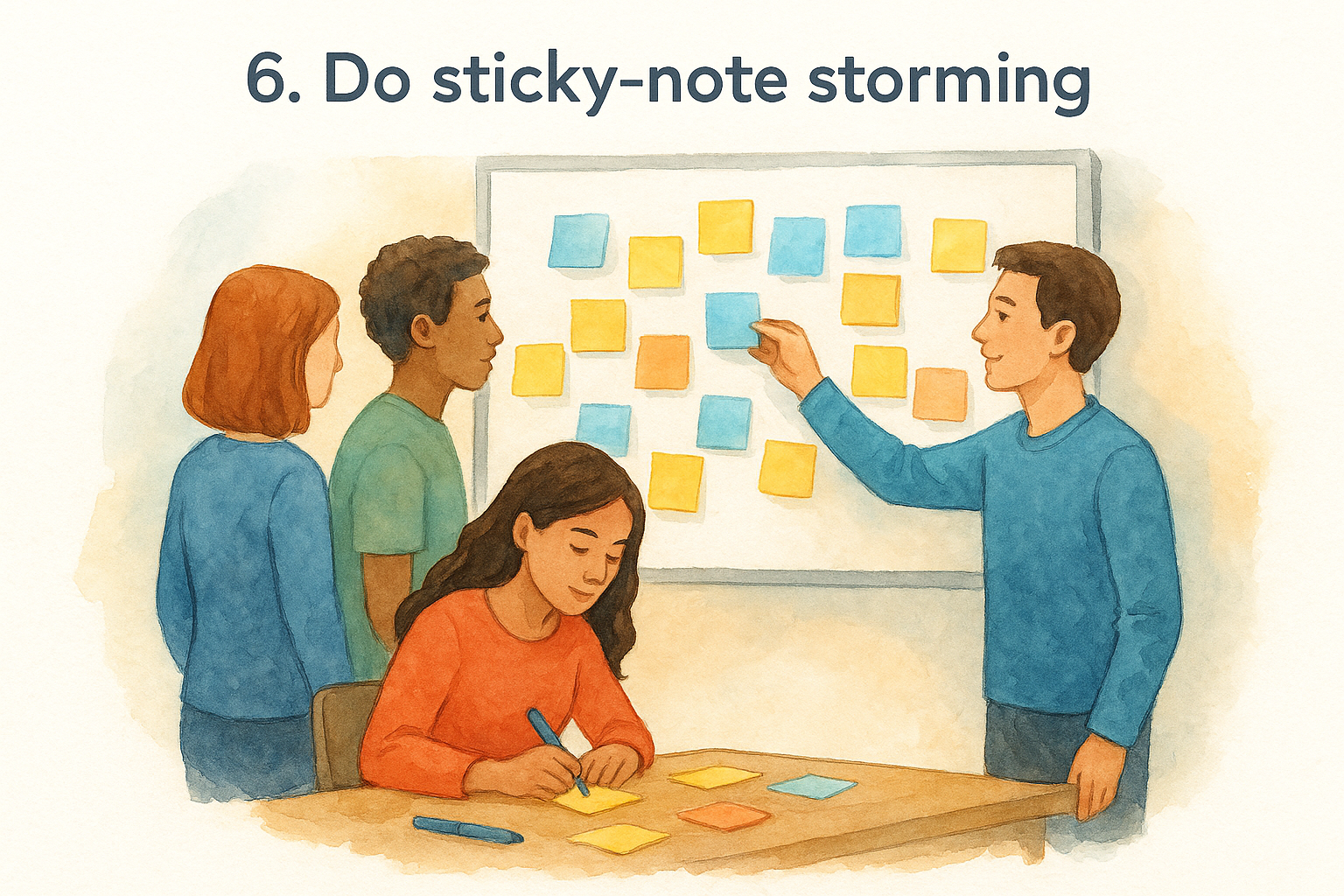
Sticky-note storming is one of the most tactile brainstorming classroom activities you can run. Students write one idea per note, post them on a shared surface, and then organize the results together.
What it teaches students
This format teaches students to isolate and articulate single ideas clearly and concisely. Moving notes around to find patterns also builds categorical thinking that transfers directly to organizing written arguments or research projects.
How to run it step by step
Give each student five to ten sticky notes and a focused prompt. Students write one idea per note in silence, then post all notes on a wall or whiteboard. Together, the class clusters related ideas into labeled groups and discusses what the categories reveal about the topic.
The physical act of moving notes makes abstract connections concrete for students who struggle with purely verbal discussion.
Materials and setup
You need sticky notes in one or two colors and a blank wall, whiteboard, or window large enough to hold the entire class’s contributions. Markers work better than pens so ideas remain readable from a distance.
Variations by grade level
- Grades 3-5: Use a single color and limit students to three notes each to keep the clustering phase manageable.
- Grades 6-12: Assign two note colors, one for original ideas and one for responses or connections to peers’ notes.
Classroom management tips
Hold a clear silent writing phase before anyone posts. Students who finish early should reread their notes and refine wording rather than starting to post ahead of the group.
How to capture and assess ideas
Photograph the final clustered board before taking it down. Ask each student to identify which cluster holds the strongest ideas and write one sentence explaining their reasoning.
7. Build a class mind map
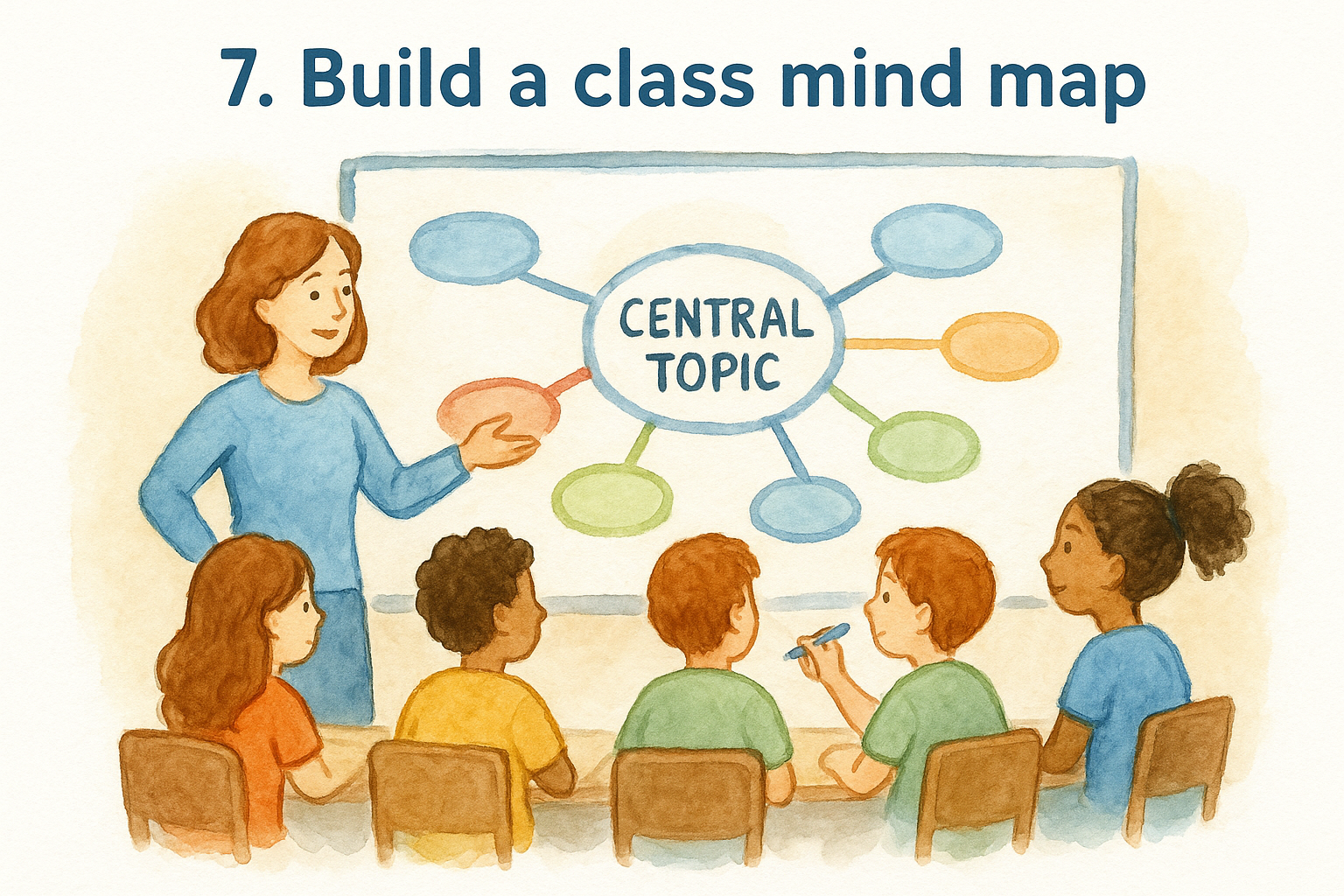
A class mind map turns a single topic into a visual web of connected ideas that grows in real time as students contribute. Unlike linear lists, the branching format shows students how concepts relate to each other, which helps them see the topic as a whole rather than a string of disconnected points.
What it teaches students
Students practice visual organization and associative thinking at the same time. They learn to connect new ideas to existing ones rather than treating each thought as isolated, which directly supports writing and analytical tasks across subjects.
How to run it step by step
Write the central topic in the middle of the board and draw a circle around it. Ask students to call out first-level categories, which you draw as branches. Then invite students to add sub-branches for more specific ideas until the map fills out across the board as a group.
A visible, shared map makes group thinking tangible. Students can see the structure of a topic in a way that verbal discussion alone never reveals.
Materials and setup
You need a large whiteboard or a projected digital tool like Google Jamboard. Colored markers help distinguish main branches from sub-branches visually so the hierarchy stays clear at a glance.
Variations by grade level
This is one of the most flexible brainstorming classroom activities you can adapt across grade levels.
- Grades 3-5: Pre-draw the main branches and ask students to fill in the sub-branches only.
- Grades 6-12: Have small groups build separate maps independently, then compare their versions with the class map.
Classroom management tips
Call on students who haven’t contributed yet before returning to familiar voices. Keep each addition brief and on-topic so the map stays readable as it grows.
How to capture and assess ideas
Photograph the finished map and share it with students digitally. Ask each student to write one sentence explaining which branch holds the strongest ideas and why.
8. Use SCAMPER to stretch ideas
SCAMPER is a creative thinking framework that gives students seven specific lenses for examining any topic or object. Each letter stands for a different operation: Substitute, Combine, Adapt, Modify, Put to other uses, Eliminate, and Reverse. As one of the most structured brainstorming classroom activities available, it stops students from defaulting to their first obvious idea.
What it teaches students
SCAMPER builds flexible, lateral thinking by requiring students to approach a single idea from multiple angles. Students learn to deliberately shift perspective rather than trust their first instinct, which strengthens creative problem-solving across every subject.
How to run it step by step
Present a topic or object, then walk students through each SCAMPER prompt one at a time. Give students two to three minutes per letter to write their responses before moving on. You can run all seven or select three to four letters for a tighter session.
Restricting students to one lens at a time prevents cognitive overload and keeps each round of ideas focused.
Materials and setup
You need a SCAMPER reference sheet or the letters written on the board with their full meanings visible. Students record responses in a notebook or on a dedicated response template, so setup takes almost no time.
Variations by grade level
With younger students in grades 3 to 5, focus on just three letters: Substitute, Combine, and Reverse. With grades 6 through 12, push students to apply all seven lenses and then rank their strongest idea from each category.
Classroom management tips
Keep the SCAMPER acronym posted visibly throughout the activity so students know which lens they are currently using. Students who finish a round early should extend their current idea rather than jump ahead to the next letter.
How to capture and assess ideas
Ask each student to circle their single strongest idea from the full sequence and write one sentence explaining why it stands out. Collect those notes to get a quick read on individual creative reasoning before moving into the next stage of the assignment.
9. Use six thinking hats
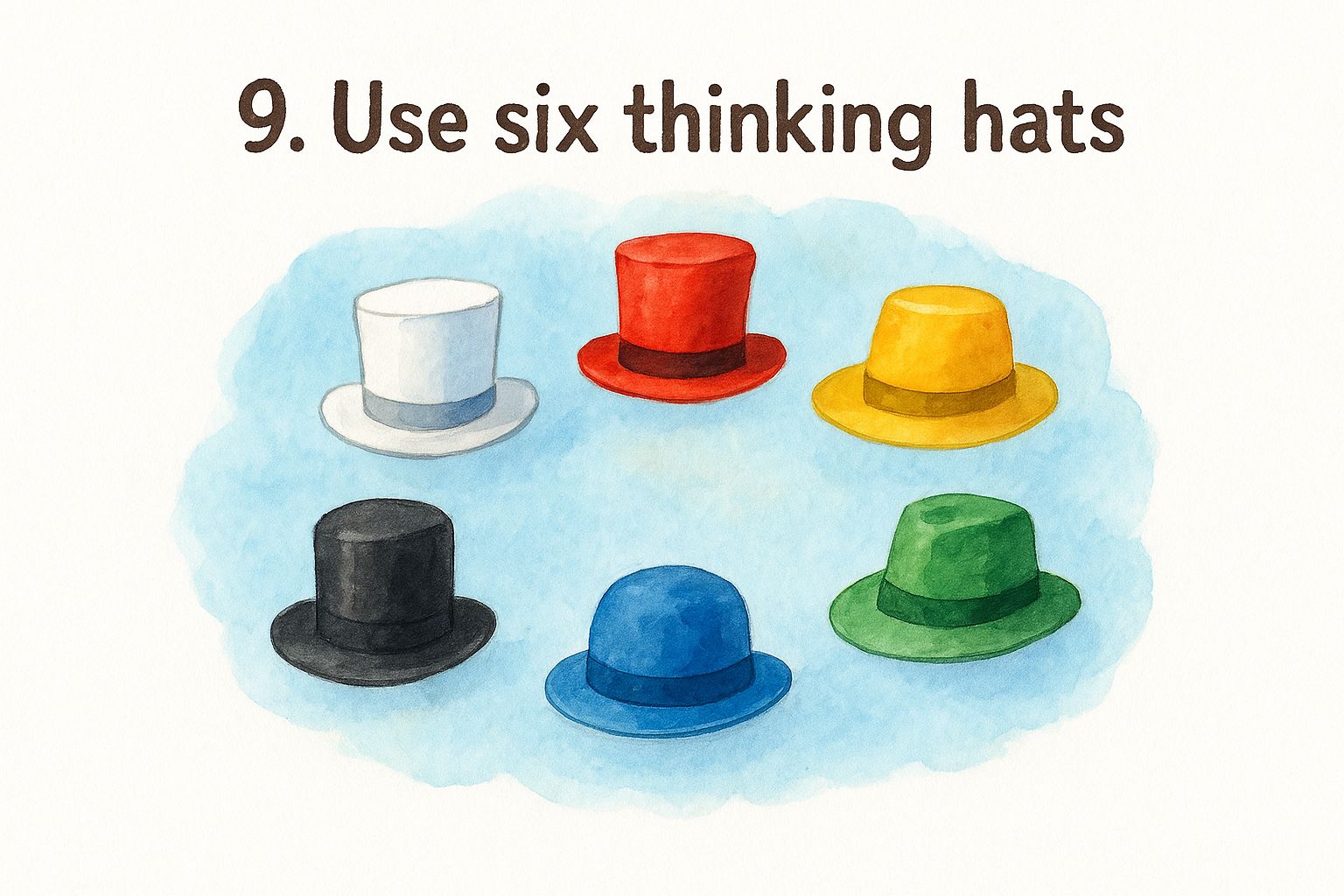
Six thinking hats is a structured role-based brainstorming framework developed by Edward de Bono. Each hat represents a distinct thinking mode: facts, emotions, caution, optimism, creativity, and process. Assigning those roles forces students to examine a topic from angles they would normally skip entirely.
What it teaches students
This activity builds perspective-taking and disciplined thinking in the same exercise. Students learn to separate emotional reactions from factual analysis, which strengthens both their reasoning and written arguments when they need to present balanced viewpoints.
How to run it step by step
Assign each student or group a colored hat and a prompt. Give students three minutes to generate ideas strictly from their hat’s perspective, then rotate hats. Move through three to four hats per session to keep the activity tight and focused.
Rotating hats mid-session shows students how the same topic looks completely different depending on the lens they bring to it.
Materials and setup
You need six colored hat labels written on paper, index cards, or the board. No printed materials are required, which makes this one of the most efficient brainstorming classroom activities you can launch with zero advance preparation.
Variations by grade level
- Grades 3-5: Use just three hats: White for facts, Red for feelings, and Green for new ideas.
- Grades 6-12: Run all six hats and ask students to write a short summary connecting insights across every perspective.
Classroom management tips
Post each hat’s role definition visibly so students stay in their assigned thinking mode throughout the round. Anyone drifting out of their hat’s perspective can self-correct using the posted description without you stopping the class.
How to capture and assess ideas
Ask each student to record two ideas per hat on a response sheet. Collect the sheets to track which thinking modes produced the strongest and most varied ideas across your class.
10. Do question storming
Question storming reverses the typical classroom dynamic. Instead of asking students to generate answers, you ask them to generate only questions about a topic for a fixed amount of time. This approach produces one of the most effective brainstorming classroom activities for removing the pressure to be right and replacing it with the pressure to be curious.
What it teaches students
Students build inquiry skills and intellectual humility in the same exercise. They practice suspending judgment long enough to explore a topic from multiple angles before locking in any conclusions.
How to run it step by step
Set a five-minute timer and ask students to write as many questions as they can without stopping. The only rule is that every line must be a question, not a statement or answer. After the timer ends, students review their list and choose the two questions they find most compelling.
The no-answers rule is what makes this work. It keeps students in discovery mode long enough to surface questions they would never have reached otherwise.
Materials and setup
You need a notebook or blank paper and a clear prompt. No technology or printed handouts are required, which makes this one of the fastest activities to set up before a lesson.
Variations by grade level
- Grades 3-5: Limit the round to three minutes and post question stems on the board as scaffolding.
- Grades 6-12: After selecting their top questions, students rank them by complexity and explain their reasoning in writing.
Classroom management tips
Keep the room completely silent during the writing phase. Students who run out of questions early should revisit their list and rewrite any statements as questions to maintain focus.
How to capture and assess ideas
Ask each student to circle their single most interesting question and submit it as an exit slip. This gives you a quick read on where each student’s curiosity sits before the next phase of the lesson.
11. Start with the worst idea
Starting with the worst idea flips the pressure of brainstorming completely. You ask students to generate the most ridiculous, impractical, or outright terrible ideas they can think of for a given topic, which removes the fear of judgment and gets the whole room laughing and thinking at the same time. Once students are loose and engaged, you reverse course and ask them to transform each bad idea into something useful.
What it teaches students
This activity builds creative risk-taking and divergent thinking by proving that no starting idea is too far off-base to be worth exploring. Students learn that bad ideas are not dead ends but raw material for better ones, which directly reduces the anxiety that shuts down brainstorming before it even starts.
How to run it step by step
Pose a clear problem and tell students their goal is to generate the worst possible solutions they can imagine. Give them three minutes to fill a page with terrible ideas. Then call on volunteers to share, and as a class, flip each bad idea into a workable direction.
The reversal step is where the real thinking happens. Students discover that their worst idea often contains the seed of something genuinely useful.
Materials and setup
You need a notebook or blank paper and a focused prompt written on the board. No technology or printed handouts are required for this activity.
Variations by grade level
- Grades 3-5: Provide a concrete, funny scenario to make the "worst idea" concept accessible.
- Grades 6-12: Ask students to write a brief explanation of how they reversed each bad idea into a strong one.
Classroom management tips
Keep the tone light but focused. If students get too silly to stay on task, redirect them by asking which bad idea has the most potential to flip into something real.
How to capture and assess ideas
Ask each student to submit their one reversed idea on an exit slip so you can track how individual thinking developed across these brainstorming classroom activities.
12. Figure storm with a persona
Figure storming asks students to step into the shoes of a specific person or character and generate ideas from that perspective. Instead of brainstorming as themselves, students think as a scientist, a historical figure, a fictional character, or even a target audience member, which immediately shifts how they approach the problem.
What it teaches students
This activity builds empathy and perspective-taking at the same time as creative thinking. Students learn to separate their own assumptions from a character’s logic, which strengthens both analytical writing and discussion skills across subjects.
How to run it step by step
Assign each student or group a specific persona relevant to the topic. Give them three to four minutes to brainstorm ideas strictly from that persona’s point of view. Then ask groups to share and compare how different personas produced different solutions to the same problem.
The moment students defend an idea as their character rather than themselves, they stop worrying about being wrong and start thinking more freely.
Materials and setup
You need a persona prompt written on the board or on index cards for each group. No technology is required, which makes this one of the more accessible brainstorming classroom activities to run on short notice.
Variations by grade level
- Grades 3-5: Use familiar fictional characters students already know well.
- Grades 6-12: Assign real historical or professional figures connected to the subject matter.
Classroom management tips
Keep the persona descriptions brief and specific so students spend their time thinking, not reading. Redirect any student who drifts out of the persona by asking them what their character would say next.
How to capture and assess ideas
Ask each student to write one idea generated by the persona and one they would never have reached on their own. This comparison shows you where the perspective shift created real value in their thinking.
13. Use four corners to surface viewpoints
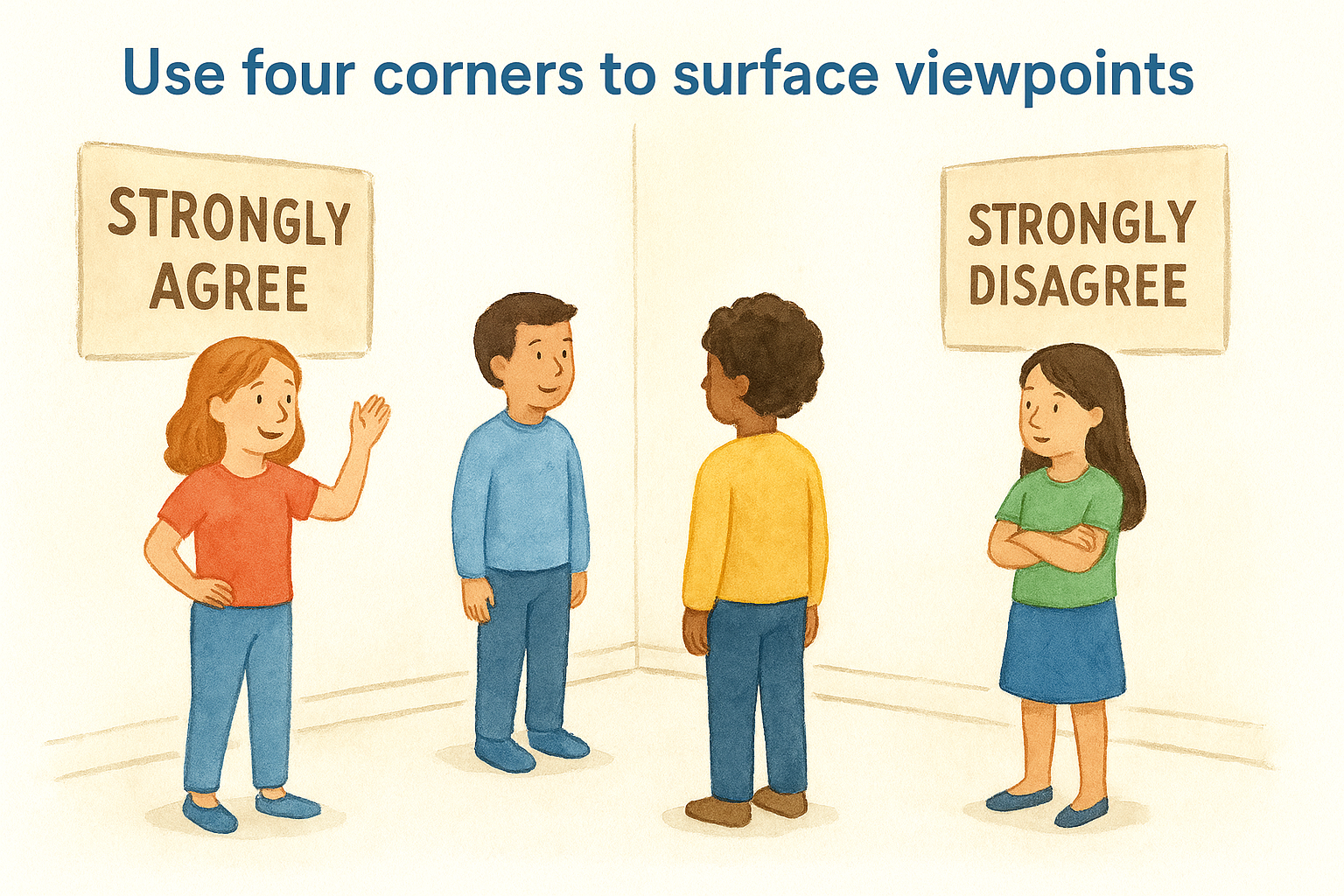
Four corners is one of the more physically engaging brainstorming classroom activities you can run because it moves students out of their seats. Label each corner of the room with a viewpoint (Strongly Agree, Agree, Disagree, Strongly Disagree), read a statement aloud, and students vote with their feet by walking to their chosen corner.
What it teaches students
This format builds perspective awareness and verbal reasoning at the same time. Students see immediately that classmates hold different views, which challenges them to articulate and defend their own position before the class debrief begins.
How to run it step by step
Post a labeled sign in each corner of the room before class starts. Read a statement connected to your topic and give students ten seconds to move. Once settled, ask one student per corner to explain their reasoning, then move to the next statement.
Hearing multiple corners defend the same statement in sequence shows students how one idea can generate genuinely different, reasonable interpretations.
Materials and setup
You need four labeled signs and a prepared list of statements tied to your topic. Write signs on large paper or print them in advance. No technology is required, making setup fast.
Variations by grade level
- Grades 3-5: Simplify to two options, agree or disagree only.
- Grades 6-12: Add a fifth option, "It depends," which pushes students toward nuanced, conditional thinking.
Classroom management tips
Set a clear movement rule before the first round so transitions stay orderly. Students who hesitate should commit to a corner before explanations begin.
How to capture and assess ideas
Ask students to write their corner choice and one supporting reason on an exit slip after the final round to give you a quick read on individual reasoning.
14. Run lightning demos for inspiration
Lightning demos bring real-world examples into your classroom fast. Each student finds one example from outside the topic, presents it to the group in 60 seconds, and explains what makes it work. This cross-domain approach reliably surfaces ideas that pure topic-focused brainstorming misses.
What it teaches students
This format trains students to identify transferable ideas and connect them across subjects. Students also build concise verbal communication skills by distilling a complex example down to a single compelling point for their peers.
How to run it step by step
Give students five minutes to find a real-world example related to the problem at hand. Then run a rapid presentation round where each student speaks for no more than 60 seconds, focusing on what works and why.
The cross-domain connection is what makes this one of the most idea-rich brainstorming classroom activities you can run in a short class period.
Materials and setup
You need devices with internet access and a shared screen or wall space where students can show or describe their examples. No printed materials are required, so setup takes under a minute.
Variations by grade level
- Grades 3-5: Provide a curated set of printed images to choose from rather than asking students to search independently.
- Grades 6-12: Require each presenter to name one specific element from their example they plan to borrow directly.
Classroom management tips
Use a visible countdown timer set to 60 seconds per student and enforce it strictly. Tight time limits keep energy levels high and prevent any single demo from slowing the room.
How to capture and assess ideas
Ask each student to write one borrowed concept from any demo on an index card before the class moves on. This gives you a quick record of which examples landed with each student.
15. Try a gallery walk and chalk talk
A gallery walk combined with a chalk talk turns your classroom walls into a collaborative thinking space. Students rotate through posted prompts or images, adding written responses silently, which gives every student a meaningful voice without the pressure of speaking in front of the group.
What it teaches students
This format builds written reasoning and collaborative thinking in the same activity. Students read peers’ contributions at each station and build on them in real time, which strengthens the associative thinking skills that sit at the core of effective brainstorming classroom activities.
How to run it step by step
Post four to six prompts or images around the room, spaced far enough apart for small clusters of students to work comfortably. Set a timer for two to three minutes per station, then rotate students clockwise until everyone has visited each post and added at least one written response.
The silent writing rule removes social pressure and equalizes participation across every personality type in your room.
Materials and setup
You need large chart paper or poster sheets mounted on walls and markers at each station. No technology is required, which makes this one of the fastest activities to prepare the morning of a lesson.
Variations by grade level
- Grades 3-5: Use images instead of written prompts to anchor student responses.
- Grades 6-12: Require students to respond directly to a peer’s comment at least once per station.
Classroom management tips
Assign starting stations to each group before the activity begins so students don’t cluster at the same prompt at the same time.
How to capture and assess ideas
Photograph each posted sheet after the activity and ask students to circle their single strongest contribution before leaving class.
Keep the momentum going
These 16 brainstorming classroom activities give you a toolkit that covers every situation, from a quick five-minute warmup to a full-class session that generates hundreds of ideas across a whole unit. The key is picking the right format for your students and your goal on any given day, not forcing every lesson through the same structure. Mix and rotate techniques across the school year so students stay engaged and keep developing new thinking skills rather than going through the motions.
Once you have ideas flowing, the next challenge is channeling them into strong, focused writing and discussion. The Cautiously Optimistic Teacher offers tools and resources designed specifically for educators who want to take student thinking further, from AI-powered question generators to lesson planning materials that connect directly to what you’re already doing in the classroom. Head over and explore what fits your students next.