
7 Critical Thinking Resources for Teachers to Use This Year
You can tell students to "think critically" until you’re blue in the face, but without the right tools and frameworks, that phrase stays abstract, for you and for them. The truth is, most curricula don’t hand teachers a step-by-step way to build these skills. You’re left to piece it together yourself, hunting for critical thinking resources for teachers that actually work in a real classroom with real time constraints. That search can feel like a second job.
Here at The Cautiously Optimistic Teacher, we spend a lot of time building and testing tools, from AI-powered question generators to differentiated unit plans, that push students beyond surface-level recall. Critical thinking isn’t a bonus skill; it’s the backbone of every lesson worth teaching, whether students are dissecting an essay prompt or evaluating a source’s credibility.
This article pulls together seven practical resources you can start using this year. Some are digital tools, some are instructional strategies, and a few are frameworks you can layer into what you’re already doing. No fluff, no theory-only recommendations, just resources that have earned their place in a working teacher’s toolkit.
1. Question Generator in The Cautiously Optimistic Teacher
If you want students to think at a deeper level, the questions you ask matter more than almost anything else. The Question Generator on The Cautiously Optimistic Teacher is one of the most accessible critical thinking resources for teachers who need higher-order questions fast, without spending an hour crafting them from scratch before every lesson.
What it is
The Question Generator uses AI to analyze content you paste in, then produces a set of questions designed to push students past recall and into analysis, evaluation, and synthesis. You can input a novel excerpt, a primary source document, a scientific article, or even a focused topic or vocabulary set. The tool structures output across different cognitive levels, so you get a range of questions that genuinely challenge students rather than just asking them to restate what they already read. That variety matters because not every student enters a lesson at the same place.
How to use it this week
Pick one upcoming lesson where you want stronger discussion or a more rigorous comprehension check. Paste the relevant text or topic into the Question Generator, review what it produces, and select four to six questions that match your specific learning objectives. You can use them as Socratic seminar anchors, written response starters, or exit ticket prompts without rebuilding your existing lesson from the ground up.
The best use of this tool is not replacing your judgment; it is freeing up your time so you can focus on facilitating the conversation rather than writing every question by hand.
Best for
This tool works best for middle and high school teachers who regularly assign reading-heavy content and need higher-order questions quickly across multiple classes or preps. It also helps teachers who are newer to writing Bloom’s Taxonomy-style questions and want a practical starting point.
Cost and access
The Question Generator is available on The Cautiously Optimistic Teacher website at no cost. You do not need to create an account to generate questions, which means you can get started in under two minutes.
Common mistakes to avoid
The most common mistake is using every question the tool generates without reviewing the output first. AI-generated questions occasionally need light editing to match your students’ reading level or your lesson’s specific focus. Spend two to three minutes reading through what the tool produces and cut anything that doesn’t directly serve your goal before handing it to students.
2. Project Zero Visible Thinking Routines
Project Zero, a research center at the Harvard Graduate School of Education, developed Visible Thinking Routines to make student thinking visible and structured. These short protocols give students a repeatable process for analyzing ideas rather than just reacting to them.
What it is
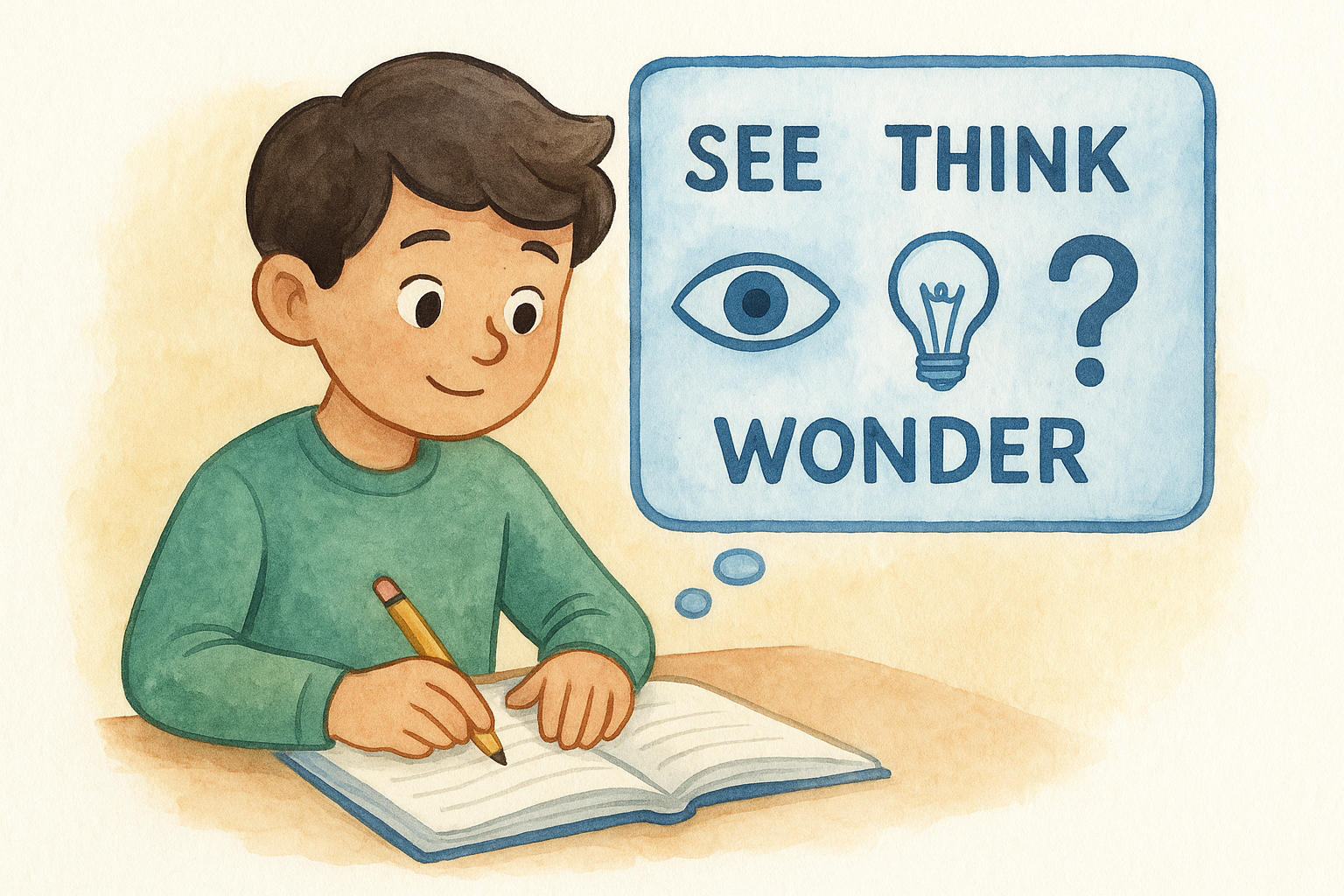
Visible Thinking Routines are brief instructional protocols that prompt students to slow down and articulate their reasoning in deliberate steps. Routines like "See-Think-Wonder" or "Claim-Support-Question" ask students to observe, analyze, and question material before forming conclusions. Each routine targets a specific thinking move, whether that is noticing details, building explanations, or weighing multiple perspectives.
How to use it this week
Pick one routine that fits your next lesson. If you are introducing a new text or unit, "See-Think-Wonder" activates prior knowledge and surfaces genuine questions. Write the three prompts on the board and give students five minutes to respond in writing before discussion begins. This low-prep approach makes it one of the most accessible critical thinking resources for teachers who want results without overhauling a lesson plan.
Visible Thinking Routines work best when you use the same routine consistently enough that students stop needing instructions and simply start thinking.
Best for
These routines fit any subject and grade level, but they are especially effective in humanities and social studies where interpretation and evidence-based reasoning drive most of the work.
Cost and access
All routines are available free through Project Zero at Harvard, with printable versions and facilitation guides included.
Common mistakes to avoid
The biggest mistake is rotating through too many different routines before students have internalized any of them. Stick with one or two routines consistently until students can run them independently without prompting.
3. Paul-Elder Critical Thinking Framework
The Paul-Elder framework, developed by Richard Paul and Linda Elder at the Foundation for Critical Thinking, gives teachers a structured model for teaching thinking itself. Unlike many critical thinking resources for teachers that focus on one-off activities, this framework gives you a shared vocabulary and architecture you can apply across every subject and grade level.
What it is
The framework centers on two core components: the Elements of Thought (purpose, question, information, inference, concepts, assumptions, implications, and point of view) and Intellectual Standards such as clarity, accuracy, precision, and relevance. Together, these components give students and teachers a common language for analyzing reasoning, whether they are evaluating an argument, reading a text, or working through a complex problem.
How to use it this week
Start by displaying the Elements of Thought wheel and introducing just two or three elements during your next discussion. Ask students to identify the assumptions behind a claim in the text you are reading or name the purpose behind a decision a historical figure made. You do not need to teach the entire framework at once; layering it in gradually produces better retention.
The Paul-Elder framework earns its place precisely because it gives you a reusable reasoning structure, not a single activity you use once and forget.
Best for
This framework works well for high school teachers who want a systematic, transferable approach to reasoning that travels across disciplines.
Cost and access
The Foundation for Critical Thinking offers many of its core materials free online, with paid books and workshops available for deeper professional development.
Common mistakes to avoid
Avoid introducing all eight elements in a single lesson. Students need time to internalize each component before you layer in more, so pace the rollout deliberately over several weeks.
4. TeachThought Critical Thinking Resources
TeachThought is an education-focused organization that has built a substantial collection of strategies, frameworks, and instructional approaches centered on deeper learning. Their critical thinking resources for teachers cover everything from classroom questioning strategies to comprehensive thinking models you can apply across subjects.
What it is
Their site offers a range of free articles, strategy guides, and printable tools focused on developing higher-order thinking in students. The content includes questioning frameworks, thinking taxonomy comparisons, and lesson design guides that help you move students from surface recall into genuine analysis and evaluation.
How to use it this week
Browse their site for a questioning strategy that matches your next major lesson or discussion. Their question stem resources give you ready-made prompts organized by cognitive level, which you can drop directly into a discussion protocol or written reflection without significant prep time.
TeachThought’s strength is breadth: you can find a strategy for almost any thinking skill you want to target.
Best for
TeachThought works well for middle and high school teachers across all subjects who want a flexible bank of strategies without committing to a single overarching framework.
Cost and access
Most resources on TeachThought are free to access without an account, though they do offer paid professional development workshops for deeper training.
Common mistakes to avoid
Avoid treating TeachThought as a curriculum replacement. Their resources work best when you use them to supplement and sharpen lessons you have already planned, not as a standalone program.
5. Reboot Foundation Critical Thinking Resources
The Reboot Foundation is a nonprofit organization focused on promoting critical thinking in schools and society. Their collection of research-backed tools and lesson plans gives teachers a practical entry point into teaching reasoning skills without needing a specialized background in philosophy or logic.
What it is
Their site offers free lesson plans, guides, and research reports built around teaching critical thinking as a disciplined practice. Materials cover topics like media literacy, logical reasoning, and evaluating evidence, all packaged in classroom-ready formats grounded in cognitive science research.
How to use it this week
Start with one of their downloadable lesson plans that aligns with a topic you are already teaching. Their media literacy materials work especially well when your students are evaluating sources for a research assignment or analyzing claims in a current events discussion.
Reboot Foundation’s resources stand out because they connect critical thinking to real-world application, which makes the skill feel relevant to students rather than abstract.
Best for
These resources fit middle and high school teachers who want to build media literacy and logical reasoning into existing units without constructing new curriculum from the ground up.
Cost and access
All core materials are free to download with no account required, so you can pull a lesson plan and adapt it to your class the same day you find it.
Common mistakes to avoid
Avoid treating these lessons as one-day standalone activities. The critical thinking resources for teachers in this collection produce better results when you space them across a unit rather than compressing them into a single period.
6. AAC&U VALUE Rubric for Critical Thinking
The Association of American Colleges and Universities (AAC&U) developed the VALUE rubric as a standardized tool for assessing critical thinking across academic disciplines. It gives you a clear, research-grounded way to evaluate student reasoning without constructing a rubric from scratch every semester.
What it is
The VALUE rubric breaks critical thinking into five scored dimensions: explanation of issues, evidence, influence of context and assumptions, student’s position, and conclusions. Each dimension includes performance-level descriptors ranging from benchmark to capstone, so you can pinpoint exactly where a student’s reasoning falls short and give feedback that actually moves them forward.
How to use it this week
Adapt the rubric to your next major writing or discussion assignment by selecting the two or three dimensions most relevant to your learning objectives. You do not need to score all five every time.
The VALUE rubric earns its place among critical thinking resources for teachers because it shifts assessment from impressionistic to evidence-based, which makes your feedback far more actionable.
Best for
This rubric fits high school and college-level teachers who want a rigorous, consistent framework for grading written arguments, research papers, and structured discussions.
Cost and access
The rubric is available free from the AAC&U website with no account required, and you can download and modify it immediately.
Common mistakes to avoid
Avoid handing students the full rubric unmodified without contextualizing the academic language first. Spend a few minutes translating key terms into language your students already use before the assignment begins.
7. Kialo Edu Structured Discussion Platform
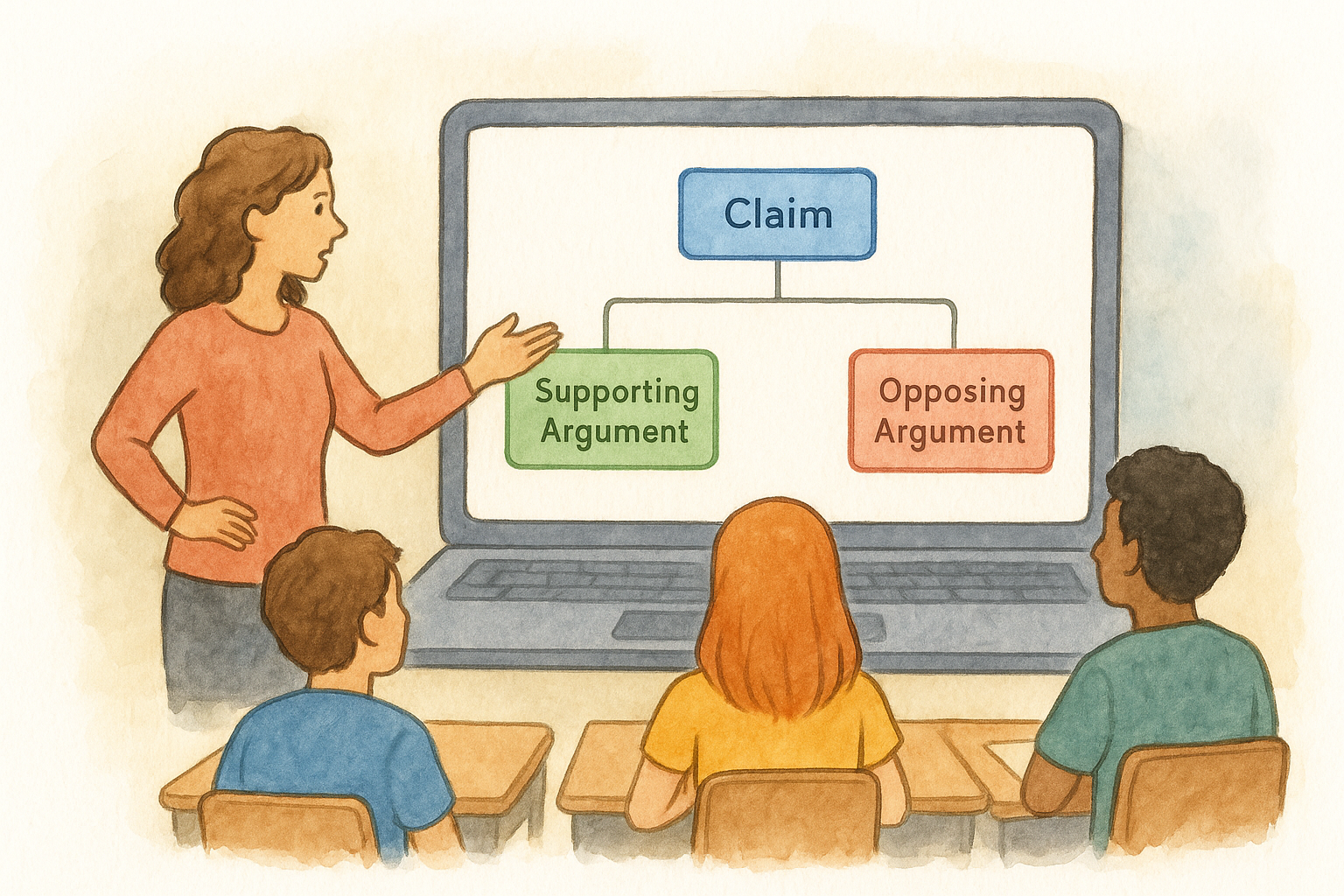
Kialo Edu brings structured argumentation into your classroom through a visual debate format that makes student reasoning visible in real time. It is one of the more engaging critical thinking resources for teachers who want students to actively construct and challenge arguments rather than just listen to a discussion.
What it is
This platform is a free tool designed specifically for schools that organizes discussions as branching argument trees. Students post claims, then attach supporting or opposing arguments directly to those claims, building a visual map of the reasoning involved.
How to use it this week
Set up a simple discussion prompt tied to your current unit and invite students to add at least one claim and two responses. Even a single 45-minute session produces a structured record of student reasoning you can reference for assessment.
Kialo Edu works best when students know the topic well enough to have a genuine position, so run it after instruction rather than before.
Best for
This platform fits middle and high school teachers who want to move classroom debate beyond verbal back-and-forth and into a format that holds students accountable for evidence-based reasoning.
Cost and access
Kialo Edu is completely free for teachers and students, with no subscription required. You create a teacher account and add students directly through the platform.
Common mistakes to avoid
Avoid launching Kialo Edu with an overly broad prompt. Narrow your discussion question to a specific, arguable claim so students can build focused, substantive responses rather than vague generalizations.
Next Steps
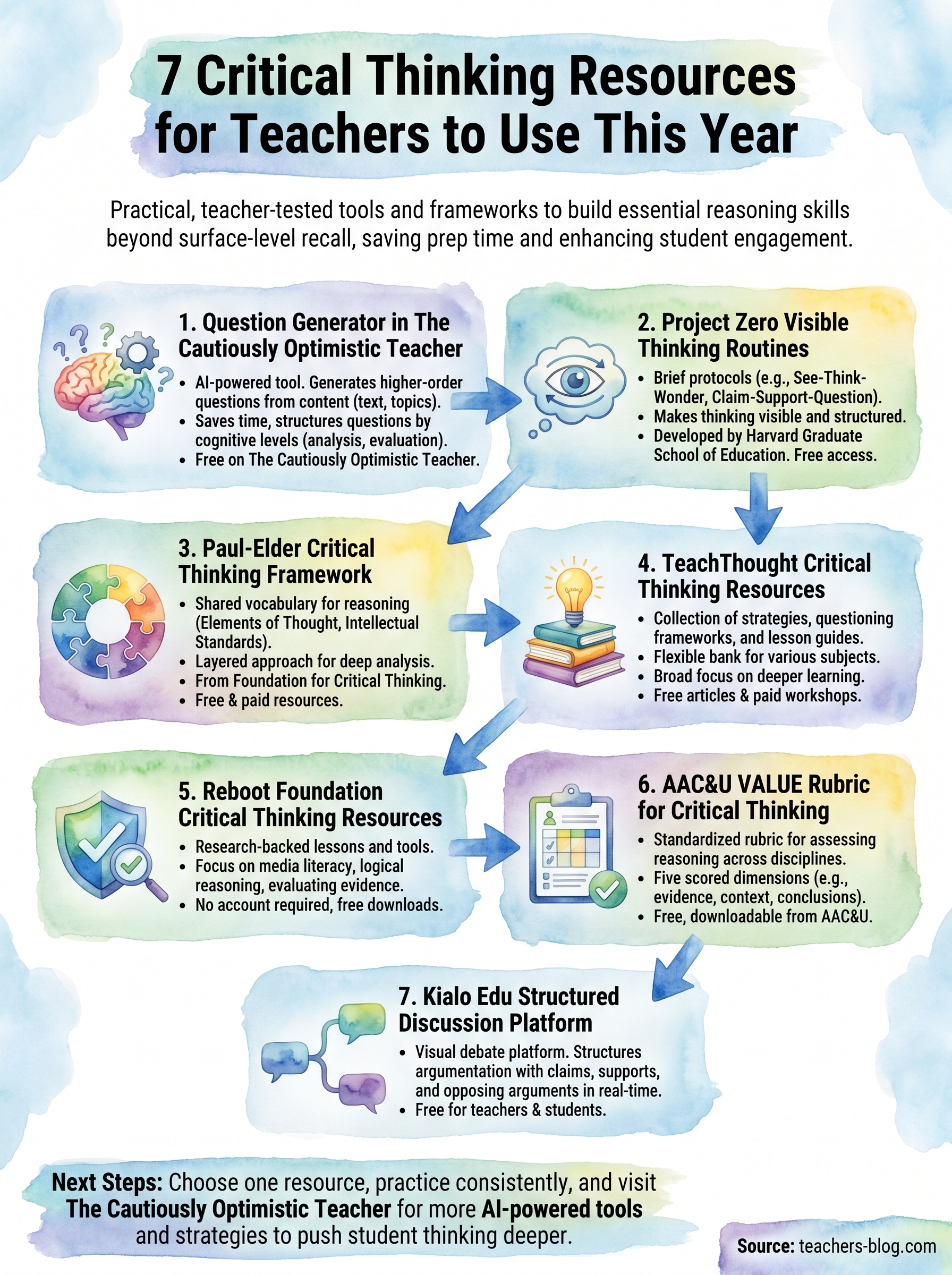
You now have seven concrete resources to work with, ranging from an AI-powered question generator to a structured debate platform. The goal isn’t to use all seven at once; pick one resource that fits your next unit and run it with your students before adding more.
Building critical thinking into your classroom takes consistent, deliberate practice, not a single well-designed lesson. The critical thinking resources for teachers listed here work best when you return to them repeatedly, giving students enough time to internalize the frameworks and routines rather than just encounter them once and move on.
Your next move is straightforward: choose the resource that solves your most immediate classroom problem and use it this week. For more tools that cut prep time while pushing students toward deeper thinking, explore The Cautiously Optimistic Teacher for AI-powered resources, differentiated lesson materials, and strategies you can put to work right away.