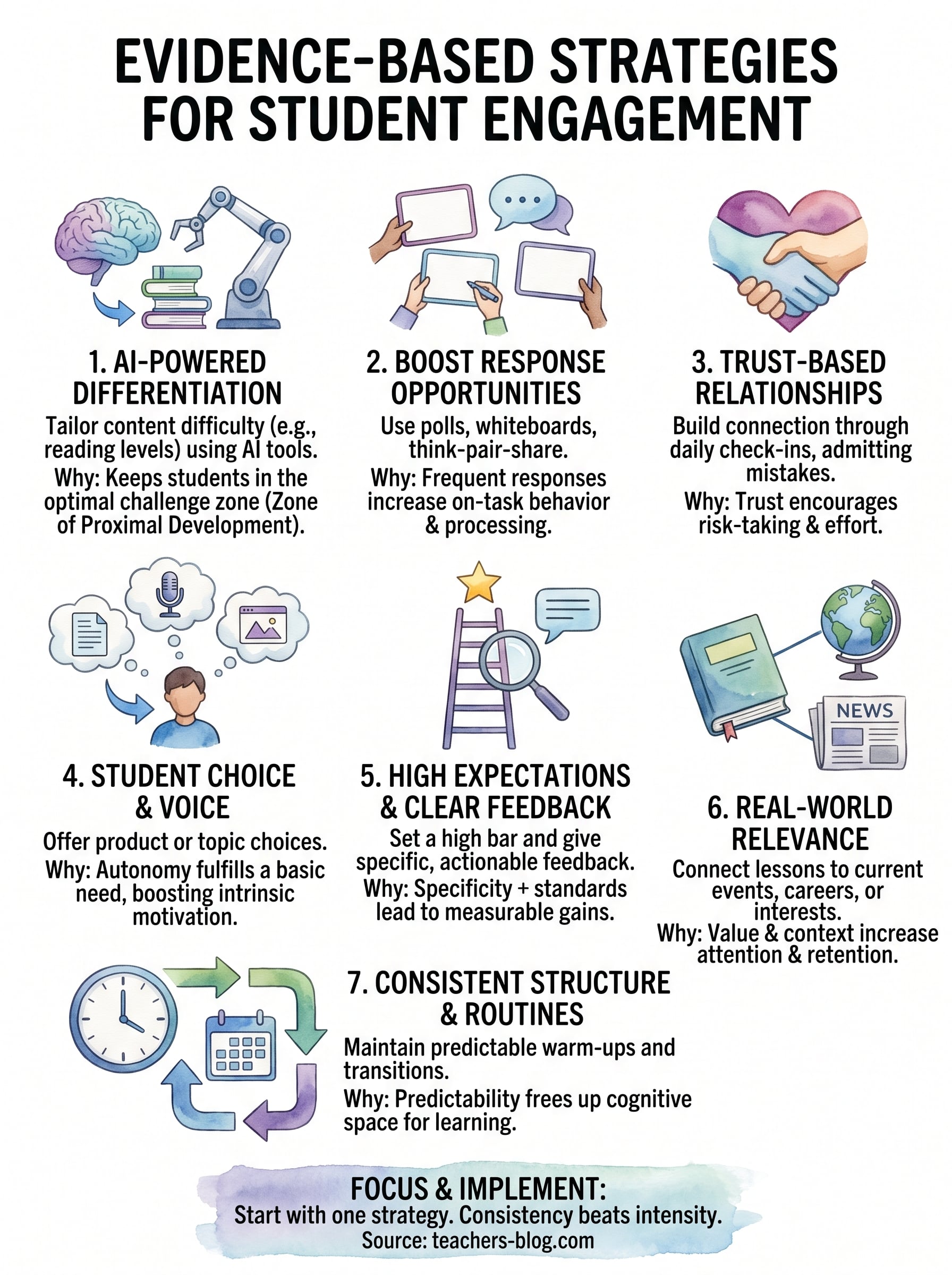
7 Evidence-Based Strategies for Student Engagement
You’ve watched it happen mid-lesson: eyes glaze over, phones creep out, and the kid who nailed yesterday’s discussion suddenly has nothing to say. Engagement doesn’t slip because your content is boring. It slips because the strategy delivering that content isn’t doing its job. That’s why evidence-based strategies for student engagement matter more than another Pinterest activity that looks good but fizzles by Thursday.
This article skips the guesswork. Every strategy here comes from classroom research, not a hunch or a trend, and each one has been tested across grade levels and subjects, from ninth-grade English to middle school science labs. If you want tactics that actually move the needle on attention, participation, and retention, this is where you start looking.
Below you’ll find seven research-backed practices you can start using this week, from retrieval practice to structured peer discussion. Each one comes with a quick explanation of why it works and how to fold it into lessons you’re already teaching, whether that’s a unit on To Kill a Mockingbird or a warm-up drill in algebra. No fluff, no filler activities, just strategies with a track record.
1. AI-powered tools to differentiate instruction
How it works
Differentiation used to mean writing three versions of the same worksheet at 10pm. Now, AI-powered tools can generate leveled materials in minutes, matching content to where each student actually is instead of where the pacing guide says they should be. A tool like the Differentiated Instruction Helper takes your existing lesson and produces variations for struggling readers, on-level students, and kids ready for a challenge, all from the same core content, which is exactly how AI personalizes learning materials without adding prep time. Pair that with one of the worksheet generators that build practice sets from keywords, and you’ve cut hours of prep while giving every student work that fits their skill level instead of a one-size-fits-all handout.
Why it works: the research
Differentiated instruction keeps students in what researchers call the zone of proximal development, the sweet spot where work is challenging but achievable. Task difficulty and student ability, when mismatched, are among the fastest ways to kill engagement. Give a struggling reader a text three grade levels above them and they check out. Give an advanced student busywork and they check out just as fast. The U.S. Department of Education’s Institute of Education Sciences has repeatedly flagged differentiated, targeted instruction as a lever for improving outcomes among students who are behind grade level, precisely because it keeps the challenge calibrated instead of static.
Engagement drops the moment work stops matching a student’s skill level, in either direction.
How to implement it in your classroom
Start small instead of trying to differentiate every single lesson. A practical rollout looks like this:
- Pick one unit you already teach and run it through an AI differentiation tool to generate three tiers.
- Group students loosely by recent formative assessment data, not by fixed labels.
- Rotate which tier gets teacher-led support each week, so no group feels permanently "low."
- Track completion and accuracy for two weeks before deciding if the tiers need adjusting.
This kind of targeted instruction doesn’t require a full curriculum overhaul, and it helps to see what differentiation looks like in a real classroom before you build your own tiers. It just requires swapping your single worksheet for three that actually fit the room you’re teaching.
2. Opportunities to respond to boost participation
How it works
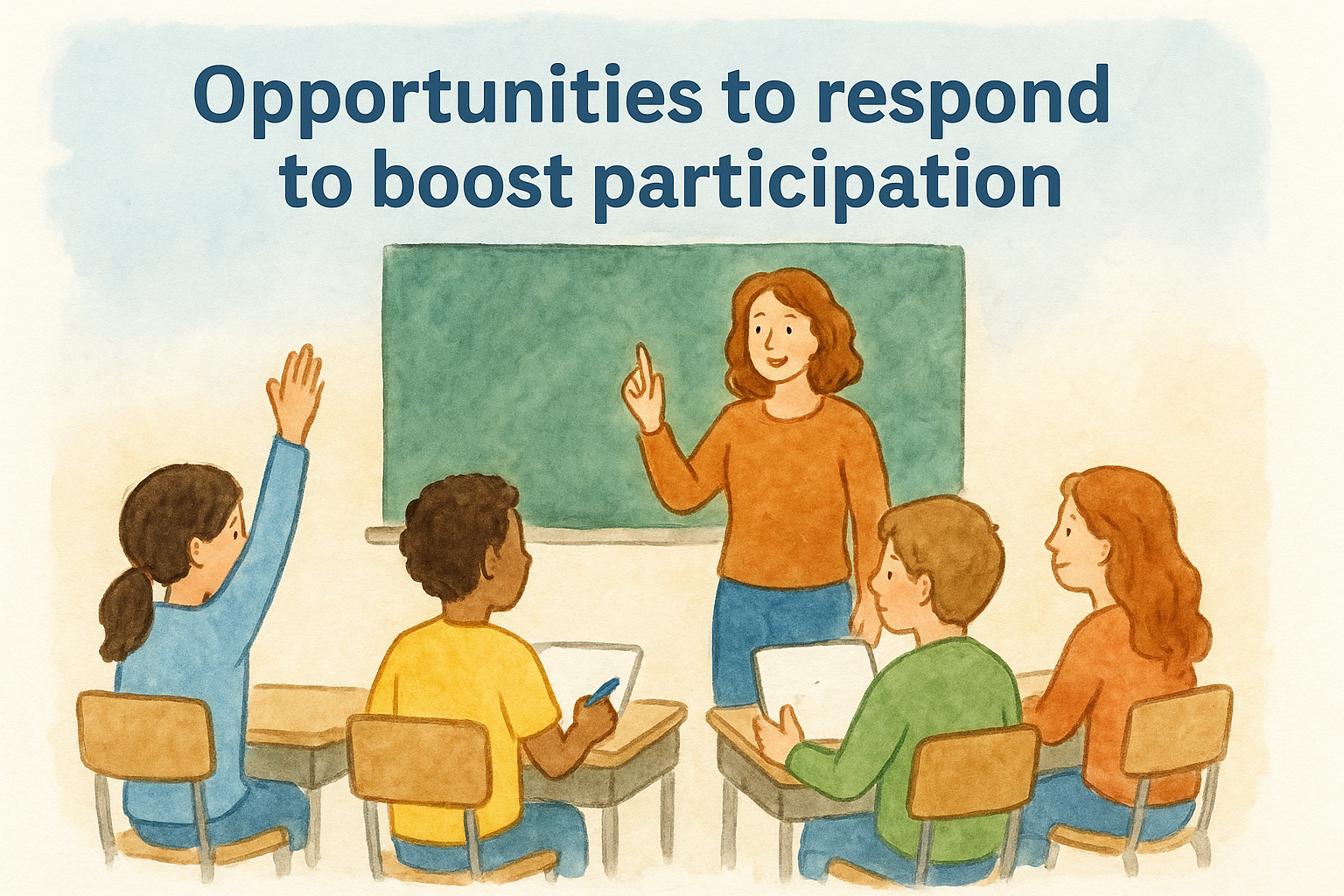
Most classrooms run on a hidden rule: raise your hand, wait to be called, and if you’re not picked, stay quiet. That structure caps opportunities to respond to a handful of students per period while the rest coast silently. Swapping in techniques like whiteboards, think-pair-share, or quick polls means every student answers every question, not just the three who always shoot their hands up first, which is the fastest route to getting more students talking in class.
Why it works: the research
Decades of classroom research tie frequent response opportunities directly to on-task behavior and achievement gains, especially for students who typically stay quiet. When a student has to produce an answer, even a wrong one, they process the material instead of watching someone else do the thinking. Increasing response rates from the typical one or two questions per lesson to ten or more has been shown to reduce disruptive behavior because there’s simply no downtime for attention to wander.
A quiet classroom isn’t necessarily an engaged one, it’s often just a classroom where only a few kids are doing the thinking.
How to implement it in your classroom
Building this habit doesn’t require new materials, just a shift in questioning routine:
- Use mini whiteboards for quick checks instead of cold-calling one student
- Add a 30-second think-pair-share before any whole-class discussion question
- Run a one-question digital poll at the midpoint of every lesson
- Track how many students respond per class period and aim to raise that number weekly
3. Trust-based teacher-student relationships
How it works
Students work harder for teachers they trust. Trust-based relationships grow from small, repeated signals: remembering a student’s weekend plans, following up when they seemed off yesterday, or admitting when you got something wrong. None of this is soft or extra. It’s the foundation that makes every other strategy on this list land, because a student who doesn’t trust you won’t take risks in front of you, and risk-taking is where real learning happens.
Why it works: the research
Decades of research on teacher-student relationships link relational trust to higher attendance, better behavior, and stronger academic performance, particularly for students who’ve had rocky school experiences before. When students feel safe with a teacher, they’re more willing to attempt hard problems, ask questions that expose confusion, and stay engaged after a wrong answer instead of shutting down. The American Psychological Association has noted that supportive teacher relationships buffer against disengagement especially during the middle and high school years, when students are most prone to checking out.
Students don’t engage with content they don’t trust the messenger of.
How to implement it in your classroom
Building trust doesn’t require grand gestures, just daily habits that build connection with students. Try these low-lift habits:
- Greet students by name at the door every single day
- Hold two-minute check-ins with disengaged students once a week
- Admit mistakes openly when you misspeak or grade something wrong
- Follow up on something a student mentioned outside of class
Consistency matters more than intensity here.
4. Student choice and voice in learning
How it works
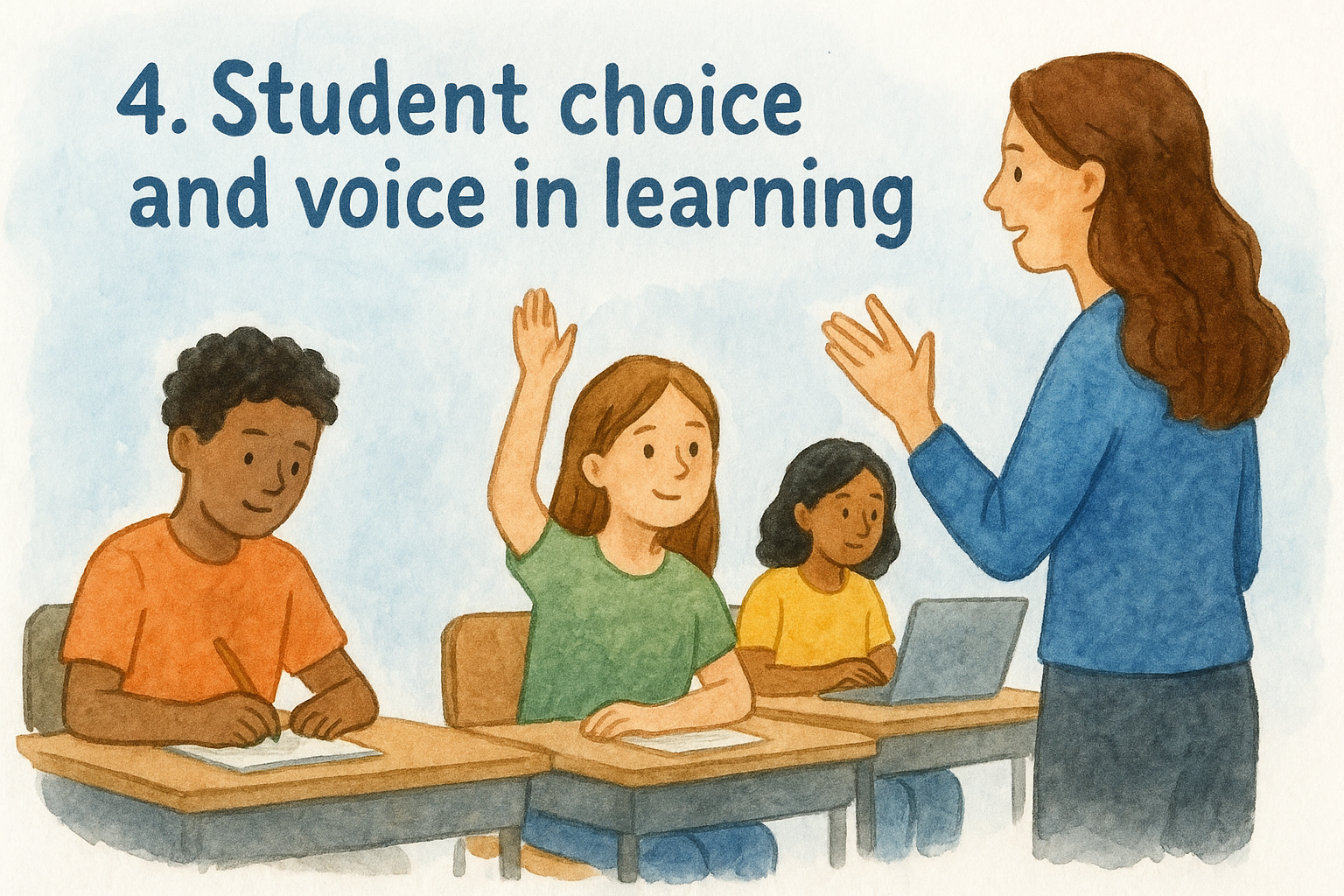
Giving students student choice over how they show learning, not whether they do the work, changes their relationship to the assignment. Let a student pick between writing an essay, recording a podcast, or building a slide deck on the same Lord of the Flies theme, and you shift them from passive recipient to decision-maker. Voice in learning means students also weigh in on topics, pacing, or classroom norms, not just final products.
Why it works: the research
Self-determination theory, one of the most cited frameworks in motivation research, identifies autonomy as a basic psychological need tied directly to intrinsic motivation. Students who feel some control over their learning report higher engagement and persist longer through difficult tasks than students working under fully teacher-dictated conditions. The effect holds across age groups, though it’s especially strong in middle and high school, where students are actively testing independence in every part of life.
Autonomy isn’t a reward for good behavior, it’s a requirement for real motivation.
How to implement it in your classroom
Offering choice doesn’t mean abandoning your learning objectives. Try this:
- Build one "choice board" per unit with three to four product options that hit the same standard
- Let students pick their own essay topic within a set theme
- Survey the class before a unit on which related questions interest them most
- Rotate who picks the warm-up activity each week
Start with one unit before scaling choice across your whole course load, then layer in other ways to motivate students in the classroom.
5. High expectations paired with clear feedback
How it works
Students rise or fall to the bar you set for them. High expectations paired with high support means you tell a student exactly what mastery looks like, then tell them precisely how their current work measures up against it. This isn’t about tougher grading. It’s about specificity: instead of "good job" or "needs work," you point to the exact sentence, calculation, or claim that needs revision and explain why.
Why it works: the research
Research on feedback consistently shows that vague praise does almost nothing for learning, while targeted, actionable feedback tied to high standards produces measurable gains. Students who believe their teacher expects real work from them, and who receive feedback that shows them how to close the gap, engage longer and push through frustration instead of settling for "good enough." Low expectations, even unintentional ones, signal to students that effort doesn’t matter much here.
Feedback without high expectations is just noise; expectations without feedback are just pressure.
How to implement it in your classroom
Make this concrete with a simple routine:
- Share a rubric or exemplar before students start any major assignment
- Give feedback on one specific element per draft instead of marking everything at once
- Require a revision based on that feedback before final grading
- State expectations out loud, not just in writing, when introducing new work
Small shifts here compound fast.
6. Real-world relevance in every lesson
How it works
Relevance means connecting a lesson to something students already care about outside your classroom: a current event, a local issue, a career path, a piece of pop culture they’re already obsessed with. Real-world relevance turns "why do I need to know this" into "oh, that’s why this matters." A geometry lesson tied to designing a skate park ramp lands differently than one built around an abstract proof, even though the underlying math is identical.
Why it works: the research
Motivation researchers consistently tie task value, whether a student sees a task as useful, interesting, or important, to how long they stay engaged when work gets hard. Students disengage fastest from content that feels disconnected from anything they’ll actually use, because their brains file it as busywork rather than learning. Studies on contextualized instruction show that framing content around authentic problems, from budgeting to environmental issues, boosts both attention and retention compared to decontextualized drills covering the identical skill.
Students don’t ask if a lesson is hard, they ask if it’s worth the effort, and relevance answers that question before you even open your mouth.
How to implement it in your classroom
Building relevance doesn’t require rewriting your curriculum from scratch:
- Open new units with a real headline, statistic, or local example tied to the concept
- Ask students how a skill applies to a job or hobby they already have
- Swap one abstract word problem per unit for one built around an actual local issue
- Invite a guest speaker, even virtually, whose work uses the skill you’re teaching
One relevant hook per unit beats a dozen forgettable ones.
7. Consistent structure and classroom routines
How it works
Routines free up mental space that would otherwise go toward figuring out what happens next. Consistent structure means students know exactly how class starts, how transitions happen, and what’s expected during independent work, without you repeating instructions every single day. A predictable warm-up, a fixed spot for turning in work, a set signal for quiet, none of it feels exciting, but it removes the friction that eats into actual learning time. When the scaffolding around a lesson is stable, students spend their energy on the content instead of decoding the logistics.
Why it works: the research
Classroom management research consistently links predictable routines to increased time-on-task and reduced disruptive behavior, especially for students who struggle with executive function or come from unpredictable home environments. Uncertainty is cognitively expensive, which is why routines reduce the behavioral load on both students and teachers. Every minute spent wondering what to do next is a minute not spent engaging with material. Studies on structured classroom environments show that students, particularly younger ones and those with attention difficulties, perform better academically and behaviorally when the daily flow stays consistent rather than shifting from week to week.
Structure isn’t the opposite of engagement, it’s what makes engagement possible in the first place.
How to implement it in your classroom
Building routines doesn’t require rigidity, just repetition, and it helps to know which classroom routines and procedures to teach from day one:
- Open every class with the same warm-up format, even if the content changes
- Post a visible agenda so students always know what’s coming next
- Use one consistent signal for transitions, like lights or a timer
- Keep your grading and feedback turnaround on a predictable schedule
Stability up front buys you flexibility later.
Choosing your next engagement strategy
Seven strategies is a lot to juggle at once, so don’t try to launch them all Monday morning. Pick the one that addresses your biggest current pain point, whether that’s silent classrooms, mismatched difficulty levels, or students who seem checked out the moment a lesson starts. Evidence-based strategies for student engagement work because they target the actual mechanics of attention and motivation, not because they’re trendy or look good on a lesson plan template.
Give whatever you choose two to three weeks before judging results. Small, consistent changes beat sweeping overhauls that fizzle by October. If differentiation is your entry point, you don’t have to build three versions of every lesson by hand. Explore the essential AI apps that save teachers time at The Cautiously Optimistic Teacher and let them handle the leveling while you focus on the relationships and routines that make students actually want to show up.