10 Daily Moves to Build Strong Student-Teacher Connections
Strong student-teacher connections are built through consistent “micro-moves” rather than grand gestures. By integrating simple habits like greeting students at the door, using the 2×10 strategy, and providing specific praise, teachers can lower student anxiety and increase cooperation. These daily investments in rapport create a “bank of goodwill” that makes classroom management more effective and sustainable.
This is Lesson 4 of Module 3: Building Teacher-Student Relationships | Full Course Outline
Mindset Shift: Transactional vs. Relational
| The Transactional Lens (Management) | The Relational Lens (Connection) |
| Focus: Getting through the lesson plan. | Focus: Getting through to the human beings. |
| View: Classroom moves are for efficiency. | View: Classroom moves are for belonging. |
| Strategy: Correcting behavior to stop a disruption. | Strategy: Connecting to understand the behavior. |
| Teacher Tone: Professional, distant, and authoritative. | Teacher Tone: Professional, authentic, and warm. |
| Result: Compliance that lasts until the bell rings. | Result: Trust that carries through the whole year. |
Introduction to Building Strong Student-Teacher Connections
Building positive student-teacher connections isn’t just a feel-good bonus – it’s central to effective classroom management. Research shows that when students feel seen, safe, and supported, they’re more motivated and well-behaved in class. In other words, investing a little time each day in connection pays off with fewer disruptions and a more engaged, respectful classroom community. This is true whether you teach energetic first-graders or jaded high school seniors – all students crave genuine connection with their teacher.
How can a busy teacher find time for building student-teacher connections? The good news: it doesn’t require grand gestures or huge time blocks. It’s about consistent small daily moves – simple habits and routines that, over time, build trust and rapport. In this module, we’ll cover ten actionable strategies you can weave into your daily routine to strengthen student-teacher connections (and by extension, make classroom management easier). These strategies range from how you greet students each day to giving out peer shout-outs and sharing a bit of your own personality. Each tip includes practical examples (and even sample handouts or prompts) to use in elementary, middle, or high school settings.
1. Greet Students at the Door to Build Student-Teacher Connections
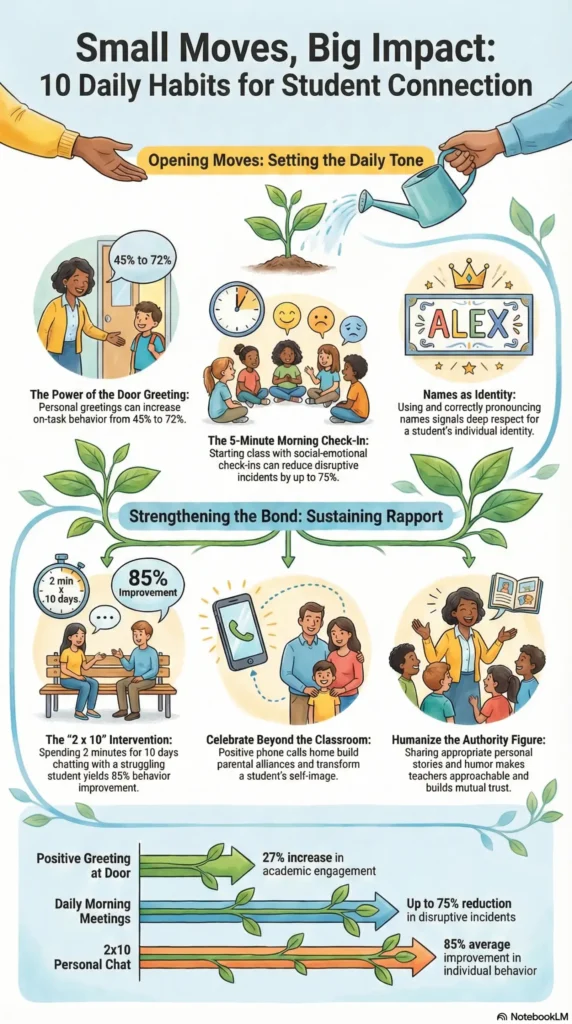
Greeting students individually at the door each day sets a positive, welcoming tone. It shows every child that you are happy to see them and helps them transition into class ready to learn. In fact, research links “positive greetings at the door” to higher academic engagement and less disruptive behavior in class. One study found that when teachers greeted students with a smile and a personal hello, on-task behavior rose significantly (from 45% to 72% on average). It doesn’t have to be an elaborate handshake for each student (though some teachers enjoy that!) – even a simple “Good morning, [Name]!” or a fist-bump can make a difference. The key is to use their name and smile, conveying that warm, upbeat energy as they enter.
Beyond boosting engagement, daily greetings help you gauge each student’s mood at the start of class. You might notice that one student looks upset or another unusually quiet – invaluable information so you can respond with empathy or a check-in before small issues become big. As one teacher notes, greeting at the door lets you “help gauge the mood [students are] in… first thing in the morning” and offer a quick reset if needed. For older students who switch classes, a brief greeting (“Hey, good to see you. How are you doing?”) at the classroom threshold can still be impactful. And don’t forget to say goodbye or good afternoon at the end of class or the day – closing on a positive note reinforces student-teacher connections. Over time, these daily hellos/goodbyes become a reassuring routine. Each one is a small investment in connection that cumulatively builds trust and community.
2. Start with a Daily Check-In or Morning Meeting
How you begin class can set the tone for the entire lesson. Dedicating the first few minutes to a class check-in (sometimes called a morning meeting or warm-up) gives students a chance to share and connect, and helps you take the emotional “temperature” of the room. In elementary classrooms, this might be a short morning meeting circle where each student greets the group or answers a fun question. For older grades, it could be a quick attendance question – instead of each student just saying “here,” ask them to respond with today’s mood or a quick opinion (“Tell us one word for how you’re feeling” or “Which do you prefer: texting or calling?”). These light interactions allow every student to speak and be heard daily, fostering student-teacher connections.
Importantly, students who feel socially connected at the start of class are less likely to act out later. One study found that integrating social-emotional check-ins (like morning meetings) can reduce disruptive incidents by up to 75%. When students have had a chance to greet peers, express themselves, or get a worry off their chest, they can better focus on academics. Your check-in can be very quick – even 5 minutes of sharing or a silly warm-up game can work wonders. For example, try a rapid-fire “Would you rather…?” question or have students rate their day on a scale from 1–5 with their fingers. Below are a few daily check-in ideas that can be adapted across grade levels:
Question of the Day – Pose a fun or thought-provoking question as a bell-ringer. (“If you had a superpower for a day, what would it be?” or “What’s one song you have on repeat lately?”) Give students 1 minute to share with a partner or the group.
Feelings Emoji or Color – Have students indicate their mood by choosing an emoji or a color from a mood meter chart (e.g. red = energized, blue = calm). This normalizes talking about emotions and lets you know who might need support.
Attendance Share – During roll call, instead of just saying “here,” students respond to a prompt. For example: “Name a food you love” or “One word for how Monday is going.” It’s quick and every student participates.
Whether it’s a structured morning meeting or a casual daily icebreaker, these moments build community. Students learn about each other (and you learn about them), which creates empathy and connections within the class. As a bonus, starting with a bit of interaction can get the wiggles out and ease students into “learning mode” more smoothly than immediately diving into strict content. Consistency is key – try to include some form of check-in each day, and you’ll likely notice the class becoming more cohesive and attentive as everyone feels more connected.
3. Learn and Use Students’ Names to Build Student-Teacher Connections
There’s an old saying: “The sweetest sound to anyone is their own name.” One of the simplest but most powerful connectors is calling students by name – correctly and often. Especially at the start of the year or semester, make it a priority to learn every student’s name quickly (yes, even if you teach multiple classes of 30+ students!). Pronouncing names correctly is vital to showing respect for each student’s identity. If you’re unsure, invite students to teach you the right pronunciation or consider having them make phonetic name tents on the first day. For example, students can fold a cardstock to display their name with a phonetic spelling or rhyme (“Naveed (rhymes with ‘seed’)”). Little efforts like this signal to students that who they are matters in your classroom.
Once you know names, use them frequently in conversation and instruction. Greet students by name (“Good morning, Jamal!”), call on them using their name, and include their names in positive feedback (“I like how Alicia got started right away on the task”). Using names not only catches students’ attention, it also creates a personal connection. Moreover, encouraging students to learn and use each other’s names builds peer respect. You might facilitate a quick name game in the first week – for instance, a tossing ball game where each student says a classmate’s name before tossing. In younger grades, songs or alliterative name activities (“Silly Sally” likes soccer) can help.
Don’t stop at just memorizing names – strive to learn a bit about the person behind each name. You can invite students to decorate their name tent or make a little “About Me” card with symbols of their interests. A high school teacher notes that these personal touches let teachers “glean valuable insights about [students’] passions or identities” early on. Displaying these or referring to them later shows students you remember what they shared. Ultimately, consistently addressing students by name (and pronouncing them correctly) builds mutual respect. It humanizes the student-teacher relationship – you’re not just saying “hey you,” you’re showing that you see that student as an individual. This is a foundational step to deeper connections.
4. Show Interest in Their Lives and Watch Student-Teacher Connections Thrive
Every student has a life outside your classroom – hobbies, dreams, family, challenges. Showing genuine interest in your students’ lives beyond academics is a powerful way to build rapport. Make a habit of asking small questions and following up on them to help build student-teacher connections. For example, if you know a student plays on the basketball team, you might ask on Monday, “How was the game Friday night?”. If another loves drama club, “How’s the play rehearsals going?” These brief conversations show students that you care about what they care about. Even a 30-second hallway chat about their favorite video game or a compliment about their band performance can light up a student’s day.
Crucial to this strategy is active listening. When a student is excited to tell you a story (“We got a new puppy!” or “I built a robot this weekend”), pause what you’re doing, give them your eyes and ears, and truly listen. One teacher shares that when she simply stops and listens to students’ little stories, “their eyes light up” with excitement. That joy comes from feeling valued. Some students, especially younger ones, love to tell you about their world – their soccer practice, their birthday plans – and by actively listening, you validate their experiences. For shyer or older students who may not volunteer personal info, you can still express interest by asking about something you learned from a survey or their work (e.g. “I remember you wrote you like drawing – have you made any cool art lately?”).
One great tool is a “get to know you” survey at the start of the year. Give students a short questionnaire to share their favorite activities, music, goals, or “something I wish my teacher knew about me.” This not only helps you discover conversation starters, but also sends the message that you’re genuinely interested in them as individuals. Be sure to actually use that information: if a student mentions they love a certain anime or sports team, bring it up casually later (“Did you catch the latest episode of ___?”). Such small gestures go a long way in building trust and student-teacher connections. Below are a few sample survey questions you might ask students (answers can be written or discussed):
What is a hobby or activity you really enjoy outside of school?
Who is someone you look up to, and why?
If you could teach the class one thing (a talent, skill, or interest of yours), what would you share?
What’s one goal you have for yourself this year?
When students do open up, respond with empathy and curiosity. Remember details they share – nothing impresses a student more than when you later ask, “How’s your dog Cooper doing?” or “Did your grandma get better after you mentioned she was sick?” Keeping notes for yourself can help if you have many students. The bottom line: by listening and remembering, you’re saying to the student “You matter to me.” Over time, these little conversations create a foundation of trust. Students will be more likely to come to you with bigger issues or accomplishments because they know you care. And in the day-to-day, a student who feels known by their teacher is more likely to stay engaged and behave, because the relationship brings a sense of personal accountability and mutual respect.
5. Make Time for One-on-One Moments (the “2×10” Strategy)
In a busy classroom, it’s easy to focus on whole-group management and miss out on individual connection. But carving out brief one-on-one moments with students can dramatically strengthen your relationships – especially with those who may be struggling. One proven approach is the 2×10 strategy: spend 2 minutes a day for 10 consecutive days chatting individually with a particular student (ideally one who is challenging or withdrawn) about anything not school-related. This might happen during homeroom, as students enter class, at lunch, or whenever you can steal a quiet moment. Remarkably, this small investment can yield big results: the originator of 2×10 found it led to an 85% improvement in that one student’s behavior on average, and often a ripple effect improving the class climate for others too. In essence, by showing sincere interest in the student’s life for a few minutes, you fulfill their need for attention in a positive way – reducing their drive to seek attention through misbehavior.
Even outside of a formal 2×10 intervention, try to rotate through your roster, giving each student a bit of individual attention over the course of a week or two. This could be as simple as kneeling by a student’s desk during independent work and asking, “How’s your day going?” or following up on a previous conversation (“You mentioned your brother was visiting – how did that go?”). For a student who often acts out, those moments can humanize your relationship; they start to see you as someone who cares, not just a disciplinarian. One teacher noted that challenging kids sometimes “needed someone to reassure them that people care about them and want them to succeed,” and a private chat was the perfect time to convey that message.
If face-to-face talk is hard to squeeze in, another idea is a dialogue journal or notebook that you pass back and forth with a student weekly. The student writes a short letter or entry to you, and you write back – it can be about hobbies, thoughts, or answering a fun prompt. This written conversation creates a personal bond and is especially great for those quiet students who open up more in writing. The key is consistency: making individual connection a daily habit. Over a month, if you chat even briefly with each of your 30 students, that’s 30 little bridges built. Students remember these moments. They’ll start swinging by your desk just to say hi or tell you something – a sign that trust is growing. As trust grows, managing behavior often becomes easier; students who feel personally connected are more likely to cooperate and meet expectations because they don’t want to disappoint someone who cares about them.
6. Express Care and High Expectations for Better Student-Teacher Connections
Sometimes the most direct way to build a connection is to tell students explicitly that you care about them. Don’t assume they know – many students, especially those who struggle, truly need to hear that you are on their side. Take opportunities to verbalize your support and belief in them. For instance, pull a student aside privately and say, “I want you to know I believe in you. I know you’re capable of great things, and I’m here to help you get there.”. These words can be powerful. When a teacher expresses unwavering belief in a student’s potential, it can transform how that student sees themselves. Your encouragement might be the thing that inspires a discouraged student to keep trying.
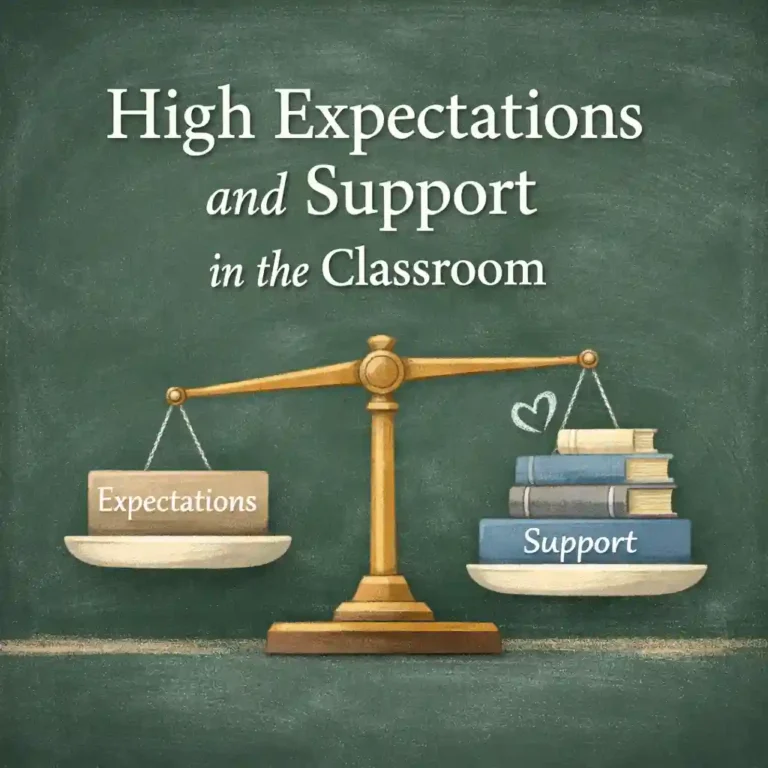
Expressing care also means showing empathy and understanding. If a student is having a hard time – maybe their behavior has been off or they seem down – you might say, “I noticed you’ve been quiet lately. I care about you and I’m here if you want to talk.” Such statements reinforce that your concern goes beyond their grades; you care about them as a person. High expectations are another facet of caring. Let students know you hold them to high standards because you know they can meet them. For example: “I’m giving you this challenge because I know you’re capable of doing excellent work – and I’ll support you along the way.” This blend of belief + support builds connection by communicating “I see your potential and I’ve got your back.” Research on teacher mindset backs this up: when students feel their teacher believes in them, it boosts their confidence and effort.
Practically, look for small moments to infuse these positive affirmations. You might write an encouraging note on an assignment (“I know this was tough, but I believe in you – keep going!”) or cheer a student on before a test (“You’ve got this!”). With students who frequently misbehave, it’s especially important to show warmth and care – they often expect adults to only give negative attention. Surprise them with kindness: greet them warmly every day no matter what happened yesterday, and acknowledge even minor improvements (“I noticed you tried hard to focus today – I’m proud of you.”). Over time, consistent messages of “I care about you, and I know you can do well” will chip away at the toughest student’s defenses. They begin to realize that you truly want the best for them, making them more receptive to your guidance. In short, don’t keep your positive feelings secret – say it and show it. A teacher’s genuine care can be a game-changer in a student’s life.
7. Give Specific Praise and Positive Notes
One of the most effective classroom management techniques is also a relationship-builder: “catching students being good” and acknowledging it. Make it a daily habit to provide specific praise to students for their efforts, improvements, or positive behaviors. Rather than a generic “Good job,” target the praise to something concrete: “Maria, you did an excellent job helping your partner understand that problem,” or “I appreciate how quietly you started your work today, Devin.” This shows you’re paying attention and valuing their contributions. Students thrive on positive reinforcement – when they know you notice the good things they do, it encourages more of those behaviors and strengthens their sense of connection to you. They see that you’re fair and appreciative, not just focusing on mistakes. Over time, a classroom saturated with authentic praise feels warm and motivating for everyone.
In addition to in-class praise, consider extending those positives beyond the classroom with positive notes or calls home. A quick email, phone call, or handwritten note to a parent or guardian describing something great their child did can have a huge impact. Parents will almost always relay the message to the student, and you’ll have a very happy kid the next day! This practice also enlists parents as allies and lets the student know that you’ll celebrate their successes publicly, not just contact home for problems. In fact, experts note that calling home for positive behavior can be even more impactful than calls about misbehavior – it strengthens your relationship with the student (and their family) and boosts the student’s confidence. Imagine a student hearing from their parent, “Your teacher called just to say how proud she is of you for participating in class today” – that student will likely feel on top of the world. Even a small gesture like a sticky note left on a desk can be memorable. For example, you might leave a note reading: “Thank you for helping Alexis pick up her spilled crayons. Your kindness did not go unnoticed – I’m proud to be your teacher.” It takes under a minute to write, but that student will beam with pride and know you see their good character.
To make this manageable, you might aim for a “positive note or call of the day,” rotating through your roster so each student gets one at some point. Keep it brief and authentic. Here are a couple of easy ways to deliver positive feedback:
Quick Desk Notes: Keep a stack of small notecards. Whenever you spot something praise-worthy, jot a one-liner and leave it on the student’s desk or notebook. (E.g. “Outstanding effort in group work today – thank you for being a leader!”)
Positive Phone Call or Email: Once a week (or daily, if you can), pick one student and contact their parent with good news. It could be about academic progress or behavior. (“I wanted to let you know that Marcus has been participating so much more this week – I’m really impressed by his effort.”) Many parents will save these messages, and the student gains extra encouragement at home as well.
Finally, celebrate improvements, not just high achievers. If a typically disruptive student has a good day, quietly tell them, “I noticed you stayed on task through the whole activity – that’s awesome progress.” By acknowledging growth and effort, you reinforce a growth mindset and show that you’re paying attention to each student’s journey. Over time, students see that you are looking for reasons to praise them, not catch them out – this builds goodwill and a positive classroom atmosphere. Students who feel appreciated and proud are far less likely to engage in negative behaviors, meaning your genuine praise is a win-win for relationship-building and classroom management.
8. Highlight Student Work and Strengths
Another daily move to build connection is to make students feel valued and proud of their contributions. Look for opportunities to highlight student work, talents, and strengths in front of their peers. When students see that their teacher is truly impressed by what they can do, it boosts their self-worth and cements a positive relationship. One simple method is maintaining a section of the classroom (or a virtual gallery, for online/hybrid classes) as a “showcase wall”. Display stellar examples of student work: essays, art projects, great homework answers, etc. Rotate these frequently so every student gets a turn to shine. Research shows that showcasing student work helps make them feel valued. It sends the message that their efforts are seen and appreciated beyond just a grade. Even at the high school level, students often enjoy having their work or achievements recognized publicly (though you might ask permission first for older kids, to avoid any embarrassment).
In addition to academics, celebrate students’ unique strengths or improvements. Did someone show exceptional kindness or leadership today? Take a moment in class to acknowledge it: “I want to give a shout-out to Orlando for helping his lab group stay organized – thank you!” This not only makes Orlando feel good, but also reinforces positive behaviors for everyone. Some teachers implement a quick end-of-day reflection where they mention a couple of “awesome things” students did that day. It can be informal but it ends class on a uplifting note, and students love to hear positive mentions of their name.
You can also involve students in showcasing themselves. For example, have a rotating “Student Spotlight” where one student each week gets to share a talent or interest with the class. In an elementary setting, this might be the traditional “Star of the Week” who brings in favorite objects and pictures from home. In middle or high school, you could have a brief segment on Fridays for a student to show off something (a song they’re learning on guitar, a piece of art, a cultural tradition, etc.) – or simply for classmates to give that student compliments. Giving students structured opportunities to share their lives or proud work helps classmates know each other and deepens the student-teacher bond as you learn more about each individual.
Lastly, give students roles and responsibilities that highlight trust in them. Assign classroom jobs (line leader, tech helper, discussion moderator, etc.) and rotate them daily or weekly. When a student is tasked with an important role, they feel trusted and seen as capable. For instance, letting a shy student be “discussion leader for the day” can both honor their insight and build their confidence. Or have students take turns at being the “greeter” who helps welcome classmates or new students – a great way to empower them. By empowering students to lead or help, you’re saying “I see your strength and I trust you,” which strongly boosts connection and mutual respect. Remember to praise them for doing the job well (tying back to tip #7). All these little spotlights and leadership opportunities accumulate into a classroom culture where students feel important. And when students feel important to you, they are far more likely to be invested in class and responsive to your expectations.
9. Encourage Peer Shout-Outs and Kindness
Connections in the classroom aren’t just about teacher-student relationships – peer relationships matter too. Fostering a supportive community where students appreciate one another will indirectly strengthen your bond with them as well (since you’re the facilitator of that positive culture). One effective routine is to incorporate peer shout-outs or compliments into your day or week. For example, some teachers end each day with 5 minutes of “appreciations.” Students can volunteer to publicly thank or praise a classmate for something specific. One elementary teacher has “Morning Shout-Outs” where a few students share something positive a peer did, followed by the class clapping for that student. She says it’s consistently the “happiest part of our day” and you can imagine why – both the giver and receiver of the compliment feel great, and it “really brings us all together” as a community. Middle and high school teachers can do this too, though older students may need a gentle push or some scaffolding (like sentence stems to prompt their shout-outs). Over time, even teens warm up to genuine peer recognition when it’s a normal part of class culture.
Another idea is a Shout-Out Box or Kudos Wall. Keep a box (or a Google Form, for a digital option) where students can drop in anonymous compliments about classmates anytime. At the end of the week, read a few aloud: “Ali wants to shout out Jaden for helping her understand the math homework – way to go, Jaden!” This practice motivates kindness (“maybe I’ll get a shout-out too if I help others”) and helps students notice the good in each other. Similarly, a Gratitude or Kindness Wall can be a bulletin board where anyone can pin a note recognizing someone else’s contribution. In all these cases, you as the teacher should participate as well – model giving shout-outs to students (“I want to recognize how patient Ivy was helping clean up today – thank you!”). When students see you actively looking for positives, it reinforces that you truly care about the class community.
To help students get comfortable with giving peer compliments, you can provide some sentence starters or guidelines. Here are a few examples you might share or post:
“I want to appreciate ___ for ___.” (E.g. “I want to appreciate Juan for always making us laugh when we’re down.”)
“Thank you, ___, for ___.” (E.g. “Thank you, Aisha, for helping me find my textbook yesterday.”)
“One thing I noticed about ___ is ___.” (E.g. “One thing I noticed about Marcus is he includes everyone in group work.”)
Encourage authenticity – the compliment should be sincere and specific, not just “So-and-so is cool.” With practice, students will get better at this. Peer shout-outs transform the classroom atmosphere: instead of competition or cliques, students start seeing each other as teammates. This sense of classroom community means students feel safer and more connected at school. And when conflicts or behavior issues arise, that foundation of empathy makes resolutions easier. You as the teacher also benefit – hearing your students speak kindly about each other is heartwarming and reduces negativity in the room. In the end, you’re all on the same team, and everyone (including you) feels a stronger bond. Class becomes a place where not just teacher affirms students, but students uplift one another – a truly positive learning environment.
10. Share Your Story and Use Humor
Connecting with students doesn’t mean you have to reveal your deepest secrets, but letting them see who you are as a person (beyond just “the teacher”) can significantly deepen trust. Appropriate self-disclosure and lightheartedness make you more relatable and approachable. Find small ways to share your world with students: maybe show a photo of your pet or family one day, tell a quick story from when you were in school, or mention your favorite hobby. Students, whether age 7 or 17, are often curious about their teacher’s life. By sharing little anecdotes (“I tried cooking a new recipe last night and it was a disaster!” or “When I was in 8th grade, I was nervous about presentations too.”), you humanize yourself. Suddenly you’re not just an authority figure but a real person with feelings, failures, and fun outside of school. This helps students, especially older ones, feel more comfortable talking to you and asking for help – they see you as someone who can understand them. When students feel like they know you, they’re more likely to open up and trust you in return.
Along with sharing about yourself, don’t underestimate the power of humor and silliness in building connections. Laughter truly is a universal connector – when you and your students laugh together, it creates a bond. You don’t need to be a stand-up comedian; just be willing to inject fun into your classroom. Maybe it’s a goofy science pun, a dramatic reading of a story in a funny accent, or a quick improv brain-break. Showing your goofy side – or simply smiling and laughing along with students – signals that you enjoy being with them. A sense of humor helps create a relaxed atmosphere where students feel comfortable being themselves. For example, if something mildly funny happens (like a voice crack or a slip of the tongue), laugh it off together. You could even have a “joke of the day” where students or you share a (school-appropriate) joke at the start of class. Some teachers famously do playful things like wear silly socks on Fridays or dance when the class achieves a goal – feel free to be as “weird” as fits your personality. As one teacher put it, “Life is too boring NOT to be weird, right?” – her willingness to be a bit silly (like making up math songs or sharing funny animal facts) helped her class create “memorable experiences together” and brought everyone closer.
Of course, balance is key. Sharing personal tidbits or humor should never cross professional boundaries or undermine your authority completely. You’re still the adult in the room. But a teacher who can laugh at a mistake or crack a genuine smile now and then is far more likely to reach students than one who is stern 100% of the time. Authenticity is crucial: students can sense a fake. So if joking isn’t your forte, you don’t need to force it – maybe your way of bonding is through a shared interest (like playing chess with the chess club or discussing a popular book series you both read). The goal is to show students a bit of the real you and to find joy in interactions. When students see that you enjoy teaching them, it’s contagious – it makes them enjoy learning from you. They’ll remember those human moments (“Remember when Ms. C told us about the time she got lost on her first day of high school?!” or “Mr. K doing the chicken dance because we all turned in homework – that was hilarious!”). These memories form the fabric of a positive student-teacher relationship that will persist even when you have to be strict. In summary: be yourself (within reason) and don’t be afraid to have fun with your class. A connected classroom is often a laughing, smiling classroom.
Conclusion
Effective classroom management is built on a foundation of mutual respect and trust, and that foundation is laid brick by brick through small daily interactions. By greeting each student warmly, checking in on their well-being, learning who they are, and celebrating their positives, you create an environment where students feel valued and connected. In such an environment, students are far more likely to cooperate, engage, and give their best effort – because they know they matter to you. As the saying goes, “Students don’t care how much you know until they know how much you care.” The ten strategies above are simple ways to show you care every single day.
Start by incorporating a few of these moves consistently – maybe greeting at the door and doing a quick daily check-in to begin with. As those become routine, add more (like increasing your positive notes or peer shout-outs). Over time, you’ll notice a shift: the classroom feels more like a community. Challenges and misbehaviors won’t vanish overnight, but they will diminish as relationships strengthen. And when issues do arise, you’ll find students are more receptive when they need redirection or support, because there’s a bank of goodwill between you. Remember that building connections is an ongoing process – keep at it, even on tough days when it feels like nothing’s working. The consistency and sincerity of your small daily moves will eventually break through.
No matter the grade level, students respond to feeling genuinely seen and appreciated. A smile, a kind word, a bit of interest or humor – these cost little time but yield major results in classroom tone. By investing a few minutes each day into relationship-building, you’re not “losing instructional time” – you’re gaining a cooperative, motivated class. In the end, a classroom full of strong connections is one where students and teacher respect one another, learn from each other, and actually enjoy the time they spend together. That’s not just good classroom management; that’s the kind of classroom experience that can be transformative for everyone involved. Here’s to making those small daily moves and watching the big impact they have on your classroom community!
Student-Teacher Connections FAQ
What is the 2×10 strategy for student-teacher connections? The 2×10 strategy involves spending 2 minutes a day for 10 consecutive days talking to a specific student about something entirely unrelated to school. This targeted attention is highly effective for building rapport with students who are struggling or withdrawn.
Does greeting students at the door really improve behavior? Yes. Research shows that positive greetings at the door can increase academic engagement by up to 20% and reduce disruptive behavior. It allows the teacher to take the ’emotional temperature’ of each student before they even enter the room.
How can I build connections if I have 150+ students? Focus on high-leverage ‘micro-moves’ like using student names, giving specific praise on written work, and using quick ‘Question of the Day’ check-ins. You don’t need deep conversations with everyone every day; small, consistent signals of care are what build a connected culture.
Reflection
Earlier in my teaching, I sometimes moved on too quickly after a conflict with a student because I assumed the issue was finished once the behavior stopped. Later, I realized the relationship itself hadn’t actually been repaired, and the student remained distant and less engaged in class. Once I began taking a few minutes to check in afterward and acknowledge what happened, those same students were much more willing to participate again.
- After a difficult interaction with a student, how intentionally do you follow up to repair the relationship—not just the behavior?
- What message might students receive if conflicts in your classroom are addressed but never revisited afterward?
- What simple check-in routine could you use to rebuild trust with a student after tension or correction?
Continue the Classroom Management Course
In the next lesson, we explore how repairing teacher–student relationships after conflict helps restore trust, reduce future behavior problems, and strengthen classroom stability because students are more likely to re-engage when they know mistakes don’t damage their standing with the teacher.
Next Lesson: Repairing Relationships After Conflict
Module 3 Progress:
Small Daily Moves That Build Connection
Back to Module 3 Overview
Return to Full Course Outline