
9 Classroom Activities To Build Community That Work
You can have the most well-planned lesson in the world, but if students don’t feel safe and connected in your room, it’s going to fall flat. That’s not a hot take, it’s something most of us learn the hard way. Classroom activities to build community aren’t just warm-and-fuzzy extras you squeeze in during the first week of school. They’re the foundation that makes real learning possible all year long.
The tricky part? Finding activities that actually work and don’t make your students cringe. A forced icebreaker can do more damage than skipping one altogether. What you need are strategies that feel natural, build genuine trust, and create a classroom where students want to show up, not just physically, but mentally. That’s exactly the kind of practical, teacher-tested approach we focus on here at The Cautiously Optimistic Teacher: resources that respect your time and your students’ intelligence.
Below, you’ll find nine community-building activities that go beyond name games and trust falls. Each one is designed to foster belonging and cooperation among students, whether you’re starting fresh in September or trying to reset the culture mid-year. Let’s get into it.
1. Community circles with AI-generated prompts
Community circles are one of the most effective classroom activities to build community because they give every student an equal voice in a structured, low-stakes format. Adding AI-generated prompts removes the pressure of coming up with fresh questions every time and keeps conversations genuinely interesting rather than predictable.
What you build
You’re building psychological safety and the habit of respectful listening. Students learn that their perspectives matter and that others are genuinely willing to hear them. Over time, this translates directly into stronger academic discussions and a classroom culture where disagreement doesn’t automatically turn into conflict.
Materials and setup
All you need is a circle seating arrangement and a set of discussion prompts. Use an AI tool like ChatGPT to generate prompts tailored to your students’ age group, current events, or your unit themes. Print them or display them on a screen. Keep a talking piece on hand, which can be anything from a stress ball to a small object from your desk, to signal whose turn it is to speak.
Steps to run it
Start by setting two or three norms out loud before the circle begins: listen to understand, don’t interrupt, and keep it respectful. Pull up your first AI-generated prompt and read it aloud. Pass the talking piece around the circle and let every student respond, with the option to pass. Once everyone has spoken, open the floor briefly for any reactions or connections students noticed.
The talking piece isn’t just a prop. It physically reinforces who has the floor, which cuts down on interrupting more reliably than reminders alone.
Variations and differentiation
You can run a fishbowl variation where a small inner group discusses while the outer group observes and then reflects. For quieter students, give everyone 30 seconds of written think time before the talking piece moves. You can also use the circle for academic reflection, not just relationship-building.
Quick troubleshoot
If students give one-word answers, try prompts that ask for a specific memory or story rather than a broad opinion. If the circle feels chaotic, co-create the norms with students before you run it again. When students have ownership over the rules, their behavior in the circle shifts noticeably.
2. Get-to-know-you bingo that avoids stereotypes
Get-to-know-you bingo is one of those classroom activities to build community that students actually enjoy because it feels more like a game than a structured exercise. The key is building a bingo card that reflects real, interesting dimensions of your students rather than surface-level or potentially stereotyping prompts.
What you build
This activity builds low-pressure social connection by giving students a concrete reason to start conversations with classmates they might otherwise never approach. You’re creating early relationship bridges before academic pressure sets in, which makes later group work feel far less awkward.
Materials and setup
Create a 5×5 bingo grid and avoid prompts tied to physical appearance or family structure since those can isolate students. Print one card per student or display a shared version on your projector. Strong square examples include:
- "Has visited another country"
- "Can solve a Rubik’s cube"
- "Speaks more than one language at home"
- "Has a sibling under age five"
Steps to run it
Hand out cards and give students 10 to 15 minutes to move around the room finding classmates who match each square. They write that person’s name in the box. Call the class back together and ask a few students to share one thing they learned about a classmate they hadn’t spoken to before.
The debrief matters as much as the game itself. Without it, bingo stays shallow.
Variations and differentiation
For older students, swap the grid for a digital version using Google Forms or Slides so students can submit personal facts beforehand and you populate the cards with their actual answers, making every square personally relevant.
Quick troubleshoot
If students only talk to their friends, set a one-name-per-card rule so they must reach out to different classmates throughout the room.
3. Speed interviews with rotating partners
Speed interviews rank among the most energizing classroom activities to build community because they combine movement, conversation, and a bit of friendly pressure into one compact format. Students rotate through short partner conversations, which means everyone ends the activity knowing something real about several classmates, not just the people sitting nearby.
What you build
You’re building conversational confidence and widening your students’ social circles at the same time. This works especially well mid-year when cliques tend to solidify and students stop reaching across familiar boundaries.
Materials and setup
Arrange desks or chairs in two rows facing each other or in a double circle. Prepare five to eight interview questions in advance. Keep them specific and accessible so students can answer quickly without overthinking.
Steps to run it
Give each pair two to three minutes to interview each other using one question. When the timer ends, one row rotates one seat. Continue until students have met four to six partners, then bring everyone back together for a brief share-out.
The rotation removes the social awkwardness of choosing a partner and forces connections that wouldn’t happen naturally.
Variations and differentiation
For a subject-specific twist, swap personal questions for content-related prompts tied to your current unit. This keeps the format useful well outside of the first week.
Quick troubleshoot
If students run out of things to say before the timer ends, give each pair a second backup question printed on a card at their station so there’s no dead air.
4. Back-to-back drawing for listening and clarity
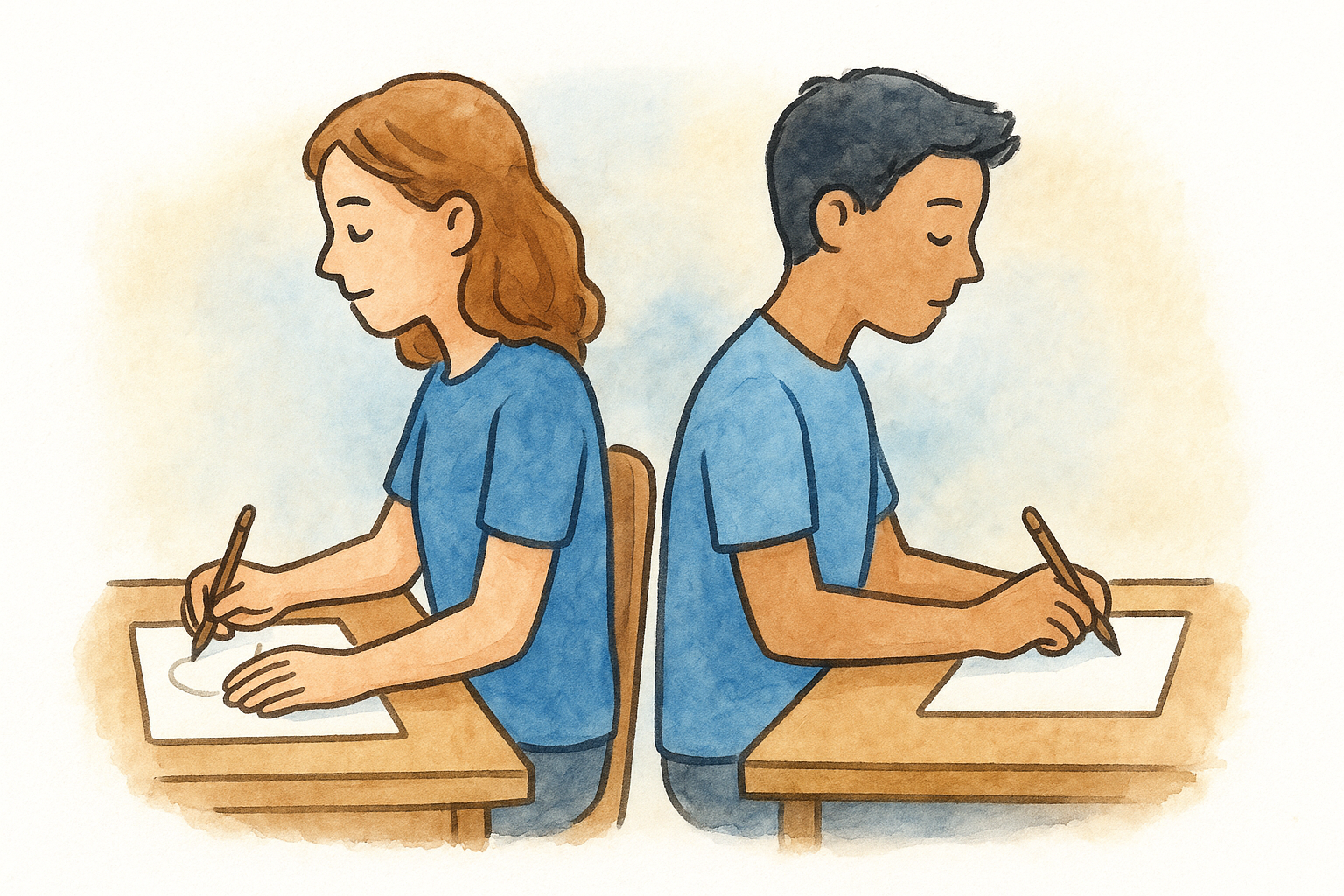
Back-to-back drawing is one of those classroom activities to build community that doubles as a genuine communication lesson. Two students sit back-to-back: one describes an image while the other draws it without looking. The gap between what the speaker meant and what the listener drew becomes the most productive learning moment of the whole activity.
What you build
This activity builds precise communication skills and empathy at the same time. Students quickly realize that clear language matters, and that the listener’s confusion is usually the speaker’s responsibility to address. That insight transfers directly into group work, peer feedback, and academic discussion.
Materials and setup
Each pair needs two sheets of blank paper and something to draw with. The describer gets a simple line drawing, which you can find in any clip art library or create yourself. Keep the images abstract enough that vocabulary, not artistic skill, determines success.
Steps to run it
Seat pairs back-to-back so neither student can see the other’s paper. Give the describer 3 to 4 minutes to talk through the image while their partner draws from the description alone. Then have pairs compare results and discuss where the communication broke down.
The comparison moment is where the real learning happens, not the drawing itself.
Variations and differentiation
Swap roles and use a different image for round two so both students experience each side of the challenge.
Quick troubleshoot
If students rush through it, remind them that the goal is accuracy, not speed. Slowing down almost always improves the result.
5. Class agreements you co-write and revisit
Co-written class agreements are among the most sustainable classroom activities to build community because students actually follow rules they helped create. When you hand down a list of expectations, students see compliance as optional. When they write the list themselves, they see ownership and accountability as personal commitments.
What you build
You’re building a shared sense of responsibility for how the classroom feels day to day. Students who contributed to the agreements are far more likely to call each other in when behavior drifts, which takes real pressure off you and strengthens peer relationships at the same time.
Materials and setup
All you need is a large sheet of chart paper or a shared digital document and markers. Post the final agreements somewhere visible so they stay present throughout the year, not just during the first week.
Steps to run it
Start by asking students: "What do you need to feel safe and respected here?" Collect answers, group similar ideas, and draft the agreement together. Revisit it after breaks, conflicts, or major transitions to check whether it still reflects what the class needs.
Agreements that never get revisited become wallpaper. Bring them back into conversation regularly so they stay meaningful.
Variations and differentiation
For younger students, simplify the language into three to five short statements. Older students can draft a more nuanced document that addresses digital behavior and group work expectations specifically.
Quick troubleshoot
If students suggest vague or unenforceable agreements, ask them to name what that would look like in practice. Concrete, specific language makes the agreements far easier to uphold when real situations arise.
6. Shout-outs and gratitude routines that feel real
Shout-outs and gratitude routines are classroom activities to build community that work precisely because they’re student-driven, not teacher-driven. The difference between a routine that lands and one that students roll their eyes at usually comes down to whether it feels genuine or scripted.
What you build
You’re building a culture where positive recognition is normalized and where students actively look for what others are doing well. That shift in attention changes how your class operates, not just during the shout-out itself, but throughout the entire school day.
Materials and setup
All you need is a designated spot in your daily or weekly schedule and a simple format students recognize. Some teachers use a shout-out board on the wall; others keep it verbal. Keep it brief and consistent so it doesn’t feel like a production.
Steps to run it
Set aside two to three minutes at the end of class or during a morning meeting. Invite students to name a specific classmate and what they observed. Specificity matters here: "thanks for helping me when I was confused about the assignment" lands harder than "you’re a good friend."
The more specific the shout-out, the more it reinforces the exact behaviors you want to see repeated.
Variations and differentiation
Try a gratitude journal where students write one weekly acknowledgment that you occasionally share aloud with permission.
Quick troubleshoot
If the same students always get recognized, prompt variety by asking students to shout out someone they haven’t thanked before.
7. One shared class goal with visible progress
Chasing a goal together does something that most classroom activities to build community can’t accomplish on their own: it gives students a concrete, ongoing reason to care about each other’s progress. When the class wins or falls short together, community stops being an abstract idea and becomes something students can actually see and track.
What you build
You’re building collective responsibility and the understanding that individual effort feeds into something bigger. Students who usually disengage often find their entry point here because the group’s outcome depends on everyone, including them.
Materials and setup
Pick a specific, measurable goal your class can directly influence, such as reading a combined total of 100 books, submitting all assignments on time for two consecutive weeks, or hitting a class-wide average on a skills check. Use a visible progress tracker, like a paper thermometer or a jar filling with marbles, posted somewhere students see every day.
Steps to run it
Set the goal together with your students so they feel invested from the start. Update the tracker publicly after each milestone and briefly call out how the class moved the needle during that stretch. Celebrate when you hit the goal, then set the next one.
The tracker does a lot of the motivational work on its own. Students check it without any prompting from you.
Variations and differentiation
Tie the goal to academic behavior, not just outcomes, so every student has a meaningful role regardless of skill level.
Quick troubleshoot
If motivation drops, break the larger goal into smaller checkpoints so students can see progress more frequently.
8. Identity gallery walk with student-created artifacts
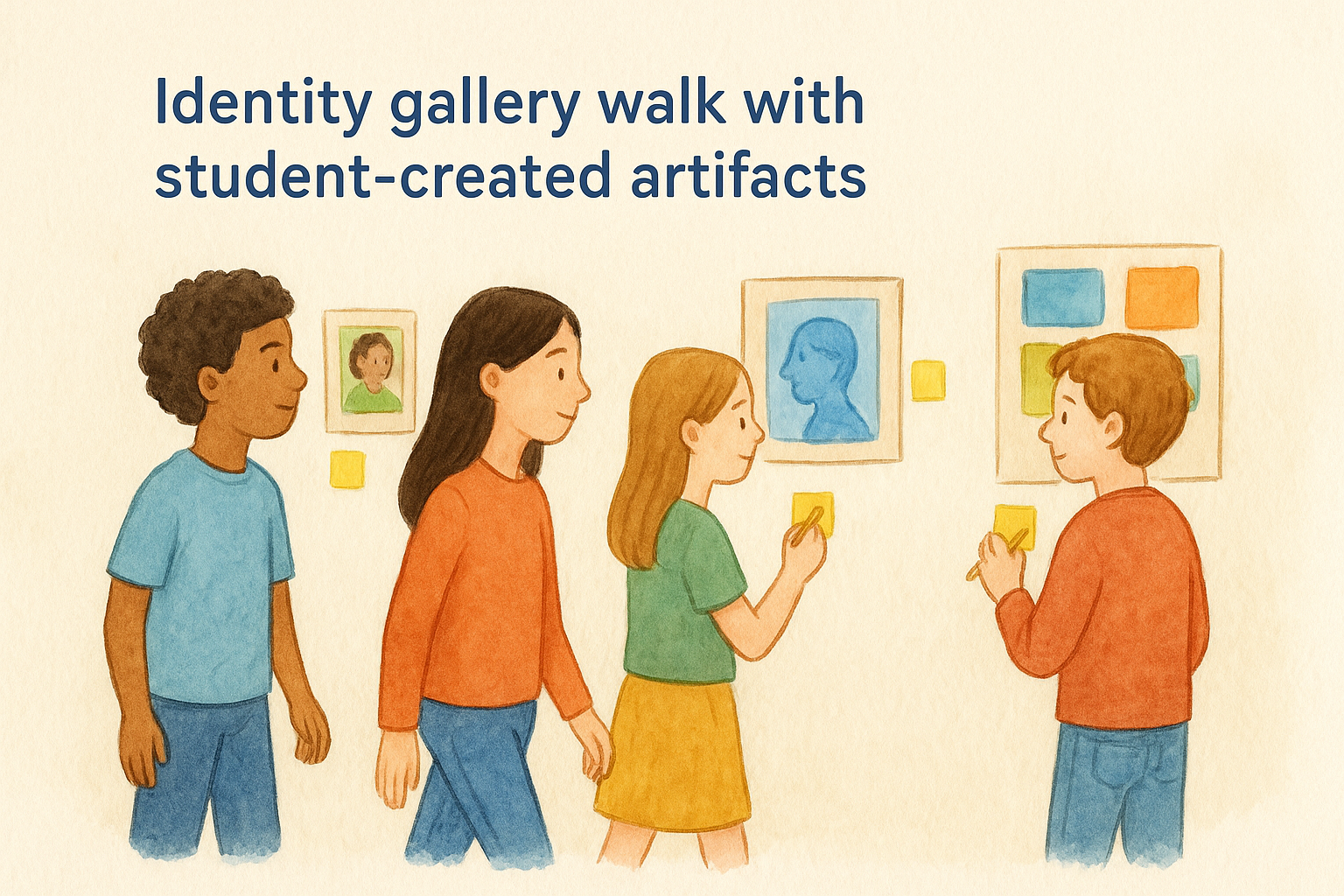
An identity gallery walk sits among the most personal classroom activities to build community because students bring their own lived experiences into the room as the actual content. Instead of learning about each other through structured games, they literally walk through each other’s stories displayed on the walls.
What you build
You’re building genuine understanding across difference by giving students space to share what matters to them on their own terms. When students see each other’s identities represented visually, they form deeper and more lasting connections than most brief icebreakers can produce.
Materials and setup
Each student needs one artifact or visual, such as a photo, a drawing, a short written piece, or a collage that represents something meaningful about who they are. Post them around the room before the activity with sticky notes nearby so classmates can leave written reactions as they move through the space.
Steps to run it
Give students 10 to 15 minutes to walk the gallery silently, reading and leaving brief written responses on sticky notes. Then bring everyone together to share one thing they noticed that surprised or connected with them.
The silent walk keeps the focus on absorbing others’ stories rather than performing reactions in real time.
Variations and differentiation
For students who prefer digital formats, allow them to submit a slide instead of a physical artifact so participation stays accessible to everyone.
Quick troubleshoot
If students feel reluctant to share personal items, offer a menu of prompts at different depth levels so they can choose what feels right without opting out entirely.
9. Weekly class meetings with a simple agenda
Weekly class meetings are classroom activities to build community that keep the relationship between you and your students alive and evolving throughout the year, not just during the first two weeks. A consistent, predictable structure means students come in knowing what to expect, which lowers resistance and increases honest participation.
What you build
You’re building ongoing communication habits and a shared investment in how the class runs week to week. Students who know their concerns get heard in a real forum are far less likely to let small frustrations quietly erode the classroom climate over time.
Materials and setup
Post a simple standing agenda with three to four recurring items: celebrations, concerns or suggestions, and a brief focus topic. Keep the meeting to 15 minutes or less so it fits consistently into your schedule without crowding out instruction.
Steps to run it
Open each meeting by reviewing last week’s follow-through so students see that the previous meeting actually mattered. Move through the agenda quickly, take brief notes on anything that needs action, and close with one clear takeaway or next step the class agrees on.
Consistency matters more than perfection. A short meeting every week builds more trust than a long one held once a month.
Variations and differentiation
Rotate the student facilitator role so different voices lead each week and no single student dominates the format.
Quick troubleshoot
If students raise issues you can’t solve, acknowledge the concern directly, explain what’s within your control, and follow up the next week so nothing disappears.
A simple plan for next week
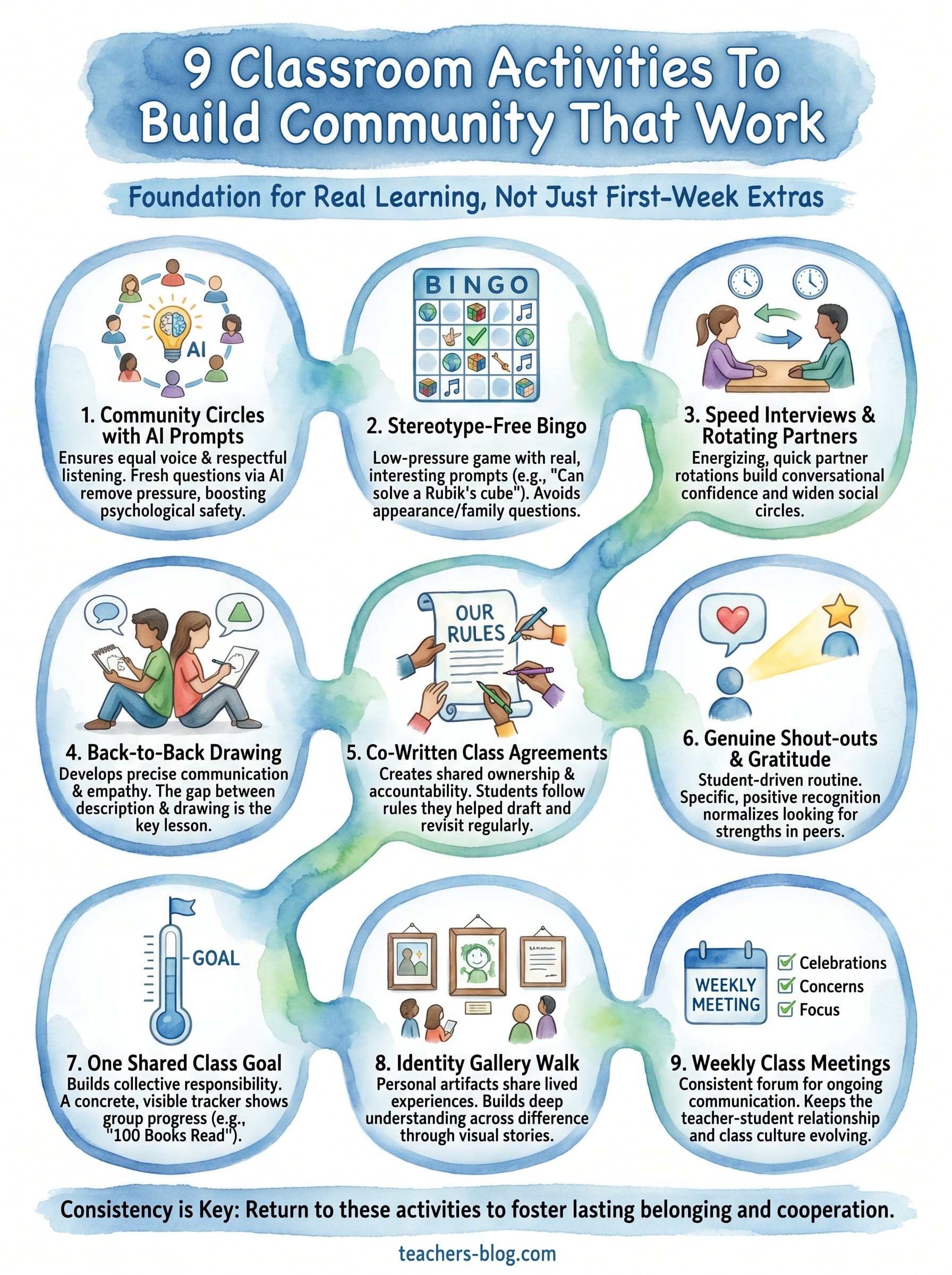
You don’t need to run all nine of these classroom activities to build community at once. Pick one that fits your current class dynamic and run it this week. If you’re starting fresh, a community circle or bingo gives you the most return for the time invested. If you’re mid-year and your class culture has stalled, try co-writing updated class agreements or launching a shared goal with a visible tracker.
Building community is not a box you check in September and move on from. Every activity on this list works best when you return to it consistently, adjusting as your students grow and change. The goal is a room where students feel genuinely connected to each other and to the work you’re doing together.
For more practical teaching strategies and tools that save you time and support your students, visit The Cautiously Optimistic Teacher and explore what’s available for your classroom.