
11 Ways: How To Improve Student Engagement That Work
You’ve planned a lesson you’re genuinely excited about, and then, blank stares. Half the class is zoned out, a few are doodling, and one kid is suspiciously focused on something under their desk. If you’ve ever wondered how to improve student engagement, you’re far from alone. It’s one of the most common challenges teachers face, and it doesn’t mean your teaching is broken. It usually means your strategies need a refresh.
The truth is, engagement isn’t something students just show up with. It’s something we build, through the activities we choose, the relationships we nurture, and the structures we put in place. Research consistently supports what experienced teachers already sense: when students feel connected to what they’re learning and why, they participate more, retain more, and actually enjoy being in your classroom. That’s the kind of outcome worth chasing, and it’s exactly what we focus on here at The Cautiously Optimistic Teacher, practical tools and strategies that make a real difference.
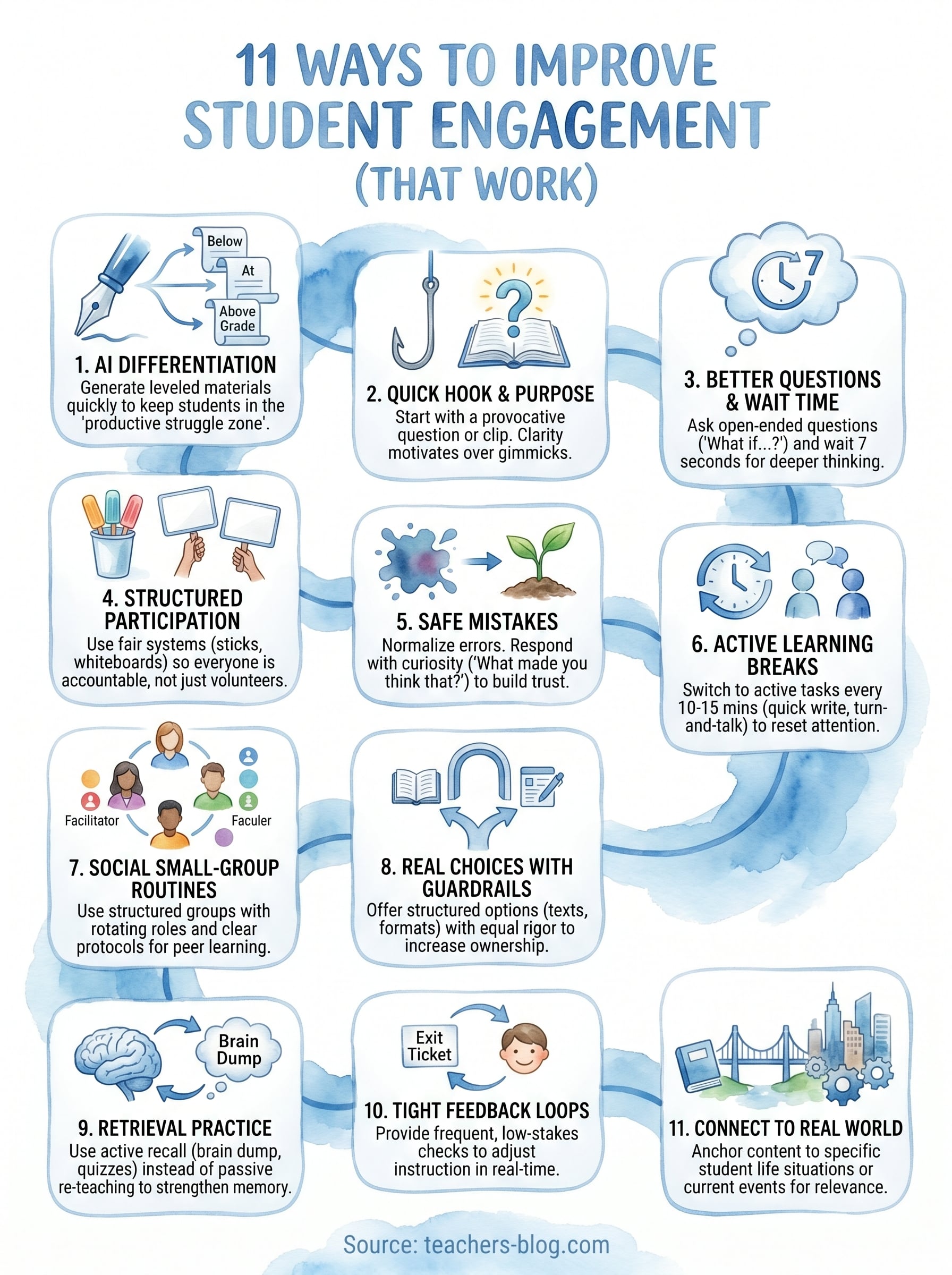
This article breaks down 11 specific, classroom-tested ways to boost engagement across grade levels and subjects. No vague advice. No "just make it fun" hand-waving. Each strategy includes clear steps you can implement this week, whether you teach 6th graders or seniors. Let’s get into what actually works, and why these approaches stick.
1. Use AI to differentiate and plan faster
AI tools have changed what’s possible in lesson planning. Instead of spending a full evening creating three versions of the same worksheet, you can generate differentiated materials in minutes, which frees up real time to observe, coach, and connect with your students during class. That shift in time investment is part of how to improve student engagement at a structural level.
Why it increases engagement
Students disengage when the work is either too easy or too hard. AI helps you close that gap by producing leveled versions of texts, questions, and tasks quickly enough to use in the same week you plan them. When students work on material that actually fits their current level, they stay in that productive struggle zone where real learning happens.
Differentiation is one of the most direct ways to signal to students that the work was designed for them, and students who feel seen work harder.
How to use it in a real lesson
Start with your core learning objective written in plain language, then ask an AI tool to generate two or three versions of your main task: one below grade level, one at grade level, and one above. You can also use it to draft scaffolded instructions, sentence starters, or exit ticket questions. The Differentiated Instruction Helper on this site is built specifically for this workflow, so you’re not starting from a blank prompt each time.
A simple repeatable process looks like this:
- Write your learning goal in one clear sentence
- Paste it into the AI tool and request leveled versions
- Review and edit the output before it reaches students
- Assign versions based on recent data, not assumptions
Where it can go wrong and how to fix it
The most common mistake is using AI output without reading it first. These tools can miss the context of your classroom, produce vague content, or generate questions that don’t quite match your standard. Fix this by treating every AI output as a working draft that needs your eyes before distribution. A five-minute review catches errors, keeps quality consistent, and makes sure the final product actually sounds like something you’d hand out.
2. Start with a quick hook and a clear purpose
The first three minutes of class set the tone for everything that follows. Students decide quickly whether the lesson is worth their attention, so what you do at the start matters more than most teachers realize. A clear, intentional opening is one of the most underused strategies for how to improve student engagement.
Why it increases engagement
When students know why they’re learning something before they start, they’re far more likely to stay with it through the hard parts. Purpose reduces the mental friction that causes disengagement. A strong hook makes the brain curious, and curiosity is a better motivator than compliance every single time.
Students who understand the relevance of a lesson before it begins participate more consistently throughout the full period.
Ways to hook students without gimmicks
Skip the trivia games that have nothing to do with your content. Instead, open with a provocative question, a short video clip, a surprising statistic, or a brief real-world scenario directly tied to your learning goal. These connections pull students in because the content itself becomes the hook, not the entertainment around it.
How to keep the purpose visible all period
Write your learning objective in student-friendly language on the board and refer back to it at least twice during the lesson. Briefly check in at a natural transition point by asking students to connect what they just did to the original goal. Visible purpose keeps students anchored when the lesson shifts direction or the activity changes.
3. Ask better questions and wait longer
The questions you ask shape the thinking your students do. Low-level recall questions get low-level answers, which means most students can coast without ever pushing their thinking. Shifting to higher-order questions is one of the clearest moves for how to improve student engagement because it demands more from every student in the room.
Why it increases engagement
When you ask a question that has more than one defensible answer, students can’t just wait for the "smart kid" to respond. They have to actually think, which pulls them into the lesson. Better questions also signal that their reasoning matters, not just their ability to memorize a correct response.
The quality of your questions determines the quality of your students’ thinking.
Question stems that pull deeper thinking
Not every question needs to be complex, but you should keep a set of reliable stems that push past surface recall. These work across subjects and grade levels:
- "What would happen if…?"
- "What’s the strongest argument against your position?"
- "How does this connect to what we studied last week?"
- "What evidence would change your mind?"
Simple wait-time moves that boost participation
After you ask a question, count silently to seven before calling on anyone. That pause feels uncomfortable at first, but it dramatically increases both the number of students who engage and the depth of what they say. You can also ask students to write their answer before sharing aloud, which gives everyone time to form a real thought before the pressure of speaking kicks in.
4. Replace hand-raising with structured participation
Hand-raising rewards the same five students every class period while everyone else learns they can stay quiet without consequence. If you want to know how to improve student engagement at a structural level, changing how you call on students is one of the fastest fixes available. Structured participation pulls every student into the lesson, not just the ones who volunteer.
Why it increases engagement
When students know they might be called on at any moment, they stop mentally checking out. Structured systems create a low-stakes expectation that everyone participates, which shifts the classroom dynamic from performance-based to practice-based. Passive students become active ones not because they suddenly feel confident, but because the structure makes participation the default.
Engagement rises when participation is an expected routine, not a voluntary choice.
Low-stress ways to call on everyone
Cold-calling without structure feels punitive. Instead, use systems that distribute turns fairly without putting students on the spot unprepared:
- Popsicle sticks or random name cards drawn from a cup
- Think-Pair-Share before any whole-class response
- Whiteboard responses where every student writes and holds up an answer simultaneously
How to grade participation without drama
Tying participation to a grade backfires when students fear judgment more than they value points. A better approach is to track quality contributions using a simple checklist, noting things like asking a question, building on a peer’s idea, or citing evidence. Sharing the criteria upfront removes ambiguity and makes participation feel achievable for quieter students, not just the vocal ones.
5. Build safe mistakes into learning
Fear of being wrong is one of the most underrated causes of disengagement. When students believe that making an error in front of peers leads to embarrassment or judgment, they stop trying altogether. This directly undermines how to improve student engagement because the students who most need to practice are the ones most likely to go silent.
Why it increases engagement
Psychological safety is the foundation of active participation. When students trust that errors are a normal and expected part of learning, they take risks, ask questions, and attempt harder tasks. A classroom without that safety becomes one where only the most confident students contribute, and everyone else watches from a safe distance.
Students who aren’t afraid to be wrong try more often, and trying more often is exactly how learning accelerates.
How to lower fear of being wrong
Start by normalizing mistakes publicly and consistently. When a student gives an incorrect answer, respond with curiosity rather than immediate correction. Ask follow-up questions to unpack their thinking before redirecting. Sharing your own errors and reasoning process out loud also helps, because it signals to students that struggle is part of the work, not a sign of failure.
Language that makes risk-taking normal
The phrases you use every day shape your classroom culture more than any single activity. Small word swaps make risk-taking feel expected rather than optional:
- Replace "That’s wrong" with "What made you think that?"
- Swap "Who has the answer?" with "Take a guess and walk us through your thinking"
- Say "Not yet" instead of "No"
6. Use active learning every 10 to 15 minutes
The human brain is not built for extended passive listening. After about 10 to 15 minutes, attention drops sharply, and students who were with you at the start start to drift. Building structured activity breaks into your lessons is one of the most direct answers to how to improve student engagement, because it works with how the brain actually processes information, not against it.
Why it increases engagement
When students switch from receiving information to doing something with it, their brains re-engage. Active processing forces students to retrieve, apply, or connect what they just heard, which both deepens understanding and signals to their brain that the material is worth holding onto. Passive learning produces passive students, but a brief task resets attention and raises energy in the room.
Ten minutes of active processing beats forty minutes of passive listening every time.
High-uptake routines you can repeat weekly
The best active learning routines are ones students already know how to do, so you’re not re-explaining the process each time. These work across subjects and take under five minutes:
- Quick writes: students write everything they remember about a topic for 90 seconds
- Turn-and-talk with a specific prompt tied to your lesson objective
- Sketch-to-stretch: students draw a visual representation of a key concept
How to keep transitions tight
Clear verbal signals and practiced routines prevent activity transitions from burning five minutes you don’t have. Give students a specific time limit before the activity starts, and count down the last 30 seconds so they wrap up rather than stopping cold mid-thought.
7. Make learning social with small-group routines
Students learn more when they talk through ideas with peers than when they absorb information through passive listening alone. Building consistent small-group routines into your weekly schedule is a direct way to improve student engagement because it turns learning into a shared process rather than a solitary one. The key word is routine: groups that work together regularly get better at it, which means less classroom management time for you as the semester moves forward.
Why it increases engagement
Social interaction activates the brain in ways that solo work simply cannot. When students explain, debate, and build on each other’s thinking, they process content at a deeper level and stay more present throughout the lesson. Accountability to peers raises effort in ways that accountability to a teacher alone rarely achieves.
Students who regularly talk through content with peers retain information at significantly higher rates than those who only listen.
Group roles that prevent uneven workload
Without clearly assigned roles, one student does the work while others watch. Use rotating roles that spread the responsibility across every group member:
- Facilitator: keeps the group moving and on time
- Recorder: captures the group’s main ideas in writing
- Reporter: shares the group’s findings with the whole class
- Challenger: pushes peers to consider opposing views
Quick protocols for talk that stays on-task
Give groups a specific structured prompt rather than a vague "discuss this." Tight protocols keep conversation focused and accountable. Set a visible timer, and before groups start, tell them exactly what a useful response looks like.
These formats require minimal setup and work across subjects:
- Numbered heads together: each student gets a number and must be ready to report
- Timed round-robin: everyone responds briefly in turn with no interruptions
- Jigsaw: each person becomes an expert on one piece, then teaches the others
8. Give students real choices with clear guardrails
Choice is one of the most reliable levers for boosting motivation in any classroom. When students get to decide how they demonstrate understanding, they invest more in the outcome because the work feels like theirs. Unstructured choice, though, creates chaos rather than engagement, which is why guardrails matter just as much as the freedom itself.
Why it increases engagement
Autonomy is a core psychological need. When students feel some control over their learning, they shift from complying with your lesson to actually owning it. That shift is one of the clearest answers to how to improve student engagement because it moves motivation from external to internal, which is far more durable.
Students who exercise meaningful choice in their work produce higher-quality results and report greater satisfaction with the task.
Choice ideas for reading, writing, and projects
You don’t need to rebuild your entire curriculum to offer meaningful options. Small, structured choices create real ownership without overwhelming your planning time:
- Reading: let students choose between two texts at the same reading level
- Writing: offer a choice of format, such as an essay, a letter, or a structured reflection
- Projects: allow students to select how they present findings, whether visually, verbally, or in writing
How to keep rigor consistent across options
Every choice option must meet the same learning standard. Build a shared rubric before you offer options, and check each choice against it to confirm the cognitive demand stays equal across the board. If one option is clearly easier, students will notice, and your rigor will erode.
9. Use retrieval practice instead of re-teaching
When students struggle with content, the instinct is to re-teach the whole thing. The problem is that re-teaching is passive for students who already partially understand and boring for those who don’t. Retrieval practice, which asks students to actively pull information from memory rather than receive it again, is a far more effective tool for how to improve student engagement and long-term retention.
Why it increases engagement
Retrieving information from memory feels harder than re-reading, and that difficulty is exactly the point. The effortful process of recalling what you know strengthens the memory trace in ways that passive review simply cannot match. Students stay mentally active during retrieval tasks because there is no text to lean on, just what they can produce on their own.
Retrieval practice consistently outperforms re-reading and re-teaching in studies on long-term retention.
Fast retrieval routines for any subject
These three formats take under five minutes and work across grade levels and content areas:
- Brain dump: students write everything they remember about a topic with no notes open
- Two-question quiz: you ask two specific questions from last week’s lesson before starting anything new
- Retrieval partner: students take turns quizzing each other using their own generated questions
How to use results to adjust instruction
Don’t collect retrieval responses and move on. Quickly scan what students produce and look for common gaps before continuing. If most students miss the same concept, spend three minutes addressing it directly rather than re-teaching the entire unit. This keeps your instruction tight and responsive without losing class time.
10. Tighten feedback loops with low-stakes checks
Students disengage when they don’t know how they’re doing. If feedback only arrives after a major test, students have already moved on mentally and the information comes too late to change anything. Frequent, low-stakes checks give students real-time information about their learning and help you adjust instruction before small gaps grow into large ones. This is a practical and often overlooked piece of how to improve student engagement at the daily classroom level.
Why it increases engagement
When students receive timely, specific feedback, they stay connected to the learning process rather than just waiting to see a grade at the end of a unit. Feedback signals that what they’re doing right now matters, not just what appears on a final assessment. Frequent checkpoints also reduce the anxiety that builds when students feel unsure whether they’re on the right track.
Students who receive consistent, low-stakes feedback try harder and recover from confusion faster than those who only hear from you at test time.
Formative checks that take under five minutes
You don’t need complicated systems to check understanding quickly. These three formats are reliable and easy to repeat all semester:
- Exit tickets: one targeted question students answer before leaving class
- Confidence check: students self-report their understanding level on a specific concept using a simple three-point scale
- One-sentence summary: students write the main idea of the lesson in a single sentence
How to respond so students believe it matters
Collecting exit tickets and doing nothing with them teaches students the check is just a ritual. Read responses before the next class and open your following lesson by addressing what you found. A two-minute acknowledgment that says "several of you struggled with X, so let’s address that now" shows students their feedback actually shapes what happens next.
11. Connect content to student lives and the real world
Students disengage fast when they can’t see why any of this matters to them personally. Relevance is not a nice-to-have element you sprinkle in at the end of a unit. It’s a core driver of attention, and building it into your daily lessons is one of the most direct ways to address how to improve student engagement across any subject or grade level.
Why it increases engagement
When students see a clear line between your content and their actual lives, the cognitive burden of staying engaged drops significantly. They’re no longer quietly fighting the question "why do I need to know this?" They’re already inside the material because it connects to something they recognize, care about, or experience regularly.
Relevance shifts the burden of motivation from the teacher to the content itself.
Ways to make relevance specific, not generic
Generic statements like "you’ll use this someday" do almost nothing for engagement. Instead, anchor your content to specific situations students already know. These moves make relevance concrete rather than vague:
- Tie a persuasive writing unit to a real debate happening in your school or community
- Connect a math concept to a financial decision students will face soon, like splitting costs or budgeting
- Link a historical event to a current situation students have already heard about
Prompts that get students to supply the connection
The most effective relevance move is having students generate the connection themselves, rather than you declaring it. Use these short prompts at the start or close of a lesson:
- "Where did you see this idea show up outside of school this week?"
- "Who in your life deals with this, and how do they handle it?"
Next steps for your classroom
You don’t need to implement all 11 strategies at once. Pick two or three that fit where your class is right now and build from there. Start with the ones that address your most pressing problem, whether that’s passive participation, fear of being wrong, or students who check out within the first five minutes. Small, consistent changes produce more lasting results than a full classroom overhaul attempted in a single week.
Every strategy in this list connects back to the same core idea: how to improve student engagement comes down to designing conditions where students feel challenged, supported, and connected to what they’re learning. That work is ongoing, and you won’t get it perfect every day. What matters is that you keep adjusting based on what you observe. If you want tools that support this process directly, explore the AI-powered resources for teachers on this site and put them to work in your next lesson.