
How to Handle Disruptive Students: 12 Practical Strategies
One kid taps a pencil, another cracks a joke at the worst possible moment, and suddenly your entire lesson plan is off the rails. If you are searching for how to handle disruptive students, you already know the daily toll: lost instructional time, frayed patience, and a class that feeds off the chaos instead of the lesson. You are not failing at classroom management. Disruption is one of the most common and exhausting parts of teaching, and most advice you find online is either too vague or too punitive to actually work.
This article skips the generic "stay calm" platitudes and gets into specific, classroom-tested techniques you can use starting tomorrow. Each strategy below targets a different type of disruption, from the student who craves attention to the one who shuts down and checks out, so you can match the response to the actual behavior in front of you.
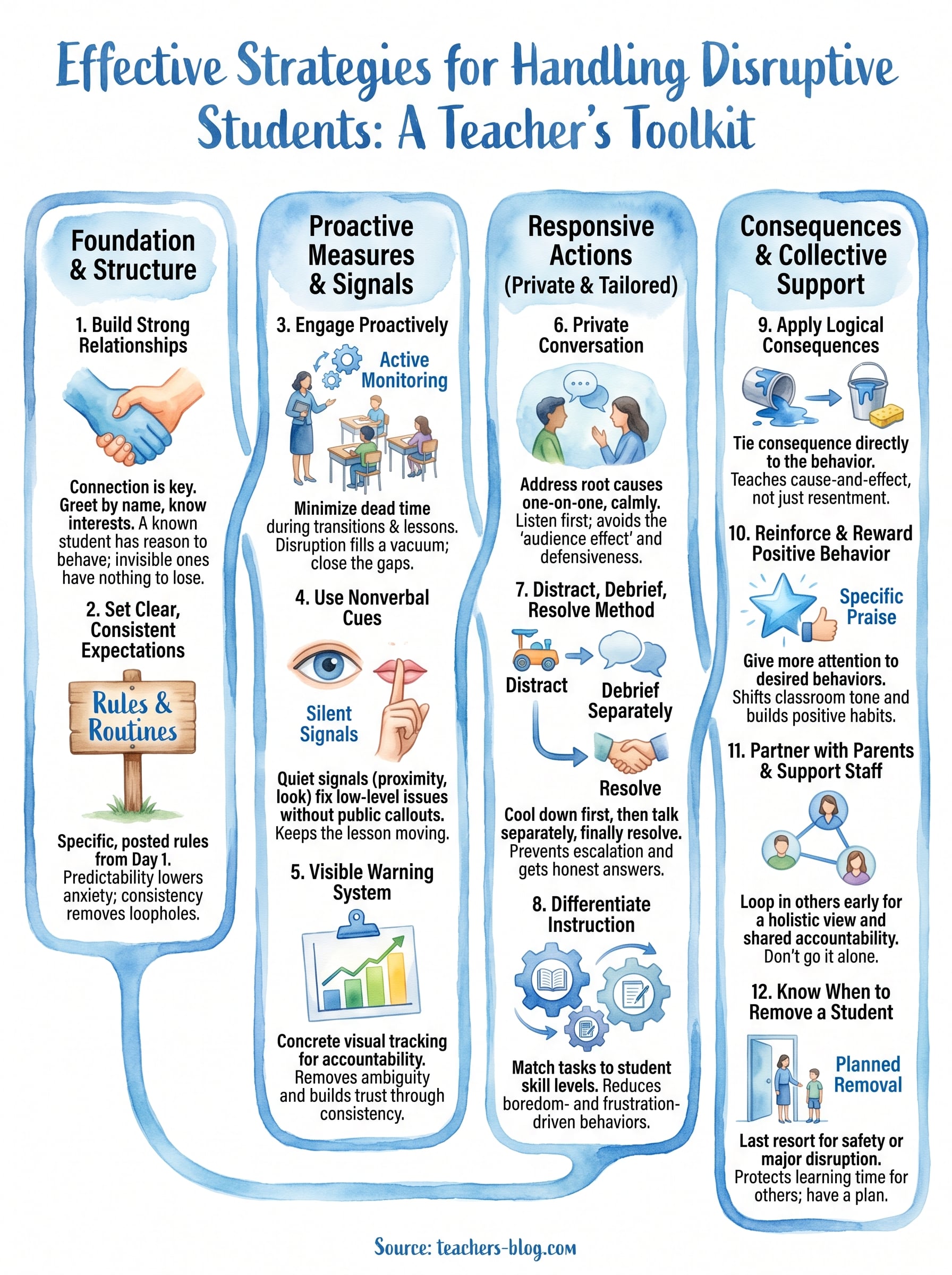
You will find 12 practical strategies covering seating adjustments, nonverbal cues, private redirects, and proactive engagement tactics that prevent disruptions before they start. Whether you teach middle school or high school, these steps build a calmer, more focused classroom without sacrificing your energy or your relationship with students.
1. Build strong relationships with your students
Most disruptive behavior is a bid for connection, even when it looks like the opposite. Students who feel invisible or disliked by a teacher have nothing to lose by acting out, while students who feel genuinely known by you have a reason to keep their behavior in check. This is why relationship-building sits at the top of this list instead of buried in the middle: it is the foundation every other strategy here depends on. Skip this step and warning systems, consequences, and redirects become a game of whack-a-mole instead of a real solution.
What it looks like
A strong teacher-student relationship shows up in small, repeated moments rather than one big gesture. It’s greeting kids by name at the door, remembering that a student has a soccer game on Friday, or noticing when someone who is usually chatty goes quiet. It also means your most challenging students get the same warmth as your easiest ones, even on the days they’ve tested your patience the most.
Why it works
Research on student-teacher relationships consistently links them to better behavior and engagement, and the logic tracks with anyone who has spent a year in front of a classroom. Students behave better for adults they trust and respect. When a student feels seen, correcting their behavior becomes a conversation between people who know each other, not a power struggle between a rule-enforcer and a rule-breaker. The CDC’s guidance on school connectedness notes that students who feel connected to adults at school show fewer behavior problems and better academic outcomes across the board (https://www.cdc.gov/healthyyouth/protective/index.htm).
A student who feels known by you has a reason to behave; a student who feels invisible has nothing to lose.
How to implement it
You don’t need an extra planning period to build these relationships. Small, consistent habits do more than one elaborate gesture:
- Greet every student by name at the door each day.
- Keep a simple notes file (even just sticky notes) on each student’s interests, so you can ask about them later.
- Spend two minutes of downtime talking to your most disruptive student about something unrelated to school.
- Send one positive note home or email per week to a parent, focused on a different student each time.
- Eat lunch in your room once a week and let a few students stop by.
Common mistakes to avoid
Teachers often reserve relationship-building for the students who are easiest to like, which leaves the students who need it most feeling shut out. Others treat it as a one-time investment at the start of the year instead of an ongoing habit that has to survive difficult days. Avoid the trap of connecting with a student only after a behavior incident, since that teaches them that acting out is the fastest way to get your attention. Instead, invest in the relationship on the calm days so you have something to draw on during the hard ones.
2. Set clear, consistent expectations from day one
Ambiguity invites testing. When students don’t know exactly what’s allowed, they’ll find the edges of your tolerance through trial and error, usually during instruction time you can’t afford to lose. Clear expectations remove that guesswork before it starts, and they work best when they’re established in the first week rather than patched together after the first disruption catches you off guard.
What it looks like
A classroom with clear expectations has posted, specific rules like "raise your hand before speaking" instead of vague ones like "be respectful." Students can tell you the routine for entering the room, submitting work, or asking to use the bathroom without checking with you first. Consistent enforcement means the same behavior gets the same response whether it’s a quiet Tuesday or the Friday before break.
Why it works
Predictability lowers anxiety and reduces the number of decisions a student has to make on the fly, which is exactly when disruptive impulses tend to win. The American Psychological Association’s guidance on classroom management notes that structured environments with defined behavioral expectations correlate with fewer disciplinary incidents (https://www.apa.org/education-career/k12/classroom-management). Kids also test consistency more than rules themselves; if they see exceptions made for some students, they’ll push to find out if they qualify too.
Vague rules invite testing; specific, consistently enforced ones close the loopholes before students find them.
How to implement it
Write three to five rules in concrete, observable language, post them where students see them daily, and teach them explicitly like content, with modeling and practice in the first week. Revisit them after long breaks, since routines fade fast over a holiday.
Common mistakes to avoid
Many teachers write too many rules, which makes enforcement inconsistent because no one, including the teacher, can remember them all. Others state expectations once in August and assume they’ll stick without reinforcement. The bigger error is inconsistency itself: letting a rule slide for a favorite student or a good day teaches the whole class that the rules are negotiable, and negotiation is exactly what fuels disruption.
3. Engage students proactively before disruptions start
Disruption often shows up right when engagement drops, not the other way around. The gap between finishing a task and getting new instructions, the three minutes after a video ends, the lull right after lunch, these are the moments where side conversations and off-task behavior take root. Proactive engagement means you’re watching for those gaps and filling them before a student fills them for you.
What it looks like
A proactively engaged classroom has almost no dead air. You’re circulating during independent work instead of sitting at your desk, calling on students who look like they’re drifting before they act out, and building transitions that take seconds instead of minutes. You notice the kid doodling instead of writing and redirect with a quiet question rather than waiting for the doodling to turn into talking.
Why it works
Most disruptive behavior fills a vacuum. Give students less unstructured time and fewer unclear moments, and you give them less opportunity to disrupt. Active monitoring also signals that you’re paying attention, which alone discourages some students from testing you. The strategy works because it treats disruption as a symptom of low engagement rather than a personality flaw, which keeps your response calmer and more effective.
Disruption fills the gaps you leave open; close the gaps and you close the opportunity.
How to implement it
Build engagement into your lesson structure instead of hoping it happens naturally:
- Plan transitions to the minute, with instructions given before students move, not after.
- Circulate constantly during independent or group work instead of staying at your desk.
- Use quick checks for understanding (thumbs up, whiteboards, cold calling) every 8 to 10 minutes.
- Have a bell-ringer or warm-up ready the moment students walk in, so there’s no idle window.
- Watch for the two or three students most likely to disengage and check in with them first.
Common mistakes to avoid
Teachers often plan the content of a lesson carefully but leave transitions and downtime as an afterthought, which is exactly where disruptions sneak in. Others confuse proactive engagement with constant teacher talk, when the real goal is active student participation. Skipping circulation because you’re tired or busy grading is a common shortcut that costs you more time in redirection than it saves.
4. Redirect low-level behavior with nonverbal cues
Not every disruption deserves a verbal response, and calling one out often gives it more oxygen than it deserves. Nonverbal redirection lets you correct a student without stopping the lesson or putting them on display in front of peers, which matters most for kids who act out for attention. A quick signal handles the tap of a pencil or a side conversation before it grows into something that needs a bigger response.
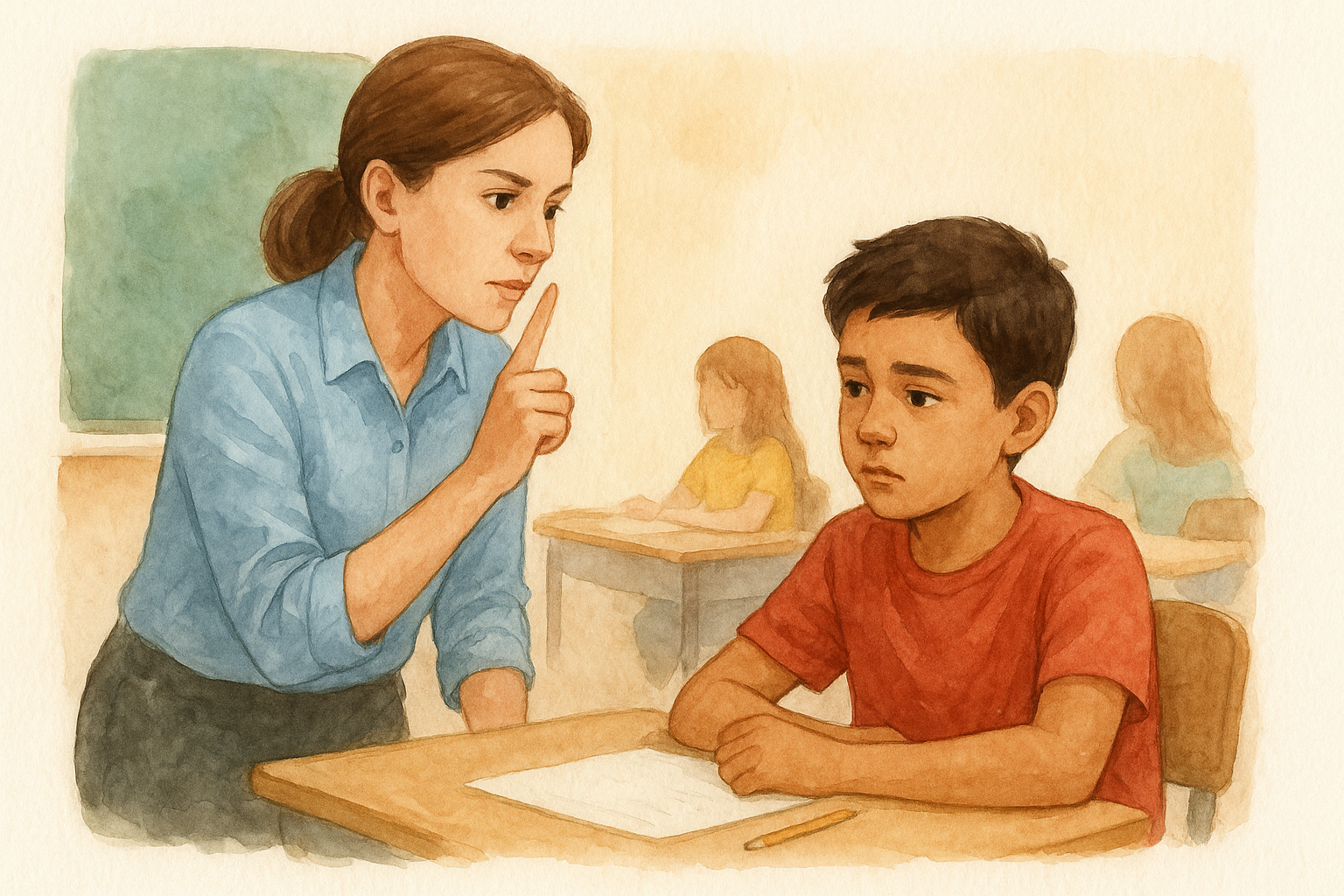
What it looks like
A teacher who uses this well might make eye contact and raise an eyebrow, walk over and stand near a talkative student while continuing to teach, or tap lightly on a desk to bring focus back. Proximity control does a lot of the work here; simply moving closer to a student often ends the behavior without a word exchanged.
Why it works
Verbal corrections interrupt instruction and can escalate a minor issue into a public confrontation, especially with students who crave an audience. Nonverbal cues sidestep both problems. They keep the lesson moving, avoid embarrassing the student, and signal awareness without inviting a response that could turn into an argument.
A quiet signal fixes a minor disruption before it becomes a public one.
How to implement it
Agree on a few simple signals with your class early in the year, such as:
- A raised hand meaning "eyes up here."
- A finger to the lips paired with eye contact for talking.
- Standing near a desk while continuing to teach, without pausing or looking at the student.
- A pointed look toward the clock or task as a reminder to refocus.
Use these consistently so students learn to read them instantly, without needing an explanation each time.
Common mistakes to avoid
Some teachers rely on cues that are too subtle for students to notice or too harsh, like a glare, which can feel more like a public callout than a quiet nudge. Others skip this step entirely and jump straight to verbal warnings, missing the chance to redirect quietly first. Overusing one signal until it loses meaning is another common slip, so rotate cues based on what actually gets a response from each student.
5. Use a visible warning system for accountability
Some disruptions survive a look or a quiet word, and that’s when students need to see the consequence coming before it lands. A visible warning system gives every student in the room the same clear signal: this behavior has a cost, and the cost is about to go up. It works best as a middle step, after nonverbal cues have already failed but before you pull a student aside for a bigger conversation.
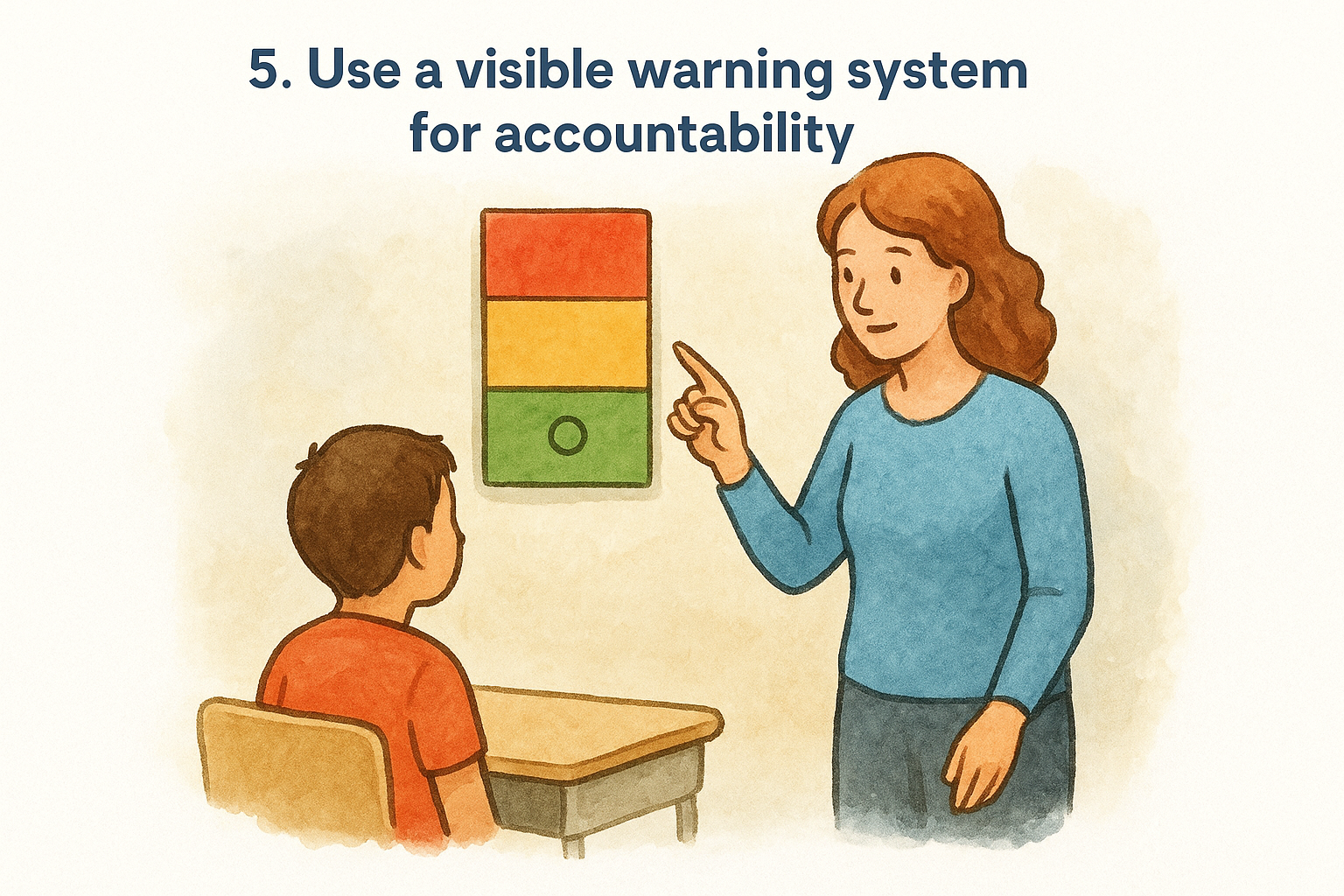
What it looks like
Many teachers use a clip chart, colored card system, or a simple tally on the board that tracks warnings without naming names loudly. A student moves from green to yellow, or gets a mark next to their number, and everyone in the room understands what that shift means without you saying a word. The system stays visible all day, so students can self-monitor instead of waiting to be caught.
Why it works
Visible tracking turns an abstract warning into something concrete a student can see and react to. It also removes the ambiguity that fuels arguments, since the chart or tally shows exactly where a student stands instead of relying on your memory or their protest that "you never said that counted." Consistency here builds trust, because students learn the system applies the same way to everyone, every day.
A visible warning system replaces arguments about fairness with a record everyone can see.
How to implement it
Pick one simple system and stick with it for the full year:
- Assign each student a number or spot on a chart, not their name, to reduce public shame.
- Move a marker or clip after a specific, previously explained behavior, not a mood-based judgment call.
- Reset the system daily so students start fresh each morning.
- Pair each level with a known consequence, so movement on the chart isn’t just symbolic.
Common mistakes to avoid
Teachers sometimes use the chart inconsistently, moving a clip for one student’s behavior but letting another slide, which erodes the trust the system depends on. Others turn it into public shaming by announcing moves loudly instead of letting the visual do the work quietly. Skipping the follow-through, where a warning never actually leads to a consequence, teaches students the whole system is a bluff.
6. Address root causes with a calm, private conversation
Repeated disruption from the same student usually points to something deeper than defiance. A private conversation lets you find out what’s actually going on, whether that’s trouble at home, an undiagnosed learning gap, or simple boredom, without the audience of the classroom shaping how a student responds. This is one of the more direct answers to how to handle disruptive students who don’t respond to smaller interventions like cues or warnings.
What it looks like
Pick a low-stakes moment, like after class or during independent work, and pull the student aside quietly. Ask open questions instead of leading with accusations: "I’ve noticed you’ve seemed frustrated in class lately, what’s going on?" works better than "Why do you keep acting up?" The tone stays curious, not confrontational, and you genuinely listen before you talk about consequences.
Why it works
Students shut down when they feel accused in front of peers, but they often open up one-on-one. Addressing the root cause rather than the symptom means the behavior is less likely to repeat, since you’re solving the actual problem instead of just suppressing its latest appearance. A student struggling with reading, for example, may act out during silent reading time purely to avoid looking incapable in front of classmates.
Treat the behavior as a symptom, not the problem, and the real problem stops repeating.
How to implement it
Keep it short, private, and judgment-free:
- Choose a moment away from peers, even just a hallway conversation.
- Open with curiosity, not accusation.
- Listen more than you talk for the first few minutes.
- End with a clear, small next step you both agree on.
Common mistakes to avoid
Many teachers skip straight to consequences without asking why the behavior is happening, missing patterns that repeat all year. Others hold the conversation in front of classmates, which guarantees defensiveness instead of honesty. Avoid turning it into a lecture; if you talk the entire time, you’ll never learn what’s actually driving the behavior.
7. Apply the distract, debrief, resolve method
Some conflicts flare up too fast for a private conversation to work in the moment, and confronting them head-on only feeds the audience effect. The distract, debrief, resolve method gives you a three-step sequence for exactly this situation: cool things down first, talk it through later, and only then decide what happens next. It’s one of the most practical answers to how to handle disruptive students who escalate quickly in front of peers.
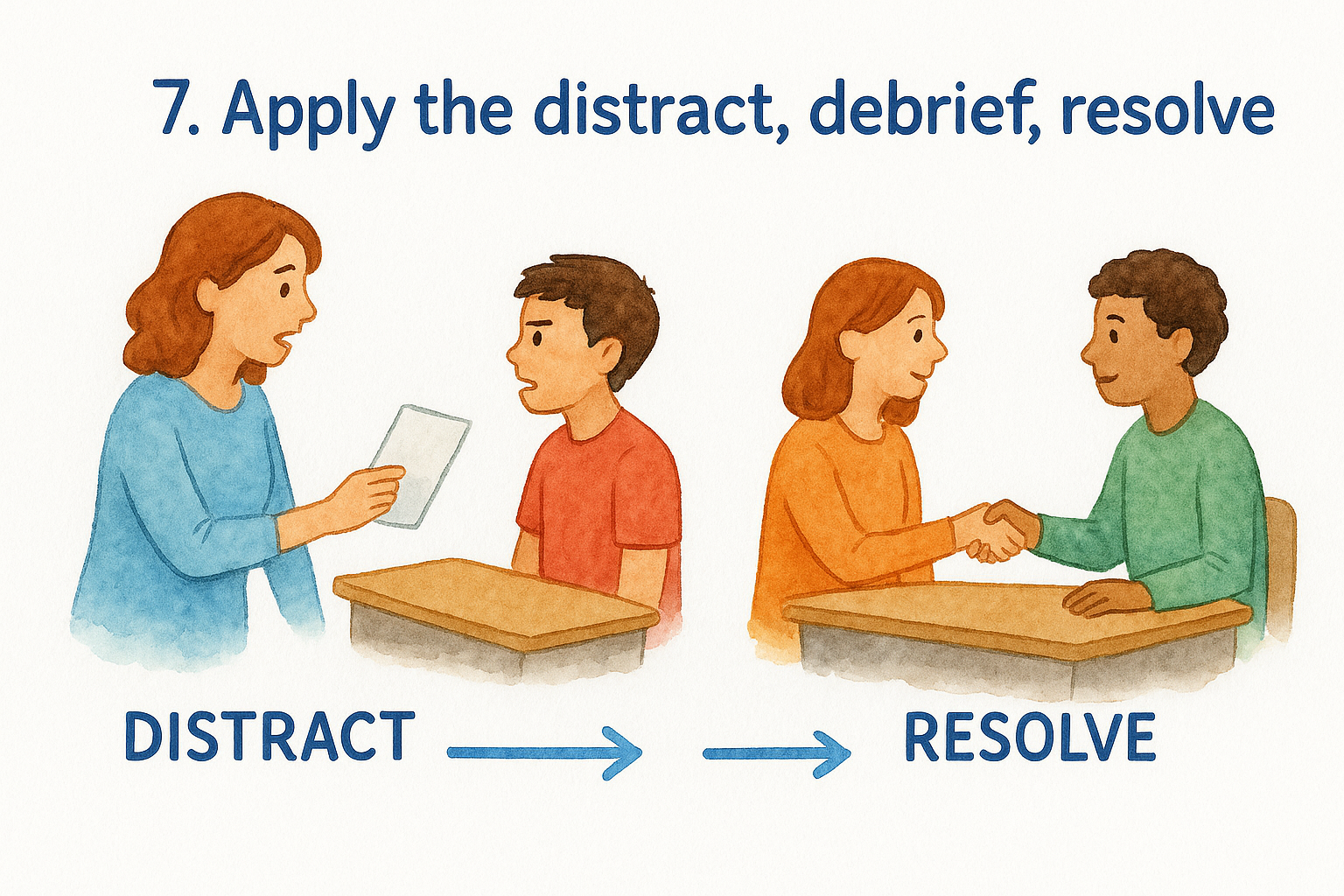
What it looks like
Picture two students snapping at each other mid-lesson. Instead of stopping class to referee, you separate them with a quick task, one gets sent to grab supplies, the other to hand out papers. That’s the distract. Later, during a passing period or independent work time, you debrief with each student separately, asking what happened and what they were feeling. Only after both conversations do you resolve the issue, whether that means an apology, a seating change, or a logical consequence.
Why it works
Students in an emotional spike can’t reason clearly, so trying to resolve conflict in that moment usually backfires. The distraction step buys everyone time to calm down without ignoring the behavior. Debriefing separately removes the pressure to save face in front of classmates, which gets you closer to the truth. Resolving last means your response addresses what actually happened instead of a reaction shaped by adrenaline.
Cooling down before resolving beats resolving before anyone’s calm enough to think straight.
How to implement it
Use this sequence deliberately rather than improvising each time:
- Distract with a task, not a threat, something that physically separates the students involved.
- Debrief each student alone, asking open questions before offering your own read of events.
- Resolve with a consequence or agreement only after both sides have spoken.
Common mistakes to avoid
Teachers often skip the distract step and demand answers immediately, which locks students into defensive positions before they’ve calmed down. Others debrief both students together, guaranteeing a shouting match instead of honest answers. Rushing the resolve step before hearing both sides tends to leave one student feeling unfairly blamed, which plants the seed for the next disruption.
8. Differentiate instruction to reduce boredom-driven behavior
Boredom drives more disruption than most teachers admit, and it hits from both directions: the student who finished early with nothing to do, and the student who’s lost and gives up rather than ask for help. Differentiated instruction closes both gaps by matching the work to where each student actually is, instead of teaching to an imaginary average student who rarely exists in a real classroom.
What it looks like
A differentiated classroom has students working on tasks pitched to their level within the same lesson, not necessarily the same worksheet. One group might tackle an extension question while another gets a scaffolded version with sentence starters. Tiered assignments let every student stay challenged without anyone finishing ten minutes early with nothing to do but talk.
Why it works
Students disengage when work feels too easy or too hard, and disengagement is where disruption starts. Matching the task to the student removes the two most common triggers for acting out: boredom and frustration. Fewer idle minutes mean fewer chances for a student to fill the gap with something you didn’t plan.
A bored student and a lost student cause the same disruption for opposite reasons.
How to implement it
Start small rather than overhauling every lesson at once:
- Build one extension question into every assignment for early finishers.
- Offer a scaffolded version of the same task for students who need more support.
- Use flexible grouping based on skill, not just who sits together.
- Keep a folder of "anchor activities" ready for students who finish early.
Common mistakes to avoid
Teachers often equate differentiation with more work, creating three separate lesson plans instead of adjusting one. Others differentiate content but forget pacing, leaving fast finishers stuck waiting with nothing to do. Skipping this step because it feels time-consuming usually costs more time later, spent managing the disruptions boredom creates.
9. Apply logical, consistent consequences
Warnings and redirects only carry weight if something follows them, and that something needs to make sense to the student receiving it. Logical consequences tie the response directly to the behavior instead of handing out a generic punishment that feels arbitrary. A student who disrupts group work loses group work privileges for a class period. A student who wastes materials cleans up the mess. The connection matters more than the severity.
What it looks like
A classroom running on logical consequences skips detention-for-everything and instead matches the response to the specific disruption. Talking during a test means moving seats for the next one. Refusing to do an assignment means finishing it during recess or lunch instead of getting a zero and moving on. Students can predict what happens next because the pattern repeats every time, not just when you’re in the mood to enforce it.
Why it works
Consistency is what makes a consequence land as fair rather than personal. Research on classroom discipline, including guidance from the U.S. Department of Education, points to consequences that are predictable and directly related to the behavior as more effective than punishment for its own sake (https://www2.ed.gov/policy/gen/guid/school-discipline/index.html). When a consequence connects logically to the action, students learn cause and effect instead of just resentment toward you.
A consequence that makes sense teaches a lesson; one that feels random just teaches resentment.
How to implement it
Decide your consequences in advance, before you’re frustrated in the moment:
- Match the consequence to the behavior whenever possible.
- Keep a short list of go-to consequences ready so you don’t improvise under pressure.
- Deliver them calmly and without lecturing.
- Apply them the same way regardless of which student is involved.
Common mistakes to avoid
Teachers often reach for the harshest available consequence when they’re angry, which breaks the logical connection and feels like punishment instead of accountability. Others let consequences slide for students they like, which undoes the trust the whole system depends on. Threatening a consequence you never follow through on is the fastest way to teach a class that your word doesn’t mean much.
10. Reinforce and reward positive behavior
Punishing what you don’t want often gets more attention than praising what you do want, even though the second approach changes behavior faster. Positive reinforcement shifts a classroom’s whole tone, because students start working for recognition instead of just avoiding trouble. This matters most for kids who’ve built a reputation as the disruptive one, since they rarely hear their name attached to anything good.
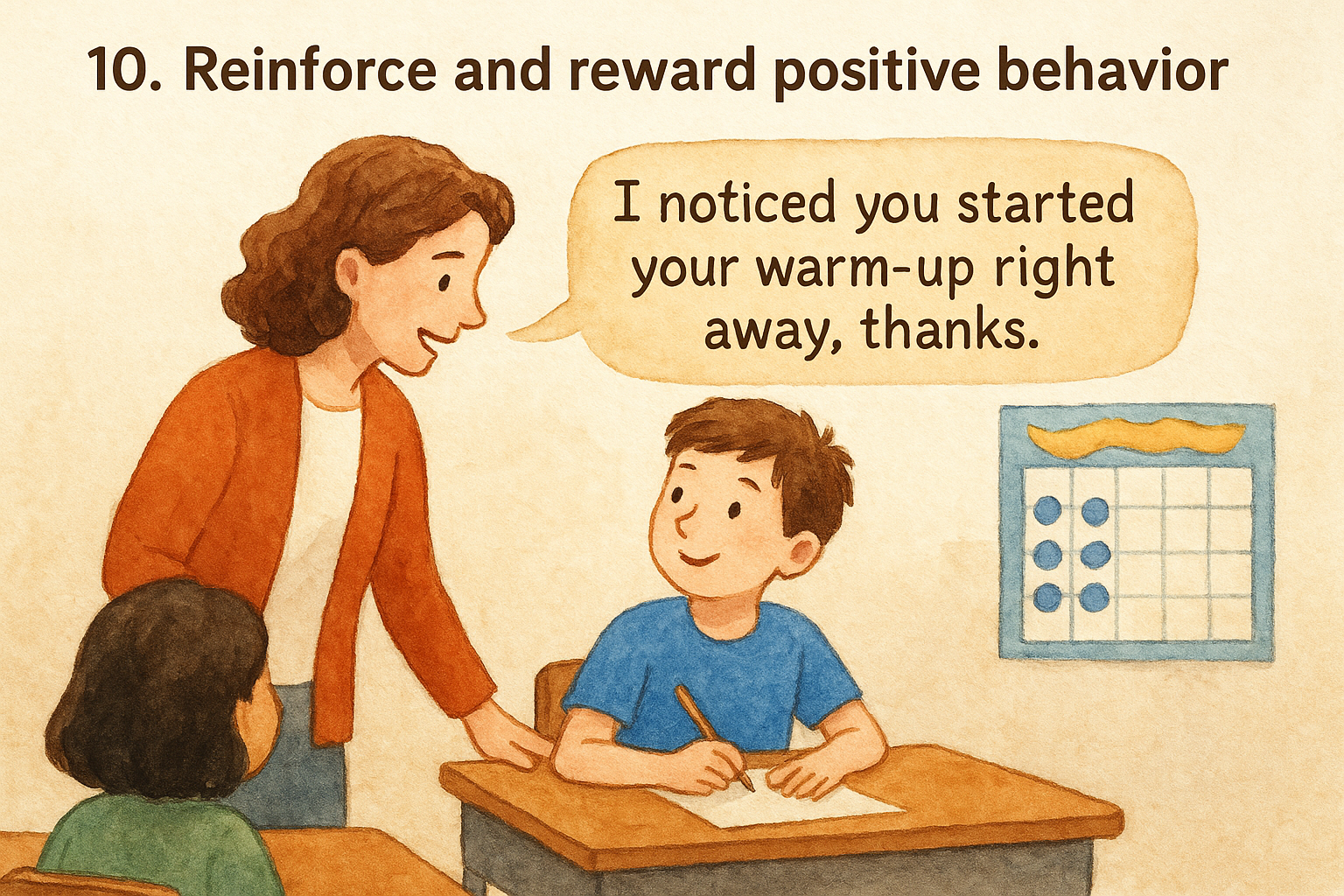
What it looks like
A teacher using this well catches a student following directions and says so out loud, specifically: "I noticed you started your warm-up right away, thanks." Specific praise beats generic praise every time, since "good job" teaches nothing while naming the exact behavior tells a student what to repeat. Some teachers pair this with a simple token system, like marbles in a jar or points toward a class reward.
Why it works
Students repeat behavior that gets attention, and for many disruptive kids, negative attention has been the only reliable kind they get. Flipping that pattern removes the payoff for acting out. This is a core piece of how to handle disruptive students long-term, since consequences stop misbehavior in the moment but reinforcement builds the habits that prevent it from returning.
Attention shapes behavior, so make sure the behavior you want gets more of it than the behavior you don’t.
How to implement it
Build recognition into your daily routine instead of treating it as an occasional bonus:
- Name the specific behavior when you praise it, not just the student.
- Catch your most disruptive students doing something right at least once a day.
- Use a visible class reward system tied to collective effort, not just individual stars.
- Send positive notes home separate from any behavior concerns.
Common mistakes to avoid
Teachers often praise only their easiest students, which leaves the kids who need reinforcement most without any. Others rely on vague, repetitive phrases that stop registering after the tenth use. Skipping this step because it feels less urgent than discipline is a mistake, since consistent recognition does more to prevent disruption than any consequence ever will.
11. Partner with parents and support staff
Some disruptive patterns are too big for one teacher to solve alone, and trying to handle everything solo often burns you out faster than the behavior itself. Partnering with parents and school support staff, like counselors, deans, or special education teams, spreads the responsibility and often surfaces information you’d never get from the classroom alone. This step matters most for chronic disruption that hasn’t responded to the strategies above.
What it looks like
A teacher doing this well loops in parents early, before a behavior becomes a pattern, with a quick call or email describing what you’ve noticed and what you’ve already tried. Support staff involvement might mean a counselor pulling a student for a short check-in, or a case manager adjusting accommodations that were never quite right for the classroom. Nobody finds out about the problem for the first time at a formal meeting.
Why it works
Parents and support staff often see sides of a student you never will, from a rough home situation to an undiagnosed anxiety issue. Bringing them in early means solutions get built around the whole student, not just the version you see for one period a day. Shared accountability also means the student hears the same message from multiple adults, which carries more weight than one teacher’s voice alone.
One teacher’s classroom is only part of a student’s story; loop in the adults who know the rest.
How to implement it
Make outreach a habit, not a last resort:
- Contact parents after the second or third repeated incident, not the tenth.
- Loop in a counselor or dean before behavior escalates to a formal referral.
- Share specific, observed behaviors rather than general complaints.
- Ask support staff what’s already documented about the student before assuming you’re starting from zero.
Common mistakes to avoid
Teachers often wait too long to contact parents, saving it for a crisis instead of an early warning. Others frame these conversations as complaints rather than collaborative problem-solving, which puts parents on the defensive instead of on your side.
12. Know when and how to remove a student from class
Sometimes a student’s behavior crosses a line that no cue, warning, or private talk can fix in the moment, and keeping them in the room does more damage than removing them. Removing a student should be a last resort, reserved for safety issues or behavior that’s actively stopping the rest of the class from learning, not a shortcut you reach for out of frustration. Knowing this line in advance keeps you from making the call emotionally.
What it looks like
A calm removal looks nothing like a shouting match. You state the behavior plainly, name the destination (the office, a buddy classroom, the counselor), and send the student on their way without an audience-pleasing speech. Planned removal follows a procedure everyone in the building already knows, so the moment feels routine instead of dramatic.
Why it works
Letting one student derail an entire class period costs every other student instructional time they can’t get back. Removal protects that time and gives the disruptive student a chance to reset away from an audience that was feeding the behavior. It also signals that some behaviors have a hard limit, which matters for classroom credibility.
Removal isn’t giving up on a student; it’s protecting everyone else’s right to learn while that student gets the support they actually need.
How to implement it
Set this up before you ever need it:
- Agree on a clear threshold in advance (safety risk, repeated defiance after other steps failed).
- Know your building’s procedure and destination before an incident happens.
- Deliver the direction calmly, without debate in front of the class.
- Follow up with the student and support staff once things settle.
Common mistakes to avoid
Teachers sometimes use removal for minor annoyances, which teaches students that acting out gets them out of class, exactly the opposite of the intended effect. Others skip the follow-up conversation, treating removal as the end of the issue rather than the start of addressing it properly.
Putting these strategies into practice
No teacher runs all 12 of these strategies at once, and you shouldn’t try. Pick the one or two that match the disruption you’re actually facing this week, whether that’s a relationship gap with one student or a class-wide need for clearer expectations. Layer in more as the first ones become habit, and give each strategy a few weeks before deciding if it’s working.
Handling disruptive students isn’t about finding one perfect trick. It’s about building a toolkit you can reach into depending on what’s in front of you, from a quiet nonverbal cue to a bigger conversation with parents and support staff. The teachers who feel calmest in front of tough classes aren’t the ones with the fewest disruptions; they’re the ones who know exactly what to do next.
If you want more ready-to-use classroom strategies like these, explore the resources at The Cautiously Optimistic Teacher and keep building your toolkit.