
How To Create A Classroom Management Plan: 8 Easy Steps
You’ve got your lesson plans ready, your materials prepped, and your content knowledge is sharp, but none of it matters if students are talking over you, off-task, or testing boundaries every five minutes. That’s exactly why knowing how to create a classroom management plan is one of the most critical skills you can develop as a teacher. It’s not about being strict or controlling. It’s about building a structure that lets actual learning happen.
The problem is, most teacher prep programs barely scratch the surface here. You graduate, walk into a classroom, and suddenly realize that managing 30 different humans with 30 different needs is a skill nobody really taught you. You’re left piecing things together from Pinterest boards, veteran teacher advice, and pure survival instinct. Some of it works. A lot of it doesn’t. And without a clear, written plan, you end up reacting to problems instead of preventing them.
Here at The Cautiously Optimistic Teacher, we build resources that help educators work smarter, from AI-powered tools to ready-to-use unit plans. This guide is no different. Below, you’ll find 8 straightforward steps to build a classroom management plan that actually holds up under real-world pressure, complete with practical examples and actionable strategies you can start using right away.
What to decide before you write your plan
Before you write a single rule or procedure, settle a few foundational questions. Jumping straight into "no phones" and "raise your hand" without thinking through the bigger picture is what leads to plans that sound good on paper but fall apart by October. Spend 20 to 30 minutes working through the decisions below before putting anything formal on the page.
Know your grade level, subject, and student demographics
Your classroom management plan needs to match the age group and subject you teach. A plan built for 10th graders in a small elective looks nothing like one designed for 6th graders in a 35-student core class. Think about attention spans, developmental needs, and how much independence your students can realistically handle at the start of the year.
Factor in student demographics and specific learning needs before you write anything. If you teach a special education class, your plan needs to account for IEP accommodations and behavior support strategies. If you have a high number of English Language Learners, your rules and procedures need visual support and clear modeling, not just text on a poster. The more specific you are about who sits in your room, the more targeted your plan will be.
The more specific your student context is, the more effective your classroom management plan becomes.
Clarify your teaching philosophy
Your management style should reflect your core values as a teacher. If you believe strongly in student autonomy, a rigid, teacher-controlled system will feel forced and hard to maintain. If you prioritize structure and predictability, a highly flexible approach will leave both you and your students uncertain. Neither philosophy is wrong, but you need to identify which one guides your decisions before building a plan around it.
Writing down two or three beliefs you hold about how students learn best gives you a clear north star for your plan. These beliefs shape every decision you make later, from how you respond to misbehavior to how much student input you invite when setting classroom rules.
Consider your physical space
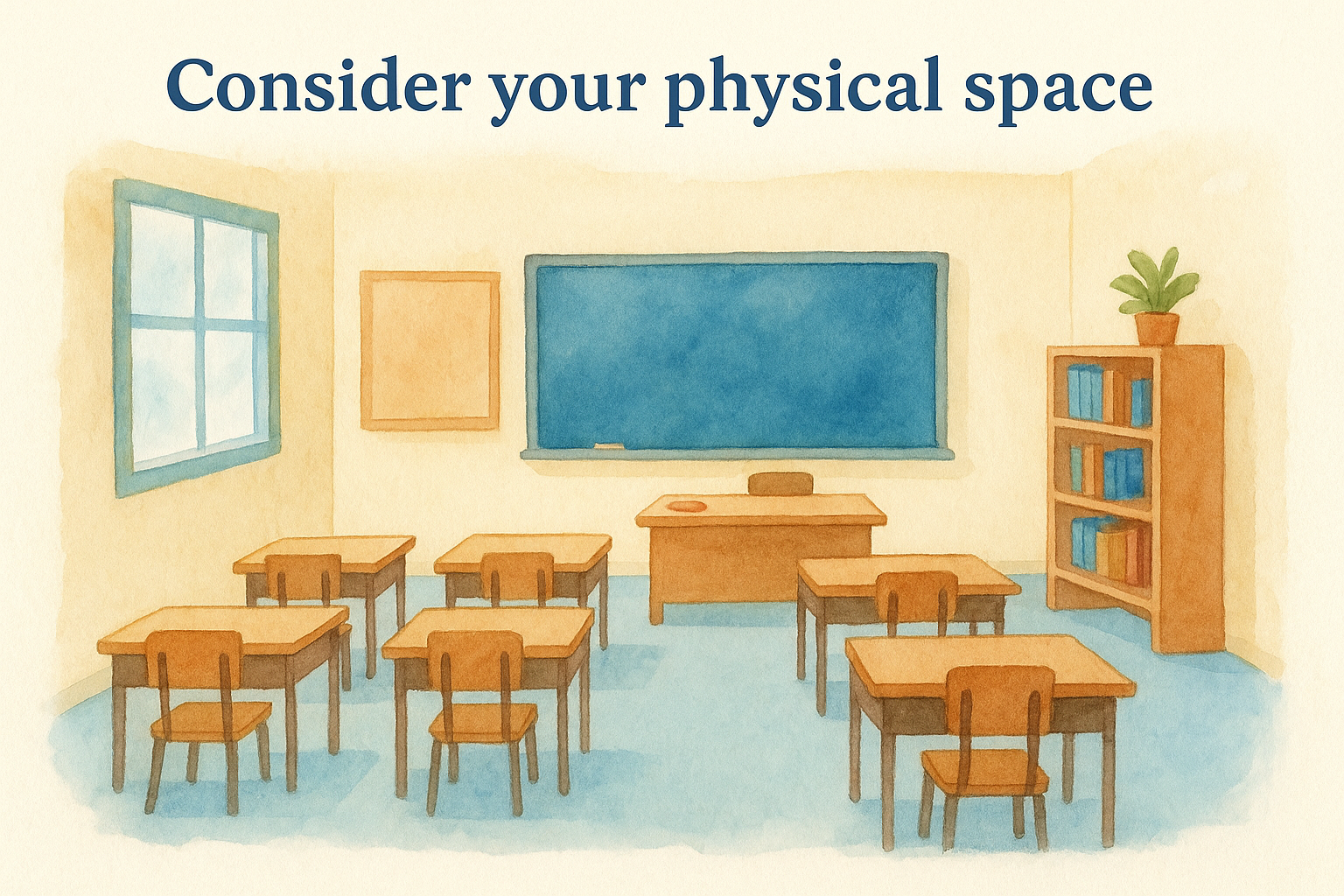
Your classroom layout directly affects how students behave. If students sit in rows, your plan works differently than if they sit in collaborative groups or stations. Before you write procedures for transitions or materials distribution, walk through your actual space and think about the physical flow. Where do students enter? Where do supplies live? How do students move from their seats to the front of the room without creating a bottleneck?
Use this simple planning template before you draft anything formal:
| Decision Area | Your Answer |
|---|---|
| Grade level and subject | |
| Class size | |
| Known student needs (IEPs, ELLs, etc.) | |
| Teaching philosophy | |
| Classroom layout | |
| School behavior policies to align with |
Filling this in first means that when you get to the actual steps of how to create a classroom management plan, you’re writing from a specific, grounded foundation rather than working from generic assumptions.
Steps 1–2: Set goals and align with policies
Before you write any rules, you need to know what you’re actually trying to achieve and what constraints already exist at your school. These two steps form the foundation that everything else in your plan builds on, and skipping them is the fastest way to end up with a plan that conflicts with school policy or has no clear purpose.
Step 1: Define your classroom goals
Your goals tell you and your students what success looks like in your room. Without clear goals, your management plan becomes a list of prohibitions with no real direction behind them. Start by identifying two or three specific outcomes you want your classroom environment to produce, and keep them focused on student behavior and learning conditions, not curriculum content.
Here are examples of strong, specific classroom goals:
- Students transition between activities in under two minutes without losing focus.
- Every student contributes at least once to whole-class discussion each period.
- Students resolve minor peer conflicts independently before involving the teacher.
Clear goals give your rules a purpose, which makes it far easier to explain them to students and get genuine buy-in.
Write your goals in plain, direct language you’d actually say out loud. Vague goals like "maintain a positive environment" are hard to measure and even harder to act on.
Step 2: Align with school and district policies
No classroom management plan exists in isolation. Your school likely has existing behavior policies, referral procedures, and disciplinary frameworks that you’re expected to work within. Before you finalize anything, read through your school’s student handbook and your district’s code of conduct carefully.
Identify the areas that directly affect your classroom:
- When are you expected to involve administration, and how are referrals processed?
- What does the school’s phone or dress code policy require?
- Are there specific consequences the school mandates for particular behaviors?
Knowing how to create a classroom management plan within these boundaries means you avoid contradicting school policy and building student confusion. Note every non-negotiable policy and design your classroom rules to reinforce them directly, not duplicate or undercut them.
Steps 3–4: Write rules and teach procedures
With your goals set and policies mapped, you’re ready to write the visible parts of your plan: the rules students will follow and the procedures that keep daily routines running. These two elements work together but serve very different purposes, and mixing them up is one of the most common mistakes teachers make when figuring out how to create a classroom management plan.
Step 3: Write clear, enforceable rules
Your classroom rules define expected behavior in broad terms. Keep your list to three to five rules maximum. Fewer than three leaves gaps; more than five becomes background noise students stop reading. Each rule should be stated positively, observable, and enforceable without making judgment calls on the fly. "Be respectful" is too vague to enforce fairly. "Wait until a classmate finishes speaking before responding" is specific enough to act on every single time.
Rules written in positive, observable language give students a clear target to meet rather than a list of things to avoid.
Here are strong examples of classroom rules that hold up across grade levels:
- Follow directions the first time they are given.
- Keep your workspace clear of phones and unrelated materials during instruction.
- Use a level 2 voice during group work.
- Stay in your seat unless you have permission to move.
Step 4: Teach and practice procedures explicitly
Procedures cover the specific steps students follow during recurring situations: entering the room, turning in assignments, or transitioning between activities. Unlike rules, procedures are not about behavior standards but about logistics. Students don’t skip steps out of defiance; they skip them because nobody modeled the steps clearly in the first place.
Spend your first two weeks of school teaching every major procedure the same way you would teach academic content. Model each step, have students practice it, and give low-stakes corrective feedback. Document your procedures before school starts using this template:
| Procedure | Steps | When to practice |
|---|---|---|
| Entering class | Check the board, begin warm-up immediately | First week, daily |
| Turning in work | Write name, place in tray, return to seat | First week, daily |
| Asking for help | Try independently, ask a partner, raise hand | First two weeks |
Steps 5–6: Use consequences and reinforcement
Rules and procedures only work when students know what happens if they follow them and what happens if they don’t. This is the part of how to create a classroom management plan that makes or breaks the whole system. Without a clear, consistent consequence structure paired with a genuine reinforcement strategy, your rules become suggestions rather than real expectations students take seriously.
Step 5: Build a logical consequence system
Your consequences need to be predictable, proportional, and directly connected to the behavior rather than reactions you make up in the moment. A student talking during instruction shouldn’t receive the same response as a student who repeatedly refuses to work across multiple days. Build a tiered system that gives you a clear path to follow every single time, regardless of how your day is going.
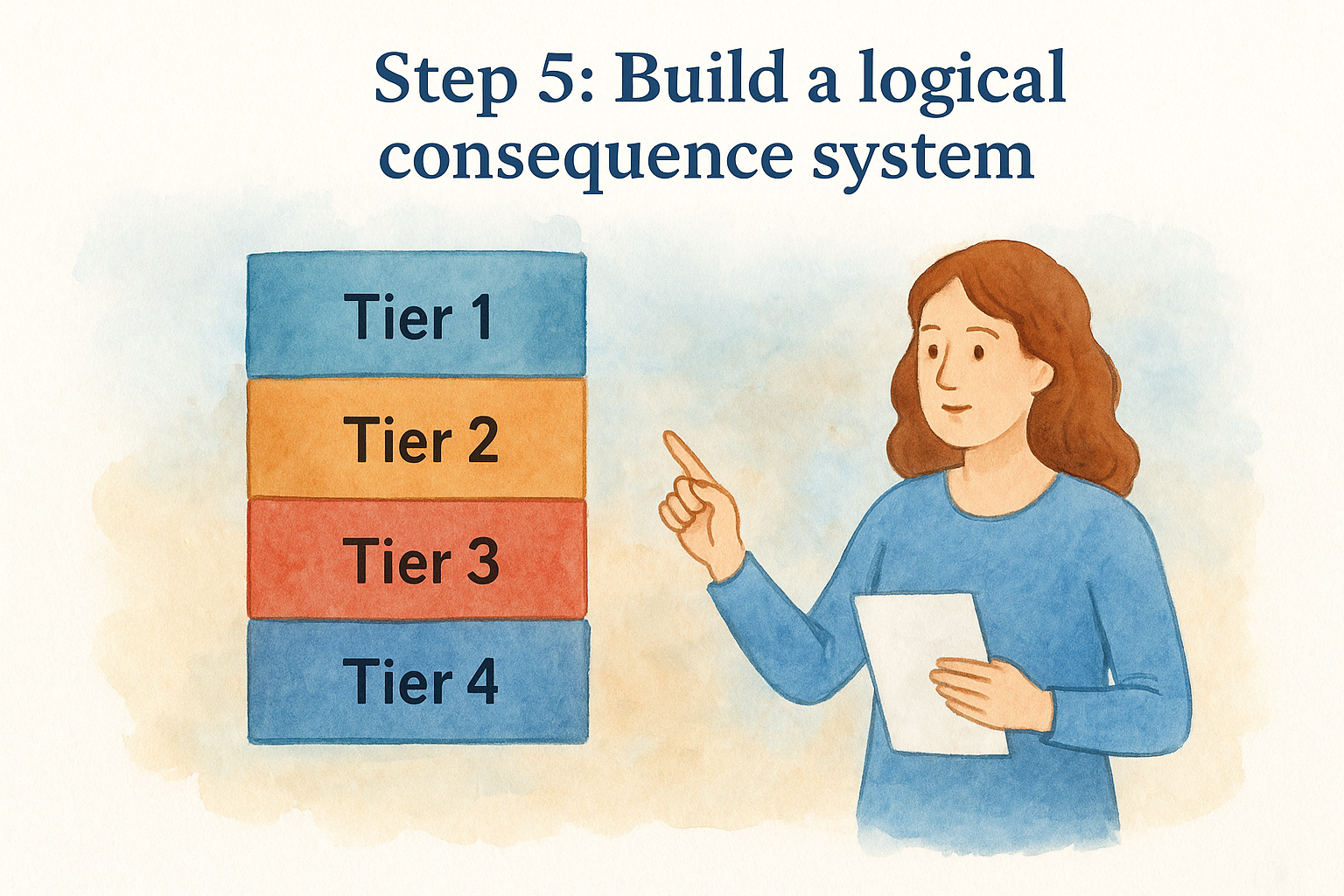
Here is a simple tiered consequence framework you can adapt to your classroom:
| Tier | Behavior Type | Teacher Response |
|---|---|---|
| 1 | Minor (off-task, talking out) | Private verbal reminder |
| 2 | Repeated minor behavior | Proximity, brief individual check-in |
| 3 | Moderate (defiance, disruption) | Seat change, parent contact, documentation |
| 4 | Serious (threats, safety issues) | Immediate admin referral |
Consistent consequences remove the guesswork for students and significantly reduce the emotional weight you carry every day.
Apply consequences calmly and privately whenever the situation allows. Public callouts escalate situations that a quiet one-on-one word could resolve in under ten seconds.
Step 6: Reinforce positive behavior consistently
Reinforcement is not about handing out prizes or over-praising students for meeting basic expectations. It’s about naming specific behaviors clearly and frequently enough that students know exactly what you want repeated. When you see it, say it directly: "I noticed you got started on the warm-up before I even finished taking attendance. That’s exactly what I’m looking for."
Build low-effort, high-impact reinforcement habits into your daily routine from day one. Positive phone calls home, brief public acknowledgments, or a simple whole-class tracking system all work well across grade levels. Reinforce the behaviors you want to see every day, not only when you happen to remember.
Steps 7–8: Partner with families and refine
Your plan doesn’t fully function until families understand it and you’ve tested it against real classroom conditions. Steps 7 and 8 take your plan from a first draft to a living system that grows stronger as the year progresses.
Step 7: Communicate your plan to families
Send a clear summary of your classroom expectations home within the first week of school. Parents and guardians who understand your system from the start are far more likely to reinforce your classroom norms at home and support you when problems arise. Keep your communication brief, specific, and free of educator jargon so it’s accessible to every family regardless of background.
Families who understand your plan early become partners in maintaining it, rather than people you only contact when something goes wrong.
Include these core elements in your family communication:
- A plain-language description of your three to five classroom rules
- Your consequence sequence, written as a clear numbered list
- How families can expect to hear from you (phone call, email, or a communication app)
- The best way to reach you if they have concerns or questions
Follow up with a personal phone call for any student who arrived with documented behavior concerns or an IEP. Those families need to know from day one that you’re proactive, not reactive.
Step 8: Review and refine your plan regularly
Your first version of how to create a classroom management plan will not be your final version, and that’s completely normal. Set a specific review date at the four-week mark to evaluate what’s holding up and what students are still struggling with consistently. Use concrete data: note how often you issue Tier 3 consequences, which procedures break down most frequently, and which rules generate the most student questions.
Adjust one or two elements at a time rather than rewriting the entire plan mid-year, which creates confusion for students who have already internalized your routines. Document your changes and the reasoning behind each one so you carry those practical lessons into your next school year with a far clearer starting point.
Next steps for a calmer classroom
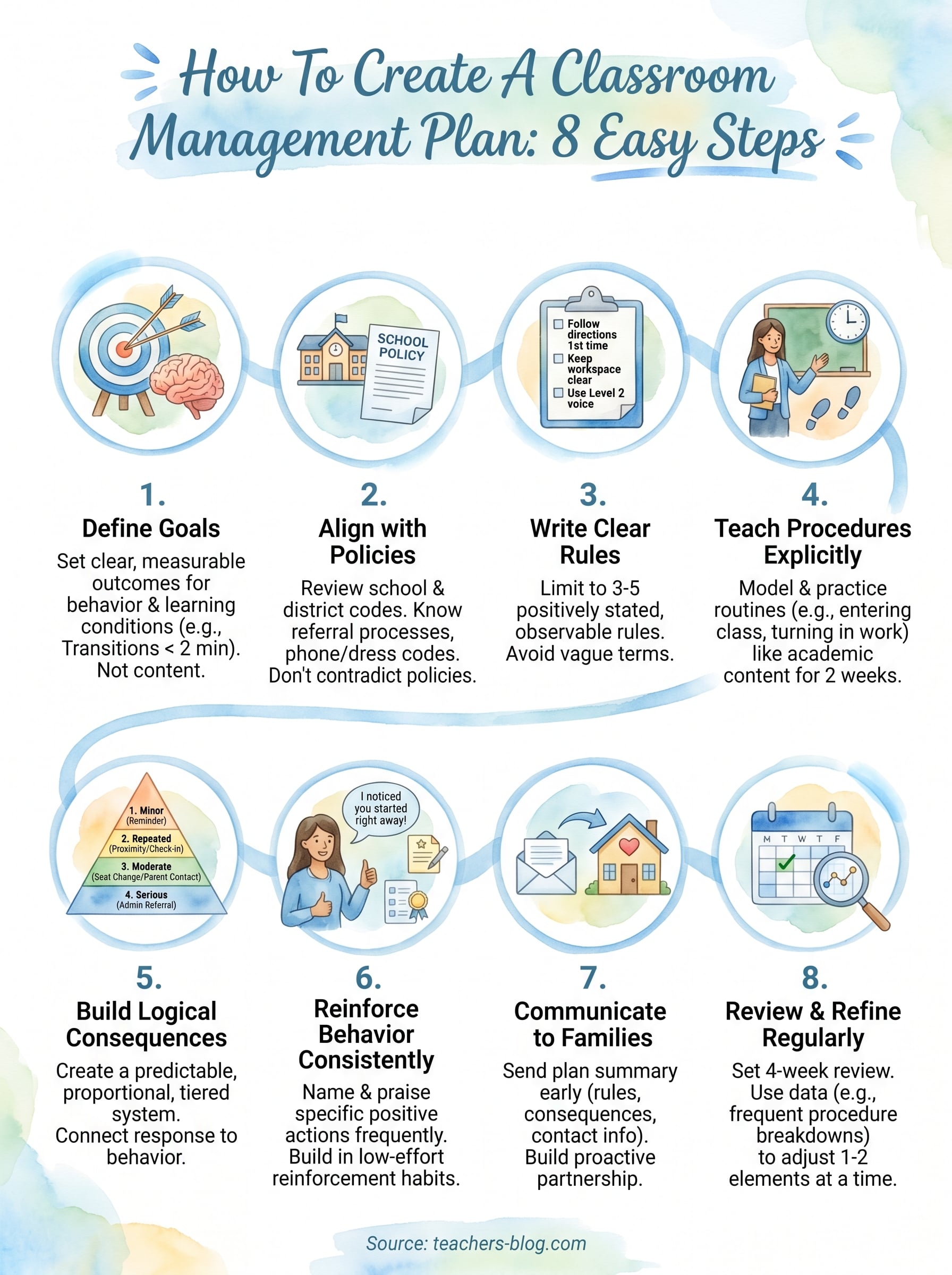
You now have a complete picture of how to create a classroom management plan that actually works in a real classroom. The eight steps above give you a clear sequence to follow, from setting goals and aligning with school policy to partnering with families and refining your approach over time. None of this requires a perfect first attempt. It requires a written plan you commit to and adjust based on real evidence.
Start this week by filling out the pre-planning table from the first section, then work through the steps in order. Don’t wait until a problem forces your hand. A proactive plan built before issues arise is dramatically easier to maintain than one you scramble to put together in crisis mode. If you want more practical tools and strategies to support your teaching practice, visit The Cautiously Optimistic Teacher for resources built specifically for educators like you.