12 Effective Teaching and Learning Methods That Work
You’ve watched a lesson fall flat even though you planned it carefully, and you’ve watched a quick, almost improvised activity light up the whole room. That gap is what sends most teachers searching for effective teaching and learning methods that actually hold up in a real classroom, not just in a textbook. If you’re tired of guessing which strategies are worth your prep time, you’re in the right place.
The honest answer to which teaching methods are most effective is that no single approach works for every subject, grade, or group of kids. What works is knowing a solid set of research-backed strategies and matching them to your students’ needs, then adjusting based on what you see happening in front of you. That’s the mindset behind every method on this list.
Below you’ll find twelve practical, classroom-tested approaches, from differentiated instruction to formative assessment techniques, that you can start using this week. Each one includes specific classroom applications so you’re not left wondering how to turn theory into Monday’s lesson plan.
1. Differentiated instruction
Differentiated instruction is the practice of adjusting your content, process, or product based on where each student actually is, not where the curriculum guide assumes they are. It’s one of the most talked-about effective methods of teaching because it directly tackles the reality every teacher faces: a single classroom holding kids reading three grade levels apart, working through the same unit at wildly different paces.
How it works
Instead of delivering one lesson to thirty students and hoping it lands, you build in flexibility at key points. That might mean offering the same short story at three reading levels, letting students choose between writing an essay or recording a video response, or grouping kids by skill for a specific task and regrouping them the next day for something else. The goal isn’t a different lesson plan for every student; it’s targeted flexibility built into the plan you already have.
Why it’s effective
When instruction matches a student’s actual skill level, they spend less time frustrated or bored and more time in what researchers call the productive struggle zone. Students who are behind get scaffolding instead of sinking further; students who are ahead get pushed instead of coasting through review they’ve already mastered. This is why differentiated instruction shows up consistently in research-backed strategies lists and why administrators push for it during observations. It also directly supports students with IEPs and 504 plans, since differentiation is often the mechanism through which accommodations actually happen day to day.
Differentiated instruction works because it treats "one lesson fits all" as the exception, not the rule.
How to try it in your classroom
You don’t need to overhaul every lesson to start differentiating. Pick one class period this week and try one of these:
- Tiered assignments: Same topic, three versions with different complexity or scaffolding.
- Choice boards: Let students pick how they demonstrate understanding, essay, poster, podcast, or short presentation.
- Flexible grouping: Group by readiness for a skill-based task, then mix groups for discussion the next day.
- Adjusted questioning: Ask lower-level recall questions to some students and higher-order analysis questions to others during the same discussion, based on where they need the stretch.
Planning three versions of the same worksheet by hand eats up prep time you don’t have. This is exactly where an AI-powered differentiation tool earns its keep: feed it your lesson objective and it generates reading passages, worksheets, or discussion prompts at multiple levels in minutes instead of a planning period. If you’re building a unit around a shared text, this is often the fastest entry point into differentiation without redesigning your whole curriculum from scratch.
2. Active learning
Active learning flips the classroom dynamic away from students passively absorbing a lecture and toward students doing something with the material while they’re still learning it. Instead of taking notes for forty minutes straight, they’re solving problems, debating a claim, or teaching a concept back to a partner. Among effective teaching methods in the classroom, this one is popular precisely because it requires almost no new materials, just a shift in how you structure the minutes you already have.
How it works
Rather than saving all application for homework, you build short bursts of doing into the lesson itself. A think-pair-share after introducing a concept, a quick whiteboard problem set, a structured debate, or a one-minute paper where students summarize what confused them all count. The key mechanic is retrieval practice: students pull information out of their own heads instead of just receiving it, which is what actually cements learning.
Why it’s effective
Decades of classroom research point to the same conclusion: students remember and apply material better when they’ve wrestled with it themselves. Passive listening feels efficient in the moment, but it produces shallow recall. Active learning forces immediate application, which surfaces misunderstandings while you can still correct them, rather than three weeks later on a test.
Students remember what they do far better than what they hear.
How to try it in your classroom
Start small before you redesign an entire unit:
- Think-pair-share: Pose a question, give thirty seconds of silent thinking, then have students discuss with a neighbor before sharing out.
- Turn-and-teach: After a mini-lesson, have students explain the concept to a partner in their own words.
- Quick polls or exit tickets: Ask one question at the end of class to check what actually stuck.
Even ten minutes of active learning worked into a lecture-heavy period changes how much students retain by the next day.
3. Project-based learning
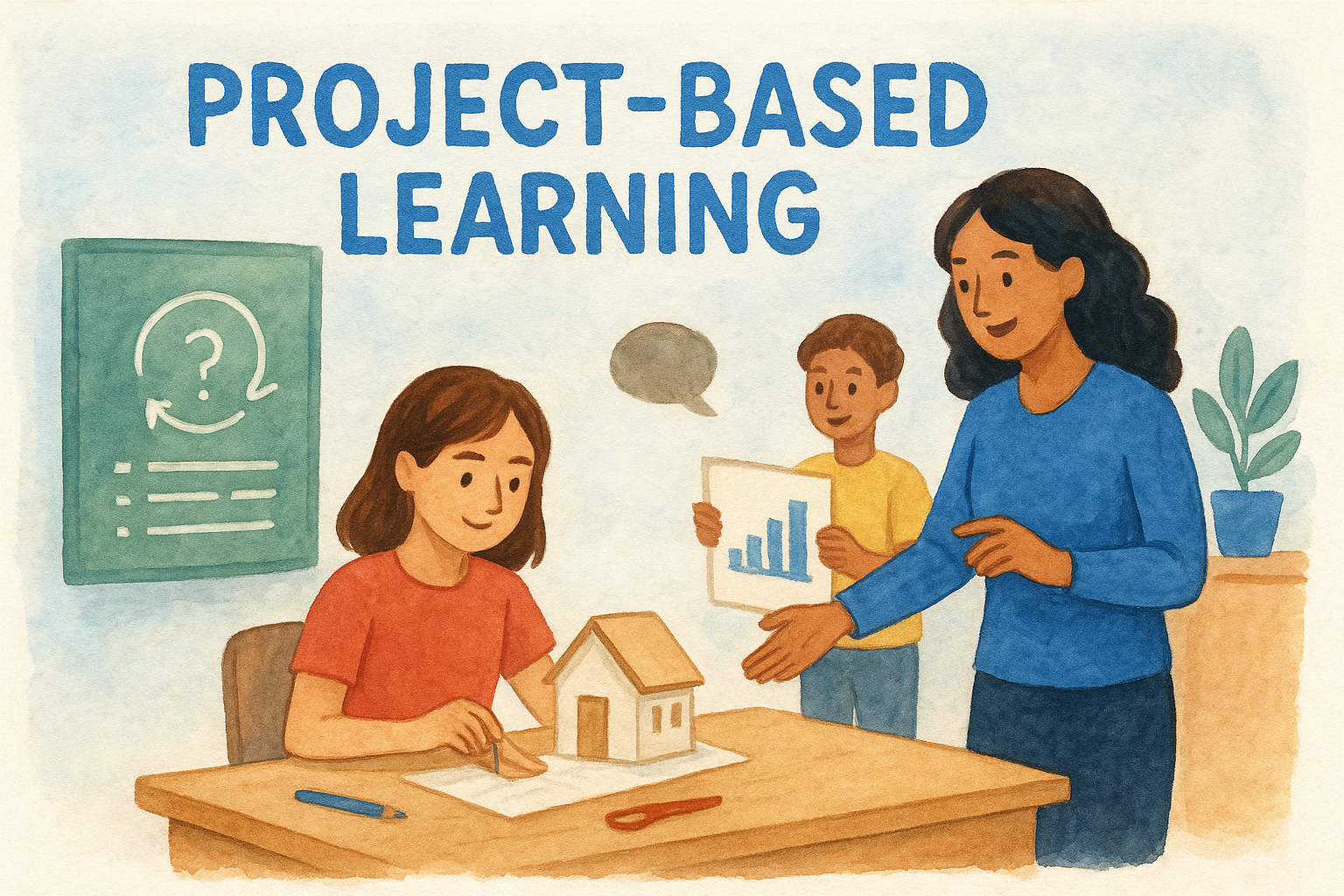
Project-based learning asks students to spend an extended stretch of time, days or even weeks, investigating a real question and producing something tangible at the end: a working model, a public presentation, a proposal sent to an actual audience. It’s one of the more demanding effective teaching and learning methods to plan, but it also produces some of the most memorable work students do all year.
How it works
You start with a driving question that has no single correct answer, something like "how could our school reduce food waste" or "what caused this historical event to unfold the way it did." Students research, draft, revise, and build toward a final product over multiple class periods, with checkpoints along the way so the project doesn’t collapse into last-minute scrambling. The teacher shifts into a coaching role, checking progress and asking pointed questions rather than delivering daily lectures.
Why it’s effective
Because the work stretches over time and ends with a real product, students engage with content at a depth that a single-day activity rarely reaches. They practice research, collaboration, and revision, skills that transfer well beyond the specific unit. This sustained engagement is a big reason project-based learning keeps showing up whenever people ask which teaching methods are most effective for building durable skills, not just short-term recall.
A project students can point to and say "I made that" sticks with them longer than any worksheet.
How to try it in your classroom
Start with a single unit rather than a full-year overhaul:
- Pick a driving question tied to your existing curriculum standards.
- Set two or three checkpoints so you can catch struggling groups early.
- Build in a real audience, even if it’s just another class, for the final presentation.
4. Inquiry-based learning
Inquiry-based learning puts students in the driver’s seat of their own questions instead of handing them a topic to memorize. Rather than starting with facts and working toward understanding, you start with a puzzle, a discrepant event, or an open question and let curiosity pull students toward the content. It overlaps with project-based learning, but the focus here is narrower and often shorter: one lesson or a short sequence built entirely around student-generated questions.
How it works
You present a scenario, a strange data set, or a provocative image and ask students what they notice and what they wonder. From there, students form their own questions, gather evidence, and test their thinking, with you guiding rather than lecturing. A science class might start with an unexplained phenomenon before ever hearing the word "hypothesis." A history class might open with a censored document and ask students to figure out what’s missing and why. The sequence typically moves from question generation to investigation to sharing findings, with the teacher nudging students back on track when they stall.
Why it’s effective
Students retain more when they’ve formed the question themselves, because they have a personal stake in finding the answer. This method builds critical thinking skills that transfer far beyond the specific content, since students practice evaluating evidence and revising their own conclusions instead of just accepting yours. It also surfaces genuine misconceptions early, since students voice their actual thinking rather than repeating back what they think you want to hear.
Curiosity does more heavy lifting than any lecture ever will.
How to try it in your classroom
Ease into inquiry with a manageable first step:
- Notice and wonder: Show an image, object, or data set and collect student questions before teaching anything.
- Guided inquiry: Provide the question, but let students design how they’ll investigate it.
- Mini research sprints: Give one class period for students to chase one self-generated question and report back.
5. Cooperative learning
Cooperative learning organizes students into small groups where everyone has a specific job and the group’s success depends on every member pulling their weight. Unlike loosely tossing kids together for a worksheet, this method builds individual accountability directly into group work, so one student can’t coast while the rest do the thinking.
How it works
Groups of three to five students take on defined roles, recorder, facilitator, presenter, checker, and work through a task where each role matters for the final result. A jigsaw activity is the classic example: each student researches one piece of a larger topic, then teaches it to their group, so the group can only finish the task if every member contributes. Tasks are structured so success requires positive interdependence, meaning students genuinely need each other, not just proximity.
Why it’s effective
Students explain ideas to peers using language that often lands better than a teacher’s explanation, and teaching a concept forces the explainer to understand it more deeply. Group accountability also reduces the free-rider problem that gives cooperative work a bad reputation among teachers who’ve only tried unstructured group projects. Done with real structure, this ranks among the effective teaching methods in the classroom that build both content mastery and social skills at once.
Group work only teaches teamwork when the structure forces everyone to actually work.
How to try it in your classroom
Start with a task small enough to troubleshoot quickly:
- Jigsaw reading: Split a text into sections, assign one per student, then reassemble groups to teach each other.
- Think-pair-share upgrade: Add a group role, like a summarizer who reports the pair’s conclusion to the class.
- Structured roles: Assign recorder, timekeeper, and presenter for any group task, and rotate roles weekly so everyone practices each one.
6. Blended learning
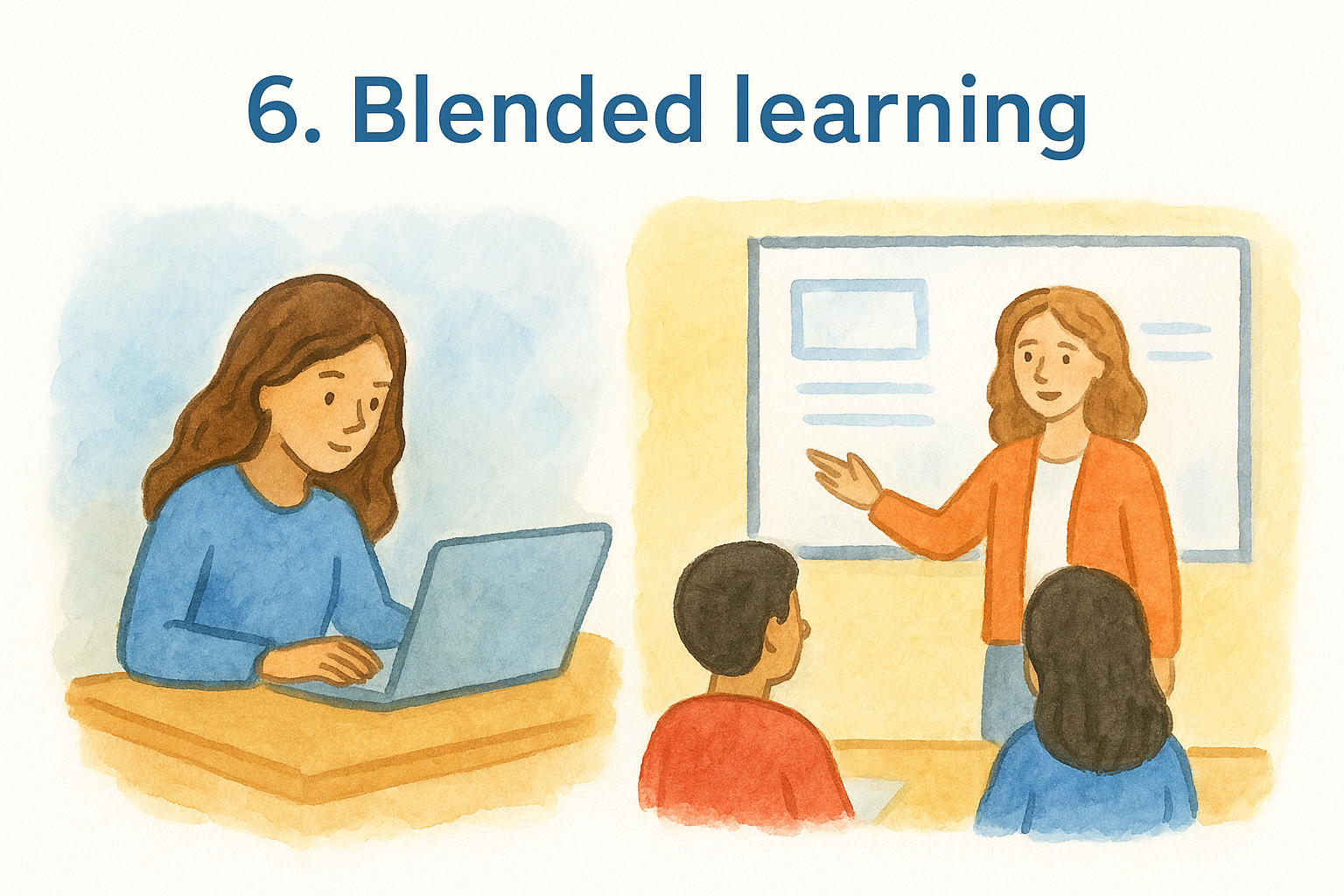
Blended learning mixes online instruction with face-to-face classroom time, so students move between digital content and in-person practice instead of getting one or the other all day. It’s become one of the more practical effective teaching and learning methods since so many schools already have the devices and platforms, the missing piece is usually a clear structure for how the two modes fit together.
How it works
Typically, students work through direct instruction, videos, readings, or interactive modules, on their own devices, then use class time for the parts that actually need a teacher: discussion, troubleshooting, and hands-on practice. A station rotation model is the easiest entry point, where small groups cycle between a digital station, a teacher-led station, and an independent practice station over one period. The online piece isn’t a substitute for teaching; it’s a way to offload the content delivery so class time gets spent on application.
Why it’s effective
Students move through digital content at their own pace, which naturally builds in a form of differentiation without extra planning on your part. Meanwhile, you get freed-up class time to work directly with students who are stuck, which is usually more valuable than another twenty minutes of you talking at the front of the room. This combination is part of why blended learning keeps coming up in discussions of which teaching methods are most effective for classrooms with uneven access to support outside of school hours.
Blended learning works best when the digital piece replaces lecture time, not teacher attention.
How to try it in your classroom
Start with one unit rather than converting your whole course:
- Station rotation: Split class into three groups cycling through digital, teacher-led, and independent stations.
- Pre-recorded mini-lessons: Record a five-minute explanation students watch before class discussion.
- Digital practice, live feedback: Assign online practice sets, then use class time to address common errors together.
7. Flipped classroom
The flipped classroom inverts the usual homework and class time relationship: students watch lectures or read material at home, then use class time for the practice, discussion, and problem-solving that used to get assigned as homework. It’s one of the more counterintuitive effective teaching and learning methods on this list, since it asks you to give up the lecture as a live event and treat class time as the space for the harder work instead.
How it works
Before class, students watch a short recorded lecture, read an assigned text, or work through a slideshow you’ve built, arriving with basic exposure to the concept already in place. Once they’re in the room, you spend the period on guided practice, answering questions, running through problem sets together, or facilitating discussion, since the content delivery already happened at home. Teachers often pair this with a quick low-stakes check, like three questions at the start of class, to confirm students actually did the pre-work before diving into application.
Why it’s effective
Students who get stuck on a concept usually get stuck during practice, not during initial exposure, so putting you in the room for the practice phase means help arrives exactly when it’s needed most. This restructuring gives you more one-on-one time with struggling students during class instead of saving that support for after-school hours few students actually use.
The flipped classroom puts the teacher where students actually get stuck, not where they’re just listening.
How to try it in your classroom
Test the model with a single lesson before flipping a whole unit:
- Record a short video: Five to eight minutes covering one concept, no longer.
- Add a quick check: Three questions students answer before class to confirm they watched it.
- Use class time for practice: Problem sets, discussion, or lab work where you can circulate and help.
8. Gamification
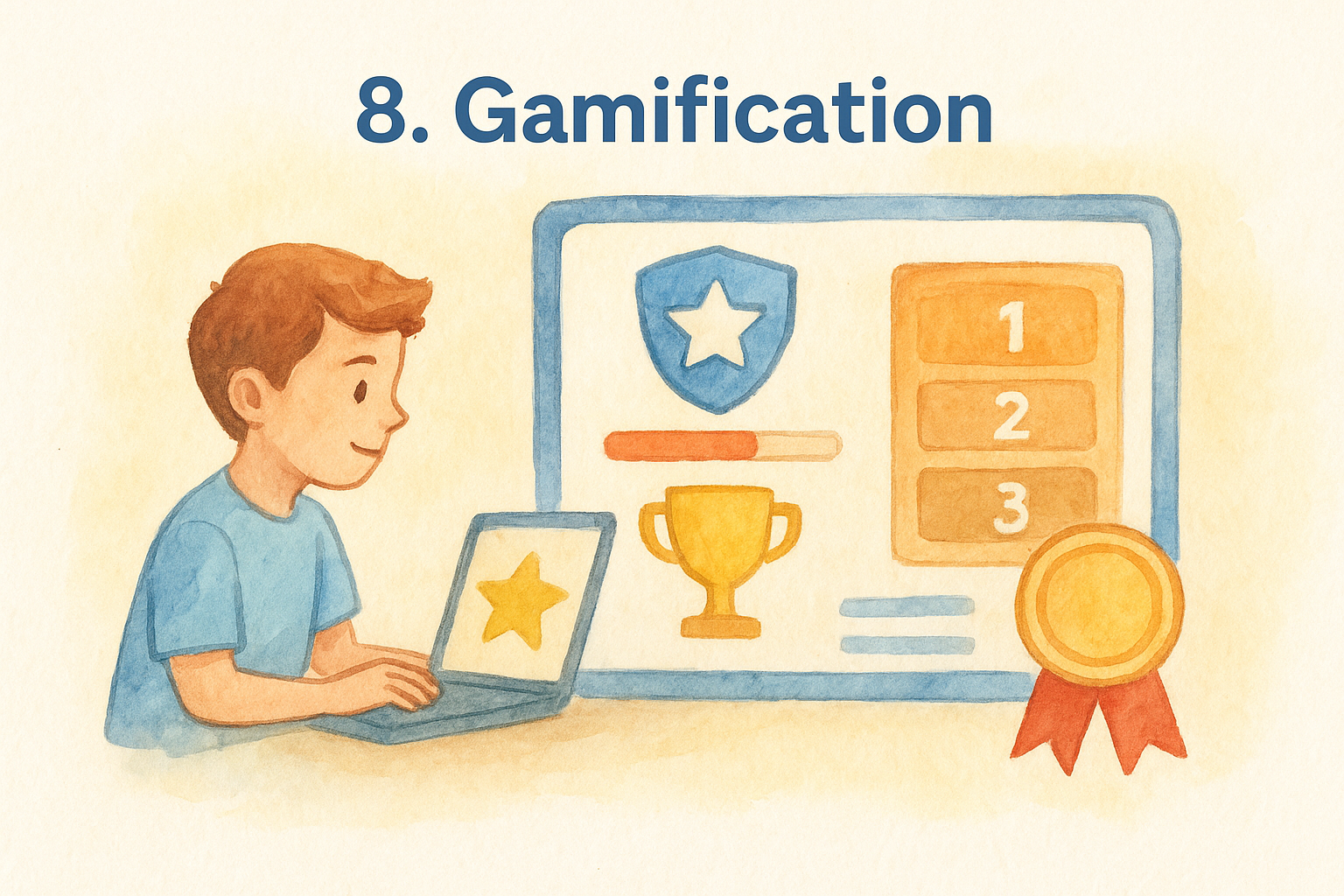
Gamification borrows the mechanics of games, points, levels, badges, leaderboards, and applies them to classroom tasks that would otherwise feel like plain drills. It’s not about turning every lesson into Kahoot, though that’s a fine starting point. Among effective teaching methods in the classroom, this one earns its spot because it taps into motivation that grades alone rarely trigger.
How it works
You take an existing task, a vocabulary review, a math fluency drill, a reading log, and layer on game structures: students earn points for completed work, unlock levels as they master skills, or compete on a leaderboard that resets weekly so no one falls permanently behind. The best versions tie progress tracking directly to skill mastery rather than compliance, so students see a visible link between effort and advancement instead of just collecting stickers for showing up.
Why it’s effective
Games tap into a reward system kids already respond to outside of school, and borrowing that structure taps intrinsic motivation that a plain worksheet rarely produces. Immediate feedback, points appearing the moment you answer correctly, keeps students engaged through repetitive practice that would otherwise stall out after a few minutes. This is part of why gamification keeps surfacing in conversations about which teaching methods are most effective for reluctant learners specifically, since it lowers the emotional stakes of getting something wrong.
A point system turns "I have to practice this again" into "I want to level up."
How to try it in your classroom
Start with one recurring task rather than gamifying your whole grading system:
- Point-based review games: Award points for correct answers during warm-ups or exit tickets.
- Badge systems: Give digital or paper badges for mastering specific skills, not just finishing assignments.
- Resetting leaderboards: Reset weekly so a bad week doesn’t sink a student’s motivation for the rest of the term.
9. Culturally responsive teaching
Culturally responsive teaching treats students’ backgrounds, languages, and lived experiences as assets to build lessons around, not obstacles to work past. Rather than teaching to one default cultural frame of reference, you actively connect content to the identities already sitting in your classroom. This is one of the effective teaching methods in the classroom that reshapes how content gets taught, not just how it gets managed.
How it works
Zaretta Hammond’s work on this topic describes it as building on students’ cultural knowledge rather than ignoring it. Practically, that means choosing texts and examples that reflect your students’ communities, inviting students to connect assignments to their own experiences, and examining your own assumptions about whose knowledge counts as "academic." A history unit might pull in local community stories alongside the textbook narrative. A reading list might rotate authors whose backgrounds mirror your students’ own.
Why it’s effective
Students engage more deeply when they see themselves reflected in what they’re studying instead of feeling like a guest in someone else’s curriculum. This approach builds trust and relevance, two things that predict engagement far better than curriculum design alone. It also reduces the achievement gaps that show up when instruction quietly assumes a single cultural default, which is why it consistently comes up when educators ask which teaching methods are most effective for diverse classrooms specifically.
Students learn more from a curriculum that reflects them back, not one that asks them to translate themselves into it.
How to try it in your classroom
Start with an audit of what’s already on your shelves and syllabus:
- Diversify your text list: Swap in at least one unit text by an author from an underrepresented background this term.
- Invite student stories: Build in a prompt where students connect the content to their own family or community history.
- Check your examples: Review word problems, case studies, and references for whose experiences they center.
10. Social-emotional learning
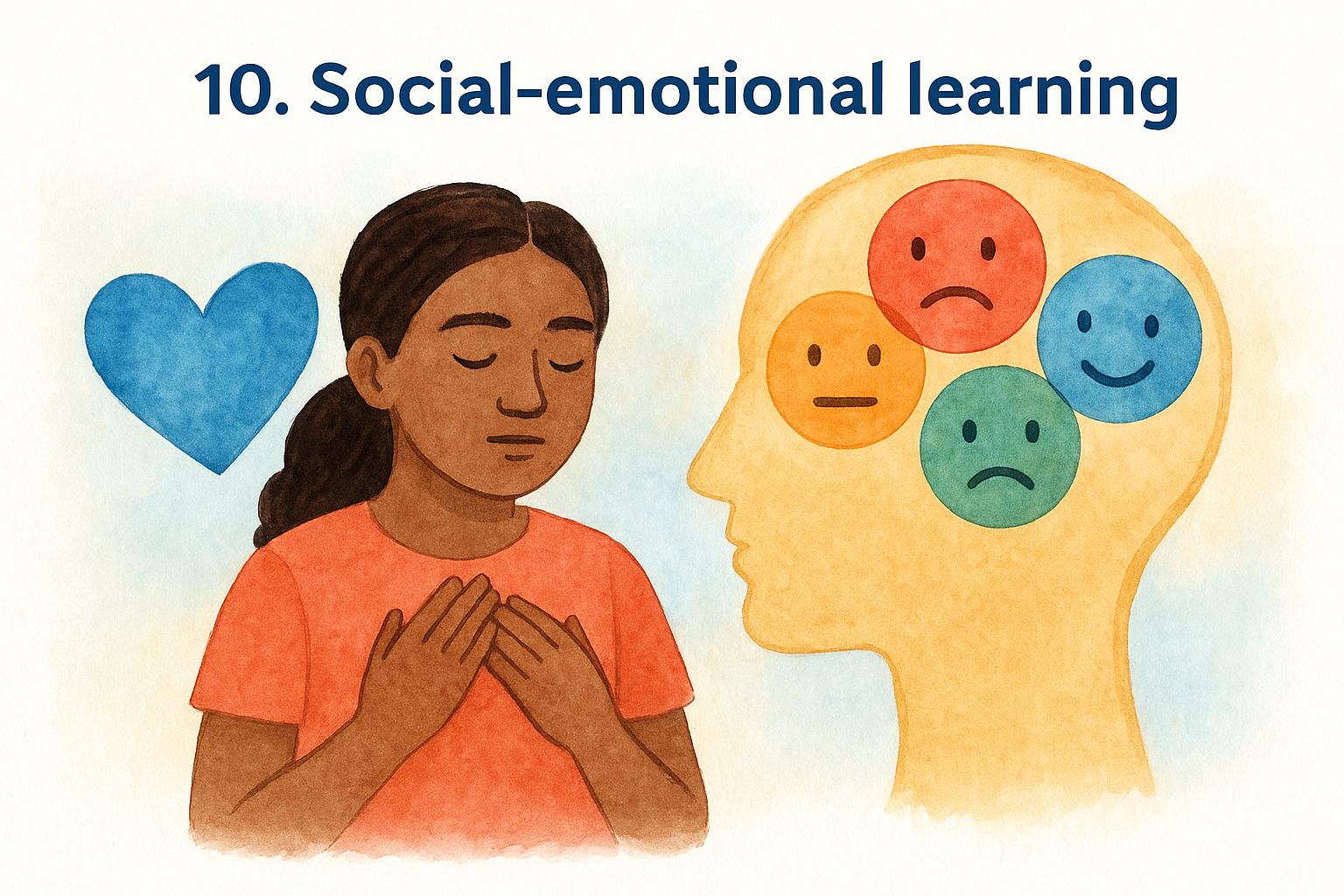
Social-emotional learning, often shortened to SEL, teaches students to name their emotions, manage stress, and work through conflict with peers, treating those abilities as skills you build on purpose rather than traits kids either have or don’t. It belongs on any honest list of effective teaching and learning methods because a student who can’t regulate frustration rarely absorbs the math lesson happening in front of them, no matter how well you’ve planned it.
How it works
You weave short, structured routines into the existing school day instead of bolting on a separate SEL class. A morning check-in where students rate their mood, a brief lesson on naming emotions before a stressful test, or a conflict-resolution script students practice until it becomes automatic all count. The CASEL framework organizes this around five core competencies: self-awareness, self-management, social awareness, relationship skills, and responsible decision-making, giving you a checklist to plan against rather than guessing what to cover.
Why it’s effective
Research collected by the Centers for Disease Control and Prevention links strong social-emotional skills to better academic performance and fewer behavior disruptions, since regulated students simply have more attention available for actual content. Building emotional regulation early also prevents small conflicts from eating class time later in the year.
A student who can name what they’re feeling has more room left in their head for the lesson.
How to try it in your classroom
Start with routines that fit into minutes you already have:
- Morning check-ins: A quick mood scale or one-word share before instruction starts.
- Conflict scripts: Teach a simple phrase structure for resolving peer disagreements.
- Reflection prompts: End class with one question about how a student handled a challenge that day.
Universal design for learning, often called UDL, asks you to design lessons with variability built in from the start instead of retrofitting accommodations after a lesson bombs. It’s one of the effective teaching and learning methods that shifts the question from
12. Formative assessment
Formative assessment means checking for understanding while you can still act on it, not waiting for the unit test to find out who’s lost. It’s the quiet engine behind most effective teaching and learning methods on this list, since every other strategy depends on knowing whether it’s actually working.
How it works
Rather than saving all evaluation for a graded test, you build small, frequent checks into daily instruction: exit tickets, thumbs-up polls, quick whiteboard responses, or a single question students answer before leaving. These checks are low-stakes by design, meant to inform your next move rather than produce a grade. The data you collect, who got it and who didn’t, decides whether you reteach tomorrow, regroup students, or move forward.
Why it’s effective
Students benefit from immediate feedback loops that catch confusion within the same class period instead of a week later on a returned test. Teachers benefit just as much, since formative checks reveal exactly which students need reteaching before a small gap turns into a failed unit. Decades of assessment research back this up: frequent low-stakes checks correlate strongly with achievement gains, which is a big reason it comes up whenever educators debate which teaching methods are most effective for closing gaps in real time rather than after the fact.
You can’t fix what you don’t measure, and a unit test measures too late to help.
How to try it in your classroom
Build in one quick check per lesson before adding more:
- Exit tickets: One question answered on a sticky note or digital form before students leave.
- Whiteboard checks: Students hold up quick answers so you can scan the room at a glance.
- Cold-call sampling: Ask a handful of random students to gauge understanding without singling anyone out.
Use what you find the same day, while reteaching still fits into your plan.
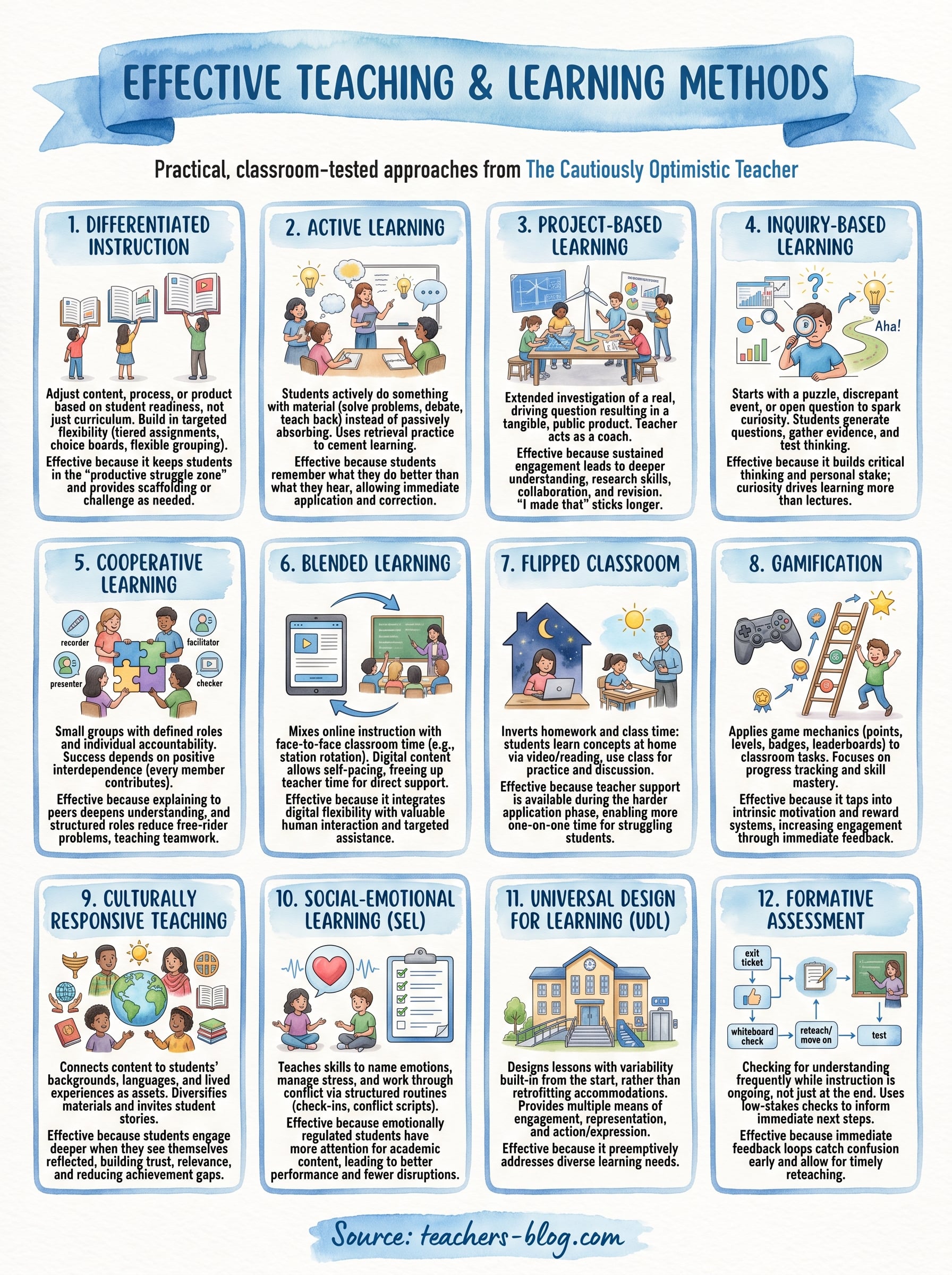
Finding the right mix for your classroom
No single strategy on this list will fix every class period, and that’s fine. The teachers who see real gains treat these effective teaching and learning methods as a toolkit, not a checklist to complete in order. Pull differentiation into a reading unit, add formative checks to a math lesson, and save project-based learning for the topic your students already care about. Watch what happens, then adjust.
Start small. Pick one method from this list, try it for two weeks, and pay attention to what shifts in engagement and understanding. That’s how lasting classroom change actually happens, one deliberate experiment at a time, not a total overhaul over a single weekend.
If you want ready-made lesson plans, AI tools that handle the differentiation and worksheet prep for you, and a steady stream of strategies like these, The Cautiously Optimistic Teacher has you covered. Your next great lesson doesn’t have to start from scratch.