7 Scaffolding Teaching Strategies for Every Classroom
You’ve got a room full of students at wildly different levels, and one lesson has to somehow reach all of them. That gap between where kids are and where the standard expects them to be is exactly what scaffolding teaching strategies are built to close. Done right, scaffolding turns an overwhelming task into a series of manageable steps, without watering down the content or lowering your expectations.
This article gives you seven classroom-tested techniques you can start using tomorrow, from breaking down complex texts to structuring group work so struggling students actually participate instead of coasting. Each strategy includes practical ways to apply it, so you’re not left guessing how theory translates to Monday morning. These aren’t abstract education-speak; they’re tools built for real lesson plans and real student needs.
Whether you’re teaching a novel unit like To Kill a Mockingbird or walking students through their first opinion essay, teaching scaffolding strategies give every learner a way in. We’ll cover how to sequence support, when to remove it, and how to pair scaffolding with differentiated instruction so your strongest students stay challenged while others catch up. By the end, you’ll have a practical toolkit ready for your next lesson plan.
1. Modeling and think-alouds
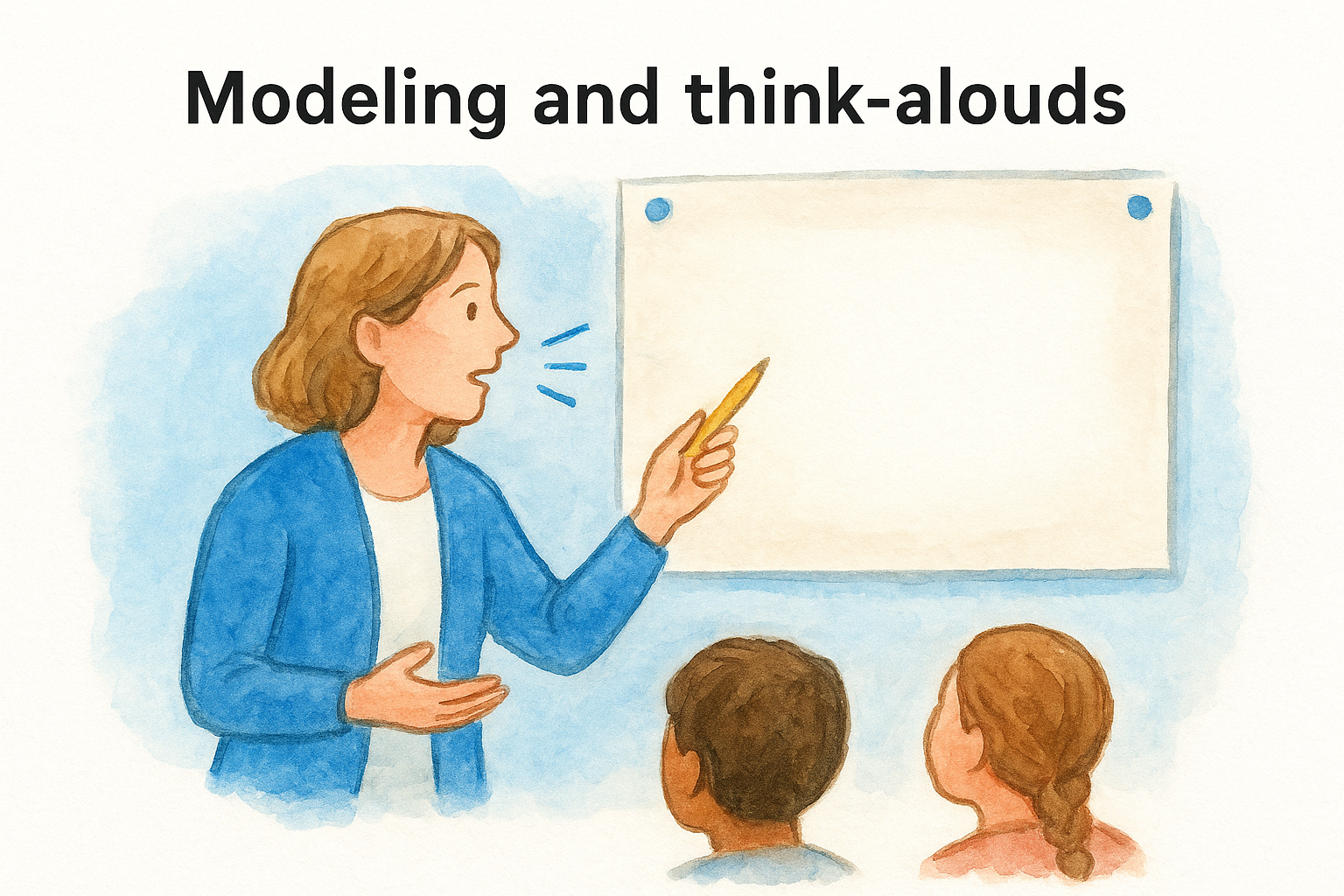
Modeling means you do the task first, out loud, while students watch and listen. A think-aloud is the narration part: you say exactly what’s going through your head as you work through a problem, so students hear the invisible thinking that usually happens silently in an expert’s mind. This is one of the most reliable scaffolding teaching strategies because it makes the mental steps visible, not just the finished product. Students don’t just see a well-written paragraph; they hear the false starts, the word choices you reject, and the reasoning behind the ones you keep.
How it works
You pick a task students will do independently soon, then perform it in front of them while verbalizing every decision. Say things like "I’m going to reread this sentence because I’m not sure it supports my claim" or "I’m crossing out this word because it’s too vague." The goal isn’t a polished performance, it’s transparency. Researchers who study cognitive apprenticeship, including work summarized by the National Center for Education Statistics, point to this kind of explicit modeling as a core piece of how novices develop expert habits of mind. Skipping this step is a common reason scaffolds fail: teachers assume kids know how to start, when really they’ve never seen the starting process demonstrated.
When to use it
Use modeling whenever you’re introducing a skill that has an invisible thinking component, like annotating a text, solving a multi-step equation, or planning an essay outline. It works best at the very beginning of a new unit or skill, before students attempt any part of the task solo. Save it too, as a quick refresher, right before independent practice when you notice students stalling.
Quick classroom example
Before students write their first opinion essay, project a blank paragraph and think aloud as you build a topic sentence:
- Say your claim out loud: "I think recess should be longer."
- Ask yourself aloud, "What’s my strongest reason?"
- Cross out a weak reason and explain why it doesn’t hold up.
- Write the final sentence and point out the structure you followed.
If students never hear how you think, they’ll assume good writing just happens, not that it’s built one decision at a time.
This five-minute demonstration gives students a concrete model to reference when they start their own opinion essay drafts, instead of staring at a blank page with no idea where to begin.
2. Activating prior knowledge
Students rarely walk into a lesson with an empty head. They’ve got fragments of relevant experience, half-remembered facts, and personal connections that can either support new learning or get in the way if you never surface them. Activating prior knowledge means deliberately pulling those fragments to the surface before you introduce new content, so students attach fresh information to something they already understand instead of storing it as an isolated fact.
How it works
Start the lesson with a quick prompt that asks students to recall, connect, or predict. A KWL chart, a two-minute turn-and-talk, or a simple "what do you already know about X" question all work. The point is retrieval, not a full discussion. You’re checking what’s already there so you can build on it, and spotting gaps or misconceptions before they derail the lesson.
You can’t scaffold new learning onto a foundation you never checked.
When to use it
Use this at the start of any unit, especially ones touching topics students have partial or informal knowledge of already, like historical events, social issues, or math concepts they’ve seen in a different context. It’s also useful before introducing a novel with unfamiliar settings or vocabulary, since students’ existing schema shapes how much of the text they’ll actually comprehend.
Quick classroom example
Before starting Lord of the Flies, ask students to jot down what they think would happen if a group of kids their age were stranded alone with no adults. Give them two minutes, then collect a few responses on the board. Their predictions become a reference point you revisit as the plot unfolds, turning prior knowledge into an active reading tool rather than a forgotten warm-up.
3. Pre-teaching key vocabulary
Nothing stalls comprehension faster than hitting three unfamiliar words in the first paragraph of a text. Pre-teaching key vocabulary means you identify the terms that will trip students up before they ever open the book or start the assignment, and you teach those words directly instead of hoping context clues will do the work. This is one of the simplest scaffolding teaching strategies to plan for, because it takes ten minutes of prep and removes a barrier that otherwise derails an entire lesson.
How it works
Scan the text or task ahead of time and pull out five to eight words that are either unfamiliar or carry a specialized meaning students haven’t seen before. Skip common words students can guess from context. Teach the selected words with student-friendly definitions, a visual when possible, and a quick example sentence. A fast matching game or a Frayer model works better than a dictionary handout, since students need to use the word, not just read a definition.
A student who’s stuck on the word doesn’t have room left to think about the idea.
When to use it
Use this before starting a new novel, a dense nonfiction article, or any unit built on academic vocabulary students haven’t encountered, like "allegory" or "congruent." It’s especially useful for English language learners and students below grade level, since unfamiliar vocabulary compounds fast when it stacks on top of already-challenging content.
Quick classroom example
Before starting To Kill a Mockingbird, pre-teach words like "scout," "malevolent," and "integrity" using quick visuals and a one-sentence example tied to the plot, so students recognize the words the moment they appear on page one.
4. Breaking tasks into manageable chunks
A multi-step assignment can look like one giant wall to a struggling student, even when you’ve explained every part. Breaking tasks into manageable chunks means you split that wall into smaller pieces, each with a clear finish line, so students can see progress instead of just distance left to go. This is one of the most direct scaffolding teaching strategies because it doesn’t change the content, it just changes the size of the bites students take.
How it works
Take the full task and divide it into three to five checkpoints, each with a concrete deliverable: a thesis statement, one body paragraph, a rough outline. Give students a deadline for each chunk instead of one due date for the whole project, and check in briefly after each step. This keeps small mistakes from snowballing into a paper that’s wrong from the first sentence.
A task that feels impossible in one piece often feels completely doable in five.
When to use it
Reach for chunking with any multi-day project: essays, research papers, lab reports, or long-term reading assignments. It works especially well for students who freeze up at open-ended instructions, since a checklist gives them a starting point instead of a blank page.
Quick classroom example
For the opinion essay unit, split the writing process into five checkpoints: claim and reasons, outline, introduction, body paragraphs, and conclusion. Collect each piece separately, give quick feedback, and let students revise before moving to the next chunk, so errors get caught early instead of buried in a finished draft.
5. Using visual aids and graphic organizers
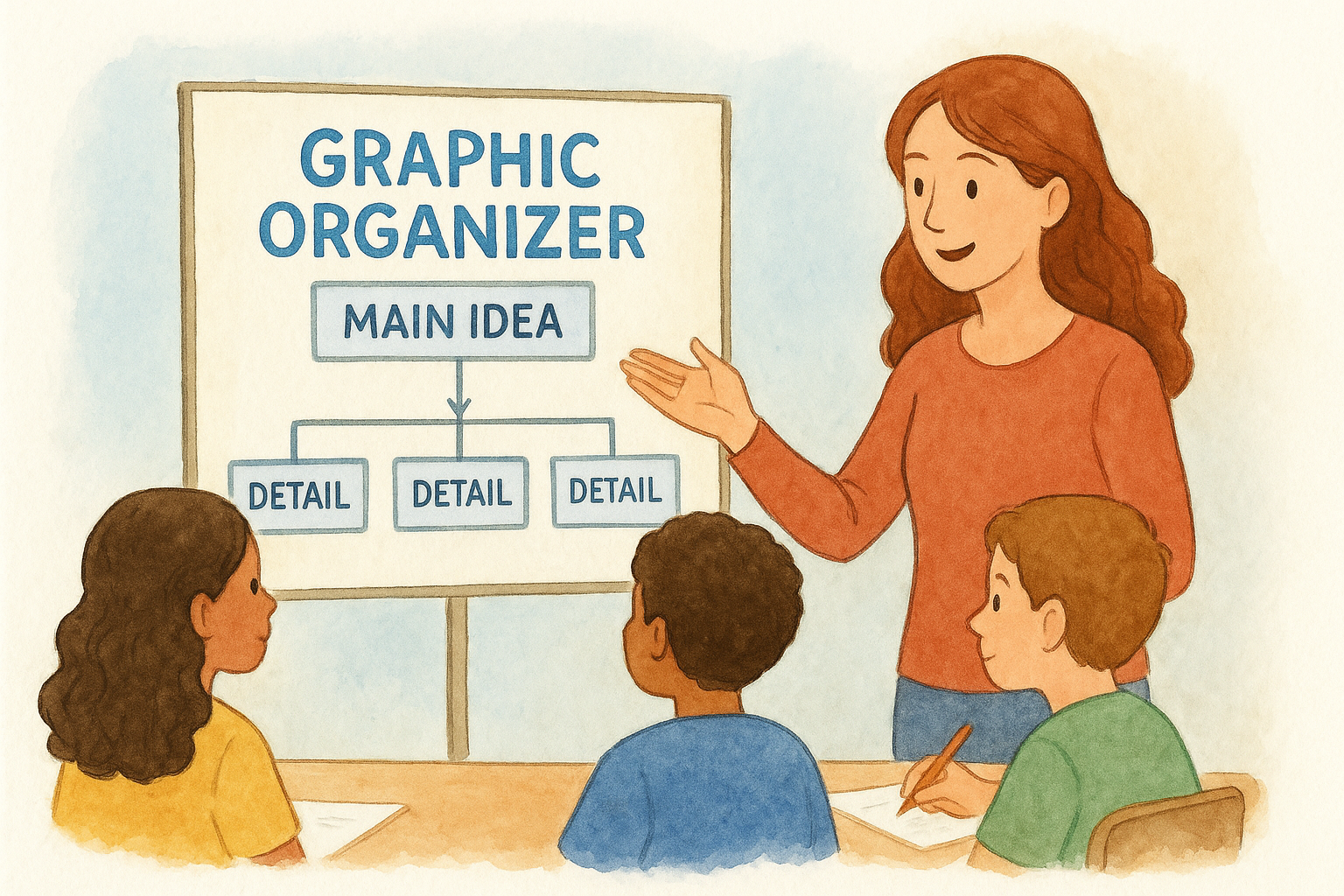
Some ideas click faster when students can see the relationships instead of just reading about them. Visual aids and graphic organizers turn abstract structure, like cause and effect or a character’s arc, into something students can point to on paper. This is one of the most flexible scaffolding teaching strategies because a single organizer works across subjects, from mapping plot events to sorting math problem types.
How it works
Match the organizer to the thinking pattern you want students to practice. Venn diagrams show comparisons, timelines show sequence, and T-charts sort pros and cons or claims and evidence. Hand students a partially filled organizer at first, then move to blank templates as they get comfortable filling in the structure themselves. The organizer isn’t busywork, it’s a physical map of the thinking you want happening in their heads.
A graphic organizer doesn’t simplify the thinking, it just gives it a shape students can hold onto.
When to use it
Bring these out whenever students need to compare, sequence, or categorize information, especially in dense units like mythology or literature analysis where multiple characters and events pile up fast. They’re also useful right before writing, since an organizer filled in during reading becomes the outline for the essay that follows.
Quick classroom example
While reading Greek mythology, give students a simple hero’s journey organizer with boxes for the call to adventure, trials, and return. Fill in the first box together as a class, then let students complete the rest independently as they read, so the abstract structure of myth becomes something concrete they can track.
6. Guided questioning and structured talk time
Left on their own, class discussions tend to run through the same three confident hands while everyone else stays quiet. Guided questioning fixes this by giving you control over who thinks through what, and structured talk time makes sure every student actually has to process the material out loud instead of just listening to someone else do it.
How it works
Plan your questions before the lesson, moving from recall to analysis: start with "what happened" before you ask "why does it matter." Pair this with a protocol like turn-and-talk, think-pair-share, or numbered heads together, so talk time isn’t optional. Give students a sentence starter if the question is abstract, something like "I think this because…" That small script keeps quieter students from freezing when it’s their turn.
Structured talk time forces every student to rehearse their thinking, not just the ones who raise their hands first.
When to use it
Use this during any discussion-heavy lesson, especially when you’re building toward a harder question and need students to warm up their thinking first. It also works well as a check for understanding mid-lesson, since a quick turn-and-talk shows you who’s tracking and who’s lost, long before an exit ticket would.
Quick classroom example
Before discussing a pivotal chapter in Lord of the Flies, ask a low-stakes recall question first ("What did Jack do?"), then a turn-and-talk analysis question ("Why might he have done that?"). Every student rehearses an answer with a partner before you call on anyone, so the whole class discussion opens with more voices ready to contribute.
Making scaffolding part of your everyday lessons
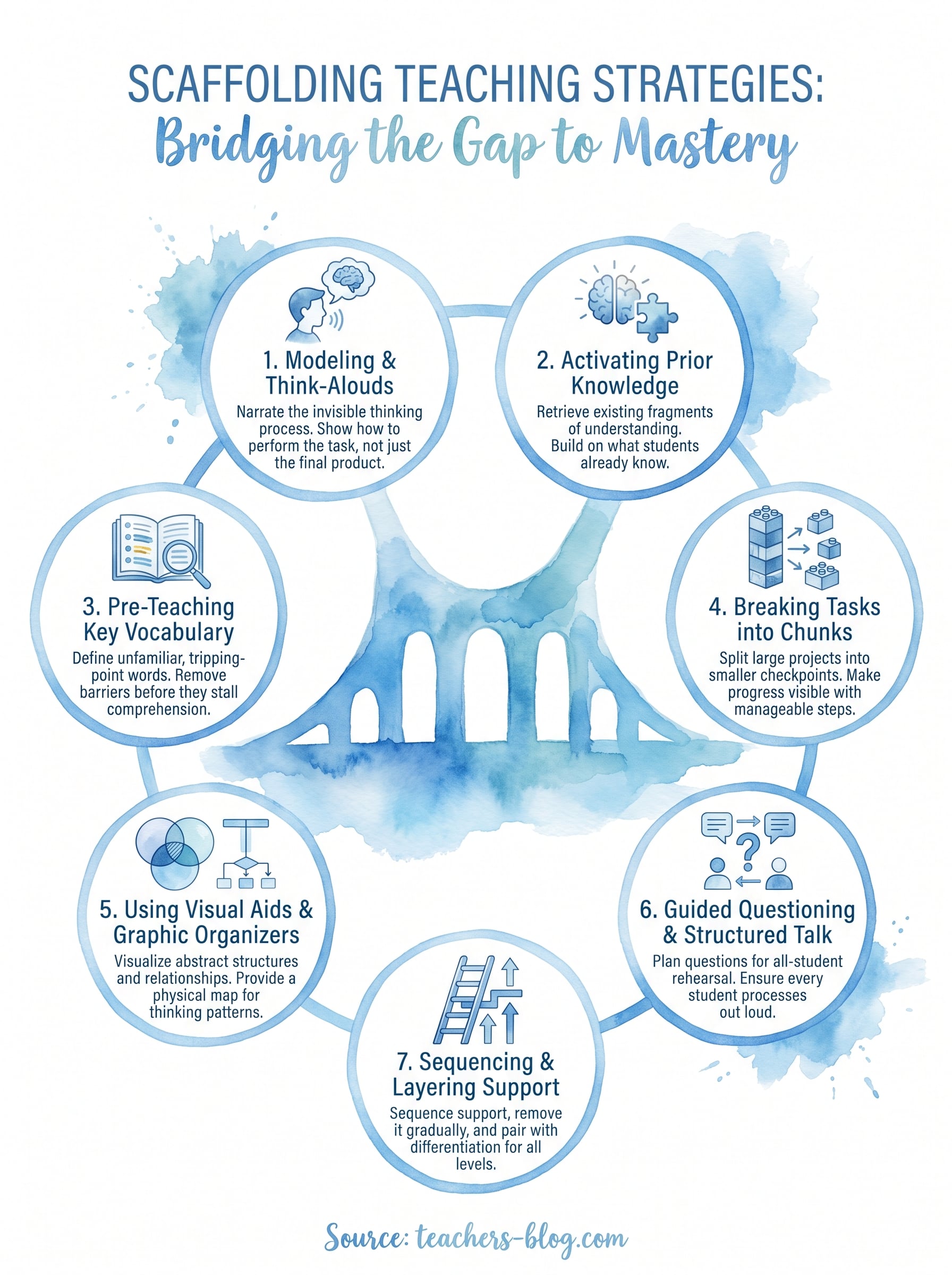
None of these seven strategies require a full lesson plan overhaul. Pick one, try it this week, and notice which students suddenly participate instead of shutting down. Scaffolding teaching strategies work best when you layer them, modeling a skill, then chunking the task, then pulling in a graphic organizer as students practice independently. The goal is never to make the content easier; it’s to make the path to mastering it visible and walkable for every student in the room.
Start small. Choose one upcoming lesson, pick two strategies from this list, and build them in deliberately rather than trying all seven at once. Watch how removing the guesswork changes who raises their hand, who finishes the assignment, and who actually retains what you taught. For more ready-to-use classroom tools, unit plans, and AI-powered resources that make this kind of planning faster, visit The Cautiously Optimistic Teacher and start building your next lesson with scaffolding already built in.