Jigsaw Teaching Strategy: What It Is and How to Use It
You’ve got a room full of students, one dense chapter or complex topic, and about 45 minutes to make it stick. Lecturing at them puts you in charge of all the thinking. Jigsaw teaching strategies flip that: students become the ones responsible for learning material and teaching it to their peers, which means engagement stops being optional.
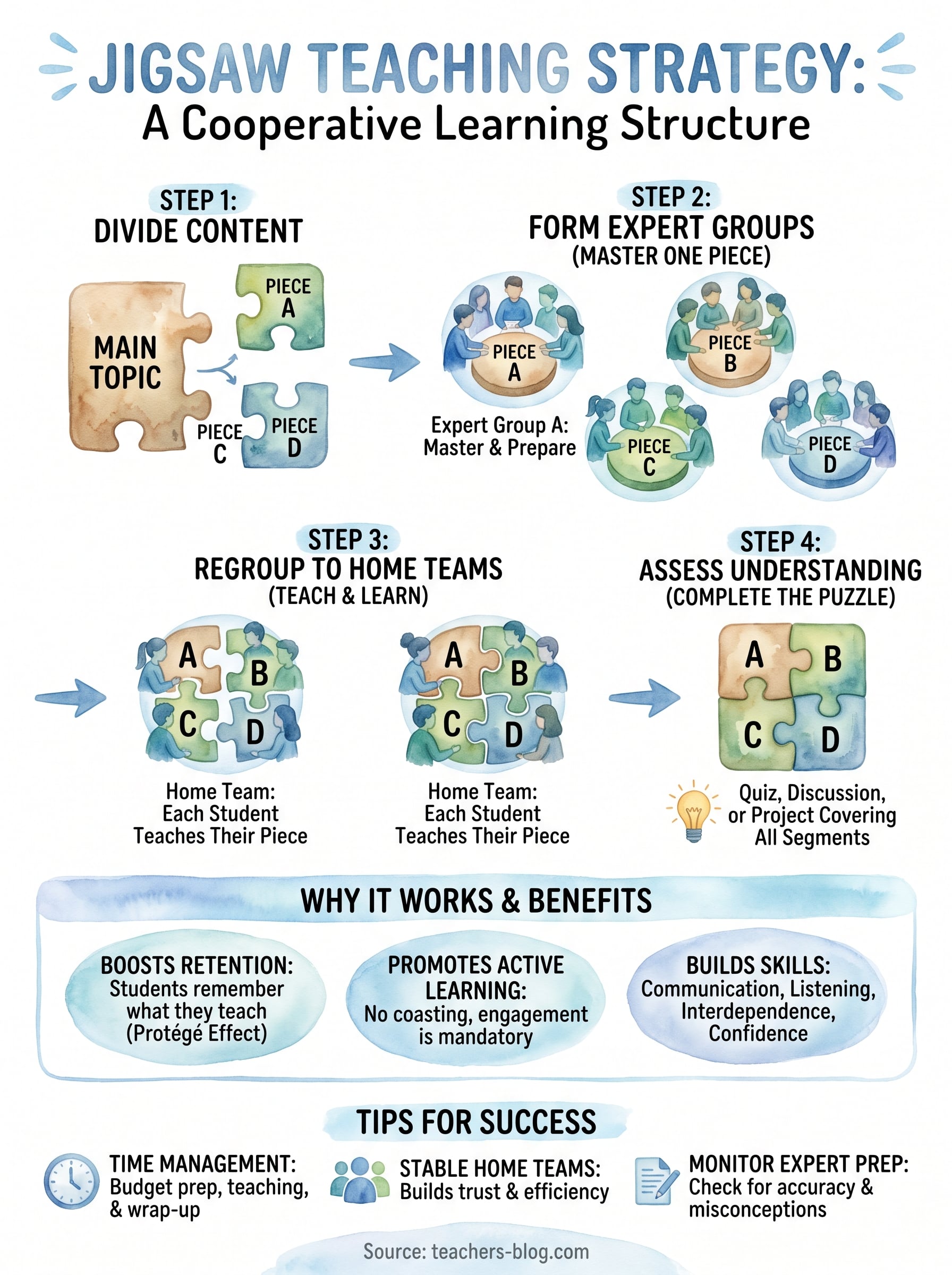
At its core, the jigsaw method is a cooperative learning structure where you split a topic into pieces, assign each student a piece to master in an "expert group," then regroup students into mixed teams where each person teaches their slice to the others. It works because nobody can coast. Every student holds a piece of the puzzle nobody else has, so individual accountability builds in automatically, without you having to police it.
Below, I’ll walk you through exactly what the jigsaw strategy looks like in practice, why it consistently outperforms passive reading assignments for retention, and how to set up your groups, timing, and materials so the activity runs smoothly the first time you try it. You’ll also get practical tips for handling common hiccups, like uneven group dynamics or students who rush through their expert material.
Why the jigsaw strategy boosts student learning
Students remember what they teach far better than what they hear. That’s the psychology driving jigsaw teaching strategies: when a student knows they’re the only source for a piece of information, their brain treats it differently than material they’ll just be tested on passively. This is sometimes called the "protégé effect," and it’s well documented in cognitive research on peer teaching. You can read more about how retrieval and explanation deepen learning through the National Institutes of Health’s research summaries on learning science, but the classroom version is simple: explaining a concept out loud forces a level of processing that highlighting a textbook never does.
When a student has to teach it, they can’t fake understanding it.
The research behind cooperative learning
Elliot Aronson developed the jigsaw classroom in the 1970s specifically to reduce competition and hostility between students in newly desegregated schools, and the structure worked so well academically that it stuck around long after its original purpose. Studies since then consistently show that cooperative learning structures like jigsaw outperform traditional lecture formats on measures of retention, comprehension, and even liking for the subject matter. Students in jigsaw classrooms also report higher self-esteem and more positive attitudes toward classmates, because the structure makes every student’s contribution visible and necessary.
What jigsaw builds beyond content knowledge
Content mastery is only part of the payoff. Running jigsaw activities regularly also builds skills your students need everywhere else:
- Communication skills, since students must explain material clearly to peers who haven’t seen it
- Active listening, because each student depends on teammates for information they don’t have
- Interdependence, which reduces the free-rider problem common in group work
- Confidence, especially for quieter students who become the go-to expert on one topic
Skeptics sometimes worry that jigsaw just shifts the teaching burden onto students without your training or expertise. That’s a fair concern if you skip the structure. Done right, though, you’re not disappearing from the process. You’re circulating, checking expert groups for accuracy before they teach, and catching misconceptions before they spread. The strategy doesn’t replace your expertise, it multiplies your reach across the room.
How to run a jigsaw activity step by step
Setting up a jigsaw activity takes more prep than a lecture, but the payoff shows up the moment students start teaching each other. Follow these steps in order the first few times until the rhythm becomes automatic.
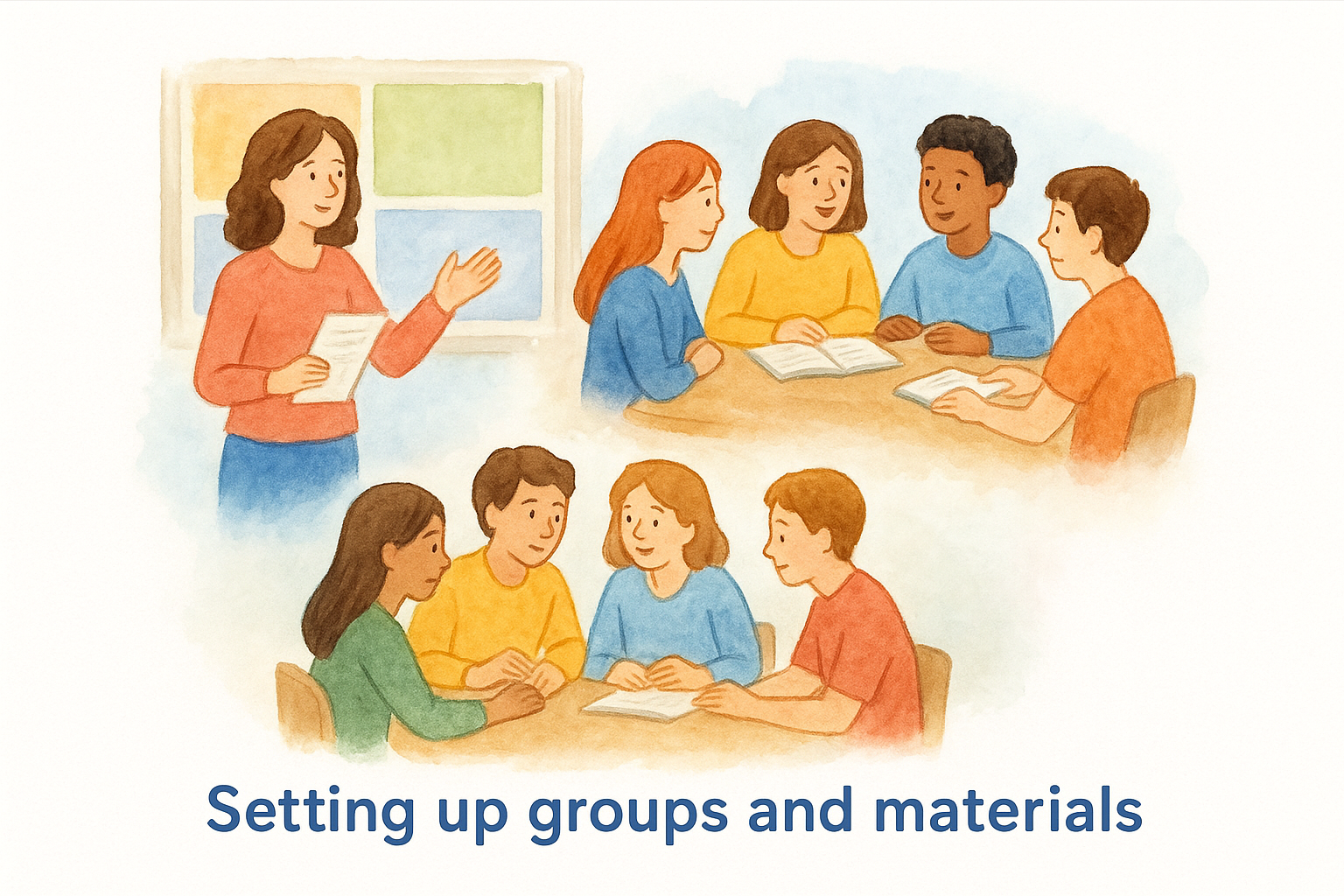
Setting up groups and materials
Before students walk in, break your topic into four to six distinct pieces that don’t overlap. Each piece should be substantial enough to teach but short enough to master in 15 to 20 minutes.
- Divide the content into equal, self-contained segments.
- Assign home teams of four to six students, one per segment.
- Form expert groups by pulling every student assigned the same segment together.
- Give expert groups time to read, discuss, and prepare how they’ll explain their piece.
- Return students to home teams, where each person teaches their segment in turn.
- Assess understanding with a quiz, discussion, or short written response covering all segments.
Every jigsaw activity lives or dies on how well you split the material before class starts.
Timing and troubleshooting on the fly
Budget roughly 15 minutes for expert group prep, 20 minutes for teaching in home teams, and 10 minutes for a wrap-up check. If an expert group finishes early, hand them a follow-up question to deepen their grasp before they teach it. If a home team stalls because one student under-prepared, step in briefly rather than letting the whole team lose momentum. Watching the clock closely during your first attempt tells you exactly where to adjust timing next time.
Jigsaw strategy examples across subjects
Teachers often assume jigsaw only works for reading assignments, but the structure adapts to nearly any subject where a topic splits into distinct sub-parts. If you can divide content into pieces that don’t depend on each other to make sense, you can run a jigsaw. That flexibility is why subject-specific unit plans for literature, history, and science all lend themselves to this format without much modification.
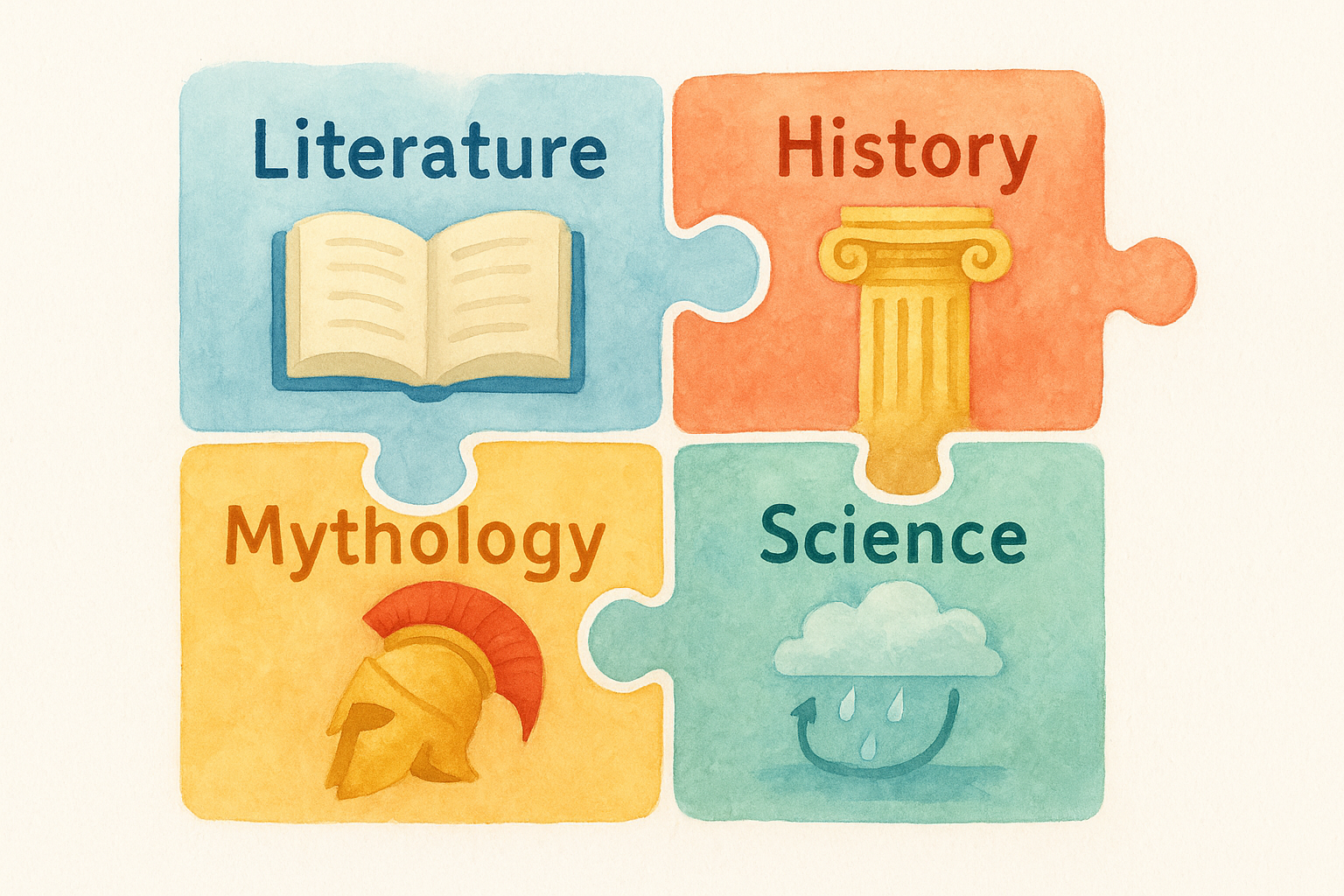
If the content splits into separate, self-contained chunks, jigsaw will work.
| Subject | Topic | How to split the pieces |
|---|---|---|
| Literature | To Kill a Mockingbird | Assign each expert group a different character’s arc or theme (justice, courage, prejudice) |
| Mythology | Greek Mythology | Give each group a different god or hero to research and present |
| History | Causes of WWI | Split into alliances, militarism, nationalism, and the assassination trigger |
| Science | The water cycle | Assign evaporation, condensation, precipitation, and collection to separate groups |
Adapting jigsaw for STEM subjects
Science and math classes benefit from jigsaw just as much as humanities courses, though the setup looks slightly different. Instead of splitting a reading passage, you split a multi-step process, like the phases of mitosis or the steps in solving a system of equations, so each expert group masters one stage and teaches it to their home team in sequence. This works especially well in a Lord of the Flies literature circle format too, where each group tracks a different symbol or character across chapters before reporting back.
Tips to make jigsaw activities run smoothly
Getting the jigsaw classroom technique to click on the first try depends less on the content you pick and more on how you manage the human factors around it. Small adjustments to grouping, pacing, and accountability prevent most of the problems teachers report after their first attempt.
Grouping strategies that prevent problems
Avoid letting students self-select expert groups, since friend clusters tend to chat instead of work. Instead, use a seating chart or random draw so each expert group has a realistic shot at focused preparation. Keep home teams stable across multiple jigsaw activities during the semester; students who’ve built trust with the same teammates teach each other more confidently and waste less time on icebreaker small talk.
A jigsaw activity only works as well as the groups you build it on.
Handling common pitfalls
Some hiccups show up in nearly every classroom running this format for the first time. Plan for them ahead of time:
- Uneven reading levels: pair a stronger reader with a struggling one inside expert groups, not home teams.
- Rushed expert prep: require each group to write three key points before returning to home teams.
- One student dominating: assign a rotating "reporter" role so teaching duties spread evenly.
- Quiet students disengaging: give every expert group a physical prop or visual to present, which pulls in reluctant talkers.
Working through these fixes once means you rarely revisit them again.
Making jigsaw work in your classroom
Jigsaw teaching strategies work because they put the learning burden where it belongs, on your students, not on your ability to hold a room’s attention for 45 straight minutes. Once you’ve split a topic into solid pieces and built stable home teams, most of the setup work is done for the rest of the year. You just swap in new content.
Start small if you’re nervous about it. Pick one unit, one class period, and one clearly divided topic, then watch how differently your students engage when they’re the ones explaining instead of listening. The first run will be a little messy. The second run will feel automatic.
If you want more ready-to-use classroom strategies like this one, along with unit plans and AI tools that cut down your prep time, browse the full collection of teaching resources on The Cautiously Optimistic Teacher.