Inquiry Based Learning Methods: Types, Steps, Examples
You already know that lecturing at students for 45 minutes straight doesn’t work. But replacing that with something better, something that actually gets students thinking, requires a shift in how you design your lessons. That’s where inquiry based learning methods come in. Instead of handing students answers, you hand them questions and let them build understanding through investigation, discussion, and discovery.
The thing is, inquiry-based learning isn’t a single strategy. It’s a spectrum. Some approaches give students heavy scaffolding; others throw the doors wide open. Knowing which type fits your classroom matters, because picking the wrong level of inquiry for your students can lead to frustration on both sides. Understanding the differences between structured, guided, open, and free inquiry is the first step toward using any of them well.
This article breaks down the core types of inquiry-based learning, walks through the steps involved, and provides concrete examples you can adapt for your own classroom. At The Cautiously Optimistic Teacher, we focus on giving educators strategies that actually translate to practice, not just theory. So whether you’re new to inquiry or looking to refine your approach, you’ll find something here worth using.
Why inquiry-based learning works
Research consistently shows that students retain information better when they construct meaning themselves rather than receive it passively. When you ask students to investigate a question, they engage multiple cognitive processes at once: they retrieve prior knowledge, evaluate new information, and connect ideas. That active processing is what makes inquiry-based learning far more durable than a lecture, and it’s the core reason the approach keeps showing up in research on effective instruction.
The science behind active learning
Cognitive science backs this up directly. Studies on elaborative interrogation and retrieval practice show that students who explain, question, and predict during learning consistently outperform those who re-read notes or listen passively. When you design an inquiry lesson, you’re asking students to do the cognitive heavy lifting, and that effort is exactly what builds long-term retention. The classroom shifts from a place where you deliver content to a place where students build understanding through guided exploration.
Students who actively process information during learning retain significantly more than those who receive it passively.
Your role in that shift is not to disappear, but to design conditions where productive struggle happens. That means choosing questions that are genuinely open, building in time for discussion and reflection, and resisting the urge to rescue students the moment they hit uncertainty. The discomfort students feel when they don’t immediately know the answer is actually part of what makes inquiry work.
It develops more than content knowledge
One strong practical reason inquiry based learning methods work across grade levels is that they build transferable skills alongside content knowledge. When students practice asking questions, evaluating evidence, and drawing conclusions, those habits carry over into every subject and into life outside your classroom. A student who learns to assess sources during a history inquiry is better equipped to handle information critically in science, language arts, or any future context.
Engagement also sustains itself differently in an inquiry classroom. When students figure something out through their own investigation, the sense of ownership over that learning is real. Students who regularly experience that kind of success tend to approach new problems more independently, because they’ve already proved to themselves that they can work through uncertainty. You don’t have to manufacture motivation; you design lessons that let it develop on its own.
The 4 inquiry based learning methods teachers use
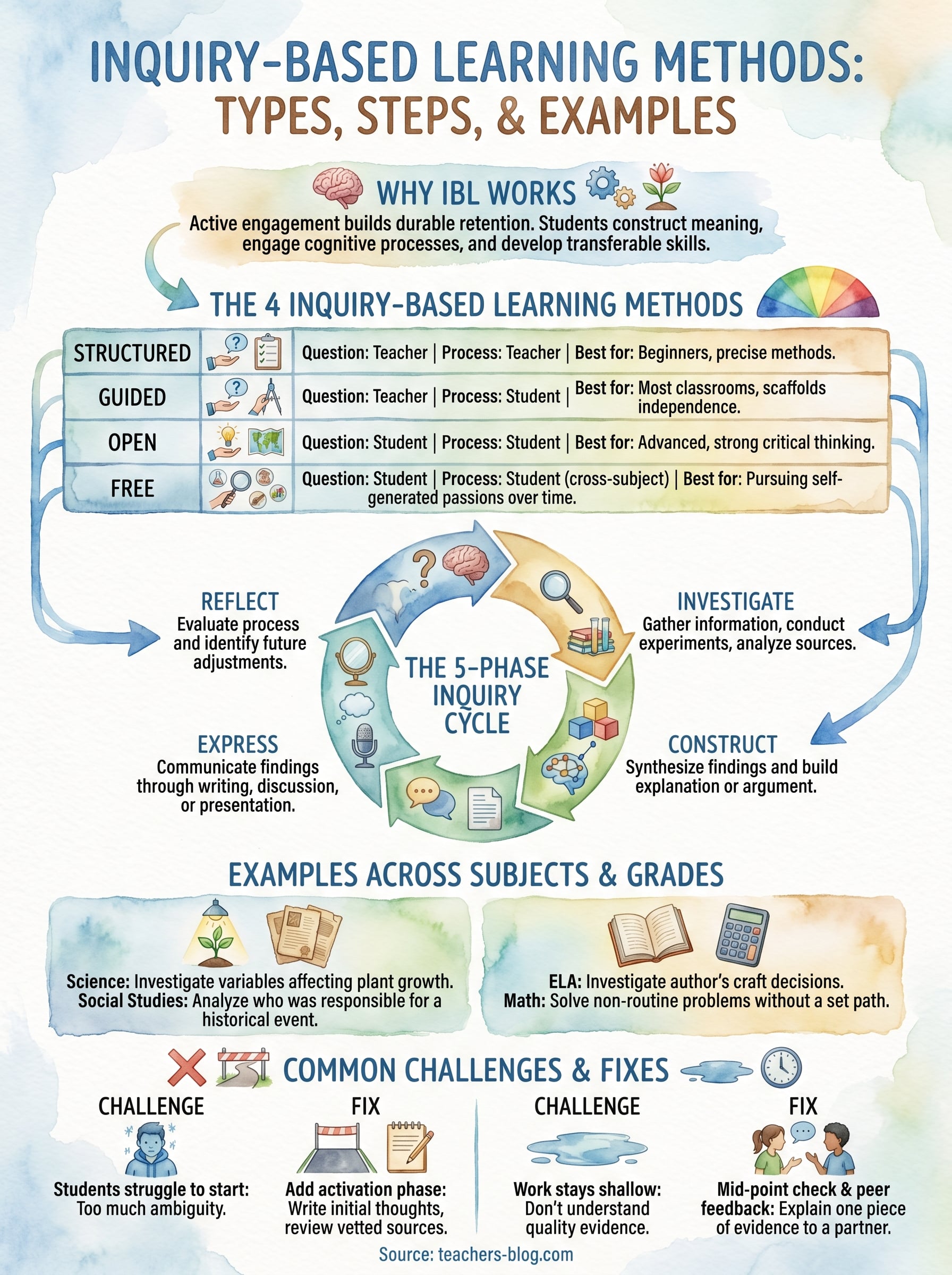
Not all inquiry based learning methods work the same way. The four main types exist on a spectrum from highly teacher-directed to fully student-driven, and the right choice depends on your students’ experience with independent thinking and the complexity of your content goals.
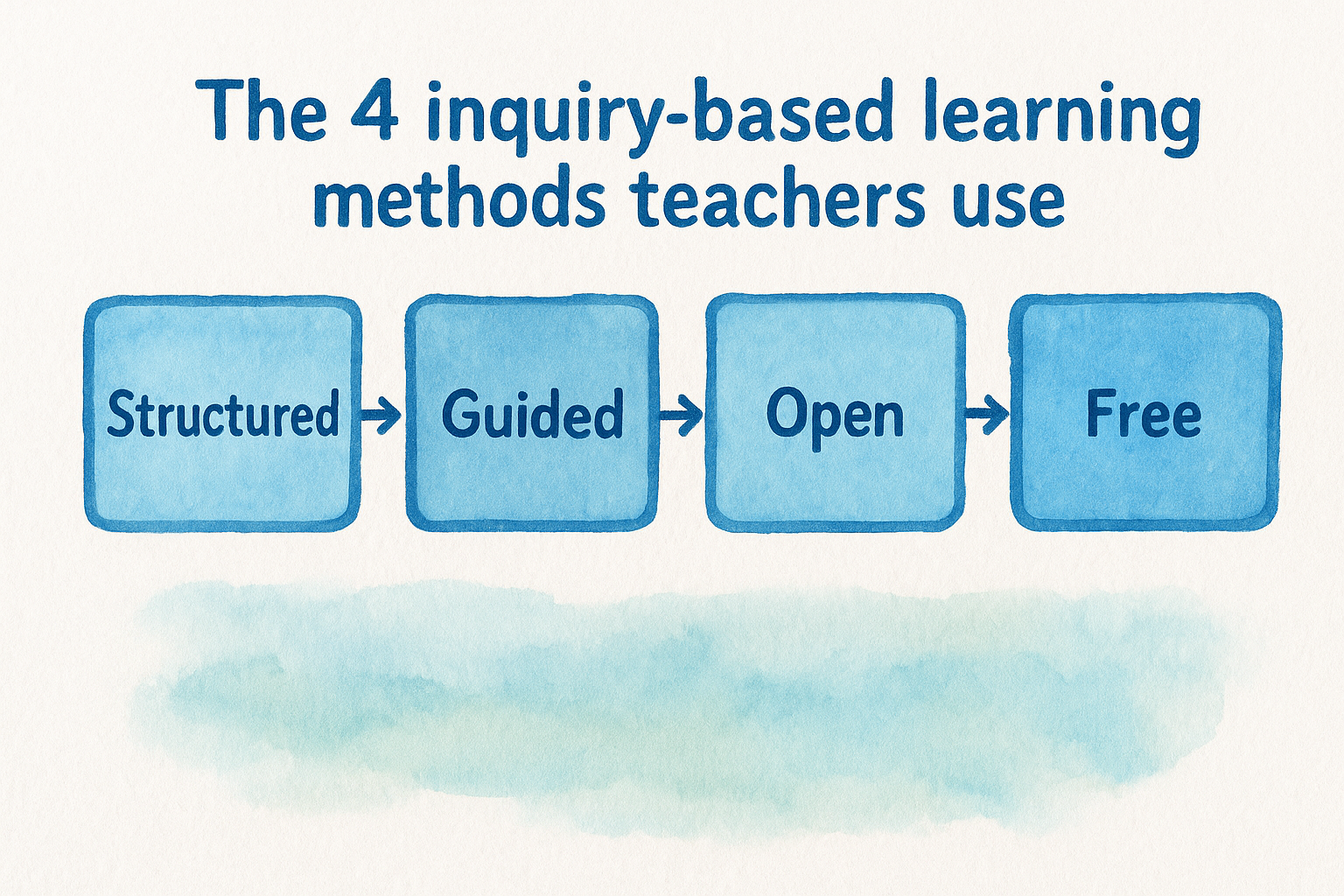
| Method | Who provides the question | Who designs the process |
|---|---|---|
| Structured | Teacher | Teacher |
| Guided | Teacher | Student |
| Open | Student | Student |
| Free | Student | Student (cross-subject) |
Structured inquiry
In structured inquiry, you provide both the driving question and the investigation steps. Students follow your procedure and report their findings. This approach works well when students are new to inquiry or when the content requires a precise method, like a controlled experiment in science. It keeps cognitive load manageable while still requiring active engagement rather than passive listening.
Guided inquiry
Guided inquiry gives students more ownership over the process. You still supply the question, but students design their own investigation to answer it. This format is often the most practical entry point for middle and high school classrooms because it maintains enough structure to prevent frustration while pushing students to think independently.
Guided inquiry tends to be the most sustainable format for most classroom contexts because it scaffolds student independence without removing it entirely.
Open and free inquiry
Open inquiry hands students full control: they generate the question, plan the process, and communicate results on their own. This format builds the deepest sense of student ownership but also requires the strongest foundation in critical thinking skills.
Free inquiry takes things further by letting students pursue self-generated questions across subject areas over extended periods. Both formats work best after students have already practiced structured and guided approaches, so they know how to work through uncertainty productively.
A simple inquiry cycle you can reuse in any unit
Regardless of which of the four inquiry based learning methods you choose, the underlying cycle stays largely the same. You can apply the same basic framework across units, subjects, and grade levels, which makes it worth investing time to teach students how it works. Once they understand the cycle, they can move through inquiry with far less hand-holding from you.
The five phases
Every inquiry cycle moves through the same core stages, even if the names shift depending on the framework you follow. Teaching students to name each phase explicitly helps them recognize where they are in the process and understand what they should be doing next.
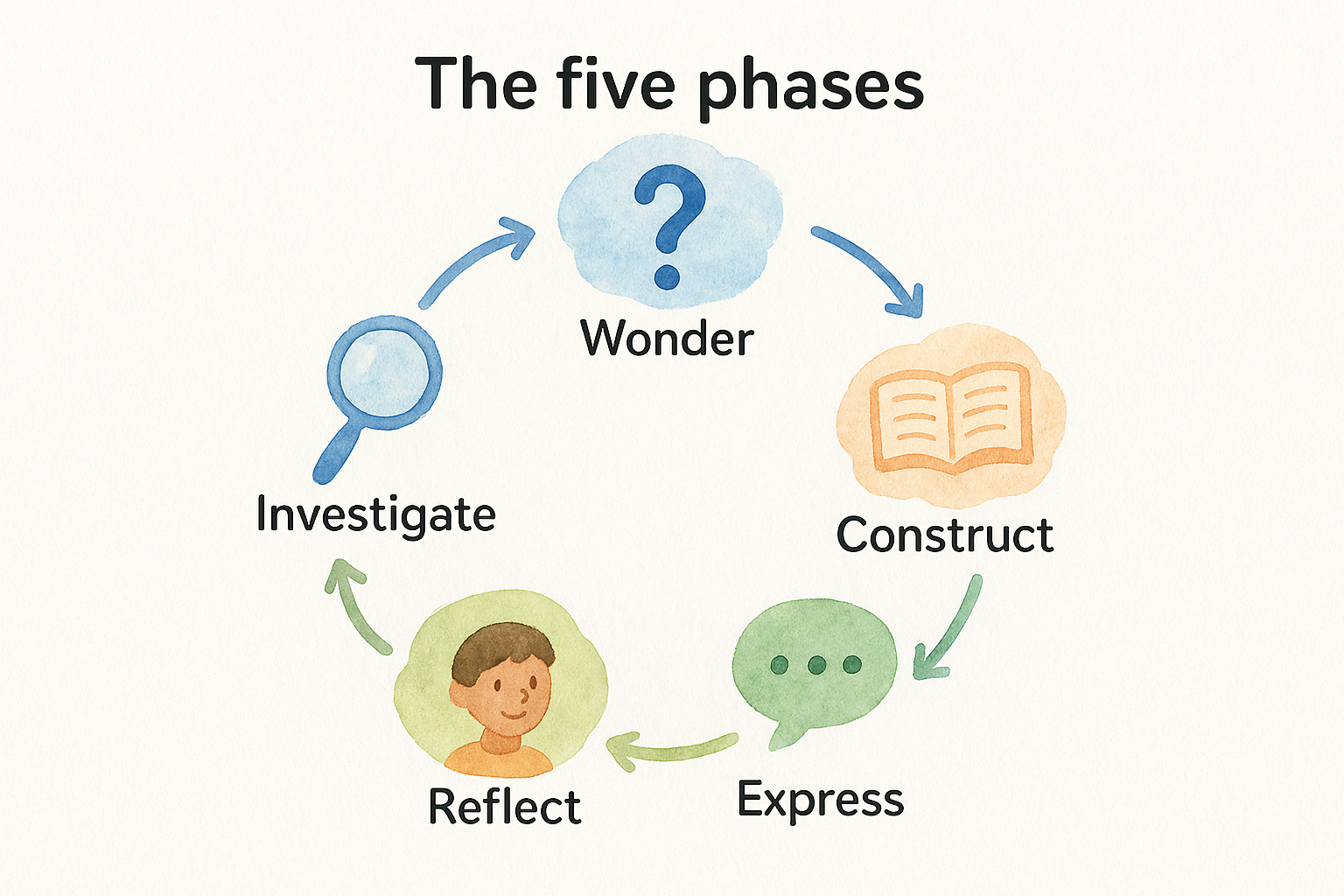
- Wonder: Students encounter a driving question or phenomenon and surface what they already know.
- Investigate: Students gather information, conduct experiments, or analyze sources based on the question.
- Construct: Students synthesize what they’ve found and build an explanation or argument.
- Express: Students communicate their findings through writing, discussion, or presentation.
- Reflect: Students evaluate their process and identify what they would do differently.
Teaching students to recognize each phase by name reduces the confusion that derails inquiry lessons before they gain momentum.
How to adjust the cycle for different inquiry types
The phase structure stays the same whether you run a structured or open inquiry unit. What changes is how much you control each step. In structured inquiry, you define the investigation method during the Investigate phase. In guided inquiry, you hand that decision to students. In open inquiry, students also generate the initial question during the Wonder phase.
Keeping the cycle consistent across units gives students a mental framework they can rely on. Over time, they internalize the process and apply it independently, which frees you to focus on deepening content knowledge rather than re-explaining how inquiry works.
Inquiry-based learning examples across subjects and grades
Seeing inquiry based learning methods in action across different subjects helps you identify where they actually fit in your planning. The examples below are not scripts to copy, but they show how the same cycle applies across contexts, grade levels, and content areas. Adjust the scope and scaffolding to match what your students can handle.
Science and social studies
A common guided inquiry in science involves asking students to investigate which variables affect plant growth. You supply the question, but students design their own experiment, select variables to test, and decide how to record data. What makes it inquiry is that students predict, test, and revise their thinking rather than confirm a predetermined answer.
The best inquiry questions in science generate disagreement first, because that friction pushes students to re-examine their evidence rather than accept easy conclusions.
Social studies lends itself naturally to this approach. A driving question like "Who was most responsible for the causes of World War I?" asks students to analyze primary sources, debate competing interpretations, and write a supported argument. You control the complexity of the sources rather than the inquiry structure, so the same format works across multiple grade levels.
English language arts and math
In ELA, structured inquiry works well when you ask students to investigate why an author made specific craft decisions in a text. Students collect textual evidence, identify patterns, and draw conclusions about the author’s intent. This builds close reading skills while keeping the inquiry grounded in observable evidence.
Math inquiry often looks like giving students a non-routine problem without a visible solution path and asking them to find and justify one. Students test strategies, compare approaches with peers, and explain their reasoning, which develops mathematical thinking that rote practice does not.
Common challenges and fixes for inquiry-based lessons
Even well-planned inquiry based learning methods run into predictable problems. Knowing what tends to go wrong before you launch a unit lets you build in fixes rather than improvise them under pressure. The three challenges below come up most often across grade levels and subject areas, and each one has a practical solution you can apply right away.
Students struggle to get started
When students freeze at the beginning of an inquiry task, the problem is usually too much ambiguity too soon. They haven’t connected the driving question to anything they already know, so they don’t know where to begin. Fix this by adding a short activation phase before students start investigating. Ask them to spend two minutes writing down everything they already think they know about the topic. That low-stakes step surfaces prior knowledge and gives students a concrete starting point.
- Provide 2-3 vetted sources as a launch pad for students who genuinely have no background knowledge
- Pair students briefly at the start so they can share initial ideas before working independently
Work stays shallow or goes off-track
Students often produce surface-level responses when they don’t understand what quality evidence actually looks like. Build in a mid-point check where students share one piece of evidence and explain why it supports their answer. Peer feedback at that stage pushes students to deepen their reasoning before they finalize their work.
Catching shallow thinking at the midpoint costs far less time than rebuilding an entire inquiry task after students submit weak final products.
Time runs short before students finish
Inquiry takes longer than direct instruction, and underestimating that time is one of the most common planning mistakes. Build your timeline backward from the Express phase and add a buffer day before any final submission. A visual progress tracker also helps students manage their own pace instead of waiting for you to redirect them.
Next steps for your classroom
You don’t need to overhaul every unit at once to start using inquiry based learning methods effectively. Pick one upcoming lesson where students already have some background knowledge and swap the direct instruction component for a guided inquiry question. Run the five-phase cycle once, reflect on what worked, and adjust before you try it again. That single iteration will teach you more about your students’ inquiry readiness than any planning document could.
From there, build your question bank. Keep a running list of driving questions that generated strong discussion or genuine disagreement so you can refine and reuse them across years. The more deliberately you document what works, the faster your inquiry lessons improve. If you want more practical strategies and classroom-ready tools to support your teaching, visit The Cautiously Optimistic Teacher for resources built specifically for educators who want to teach smarter, not just harder.