
Fred Jones Classroom Management: Tools For Teaching Guide
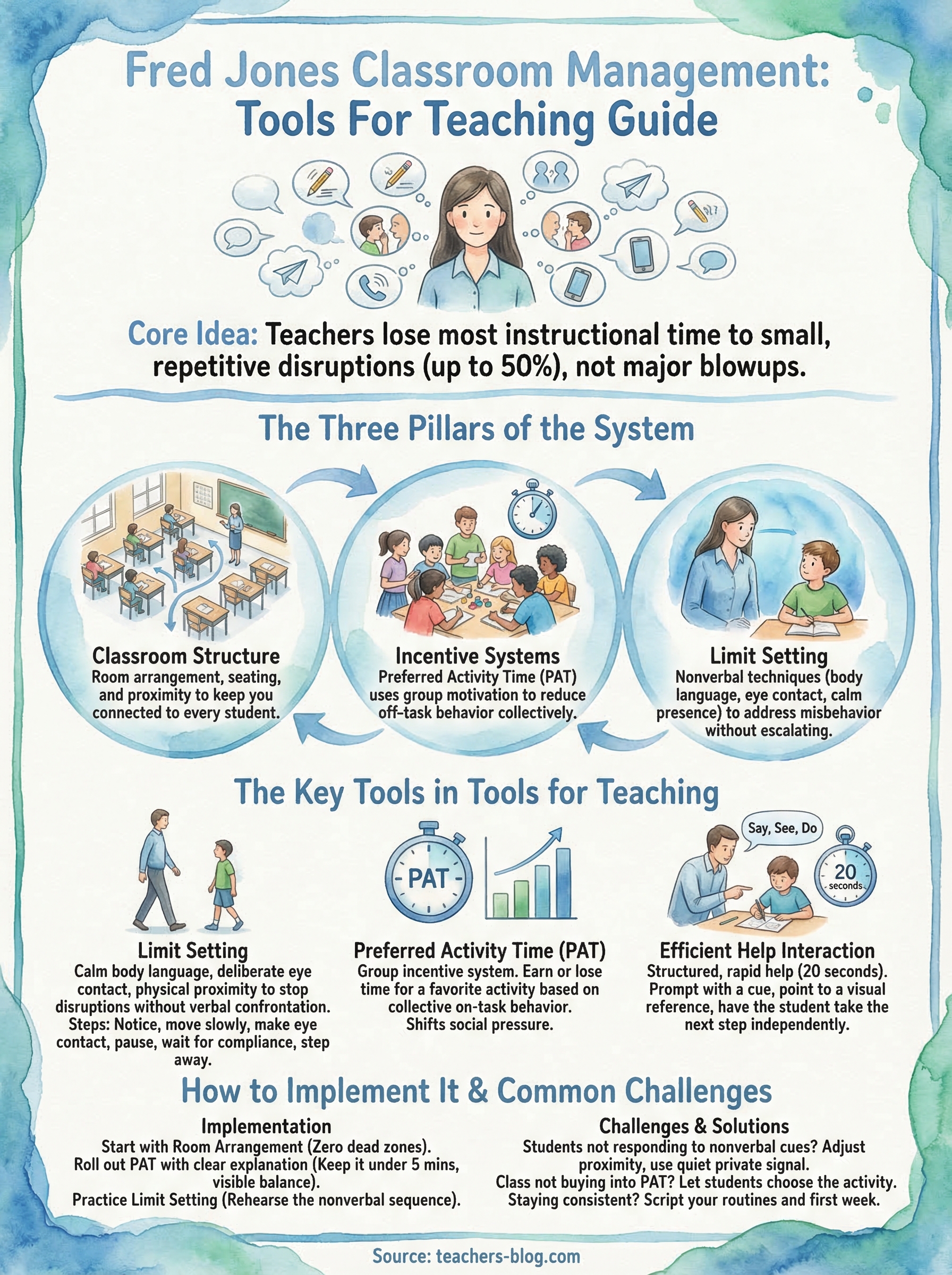
You’ve got a student tapping a pencil nonstop, two kids whispering in the back, and half the class drifting off into their phones. You could raise your voice, or you could use a system that handles most of it without saying a word. That’s the core idea behind Fred Jones classroom management, a methodology built on the premise that teachers lose most of their instructional time to small, repetitive disruptions rather than major blowups.
Dr. Fred Jones spent decades observing real classrooms and boiled his findings into a practical framework called Tools for Teaching. His approach focuses on body language, incentive systems, and efficient help interactions, tools that reduce off-task behavior while keeping students engaged. It’s not theory for theory’s sake. It’s a field-tested system designed for the daily grind of actual teaching.
Here at The Cautiously Optimistic Teacher, we’re always looking for strategies that help educators work smarter, not just harder. Jones’ framework fits that goal perfectly because it addresses the root causes of classroom disruption rather than just reacting to symptoms. In this guide, we’ll break down the key components of Fred Jones’ methodology, walk through how each one works in practice, and give you concrete steps to start using these tools in your own classroom. Whether you’re a first-year teacher or a veteran looking to tighten things up, there’s something here worth grabbing.
What Fred Jones classroom management is
Fred Jones classroom management is a research-based discipline system developed by Dr. Fred Jones, a psychologist who spent years conducting classroom observations across hundreds of schools. His core finding was direct: teachers waste up to 50% of instructional time dealing with low-level disruptions like side conversations, off-task behavior, and students waiting around for help. His framework, published in the book Tools for Teaching, gives teachers a concrete set of strategies to reclaim that time without constant confrontation or raised voices.
The Origin of Tools for Teaching
Jones didn’t build this system from behind a desk. He and his research team observed thousands of hours of real classroom instruction across grade levels and subject areas to find out exactly where time goes and what stops learning cold. What they found surprised most educators: the biggest classroom management problems are rarely dramatic blowups. They’re the slow drain of pencil-tapping, side conversations, and wandering attention that teachers deal with dozens of times every single day.
The research found that the average teacher loses roughly half of available instructional time to these minor, repetitive disruptions, not to serious behavioral incidents.
That finding shaped everything Jones built. Rather than designing a reactive system that kicks in after disruptions happen, he focused on prevention and nonverbal communication as the first line of response. The book Tools for Teaching was first published in 1987, revised in 2007, and remains a practical reference that working teachers still pull off the shelf today.
The Three Pillars of the System
Jones organized his methodology around three interconnected areas that, taken together, address most of what derails a classroom on a typical day. Here’s a quick breakdown of how they fit together:
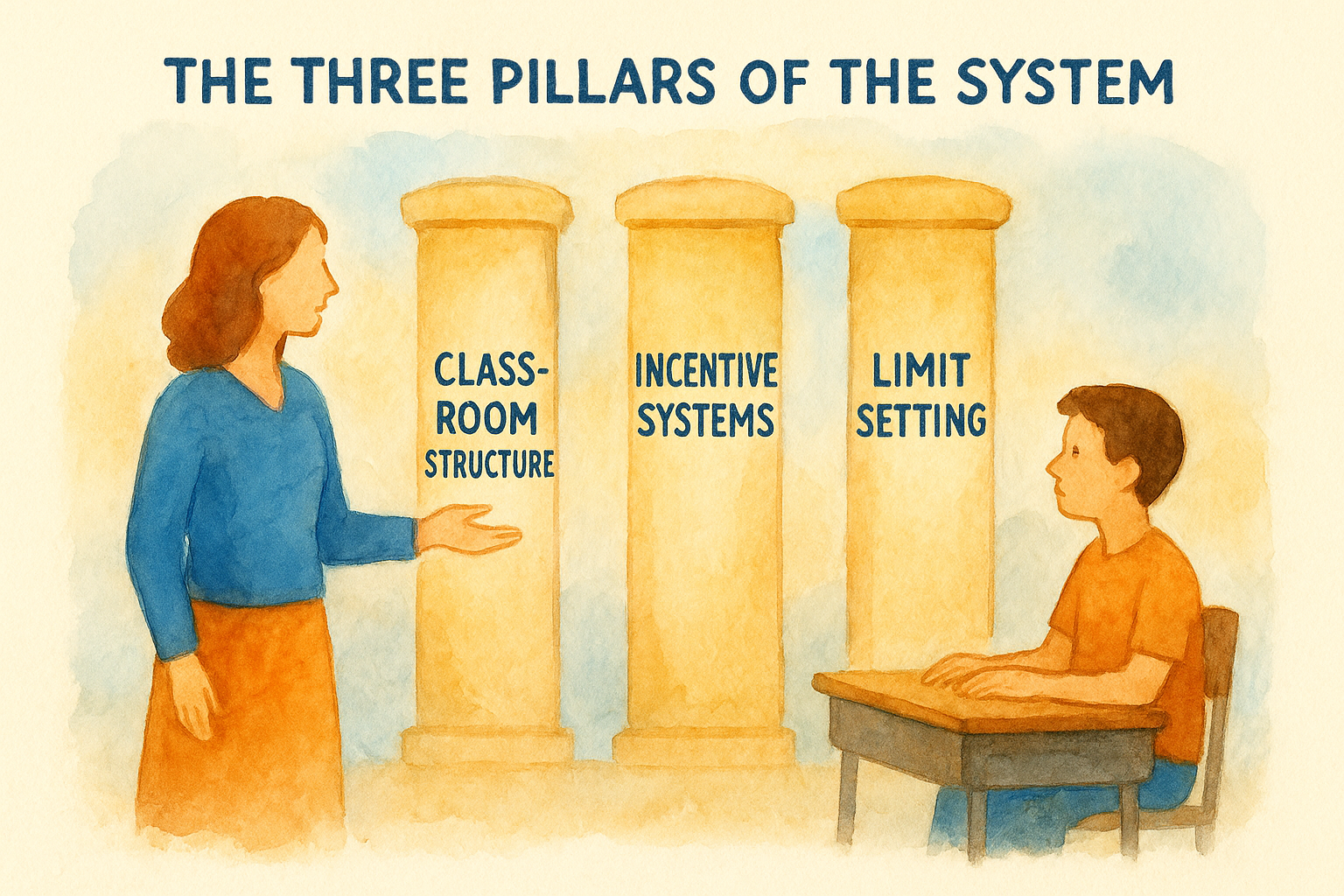
- Classroom structure: Room arrangement, seating, and physical proximity to keep you connected to every student at all times
- Incentive systems: The “Preferred Activity Time” (PAT) model, which uses group motivation to reduce off-task behavior collectively
- Limit setting: Nonverbal techniques including body language, eye contact, and calm physical presence to address misbehavior without escalating it
Each pillar reinforces the others. Strong classroom structure makes your limit-setting more effective because you can physically reach any student quickly. A solid incentive system means students have a collective reason to stay on task, which reduces how often you need to use limit-setting at all.
What Makes It Different from Other Approaches
Most classroom management systems ask you to react to problems after they surface. Jones flips that entirely. His approach puts prevention and environment design at the center, so you’re shaping behavior before it becomes a problem rather than spending your period firefighting small incidents. Where other frameworks lean on consequences and rewards tied to individual behavior, Jones builds group accountability into the incentive structure, which shifts the social dynamic inside the classroom.
You’re not the only one invested in good behavior when the whole class stands to gain or lose Preferred Activity Time based on their collective choices. That shift changes how students relate to each other around behavior, not just how they relate to you. The result is a system where peer influence works for you instead of against you, which is a dynamic that most classroom management approaches never address directly.
Why it works in real classrooms
Fred Jones classroom management works because it targets the right problems. Most discipline approaches assume the biggest threat to learning is the student who flips a desk or picks a fight. Jones’ research showed that chronic low-level disruption, not dramatic incidents, is what actually destroys instructional time. When a system addresses those specific problems directly, you see results because it’s solving the right equation.
It Addresses the Actual Source of Lost Time
Teachers burn time in two main ways: handling off-task behavior and giving inefficient one-on-one help to students who raise their hands and wait. Jones built his system specifically around both of those drains. His limit-setting tools reduce how often you have to interrupt instruction to redirect students, and his “say, see, do” model for individual help cuts the average help interaction from several minutes down to roughly 20 seconds. Those savings add up fast across a full school day.
When you solve the small problems efficiently, the big problems rarely materialize because you never lose control of the room’s momentum.
Research on classroom management consistently supports this kind of low-key, high-frequency intervention. Teachers who respond early and calmly to minor misbehavior create fewer escalations than teachers who ignore small disruptions until they grow into confrontations. Jones built that principle into the DNA of his system.
It Works With How Students Actually Respond to Social Pressure
Students care deeply about what their peers think, and most classroom management systems ignore that completely. Jones uses it. When the entire class stands to gain or lose Preferred Activity Time based on collective behavior, students start monitoring each other without you having to say a word. That peer accountability does work for you that no consequence chart or individual sticker system can replicate.
Group incentive structures have solid support in behavioral research. When individual motivation aligns with group outcomes, compliance increases and the teacher spends far less energy policing individual choices. Jones designed PAT around exactly this dynamic. You’re not bribing students to behave. You’re giving them a shared stake in the classroom environment, which produces behavior change that lasts longer and requires less ongoing enforcement from you.
The practical result is a classroom where most of your energy goes into teaching the content, not managing the crowd.
The key tools in Tools for Teaching
Fred Jones classroom management groups its strategies into three concrete tools you can learn, practice, and apply in sequence. Each tool targets a specific source of lost instructional time, and together they form a complete system rather than a collection of disconnected tips.
Limit Setting
Limit setting is Jones’ approach to stopping misbehavior without verbal confrontation or threats. When a student goes off-task, you use calm body language, deliberate eye contact, and physical proximity to communicate that you’ve noticed and expect them to self-correct. You move toward the student slowly, make eye contact, wait, and then move away once behavior shifts. No lecture. No public call-out.
The power of limit setting is that it stops disruptions without breaking the instructional flow for the rest of the class.
Most students respond to a calm, nearby adult presence faster than they respond to verbal correction, which tends to trigger defensiveness. Your teaching momentum stays intact while the student gets the message through nonverbal cues alone.
Preferred Activity Time
Preferred Activity Time, or PAT, is Jones’ group incentive system. You set aside a block of time, typically at the end of class, for an activity students genuinely enjoy. They earn time in that block or lose it based on collective on-task behavior throughout the period. The entire class shares the consequence, which creates peer accountability without you engineering it.
PAT works because it shifts the motivation structure inside your room. Students have a shared reason to stay on task, and that social pressure handles a significant amount of behavior management automatically. You’re not rewarding individual students for compliance. You’re letting the group’s collective choices determine the outcome for everyone, which is a fundamentally different dynamic than individual behavior charts or sticker systems.
The Efficient Help Interaction
Inefficient help is one of the biggest hidden drains on classroom time. Jones found that teachers often spend three to five minutes with one student while the rest of the class drifts. His solution is a structured, rapid interaction built around “say, see, do” teaching: you prompt the student with a short verbal cue, point to a visual reference, and have them take the next immediate step themselves. That interaction takes roughly 20 seconds.
This approach keeps you mobile, keeps students working, and prevents the learned helplessness that develops when students expect you to sit with them until the problem is essentially solved for them.
How to implement it in your classroom
Implementing Fred Jones classroom management doesn’t require a complete overhaul of your teaching style. You can phase in the tools one at a time, starting with the pieces that give you the fastest return on your effort. Most teachers begin with room arrangement because it costs nothing and creates immediate structural advantages that make every other tool more effective.
Start with your room arrangement
Room layout is the foundation of Jones’ system. You need to be able to reach any student in the room within a few steps, which Jones calls the “interior loop.” Rearrange desks so there’s a clear path from the front of the room through every row and cluster. If you teach from behind a desk or podium, this step alone will change how much time you spend physically present with your students during independent work.
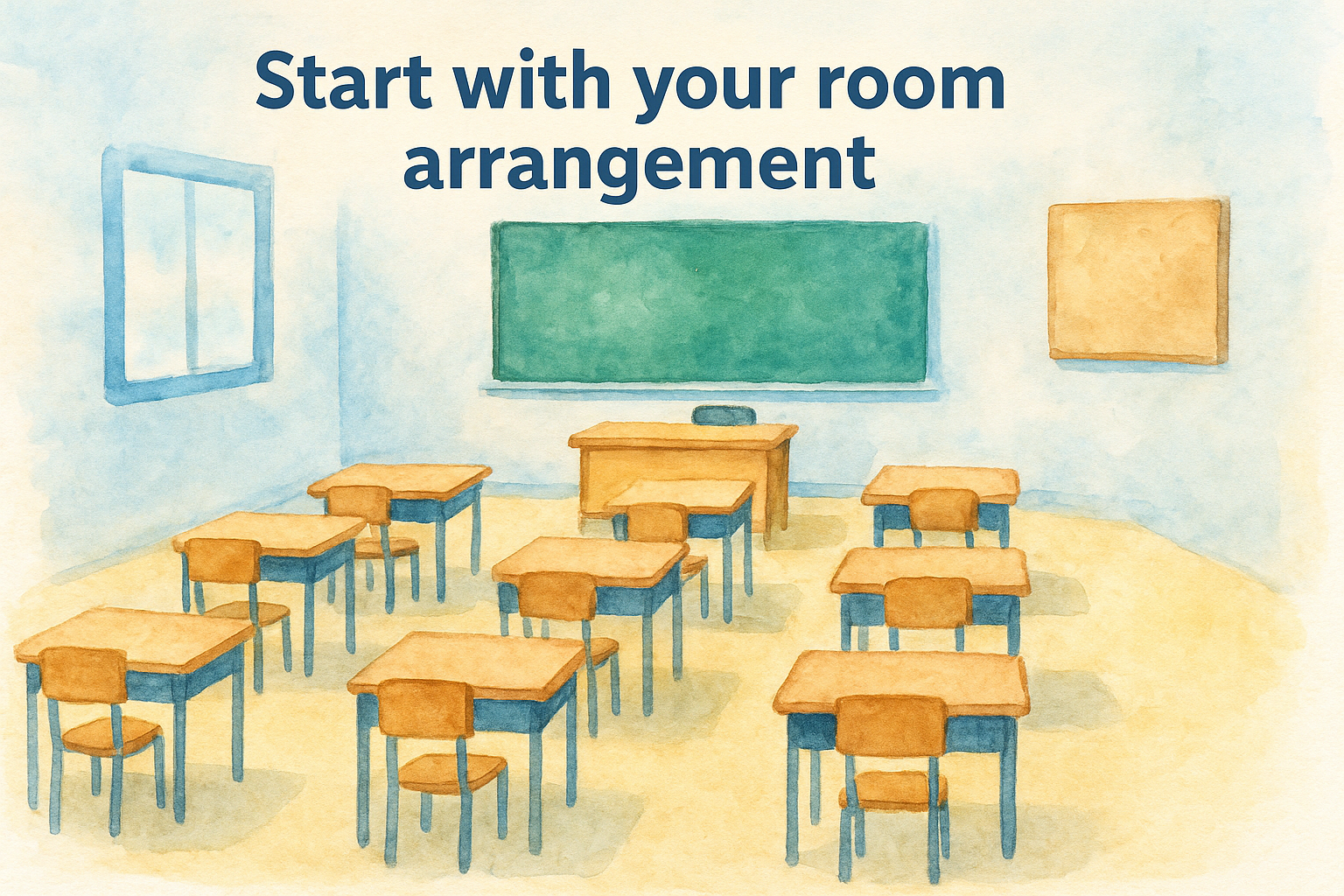
A room where you can reach every student in seconds makes limit setting and efficient help interactions far more practical to execute consistently.
Your goal is zero dead zones, meaning no corner or cluster of desks that requires you to squeeze past furniture or ask students to move before you can get there. Solve this once, and the rest of the system operates more smoothly from day one.
Roll out PAT with a clear explanation
Preferred Activity Time only works if students understand the system before it starts. On the first day you introduce PAT, spend five minutes explaining the concept directly. Tell students what the activity will be, how much time they start with, and exactly what behaviors will cost the group minutes. Write the current PAT balance somewhere visible in the room so there’s no ambiguity about where things stand.
Keep your starting activities genuinely appealing. Students need to believe they’re losing something real when off-task behavior cuts into PAT. Let student input shape what that time looks like, within reason, and you’ll get buy-in that makes the system run largely on its own.
Practice limit setting before you need it
Limit setting is a physical skill, not just a concept, so you need to practice it before a real situation forces you to improvise. Run through the sequence mentally: notice the behavior, move toward the student slowly, make steady eye contact, pause, wait for compliance, then step away. The entire interaction should feel calm and deliberate rather than rushed or reactive.
Scripts and routines you can use tomorrow
Fred jones classroom management gives you concrete tools, but knowing what to actually say and do when the moment hits is what makes those tools usable in real time. The routines below translate Jones’ core principles into specific language and sequences you can practice tonight and run starting tomorrow.
A limit-setting script for off-task behavior
When you spot a student going off-task, your instinct might be to say something immediately. Jones’ approach asks you to slow that impulse down. Walk toward the student at a calm, unhurried pace, make steady eye contact, and stop within a few feet of them. Say nothing. Hold the pause for three to five seconds. Most students will self-correct before you say a single word.

The silence itself is the message: you’ve noticed, you’re not leaving, and you expect them to fix it.
If the student doesn’t redirect, you can add a quiet, neutral verbal prompt like “Let’s get back to it” before stepping away. Keep your tone flat, not warm and not sharp. You’re communicating expectation, not disappointment. Once the student returns to work, move on immediately without lingering.
A PAT rollout script for day one
Walk students through the PAT system the first day you use it. Keep the explanation under five minutes and make it concrete. A simple script sounds like this: “At the end of class, we have ten minutes set aside for [activity]. Every time I need to stop to redirect the group, we lose thirty seconds. The time you protect is time you keep.” Write the starting balance on the board and update it visibly throughout the period so students can track it in real time.
The key is to run PAT consistently for the first two weeks without skipping it. Students need to trust that the system is real before it changes their behavior. Let the group choose from two or three activity options at the start of each week so they feel genuine ownership over what’s at stake.
A help interaction routine
When students raise their hands during independent work, you need a repeatable sequence that takes 20 seconds or less. Move to the student, glance at their work, give a single targeted prompt like “Look at step two again” or “What does the example on the board tell you to do next?”, and step away before they respond. You’re prompting independent thinking, not delivering the answer. Doing this consistently prevents the cycle where students stop trying because they expect you to solve it for them.
Common challenges and how to handle them
Even a well-designed system runs into friction when it meets a real classroom. Fred Jones classroom management gives you strong tools, but those tools require adjustment when specific situations push back. Knowing the common sticking points in advance means you can troubleshoot them without abandoning the framework entirely.
Students who don’t respond to nonverbal cues
Some students genuinely don’t pick up on proximity and eye contact the way the system expects. This usually happens with students who have attention challenges or anxiety, where a nearby adult presence registers as threatening rather than redirecting. When that happens, adjust your approach before escalating. Step closer than usual, then pause farther back than normal, and observe which distance produces a calm self-correction rather than a freeze or a reaction.
For students who consistently need more than a nonverbal cue, build a private, pre-agreed verbal signal into your routine. One quiet word or a specific tap on the desk edge keeps the interaction low-profile and non-confrontational while still giving that student a clear prompt to redirect.
Getting the whole class to buy into PAT
The most common reason PAT fails in the first two weeks is that the activity students are earning feels like something they’d do anyway, so losing time from it carries no real weight.
You fix this by letting students choose the activity from a short list rather than assigning it yourself. When they pick it, they own the loss if it shrinks. Run PAT without exceptions for the first three weeks. If you skip it once because the period ran long, students stop trusting the system, and peer accountability fades with it.
Staying consistent when you’re stretched thin
Consistency is the part of any classroom management system that collapses under pressure first. On a hard day, it’s easy to let a side conversation slide or skip the limit-setting walk because you’re tired. That inconsistency is exactly what students notice fastest. Build the routines into your muscle memory so they run automatically rather than requiring a deliberate decision every time.
One practical way to protect consistency is to script your first week of PAT explanations and your limit-setting sequence before school starts. When the routine lives on paper first, it’s easier to execute reliably when the day gets difficult and your mental bandwidth runs low.
Next steps
Fred Jones classroom management gives you a system built on research, not guesswork. You now have the three core tools, room arrangement strategies, PAT rollout scripts, limit-setting sequences, and practical fixes for the most common sticking points. The framework works because it targets the actual causes of lost instructional time rather than reacting to symptoms after the damage is done.
Start with one tool this week. Fix your room layout first, then introduce PAT the following Monday with a clear explanation and a visible balance on the board. Add your limit-setting routine once the other two feel natural. Building the system in layers gives each piece time to take hold before you add more.
When you’re ready to bring more efficiency into your classroom, explore the tools and resources at The Cautiously Optimistic Teacher. You’ll find AI-powered tools and practical strategies that help you spend less time managing and more time teaching.