Classroom Attention Signals That Actually Work
Classroom attention signals are not discipline tools; they are cognitive transition cues. Their primary job is to interrupt scattered attention and signal a new direction. To achieve behavioral fluency, a signal must be neutral, predictable, and explicitly taught. When a signal is automated through practice, it preserves instructional time and prevents the teacher from needing to overpower noise with their voice.
This is Lesson 2 of Module 5: Proactive Classroom Management Strategies | Full Course Outline
Mindset Shift: From Overpowering to Orienting
| The Power Lens (Overpowering) | The Cognitive Lens (Orienting) |
| Goal: To be louder than the students. | Goal: To provide a predictable “stop” cue. |
| Teacher Action: Yelling, flickering lights repeatedly. | Teacher Action: Using one calm, consistent signal. |
| Student Experience: Stress-response or “tuning out.” | Student Experience: Automatic shift in focus. |
| If it Fails: Teacher gets angry and lectures. | If it Fails: Teacher “resets” and practices again. |
| Result: Escalation and voice strain. | Result: Calm transitions and preserved dignity. |
Let’s be honest. Most classroom attention signals don’t fail because students are “disrespectful.” They fail because they are used reactively, inconsistently, or emotionally.
If you’ve ever:
Counted down from five while students kept talking
Said “Guys… guys… guys…” louder and louder
Clapped three times while half the class stared at you
Felt your blood pressure rise while trying to regain control
You’re not alone.
The goal of classroom attention signals is not to overpower noise.
It’s to create a predictable shift in attention.
And that’s a neurological difference, not just a management trick.
What Classroom Attention Signals Are Actually For
Attention signals are not discipline tools.
They are transition tools.
Their job is to:
Interrupt scattered attention
Reorient the group
Reduce cognitive load
Signal “new direction incoming”
That’s it.
When used correctly, they:
Preserve your voice
Preserve student dignity
Preserve instructional time
When used poorly, they escalate tension and create power struggles.
Why Most Classroom Attention Signals Fail
Let’s break this down.
1. They’re Introduced During Chaos
If the first time students hear your signal is when you’re already frustrated, it won’t feel neutral.
It will feel emotional.
Students respond to tone more than words.
2. They’re Inconsistent
If sometimes you count down.
Sometimes you clap.
Sometimes you say “Hey!”
Sometimes you just wait…
Students don’t know what to respond to.
Predictability builds compliance.
Inconsistency builds confusion.
3. They’re Layered With Emotion
When a signal becomes:
“FIVE! FOUR! I SAID FOUR!”
It stops being a signal and becomes a threat.
And threat activates stress responses, not cooperation.
The Science: Why Classroom Attention Signals Work
From a cognitive standpoint, attention is limited.
Students are constantly filtering stimuli:
Peer conversations
Visual movement
Internal thoughts
Emotional states
An effective attention signal works because it:
Interrupts the noise pattern
Is predictable
Requires minimal processing
Is paired with consistent follow-through
The brain loves patterns.
When the same signal always means the same thing, the response becomes automatic.
That’s the goal:
Automatic compliance.
Not emotional compliance.
The 7 Top Classroom Attention Signals That Work
These are adaptable across elementary, middle, and high school.
The key is not the type of signal.
The key is how you teach and use it.
1. The Calm Countdown
Not a threat countdown.
A neutral one.
Example:
“5… 4… 3…”
Spoken slower than you think necessary.
Your tone should say:
“I know you’ll respond.”
Not:
“Please don’t make me angry.”
Why it works:
Predictable pattern. Auditory cue. Built-in pause.
2. Call-and-Response
Examples:
Teacher: “Class.”
Students: “Yes.”
Teacher: “Ready to learn?”
Students: “Ready to grow.”
Older students:
Teacher: “If you can hear me…”
Students: “…clap once.”
Why it works:
It requires participation. The brain shifts from passive noise to active response.
Important: Do not overuse it. It loses novelty quickly.
3. The Non-Verbal Signal
Hand raised
Lights flicked once
Timer displayed on board
Visual countdown
This is powerful in middle and high school.
You stop talking.
Raise your hand.
Wait.
Students mirror.
Silence spreads.
Why it works:
Humans mirror behavior. Calm spreads faster than noise when consistent.
4. The Proximity Pause
Walk to the center of the room.
Stand silently.
Make eye contact.
Wait.
You don’t say anything.
This works especially well with older students.
Why it works:
It signals transition without confrontation.
5. The Timer Reset
Project a 10-second countdown.
Say:
“Wrap it up.”
Nothing else.
Timer runs.
You begin when it ends.
No lecture.
No nagging.
Why it works:
It externalizes the control. The timer becomes the neutral authority.
6. The Rhythmic Cue
Clap pattern.
Desk tap.
Short chime sound.
Important:
It must always mean the same thing.
And you must stop speaking immediately when you use it.
Students copy the behavior they see.
7. The Quiet Voice Shift
This is underrated.
Instead of raising your voice, lower it.
Begin speaking in a near whisper.
Students lean in.
Curiosity replaces resistance.
This works best when your classroom culture is strong.
The Most Important Rule for Classroom Attention Signals
Pick one primary signal.
Teach it explicitly.
Practice it when the room is calm.
Do not rotate randomly.
Consistency builds automaticity.
Automaticity reduces stress—for you and for students.
How to Teach a Classroom Attention Signals (Step-by-Step)
This is the part most teachers skip.
Step 1: Explain the Purpose of Classroom Attention Signals
“Sometimes we need to shift quickly from discussion to instruction. This signal helps us do that without me yelling.”
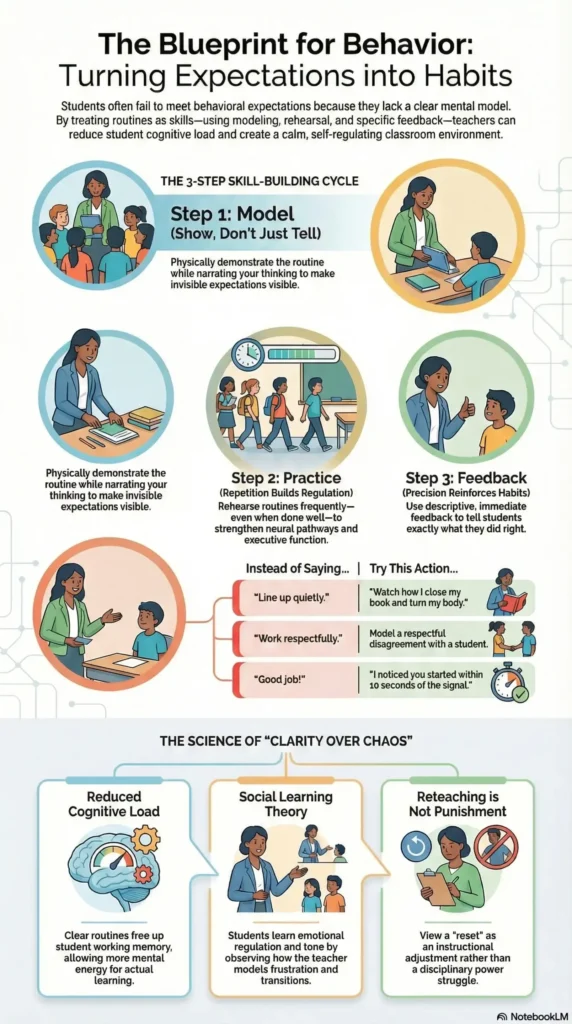
Step 2: Model It
Demonstrate exactly what it looks like.
Step 3: Practice It
Have them intentionally talk.
Use the signal.
Time how long it takes.
Make it a challenge.
Step 4: Reset and Try Again
The goal:
Under 5 seconds.
Step 5: Reinforce Calmly
“Nice. That took four seconds.”
That’s it.
No sarcasm.
No power struggle.
What To Avoid When Using Classroom Attention Signals
❌ Using five different signals
❌ Yelling over students
❌ Adding lectures after the signal
❌ Using it only when you’re upset
❌ Turning it into a punishment
The signal is neutral.
Keep it neutral.
A Proactive Mindset Shift
Attention signals are not about control.
They are about:
Protecting instructional time
Reducing teacher stress
Teaching self-regulation
Building predictability
In fact, when done well, attention signals become part of classroom structure.
And structure reduces behavioral load.
Which means:
You spend less time managing
And more time teaching
Final Thought on Classroom Attention Signals
The best classroom attention signals don’t feel dramatic.
They feel boring.
And boring is good.
Because boring means predictable.
And predictable means safe.
And safe classrooms regulate themselves far better than loud ones ever will.
Classroom Attention Signals FAQ
Why do classroom attention signals fail? Most attention signals fail because they are used inconsistently or introduced during chaos. For a signal to work, it must be introduced when students are calm, practiced until it is an automatic habit, and used with a neutral, non-emotional tone.
What are the best attention signals for middle school? Middle and high school students respond best to non-verbal or neutral signals, such as a raised hand, a chime, or a ‘proximity pause.’ These signals avoid the ‘childish’ feel of some call-and-response methods while effectively shifting the group’s focus.
How do you teach an attention signal for behavioral fluency? To reach fluency, use the ‘Model-Practice-Reset’ cycle. Explain the signal’s purpose, model the expected behavior, have students practice it while talking, and time the response. If it takes longer than 5 seconds, calmly reset and try again until the response is automatic.
Reflection
I remember trying to regain attention by talking louder or waiting for students to quiet down, but it often turned into a battle for control. I didn’t realize that students were already overloaded with distractions and needed a clear, predictable cue to refocus. Once I introduced a consistent attention signal the shift in focus became almost automatic. Honestly, sometimes I find it difficult to be consistent but it is worth it.
Do you have one consistent attention signal?
Have you explicitly taught it?
Is your tone neutral when you use it?
Do you trust the process enough to wait?
Continue the Classroom Management Course
In the next lesson, we will explore how teacher voice and body language shape classroom climate by communicating calm authority, reducing escalation, and helping students regulate their behavior.
Next Lesson: Voice, Presence, and Non-Verbal Cues
Module 5 Progress:
- Clear Expectations vs. Long Rule Lists
- Modeling, Practice, and Feedback
- Attention Signals That Actually Work
- Voice, Presence, and Non-Verbal Cues
- Consistency Without Rigidity
Back to Module 5 Overview
Return to Full Course Outline