
10 Ways to Run Team Review Games That Engage Every Student
The challenge with team review games is rarely a lack of enthusiastic students. It is making sure every student thinks, learns, and gets meaningful feedback—even if one confident teammate knows all the answers. A classroom game can be lively and still leave quiet students watching. Good structure keeps the excitement while making participation visible.
This guide is for middle and high school English teachers who already know which content they want to review and need a practical system for teams, roles, pacing, scoring, and inclusion. For the activity ideas themselves, see our English Classroom Review Games hub, including literature, grammar, vocabulary, reading comprehension, and exam-preparation lessons.
Decide what winning should mean
Before students arrive, decide whether the game assesses knowledge retrieval, supported interpretation, collaboration, or a mixture. In a definition round, one accurate answer may be enough. In a literature round, the best response might need a claim, relevant text evidence, and an explanation. Using the same speed-based scoring for both will favour quick recall over careful thinking.
State the rules and the learning goal in plain language. For example: “Every student will write an initial answer; teams then agree on their strongest response. Points reward accuracy and explanation. We will finish with a short independent exit ticket.” This is a useful approach whether the game uses cards, a board, or a shared screen.
10 ways to make team review games more inclusive
1. Start with independent think time
Routine: After displaying a question, give everyone at least 20–40 seconds to write a first response. Then let teams compare ideas. For a complex paragraph or evidence task, allow more time. This prevents the fastest speaker from becoming the team’s permanent spokesperson.
A teacher can say: “Nobody answers for the team until everyone has written something.” The independent response becomes useful formative evidence and gives students a reason to participate in the discussion.
2. Make team roles explicit and rotate them
Use four flexible roles: reader restates the prompt; evidence finder locates a relevant clue; reasoning checker tests the proposed answer; presenter shares the team’s decision. With three students, combine the first two roles. Rotate after two or three questions.
Do not assign students permanently to roles based on perceived ability or confidence. Everyone should practise explaining and evaluating an answer over the course of the unit.
3. Give points for explanations, not just speed
A simple rubric is one point for an accurate answer, one for relevant evidence, and one for clear reasoning. In a grammar round, replace evidence with the applicable rule; in an argument round, require a fair counterclaim or an explanation of evidence quality.
Students should know that a partially correct answer can earn feedback and a chance to improve. Avoid subtracting points for taking longer when the objective is deep analysis.
4. Build in the right to revise
After a team responds, announce a short “revision window.” Students can consult the text, correct a misidentified literary device, or add missing reasoning. Give a small revision point if the change is justified.
A student who notices that an answer was too broad has done worthwhile thinking. Treating every first attempt as final can make guessing more important than learning.
5. Keep groups small enough to contribute
Groups of three or four usually make role rotation and discussion manageable. If your class requires larger groups, assign turn-taking rules so each person contributes an idea before the team submits. A confident leader should not be able to answer alone every round.
You can use mixed-readiness teams for peer explanation, but do not automatically make the strongest student responsible for teaching everyone else. Rotate responsibility and listen for individual understanding.
6. Avoid elimination as a participation mechanic
In an elimination game, some students may spend most of the lesson watching other people. Keep everyone active in every round and offer a new question after errors. If a dramatic moment is important to the game, make the effect brief and playful rather than removing access to the learning.
A whole-class bonus round after a difficult prompt can restore participation and give the teacher a chance to clarify a common misconception.
7. Offer more than one way to respond
Depending on the learning target, students might speak, write, point to a passage, or submit a shared team response. For an oral-presentation lesson, speaking may be essential; for a symbolism lesson, a carefully written explanation can show the same interpretation.
Display question text while reading it aloud when possible, and give adequate processing time. Do not make standing, running, or public speaking a requirement unless those actions are integral and accessible to the learning objective.
8. Balance question types
Move among accessible recall, application, and interpretation questions. For instance: define foreshadowing, identify whether a short invented example qualifies, and explain how an actual story detail shapes a reader’s expectation.
This sequence gives students a foothold while still challenging them to use knowledge. A wall of difficult trick questions can frustrate students; a series of only easy questions does not reveal much progress.
9. Use a scoreboard that doesn’t punish mistakes disproportionately
Try awarding points for successful reasoning and improvement rather than reducing scores for incorrect answers. When teams fall far behind, introduce a reasonable opportunity to earn points by correcting misconceptions or answering a challenge that everyone can attempt.
Do not manipulate results secretly to manufacture a winner. Students are more likely to trust a game whose rules are clear and applied consistently.
10. End with individual evidence of learning
A team’s victory does not prove that each member understands the content. End with an unseen short question or application prompt answered independently. Collect these and look for patterns: who can now explain why a passage is ironic, identify a claim with evidence, or edit a complex sentence?
These answers guide your next lesson more reliably than team rankings. They also give the student who lost the game a chance to demonstrate real growth.
A ready-to-use participation script for the teacher
Opening: “Today’s game is practice, not a judgment of who’s smartest. Everyone will write a first answer. Then you’ll share ideas, check the evidence, and agree on your team’s response. We award points for being accurate and explaining why.”
Before each question: “Read carefully. Write independently. Now compare. The presenter shares the final answer only after the team has listened to everyone.”
After an incorrect answer: “Good attempt. What new detail changes your thinking? You have one opportunity to revise your explanation.”
At the end: “Put the team scores aside. Complete this final question by yourself so I can see what to teach next.”
Common game-management problems and quick fixes
One student answers every question
Use simultaneous writing and rotate presenters. Ask a different teammate to explain the reason behind the choice. If several students have not attempted the question independently, pause and reset the routine.
Teams argue about the correct answer
Refer to shared criteria. An interpretive answer should be defensible with relevant text evidence; sometimes two conclusions can both be reasonable. Use teacher moderation for open-ended tasks and explain why one answer is stronger only when the evidence warrants it.
Fast teams finish while others are still reading
Let every team use the full reading window. Add an optional enrichment prompt for groups who finish early, such as “What alternative interpretation could someone reasonably defend?” Do not penalize students for accessibility supports.
Students lose interest after falling behind
Limit the effect of cumulative scoring, celebrate useful revisions, and make every round playable. A challenge for all teams can refocus attention on a shared learning goal.
A 45-minute team review lesson template
Minutes 0–5 — Individual warm-up: Students retrieve three concepts from the current unit without team help. Explain that this is the baseline, not a scored contest.
Minutes 5–9 — Rules and modelling: Explain roles, points, acceptable evidence, and how to revise. Model a weak and a strong answer to the same question.
Minutes 9–23 — Round one: Use six short recall and application questions. Rotate roles halfway through and insist on individual writing before team discussion.
Minutes 23–36 — Round two: Shift to three analytical questions that require a quotation, example, or detailed explanation. Give sufficient time and accept more than one supported interpretation.
Minutes 36–40 — Final challenge: Teams create a concise response to one synthesis question, such as “How do point of view and conflict work together in the text?”
Minutes 40–45 — Exit ticket: Each student answers a fresh question independently and identifies one idea they changed their mind about during play.
Adjusting the routine for different grade levels
Grades 6–7: Start with pairs or groups of three. Use short directions and visual role reminders. Give sentence frames such as “Our evidence is ___, which suggests ___.”
Grades 8–9: Require explanation of literary techniques, claims and evidence, grammar corrections, and comparison of interpretations. Try a set of short story review games or reading comprehension games with these roles.
Grades 10–12: Include ambiguity, counterarguments, and evidence limitations. Rotate a facilitator or skeptic role, and reward careful qualification rather than performative certainty.
If students have accessibility accommodations, treat them as part of normal game planning. A shared-screen experience can reduce device demands, but it may still require alternative access to visual questions, audio, or sufficient thinking time.
What team games do and do not assess
Team discussions provide valuable information about reasoning processes, cooperation, and misconceptions. They are not a clean measure of individual achievement. A learner can earn team points through someone else’s answer or contribute insight that a simple scoreboard does not capture.
The Common Core speaking and listening anchor standards emphasize effective participation in collaborative discussions. Combine those goals with the specific reading, writing, or language standard behind the question. Do not assign individual grades based solely on team score.
How Plot Twist! can support teacher-led team review
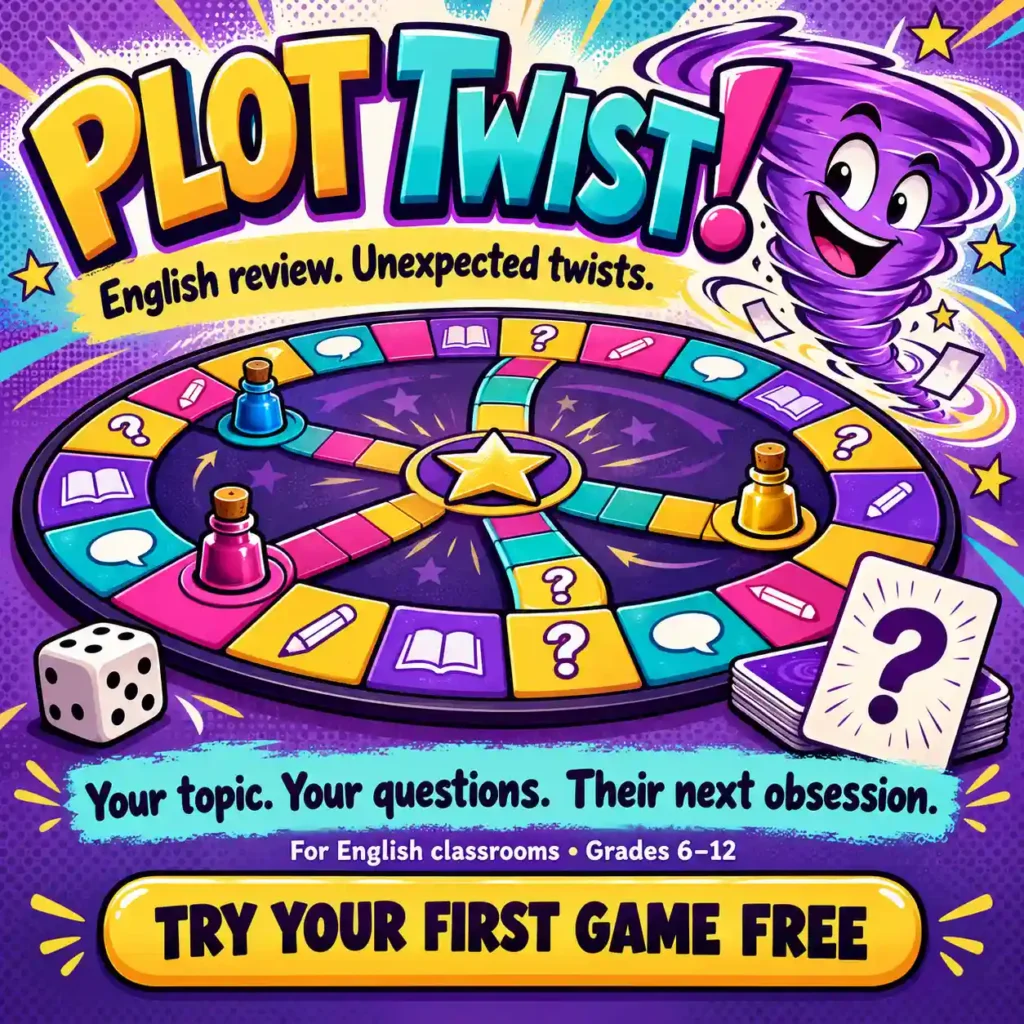
Plot Twist! is designed for English teachers who want a whole-class review game on a shared screen rather than individual logins. Teachers choose two to seven teams, set the game up around a topic or permitted lesson materials, and guide questions that lead toward a final challenge.
The game supplies playful competition, ink scoring, and surprise events. The teacher still sets the expectations for fair discussion, role rotation, and evidence. For interpretive English answers, manual teacher evaluation can help recognize multiple justified responses. The first game is free; review the generated questions before playing.
Frequently asked questions
What is the ideal team size for classroom review games?
Three or four students is a practical starting point because everyone can hold a role and contribute to the discussion. Adjust for class size and accessibility rather than enforcing one number.
How can I stop one confident student from dominating?
Require independent answers first, rotate the presenter, and ask another teammate to supply the evidence or explanation. Praise the quality of the process rather than only the final score.
Should students earn points for participation?
Reward demonstrable actions tied to the learning goal, such as providing evidence or revising an answer. Avoid scoring personality traits like enthusiasm or public confidence.
Do teams need different questions to keep the game fair?
Not necessarily. Shared questions allow students to compare reasoning and receive common feedback. If questions differ in difficulty, use consistent scoring criteria and acknowledge that scores are not directly comparable.
Engagement is the process, not the noise level
A successful team review game has energy, but the strongest evidence of success is more students producing accurate, thoughtful answers. When everyone has time to think, a real role, and useful feedback, the game becomes a teaching tool rather than a spectator sport. Continue with the complete English Review Games collection for lesson-ready topics.