12 Active Learning Strategies for Student Engagement
You’ve watched it happen. Half the class is scrolling through the lecture with glazed eyes while you talk at them instead of with them. Passive note-taking doesn’t build understanding, and it definitely doesn’t hold attention past the ten-minute mark. That’s why active learning strategies for student engagement matter so much right now: they shift students from spectators to participants, and participation is where actual learning happens.
This list gives you active learning strategies for teachers that work in real classrooms, not theoretical models that sound good in a workshop. You’ll find active student engagement strategies you can drop into tomorrow’s lesson plan with minimal prep, alongside ones worth building into a full unit. Each one gets students talking, moving, questioning, or creating instead of just receiving information.
Below, you’ll find 12 approaches covering everything from quick-fire discussion techniques to structured group tasks and movement-based activities. Some fit a five-minute warm-up, others anchor a whole class period. Pick a few that match your subject and grade level, try them this week, and watch which ones actually get your students leaning forward instead of checking the clock.
1. Use AI-generated questions to spark discussion
Starting class with a stack of questions you wrote at 10 p.m. the night before gets old fast. AI-generated questions solve that problem by giving you a fresh set of discussion prompts in seconds, pulled directly from whatever material you’re teaching that day. This is one of the fastest ways to build active student engagement strategies into a lesson without adding hours to your prep time, and it’s only one of the AI tools that keep students engaged.
How it works
You feed a reading passage, article, or unit topic into one of the tools that build critical thinking questions, and it produces a set of prompts tailored to that content. Instead of relying on the same three questions you’ve asked every year, you get variety: literal comprehension questions mixed with inference-based ones, plus a few that push students toward evaluation and synthesis. You can sort these into warm-up prompts, mid-lesson checks, or exit-ticket discussion starters depending on where you need engagement most.
Why it boosts engagement
Questions written by a human teacher under time pressure tend to repeat patterns: same phrasing, same difficulty level, same predictable answers. Fresh, varied questions catch students off guard in a good way. They can’t autopilot through a discussion when the prompt asks them to compare two characters’ motivations instead of just naming what happened in chapter three.
Varied, well-pitched questions turn a passive discussion into one where students actually have to think before they talk.
Students also respond better to open-ended, layered questions than to yes-or-no ones, and a generator can produce a batch quickly enough that you’re not stuck reusing the same three prompts every unit.
Best for
This strategy suits any subject where discussion drives the lesson: English literature units, history source analysis, science lab debriefs, even math word problems that need unpacking. It works particularly well for teachers covering To Kill a Mockingbird, Lord of the Flies, or Greek mythology units, where layered discussion questions dig into theme and character rather than plot recall.
Quick tip to get started
Before your next class, paste tomorrow’s reading into a question generator and ask for five discussion questions at mixed difficulty levels. Print them on strips of paper, hand one to each small group, and give them three minutes to discuss before sharing out. You’ll spend less prep time and get richer answers than a whole-class question you wrote from memory.
2. Think-pair-share for quick peer discussion
Sometimes the simplest tool works best. Think-pair-share takes thirty seconds to explain and gets every student talking within a minute, no special materials required. It’s one of those active learning strategies for student engagement you can use five times a day without it ever feeling repetitive to students.
How it works
Pose a question, then give students thirty to sixty seconds of silent thinking time before they turn to a neighbor and compare answers. After a minute or two of paired discussion, call on a few pairs to share with the whole class. The structure forces individual thought first, which stops the loudest students from dominating before quieter ones even form an opinion.
Why it boosts engagement
Silent think time matters more than teachers usually give it credit for. Without it, the same three hands shoot up every time, and everyone else checks out. Paired talk time gives every student a low-stakes chance to test an answer before risking it in front of the whole room.
Give students thirty seconds of silence before you ask them to talk, and you’ll hear better answers from more voices.
Quiet students in particular open up more in a pair than in a full-class setting, which is one of the simplest ways of drawing reluctant students into class discussion, and that confidence often carries into later whole-group discussion.
Best for
Use this anywhere you’d normally ask a question and get silence back: warm-ups, mid-lecture checks, or wrapping up a reading.
Quick tip to get started
Next time you ask a question, add "turn and talk" before you call for hands. Time it at ninety seconds total.
3. Jigsaw learning to build subject-matter experts
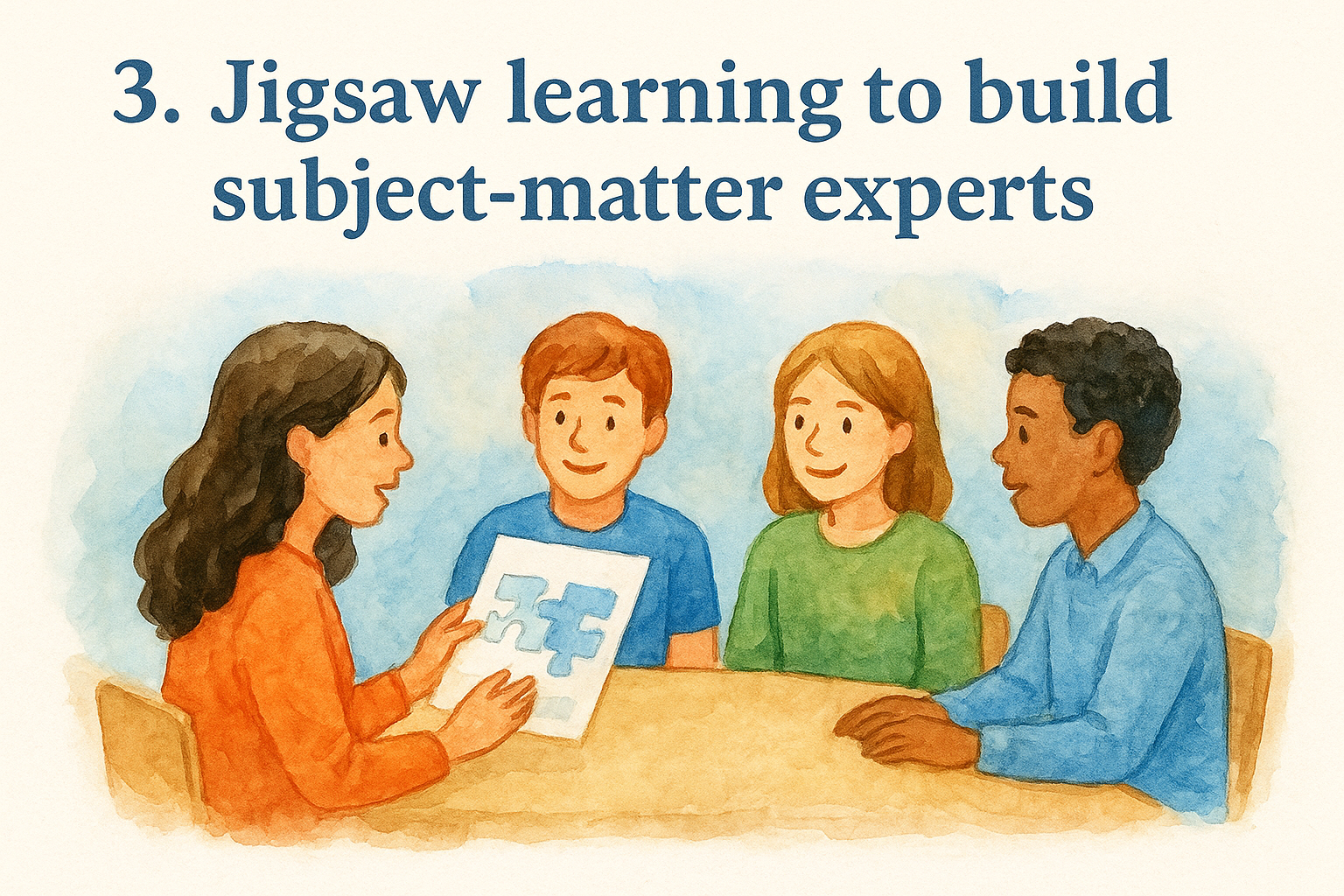
Splitting a big topic into chunks and making each student responsible for one piece changes the whole dynamic of group work. Jigsaw learning turns students into temporary experts who have to teach their piece to classmates, which means everyone has a job and nobody hides in the back row. It’s one of the more structured group learning techniques on this list, and it rewards a bit of upfront planning.
How it works
To run the full jigsaw method, divide your material into four or five distinct sections, then form "home groups" of that same size. Each student leaves their home group to join an "expert group" made up of students assigned the same section from other home groups. Together, the expert group studies their piece, discusses it, and prepares to explain it clearly. Then everyone returns to their home group and teaches their section in turn, so the full topic gets covered through peer instruction rather than a single lecture.
Why it boosts engagement
Accountability drives this one. When your home group depends on your explanation to understand a quarter of the material, skipping the reading isn’t an option.
When classmates depend on your explanation, skipping the prep work stops being an option.
That built-in responsibility pushes even reluctant students to prepare, since nobody wants to be the one who shows up empty-handed.
Best for
Jigsaw works well for content-heavy units: mythology figures, historical causes of a war, or the systems of the body in science class.
Quick tip to get started
Keep expert groups to four students max, and give them a simple graphic organizer to fill in before they teach their home group.
4. Socratic seminars for deeper critical thinking
Handing discussion over to students entirely feels risky the first time you try it, but Socratic seminars prove students can carry a conversation further than a teacher-led one ever gets. This format asks students to build on each other’s ideas using a shared text as evidence, with you stepping back into a facilitator role instead of the usual question-and-answer routine.
How it works
Students sit in a circle after reading a text closely, and you open with one broad question tied to theme or argument. From there, students respond directly to each other, citing the text to support or challenge a classmate’s point, while you stay mostly silent except to redirect if the conversation stalls. A fishbowl variation works well for larger classes: half the class discusses in an inner circle while the outer circle takes notes and swaps in halfway through.
Why it boosts engagement
Students engage differently when they know a teacher isn’t going to jump in and fix a weak answer. They have to listen closely to each other, since the next comment usually has to connect to what a classmate just said.
Take the teacher’s voice out of the middle of the conversation, and students start actually listening to each other instead of waiting for your verdict.
That shift in peer accountability pushes students to prepare more thoroughly before class, since a seminar with no textual evidence falls flat fast.
Best for
This fits literature units especially well, alongside history or ethics discussions built around a single complex text, and it pairs neatly with other activities that push students to think harder.
Quick tip to get started
Give students a simple sentence starter list (‘I’d like to build on what X said…’) before their first seminar attempt.
5. Role-play and simulations for real-world practice
Asking students to argue a Supreme Court case or negotiate a peace treaty from inside the role changes how they process the material. Role-play and simulations take content off the page and put students inside the decisions, arguments, or trade-offs a historical figure or scientific process actually involved. This is one of the more memorable active learning strategies for student engagement, since students tend to remember what they acted out long after they’ve forgotten a worksheet.
How it works
Assign each student a role, whether that’s a historical figure, a character, a stakeholder in a debate, or a component in a system like a cell or a supply chain. Give them a scenario with constraints and a goal, then let them work through it in character, making decisions and responding to what other roles do. Debrief afterward by connecting what happened in the simulation back to the actual content you’re teaching.
Why it boosts engagement
Students stop being outside observers of history or science and become participants making the same calls the real people faced.
Students remember decisions they made in character far longer than facts they copied off a slide.
That shift from memorizing outcomes to living through the choices behind them sticks in a way lecture notes rarely do.
Best for
History units, government and civics classes, and science topics involving systems or processes all suit this approach well.
Quick tip to get started
Start small: a ten-minute mock trial or negotiation scenario tests the format before you commit to a full-period simulation.
6. Gallery walks and concept mapping for visual thinkers
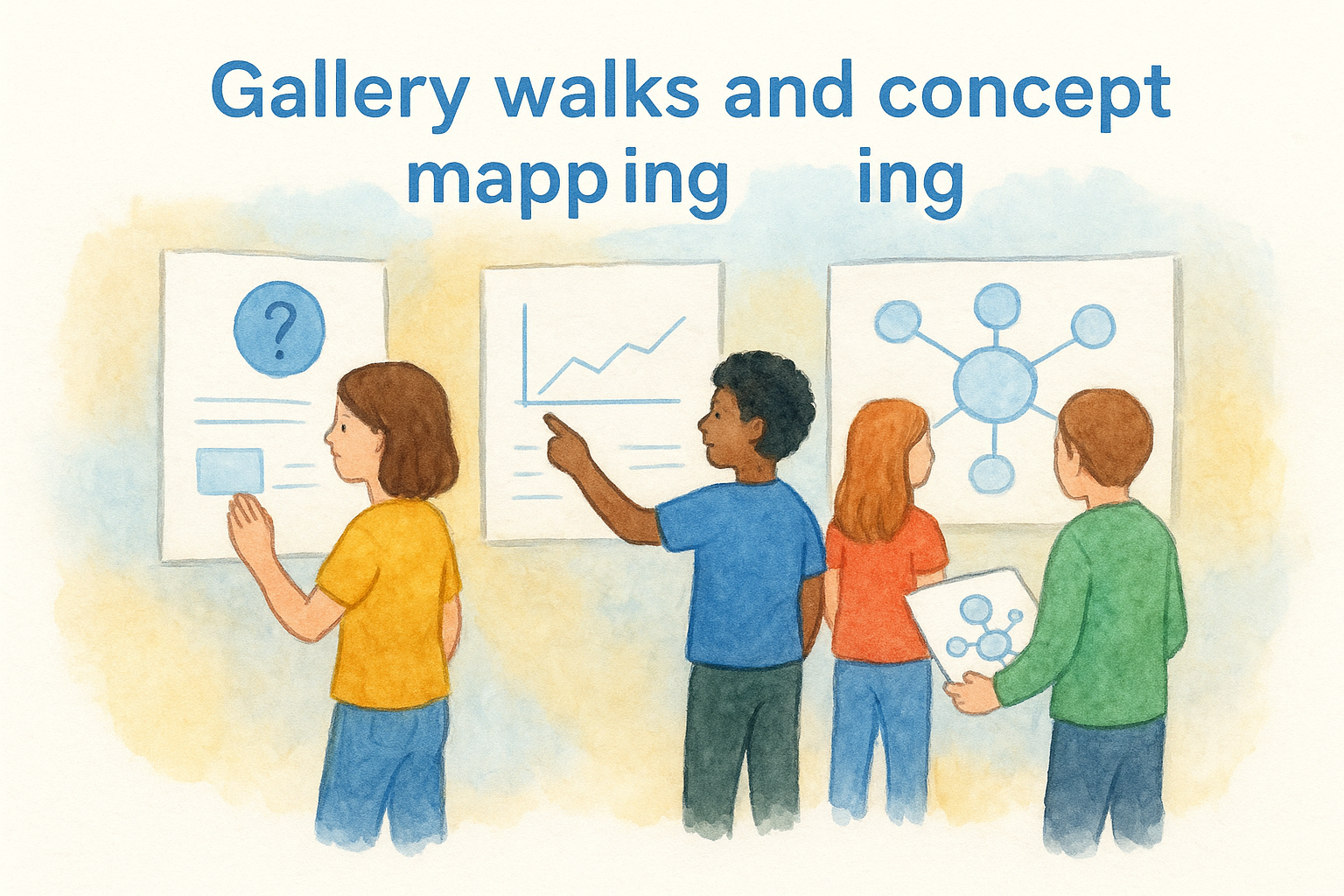
Not every student processes ideas best through talking. Gallery walks and concept mapping give visual and kinesthetic learners a way to show connections that a discussion-based format never reaches. Both techniques get students out of their seats and looking at classmates’ thinking side by side, which naturally sparks comparison and debate.
How it works
For a gallery walk, post large chart papers around the room, each with a question, image, or excerpt, and rotate small groups through each station with a few minutes to add notes or answer prompts. Concept mapping works similarly but focuses on one central idea: students build out branches showing causes, examples, or related terms on paper, with a digital tool, or using ready-made visual organizers. Combine the two by having groups build a concept map at each station, then walk the room to compare approaches.
Why it boosts engagement
Movement itself wakes students up, which is why getting students out of their seats to learn works, but the real value comes from seeing how classmates organized the same information differently.
Watching another group map the same idea a completely different way often teaches more than a lecture ever could.
That visible variety pushes students to defend their own thinking or revise it on the spot, which is a quieter but no less powerful form of active student engagement strategies than a loud debate.
Best for
Science units full of interconnected processes, vocabulary-heavy units, and any content where relationships between ideas matter more than a single correct answer all fit this format well.
Quick tip to get started
Limit each gallery station to three minutes and use a timer visible to the whole room, so groups keep moving instead of stalling at one poster.
7. Peer teaching and peer review for shared ownership
Handing students the responsibility of teaching a concept or reviewing a classmate’s work shifts the whole power dynamic of a lesson. Peer teaching and peer review ask students to step into the role you usually hold, which forces a deeper level of understanding than simply absorbing your explanation ever does. This is one of the active learning strategies for student engagement that also builds real classroom community, since students start relying on each other instead of only on you.
How it works
Pair students up so one explains a concept, solves a problem aloud, or walks a partner through their reasoning while the other asks questions or checks the logic. For structured peer feedback, give students a clear rubric or checklist before they trade essays, lab reports, or projects, so comments stay specific instead of vague praise. Rotate partners regularly so students get exposed to different explanation styles and don’t settle into one comfortable pairing.
Why it boosts engagement
Explaining something out loud exposes gaps in understanding that reading or listening never reveals. Students catch their own confusion mid-sentence, which pushes them back into the material with sharper questions.
You don’t really know a concept until you’ve had to explain it to someone else and answer their follow-up question.
Reviewing a peer’s work adds a second layer, and one of the clearest benefits of peer assessment is that students start noticing patterns and errors in someone else’s writing that sharpen their eye for their own mistakes too.
Best for
Writing-heavy classes, math problem sets, and any unit built around a skill students practice repeatedly all suit this well.
Quick tip to get started
Give reviewers three specific questions to answer about a peer’s work, not a blank space for comments.
8. Problem-based and project-based learning
Assigning a real problem instead of a worksheet changes what students spend their energy on. Problem-based and project-based learning hands students an open-ended question or challenge and asks them to research, plan, and produce something over days or weeks instead of an hour, though the difference between the two approaches matters once you start planning. It’s one of the more demanding active learning strategies for student engagement to set up, but the payoff shows up in how much ownership students take over the final product.
How it works
Start with a driving question that has no single correct answer: design a sustainable garden for the school courtyard, or propose a solution to a local traffic problem. Students work in teams to research, draft plans, gather feedback, and revise before presenting a finished product to a real or simulated audience, and a few strategies for running long projects keep that process on track. You act as a coach checking in on milestones rather than a lecturer delivering content upfront.
Why it boosts engagement
A grade alone rarely motivates sustained effort across two weeks. An audience does.
A real audience at the end of a project pushes students harder than a grade ever will.
Knowing classmates, parents, or community members will see the final result pushes students to revise work they’d otherwise turn in half-finished.
Best for
Science units built around design challenges, social studies units tied to civic issues, and any class with room for a multi-week unit all suit this format well.
Quick tip to get started
Build in two checkpoint dates before the final deadline, so you catch stalled groups early instead of discovering the problem the night before presentations.
9. Flipped classroom for self-paced content review
Lecturing for twenty minutes and then expecting students to practice a skill in the last five minutes of class backwards. Flipped classroom models fix that by moving direct instruction to homework and using class time for the harder work of applying it. This is one of those effective teaching and learning methods that changes what class time is actually for, not just how a single lesson runs.
How it works
Students watch a short video, read a text, or work through a slide deck at home covering the basic content you’d normally lecture on. Class time then shifts entirely to practice: problem sets, discussion, lab work, or projects where you’re available to help instead of talking at the front of the room. A quick low-stakes check, like three questions on a form, confirms who actually did the homework before class starts.
Why it boosts engagement
Direct instruction rarely needs a live audience, but application almost always benefits from one. Freeing up class time for the messy, question-filled part of learning puts you next to struggling students exactly when they need help.
Save your class time for the part of learning students actually get stuck on, not the part they can absorb alone.
Best for
Math and science classes with skill-based practice benefit most, along with any course where homework review usually eats up class time.
Quick tip to get started
Keep home videos under ten minutes, and pair them with a three-question comprehension check due before class.
10. Real-time polling and digital response tools
Getting an honest read on whether the whole class understands a concept usually means asking "any questions?" and hearing silence, which is why quick checks for understanding matter mid-lesson. Real-time polling fixes that by giving every student a way to answer instantly and anonymously, so you see actual comprehension instead of a room full of nodding heads. This is one of the quickest active learning strategies for student engagement to add to an existing lesson without changing your plan at all.
How it works
Pose a question through one of the digital polling apps built for classrooms and let students answer on a phone, tablet, or laptop, with results displayed as a live bar graph or word cloud within seconds. You can run a quick multiple-choice check, a one-word exit ticket, or an open response question that surfaces misconceptions before they harden into bad habits. Because answers stay anonymous by default, you get honest data instead of the guesses students think you want to hear.
Why it boosts engagement
Every student answers, not just the confident ones with hands up. Seeing the class-wide result displayed live turns a quiet check for understanding into a shared moment, since students want to see where their answer landed compared to everyone else’s.
Anonymous, instant polling gets an honest answer out of every student, not just the ones brave enough to raise a hand.
Best for
Large classes, quick mid-lesson checks, and any moment you’d normally ask a vague comprehension question all suit this well.
Quick tip to get started
Run one poll question halfway through your next lesson, purely to catch confusion before it compounds.
11. Structured debates for argumentation skills
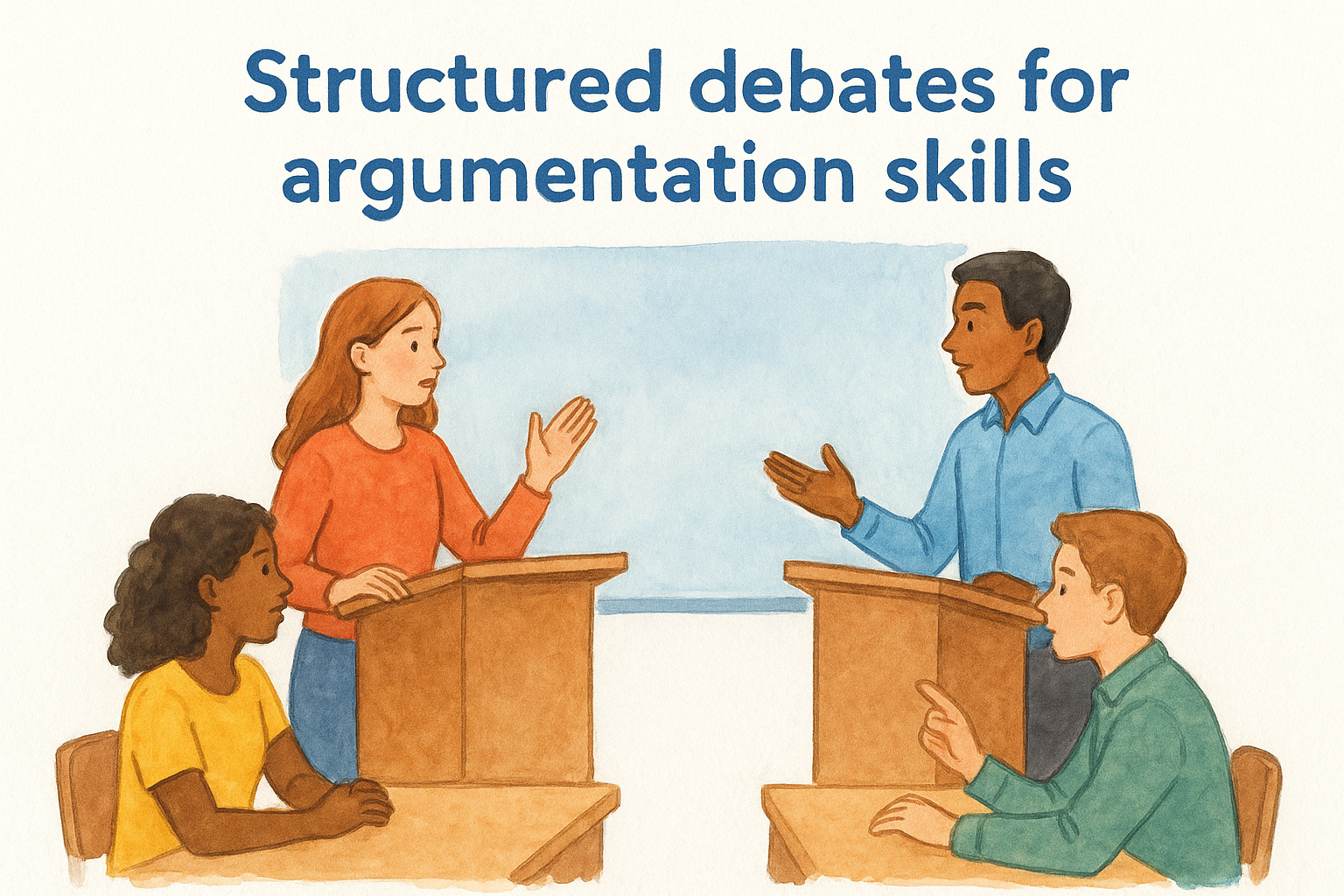
Asking students to defend a position they didn’t choose builds a different muscle than a free-form discussion ever does. Structured debates force students to research both sides of an issue, organize evidence, and respond to counterarguments on the spot. This is one of the active learning strategies for student engagement that doubles as direct practice for persuasive writing and public speaking.
How it works
Give students a debatable claim tied to your unit, assign sides (sometimes against their personal opinion on purpose), and set a clear format: opening statements, rebuttals, and closing arguments with strict time limits. Smaller formats work fine too, like a four-corners debate where students physically move to a spot representing their stance, then defend it to whoever’s standing nearby; you’ll find step-by-step guides for activities like this worth borrowing.
Why it boosts engagement
A ticking clock and an opposing team change how seriously students prepare. Nobody wants to freeze mid-rebuttal in front of classmates, so the format itself pushes deeper research than a standard essay assignment usually gets.
Arguing a side you didn’t pick teaches students to actually understand the other side, not just dismiss it.
Debate also rewards listening closely, since a strong rebuttal depends on catching a weak point in what the opposing team just said.
Best for
History, government, and ethics units built around a genuine controversy suit this best, along with persuasive writing units needing a live rehearsal before the final draft.
Quick tip to get started
Run a five-minute four-corners debate on a low-stakes question first, so students learn the format before tackling a graded, full-length debate.
Making active learning part of your routine
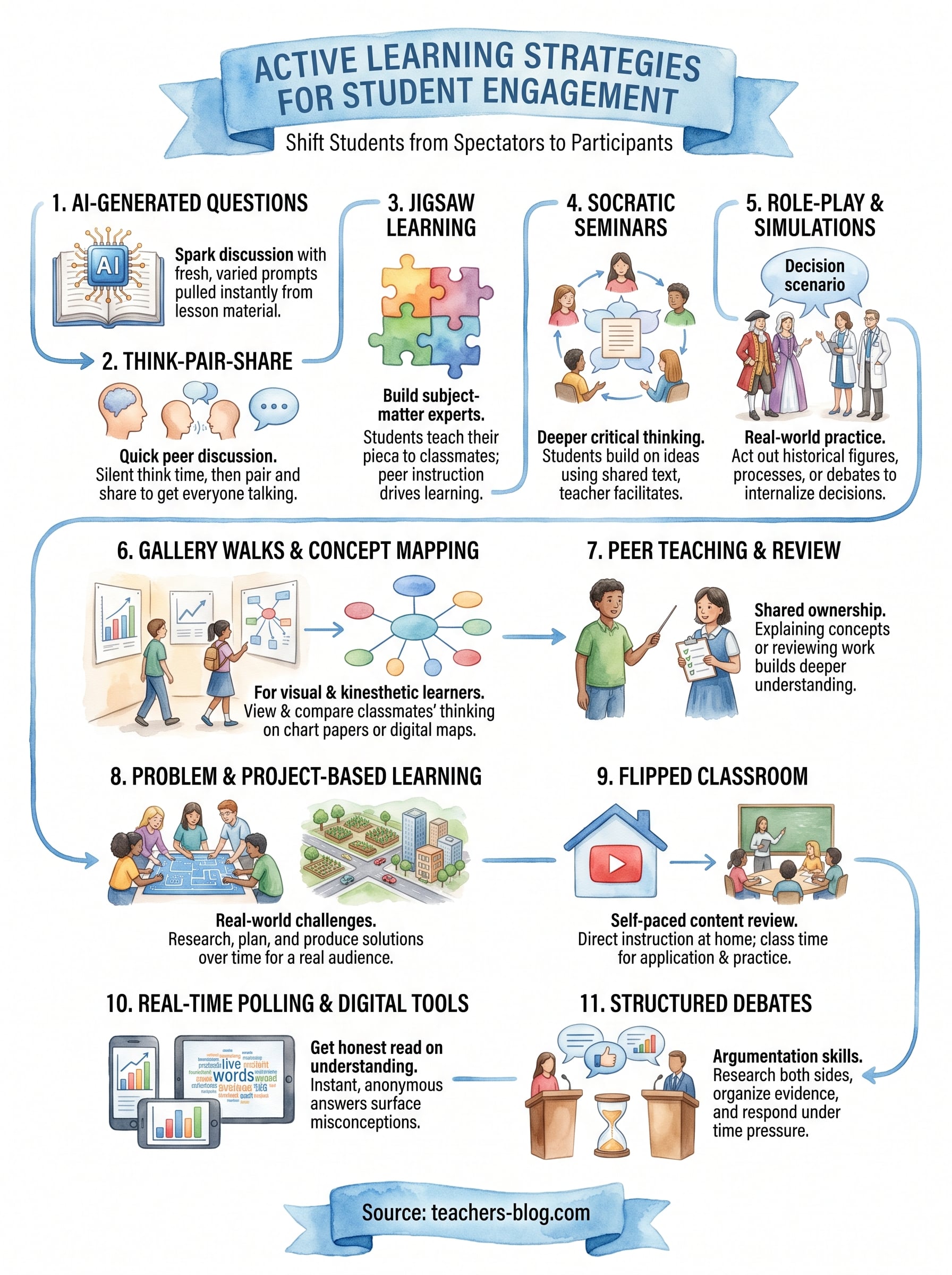
You don’t need to overhaul every lesson this week. Pick two or three active learning strategies for student engagement from this list, the ones that fit your subject and your students best, and build them into a single unit first. Think-pair-share and polling take minutes to add tomorrow. Jigsaw, debates, and project-based learning need more planning, so save those for a unit you’re already reworking.
What matters most is consistency, not variety. Students settle into active student engagement strategies faster when they see the same formats repeat with new content, rather than a new gimmick every day. Track which techniques get the strongest response from your particular class, drop the ones that fall flat, and keep refining from there.
If you want ready-made discussion questions for exactly this kind of classroom, try the free AI question generator for teachers and build tomorrow’s prompts from any text in seconds.