
Benefits Of Student Engagement: Academic, Social Behavioral
Every teacher has seen it, a student leans forward, raises a hand, asks a question that shifts the entire class discussion. That moment isn’t random. It’s the result of engagement, and the benefits of student engagement reach far beyond a single classroom exchange. When students actively participate in their learning, the effects ripple outward into grades, relationships, and behavior in ways that research consistently supports.
But engagement isn’t just a nice-to-have. It’s the mechanism through which real learning happens. Students who are cognitively, emotionally, and behaviorally invested in school retain more information, develop stronger social skills, and are significantly less likely to act out or disengage entirely. For teachers trying to justify a shift in practice, or for administrators weighing new initiatives, understanding these specific advantages matters.
That’s exactly the kind of practical, evidence-based thinking we prioritize here at The Cautiously Optimistic Teacher. We build resources and strategies that help educators move from theory to action, because knowing why engagement matters is the first step toward making it happen. This article breaks down the academic, social, and behavioral benefits of student engagement, what the research says, what it looks like in practice, and why it should shape how you plan your lessons.
Why student engagement matters in school
Student engagement isn’t a classroom trend or a feel-good administrative goal. It’s one of the strongest predictors of academic performance, school completion, and long-term student success that researchers have identified. When students are genuinely engaged, they process information more deeply, ask better questions, and build the kind of intrinsic motivation that carries them well past any single unit or school year. Understanding why engagement matters gives you a foundation for making deliberate instructional choices that produce real results.
The research connects engagement to measurable outcomes
Studies consistently show that engaged students outperform their disengaged peers on both standardized assessments and classroom-based measures. Research reviewed by organizations like the National Center on Safe Supportive Learning Environments confirms that high engagement levels correlate directly with higher graduation rates, stronger academic performance, and reduced disciplinary incidents across grade levels.
When students feel genuinely connected to their learning, both their behavior and their academic results improve in ways that show up clearly in the data.
The benefits of student engagement also become more visible when you track outcomes across multiple years. Students who were consistently engaged in middle school tend to demonstrate stronger writing skills, better attendance, and higher self-reported academic confidence by the time they reach high school. These aren’t minor statistical variations. They’re patterns that repeat consistently across studies and across schools with very different demographics, which tells you something important about how universal this effect actually is.
Disengagement carries costs you can’t ignore
The flip side of this picture matters just as much. Disengaged students are significantly more likely to develop persistent behavior problems, fail core courses, and eventually drop out before completing their education. Research from the National Dropout Prevention Center has linked chronic disengagement to lower lifetime earnings and reduced economic stability. When a student loses connection to their learning repeatedly over months or years, the compounding effect is severe.
Those costs don’t stay inside your classroom walls. The student, the school, and the broader community all bear the consequences of widespread disengagement, which is part of why districts and administrators increasingly treat engagement as a serious policy priority rather than a soft metric.
Engagement gives you real-time instructional feedback
Engagement also functions as direct, immediate feedback on your teaching. When students lean forward, respond thoughtfully, and work independently with genuine focus, that signals your lesson design and delivery are landing. When they don’t, it identifies something specific that needs to change, whether that’s the format, the pacing, the level of challenge, or the relevance of the material to their lives.
Teachers who pay close attention to engagement patterns tend to improve their practice faster as a result. You’re reading the room not just to manage behavior, but to gather actionable instructional data. Every stretch of strong engagement tells you what works in your context. Every moment of visible disconnection is a prompt to adjust. That feedback loop, when you actually use it, makes you a sharper, more responsive educator over time.
What student engagement includes
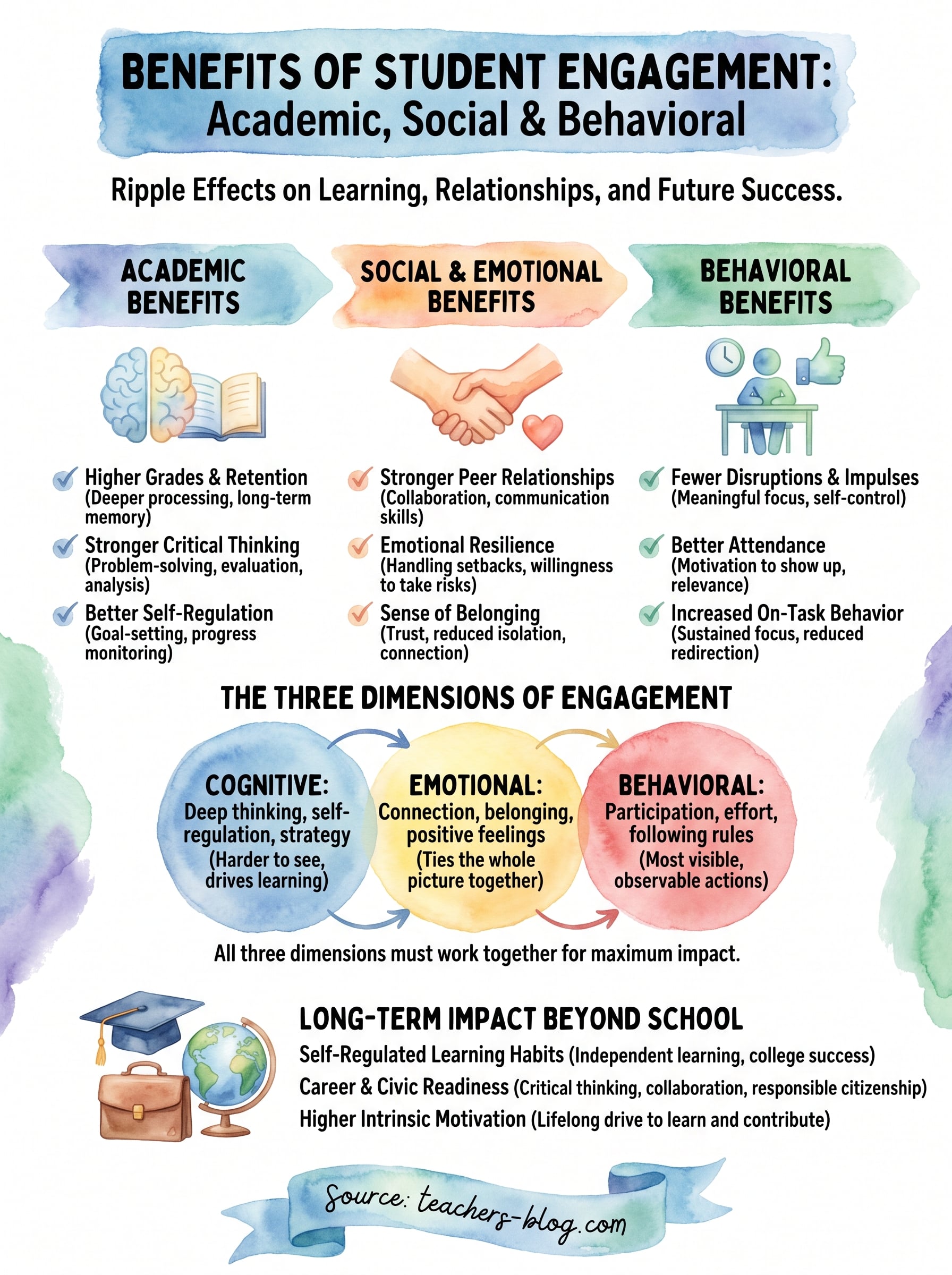
Student engagement is often treated as a single thing, but researchers consistently identify three distinct dimensions that work together to shape how connected a student feels to their learning. Treating engagement as just one category leads to instructional blind spots. You might increase participation and still miss the fact that a student is going through the motions without any real cognitive investment.
The three dimensions of engagement
Each dimension captures a different layer of how students interact with school, and each one produces its own set of outcomes. Understanding all three helps you recognize which type of engagement is missing in your classroom and what specifically needs to change.
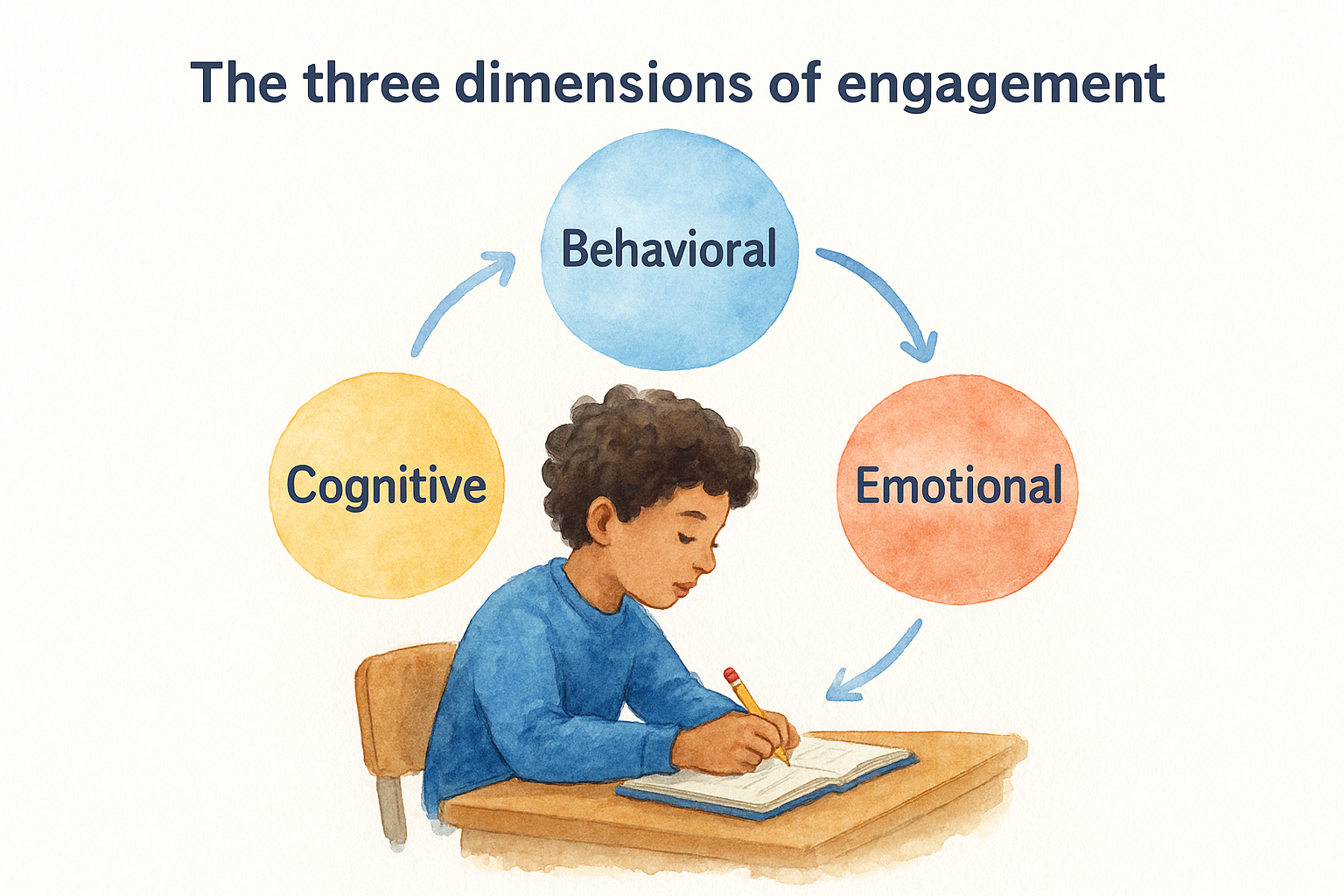
| Dimension | What it looks like | What drives it |
|---|---|---|
| Behavioral | Attending class, completing work, following routines | Clear expectations, consistent structure |
| Cognitive | Deep thinking, self-regulation, goal-setting | Challenging tasks, meaningful feedback |
| Emotional | Feeling connected to teachers, peers, and content | Belonging, relevance, positive relationships |
Behavioral engagement is the most visible type because you can observe it directly. A student who shows up, stays on task, and submits assignments is behaviorally engaged. But behavioral engagement alone doesn’t guarantee learning. A student can follow every direction without ever thinking critically about the material in front of them.
Why all three dimensions matter
Cognitive and emotional engagement are harder to see than behavioral engagement, but they drive the outcomes that actually matter most.
Cognitive engagement refers to how deliberately and strategically a student approaches their work. When a student sets a goal before writing, checks their own understanding, or revises their thinking after feedback, that’s cognitive engagement in action. This dimension connects most directly to the long-term benefits of student engagement, because students who regulate their own thinking develop skills that transfer across subjects and years.
Emotional engagement ties the whole picture together. When students feel a genuine sense of belonging in your classroom and see the material as relevant to their lives, they invest more cognitive effort and show up more consistently. Classrooms where emotional engagement is strong tend to see better results across all three dimensions, because students who feel connected are far more willing to take the academic risks that real learning requires.
Academic benefits of student engagement
The academic benefits of student engagement show up in grades, test scores, and the depth of knowledge students actually carry forward. When a student is genuinely invested in what they’re learning, they process material more thoroughly, store it more effectively in long-term memory, and retrieve it more accurately under pressure. Teachers who build engagement into their instruction aren’t just making class more enjoyable; they’re directly influencing how much their students learn and retain.
Higher grades and better retention
Engaged students consistently earn higher grades than their peers who are physically present but mentally elsewhere. This connection isn’t coincidental. When students pay close attention, ask clarifying questions, and revisit challenging material, they activate the kind of deep processing that actually sticks. Passive learning, where a student listens without interaction or reflection, produces shallow retention that fades quickly after an assessment.
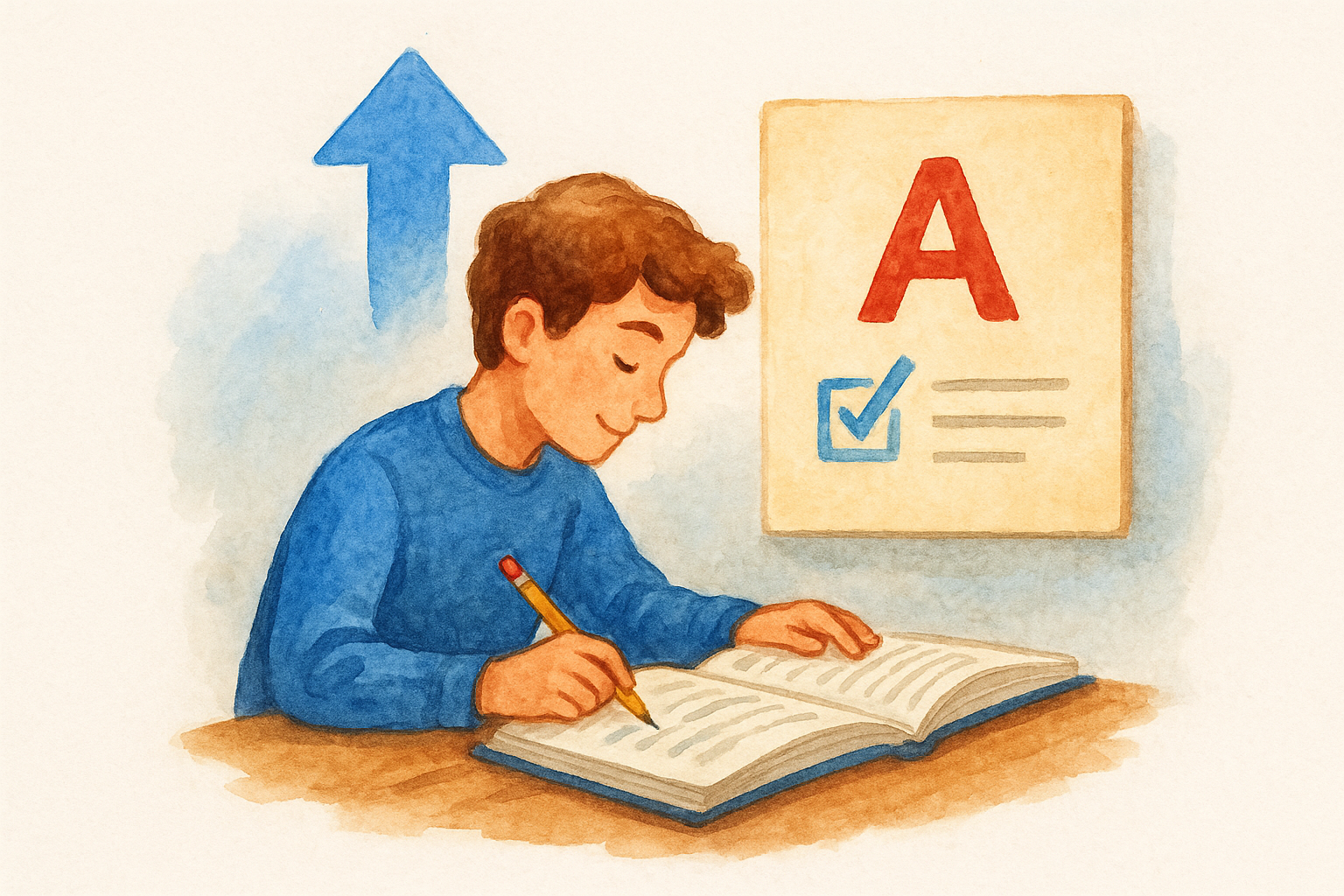
Students who engage actively with content retain significantly more of what they learn because they connect new information to what they already know.
Research in cognitive science supports this directly. Active retrieval practice, such as answering questions, discussing ideas, or explaining concepts back to peers, dramatically outperforms re-reading or passive review in terms of long-term retention. When your classroom regularly asks students to retrieve and apply what they’ve learned rather than just absorb it, you’re setting them up to perform better across every subject.
Stronger critical thinking and self-regulation
Engagement also builds critical thinking skills that transfer far beyond any specific unit. When students wrestle with complex problems, evaluate competing ideas, or revise their work based on feedback, they develop the cognitive habits that academic success requires at every level. These aren’t skills you can deliver through a direct instruction sequence. They develop through practice inside lessons that require students to think, not just follow.
Self-regulation, the ability to set goals, monitor progress, and adjust strategies, grows directly out of consistent cognitive engagement. Students who regularly set learning targets before an activity and reflect afterward build a metacognitive toolkit that helps them tackle difficult material independently. That independence matters enormously when students face high-stakes writing assignments, cumulative exams, or any task that requires sustained intellectual effort without a teacher standing over their shoulder.
Social and emotional benefits
The benefits of student engagement extend well beyond grades and test scores. When students are genuinely invested in their classroom community, they build social and emotional skills that shape how they navigate relationships, handle setbacks, and show up for others throughout their lives. These outcomes aren’t accidental. They’re the direct result of students feeling seen, valued, and connected inside a learning environment that asks something meaningful of them.
Stronger peer relationships and classroom community
Engaged students interact with their classmates more frequently and more productively. When your lessons include collaborative tasks, structured discussions, and shared problem-solving, students practice communication skills in real time. They learn how to listen without interrupting, disagree without shutting down, and build on someone else’s idea rather than dismissing it. These aren’t abstract social competencies. They’re habits students develop through repeated, structured practice inside your classroom.
Students who regularly collaborate in engaged learning environments develop stronger communication skills than those who work in isolation most of the day.
Classroom community deepens when students feel accountable to each other, not just to the teacher. Group projects, peer review, and structured discussions give students reasons to invest in each other’s success. That shared investment builds trust and reduces the social isolation that often underlies behavioral problems and chronic absenteeism.
Emotional resilience and sense of belonging
Emotional engagement gives students something equally important: a sense that they belong in school. When students feel connected to their teacher and their peers, they are more willing to take academic risks, ask questions they fear sound "dumb," and persist through difficult material without shutting down. That willingness to stay in the struggle is one of the clearest signs of emotional resilience developing in real time inside your classroom.
Students who feel emotionally anchored to their learning environment also handle setbacks more effectively. They recover from a bad grade or a frustrating lesson more quickly because they trust the people around them. Building emotional engagement into your instruction isn’t a detour from academic goals. It’s what makes those goals achievable for the students who would otherwise give up before they get there.
Behavioral benefits in the classroom
When students are genuinely engaged, classroom management becomes less of a battle. The behavioral benefits of student engagement follow naturally when students have a real reason to be present and participating. Disruptive behavior most often fills a void, when the work feels irrelevant, too easy, or disconnected from anything a student cares about. Engagement closes that void directly, before it becomes a discipline issue.
Fewer disruptions and stronger self-control
Engaged students interrupt less and comply more consistently because they’re focused on something that holds their attention. Research on motivation and behavior consistently shows that students who find the work meaningful are far less likely to create disruptions. They’re busy thinking, not looking for ways to fill dead time. When your lessons provide genuine intellectual challenge, most minor behavior issues disappear before you ever have to address them.
Classrooms with high engagement levels consistently report fewer behavioral referrals, not because teachers enforce rules more strictly, but because students have less reason to act out.
Engagement also builds impulse control and self-regulation over time. When students practice staying on task, waiting their turn during discussions, and redirecting their own attention after a distraction, they’re developing habits that carry real value. These self-management skills transfer beyond your classroom to every setting that asks something demanding of them.
Better attendance and on-task behavior
Students who feel connected to what they’re learning show up more consistently. Chronic absenteeism drops when students have concrete reasons to come to school beyond obligation. If your classroom is a place where something purposeful and interesting happens each day, students are simply more motivated to be there. That connection between engagement and attendance is one of the clearest behavioral patterns researchers have documented across grade levels.
On-task behavior follows the same logic. When students understand the purpose behind an activity and feel capable of contributing, they stay focused for longer stretches without needing repeated redirection from you. A student who drifts off-task repeatedly often signals a design problem in the lesson rather than a discipline problem in the student. Adjusting the level of challenge, the format, or the relevance of your work tends to solve the behavior issue more effectively than any consequence system can.
Long-term benefits beyond this school year
The benefits of student engagement don’t expire in June. Students who spend their school years genuinely connected to their learning develop habits, skills, and self-concepts that follow them into college, careers, and adult life. What you build in your classroom right now becomes part of how those students approach every challenging situation they face for the rest of their lives.
Students carry engagement habits into future learning
Engaged students internalize routines that serve them long after they leave your classroom. When students regularly practice setting goals, monitoring their own progress, and persisting through difficulty, they develop self-regulated learning habits that researchers link to higher college completion rates and stronger performance in complex professional environments. These aren’t skills you can hand students in a worksheet. They grow through consistent practice inside learning tasks that require genuine cognitive investment.
Students who develop strong engagement habits in school are significantly more likely to continue learning independently as adults.
Students who experience emotional connection to their academic work throughout school also report higher levels of intrinsic motivation in adulthood. That internal drive to learn and improve, rather than waiting for external rewards, is one of the most powerful predictors of long-term professional and personal success that education research has identified.
Engagement builds the foundation for career and civic readiness
The skills that engagement produces, critical thinking, collaboration, and communication, are exactly what employers consistently identify as the most difficult to find in new workers. When you build lessons that require students to analyze, debate, and produce original work, you’re preparing them for careers that require more than basic compliance. Students who spent years genuinely thinking in school arrive at their first jobs ready to contribute in ways that passively schooled peers simply aren’t.
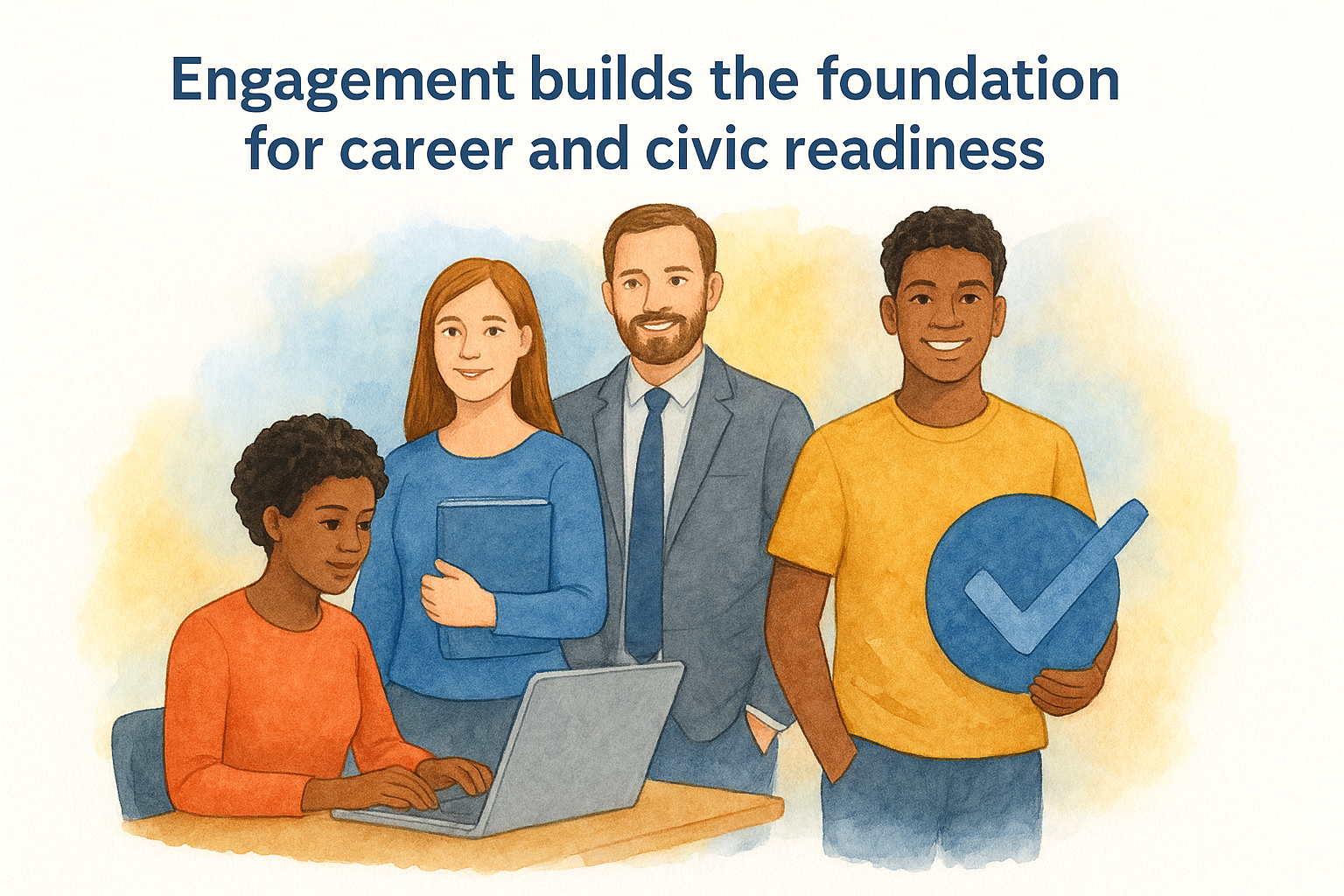
Civic readiness follows the same pattern. Engaged students are more likely to vote, participate in community organizations, and take responsibility for the world around them as adults. Students who felt a genuine stake in their learning develop a sense of agency that transfers directly into civic life. The classroom community you build matters beyond your school’s walls, because students who learn to care about something in your room carry that capacity outward into every community they join.
How to increase student engagement day to day
Knowing the benefits of student engagement is useful, but the real work happens when you translate that knowledge into your daily lesson design. Small, consistent choices about how you structure tasks and how you invite students to participate build engagement over time far more reliably than occasional high-effort activities.
Build choice and relevance into your tasks
Students engage more deeply when they have some control over how they work. That doesn’t mean open-ended chaos. It means offering structured choices, such as letting students pick between two writing prompts, choose their own research angle, or select the format for presenting their findings. When students see themselves in the assignment, they invest more fully in completing it.
Relevance works the same way. Connecting content to students’ actual lives, current events, or real problems gives them a reason to care beyond a grade. Even one concrete connection per lesson, a news story that illustrates the concept you’re teaching or a real-world scenario that frames the problem, raises the ceiling on how engaged students can actually get. A single relevance shift inside an existing lesson often produces more sustained engagement than an entirely new activity.
Small daily adjustments to choice and relevance consistently outperform occasional high-effort engagement events.
Use low-stakes participation structures consistently
Cold-calling tends to produce anxiety, not thinking. Structured participation routines, like think-pair-share, numbered heads together, or brief written responses before discussion, give every student time to formulate a thought before they’re expected to speak. When students feel prepared rather than put on the spot, they participate more willingly and more substantively.
Using these structures consistently, not just occasionally, signals to students that participation is a shared expectation, not a performance reserved for confident volunteers. That shift alone reduces one of the biggest silent barriers to engagement in any classroom.
Give feedback that moves students forward
Feedback quality directly shapes cognitive engagement. Specific, actionable comments that tell students exactly what to improve and how give them a clear path forward. When students receive feedback they can actually use, they re-engage with the work instead of setting it aside. Vague praise or generic corrections tend to end a student’s investment in a task rather than extend it.
How to measure and document engagement
Measuring engagement gives you evidence that the benefits of student engagement are actually occurring in your classroom, not just in theory. Without documentation, you’re relying on memory and impression to make instructional decisions. Tracking engagement consistently turns what you observe into actionable data you can use to adjust your lessons, support individual students, and communicate progress to administrators or families.
Use observation to track patterns in real time
Informal observation is your most accessible tool. During any lesson, you can scan the room deliberately and note which students are on task, which are participating verbally, and which are physically present but mentally checked out. The key is making that scan intentional rather than incidental. When you build brief observation windows into your lesson plan, such as a two-minute independent work period where your only job is to watch and note, you collect far more useful information than you would by managing the room reactively.
What you observe repeatedly across multiple lessons tells you far more about a student’s engagement than any single snapshot.
Look for patterns across time rather than isolated moments. A student who seems disengaged on a Friday afternoon is less significant than a student who shows the same pattern every time the class moves into group work. Patterns reveal structural problems in your lesson design that single observations can’t.
Document what you see with simple systems
You don’t need elaborate tracking software to document engagement well. A simple weekly checklist with student names and three or four observable indicators, eye contact, voluntary participation, on-task behavior, and task completion, takes about five minutes to complete and builds a clear record over time. Paper works fine. A shared spreadsheet works fine. What matters is consistency, not complexity.
Anecdotal notes add depth to checklists. When a student makes a comment that reveals strong cognitive engagement or when a typically withdrawn student contributes to a discussion, write it down with a date. Those notes become concrete evidence during parent conferences, IEP meetings, or conversations with your administration about whether an instructional change is working. Documentation transforms your observations from fleeting impressions into professional records that inform real decisions about how you teach and which students need additional support.
Next steps you can take this week
The benefits of student engagement are well-documented, but they only reach your students when you act on what you know. Start small and specific. Pick one lesson this week and add a single structured participation routine, think-pair-share or a brief written response before discussion. Notice which students respond and which stay quiet. That observation alone gives you useful information to build on.
From there, look at your next unit plan and identify one place to add student choice and one place to make the content more relevant to your students’ actual lives. You don’t need to redesign everything at once. Small, deliberate shifts in how you structure tasks and invite participation produce real, cumulative results over a school year.
For more practical strategies, tools, and ready-to-use resources designed to help you build a more engaged classroom, visit The Cautiously Optimistic Teacher and explore what’s there for you.