
Cult of Pedagogy Classroom Management: Strategies That Work
If you’ve ever typed Cult of Pedagogy classroom management into a search bar, you already know Jennifer Gonzalez has built one of the most respected libraries of teaching strategies out there. Her podcast episodes, blog posts, and frameworks have helped thousands of educators rethink how they handle behavior, build routines, and create classrooms that actually function. But with so much content spread across years of publishing, finding the exact strategy you need right now can feel like digging through a very well-organized, but very large, filing cabinet.
That’s where this guide comes in. Here at The Cautiously Optimistic Teacher, we spend our time pulling apart what works in real classrooms and putting practical tools directly into teachers’ hands, from AI-powered lesson helpers to ready-to-use unit plans. We’re fans of Cult of Pedagogy’s work, and we wanted to create a resource that gathers their best classroom management insights into one actionable place, while adding our own perspective on implementation.
Below, you’ll find a breakdown of the most effective Cult of Pedagogy classroom management strategies, organized by common challenges you’re likely facing. Whether you’re a first-year teacher building a behavior plan from scratch or a veteran who’s hit a wall mid-year, this article walks you through specific techniques, when to use them, and how to adapt them to your students. Let’s get into it.
What this approach means in real classrooms
The Cult of Pedagogy classroom management framework isn’t a rigid system with color-coded cards or a points chart you tape to the wall. Jennifer Gonzalez builds her approach around a core belief: students behave better when they feel respected, when expectations are clear, and when teachers respond to problems with consistency rather than frustration. That might sound simple, but the way it plays out in practice looks very different from what most professional development sessions teach.
The core principles behind the framework
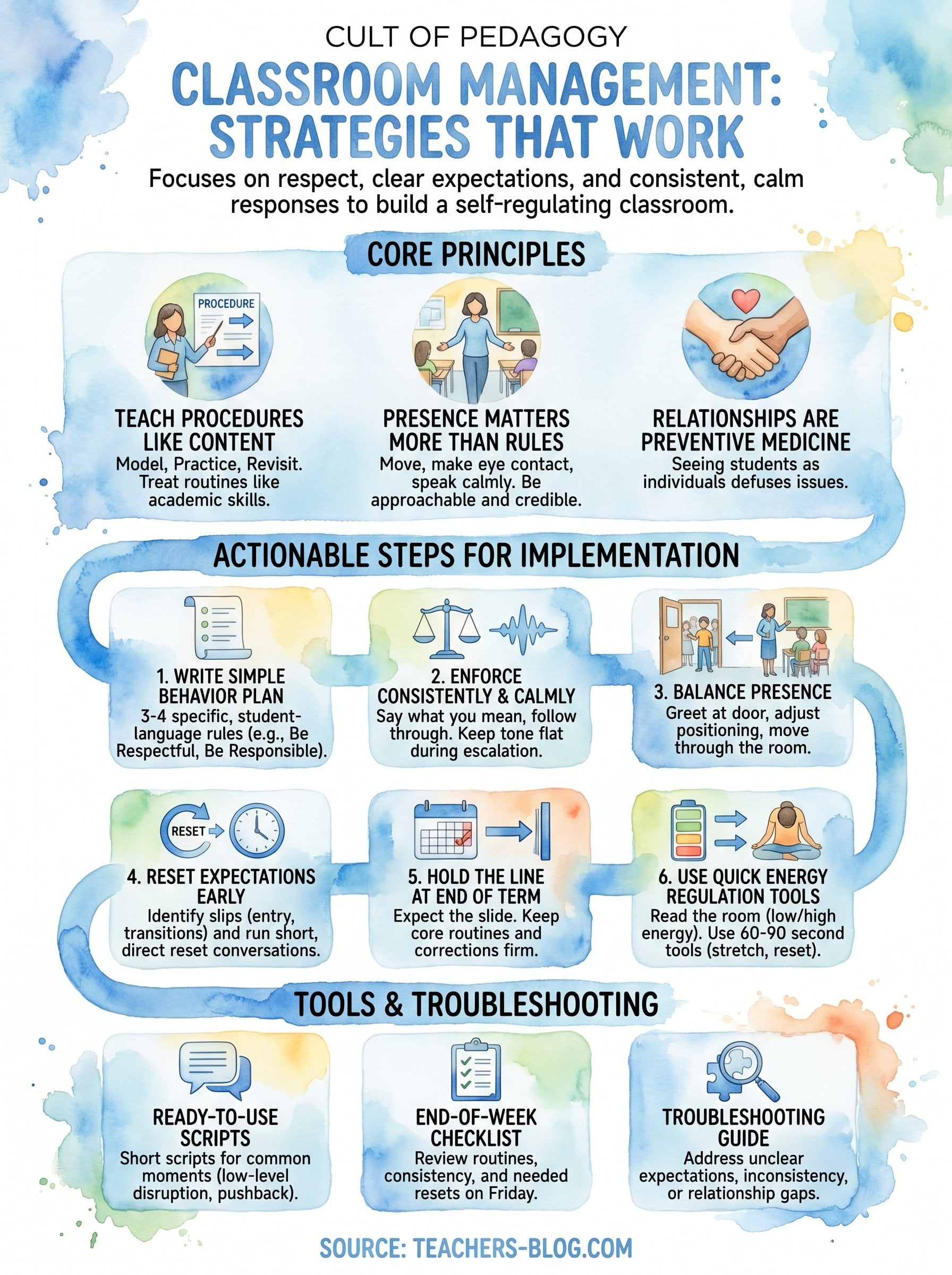
Gonzalez pulls from several well-researched ideas, but three show up across her work repeatedly. First, procedures need explicit instruction, just like academic content does. You can’t hand students a syllabus, point at a poster, and expect routines to stick. Second, your presence in the room matters more than your rules. Teachers who move through the classroom, make eye contact, and speak calmly carry more authority than those who stand at the front and raise their voices. Third, relationships function as preventive medicine: when students know you see them as individuals, minor behavior issues often defuse before they escalate.
The goal isn’t to control students. It’s to build a classroom where control rarely becomes necessary.
These three principles connect to each other directly. A teacher who teaches procedures clearly gives students a predictable environment. A teacher who maintains a calm and approachable presence signals that the classroom is safe. Building genuine relationships makes students want to cooperate, not just comply.
What changes when you apply it consistently
When you work through these ideas in a deliberate way, a few specific things shift in your day-to-day experience. Your transition times get shorter because students know exactly what to do when they walk in, finish early, or switch tasks. Your voice drops because you’re not reacting to chaos anymore. You start catching problems early rather than addressing them after they’ve disrupted half a period.
Most teachers who adopt this approach report that the first two to three weeks feel like extra work. You’re stopping lessons to re-teach a procedure. You’re making deliberate choices about where you stand and how you speak. But after that investment period, the routines run themselves. Students remind each other, and you spend more time actually teaching.
Who this works for
This approach works best when you treat it as a whole-system commitment rather than a collection of tricks to pull out when things go wrong. It’s equally useful for first-year teachers who are building their management style from scratch and for experienced teachers who’ve noticed specific problems creeping back in, like a noisy dismissal routine or students ignoring instructions the first time.
The framework is also particularly effective in middle and high school classrooms, where students often resist management systems that feel childish or punitive. Because this approach centers respect and clear communication over compliance and consequences, older students tend to respond to it better than they respond to reward charts or behavior contracts. It asks something of students, but it also offers something back: a classroom that functions, a teacher who stays regulated under pressure, and expectations that actually make sense to a teenager sitting in your third-period class on a Friday afternoon.
Step 1. Write a simple behavior plan
A behavior plan works only when students can actually remember it. The cult of pedagogy classroom management approach pushes back hard against the wall of 15 laminated rules that teachers spend a weekend making and students ignore by Tuesday. Your plan should be short enough to memorize, specific enough to enforce, and written in language that matches how your students actually talk.
Keep it to three or four rules
Most effective classroom behavior plans limit themselves to three to four rules that cover the widest range of situations. Think in categories: respect for people, respect for the learning environment, and personal responsibility. When a problem occurs, you can almost always point it back to one of those categories without needing a separate rule for phones, bathroom passes, and talking during tests.
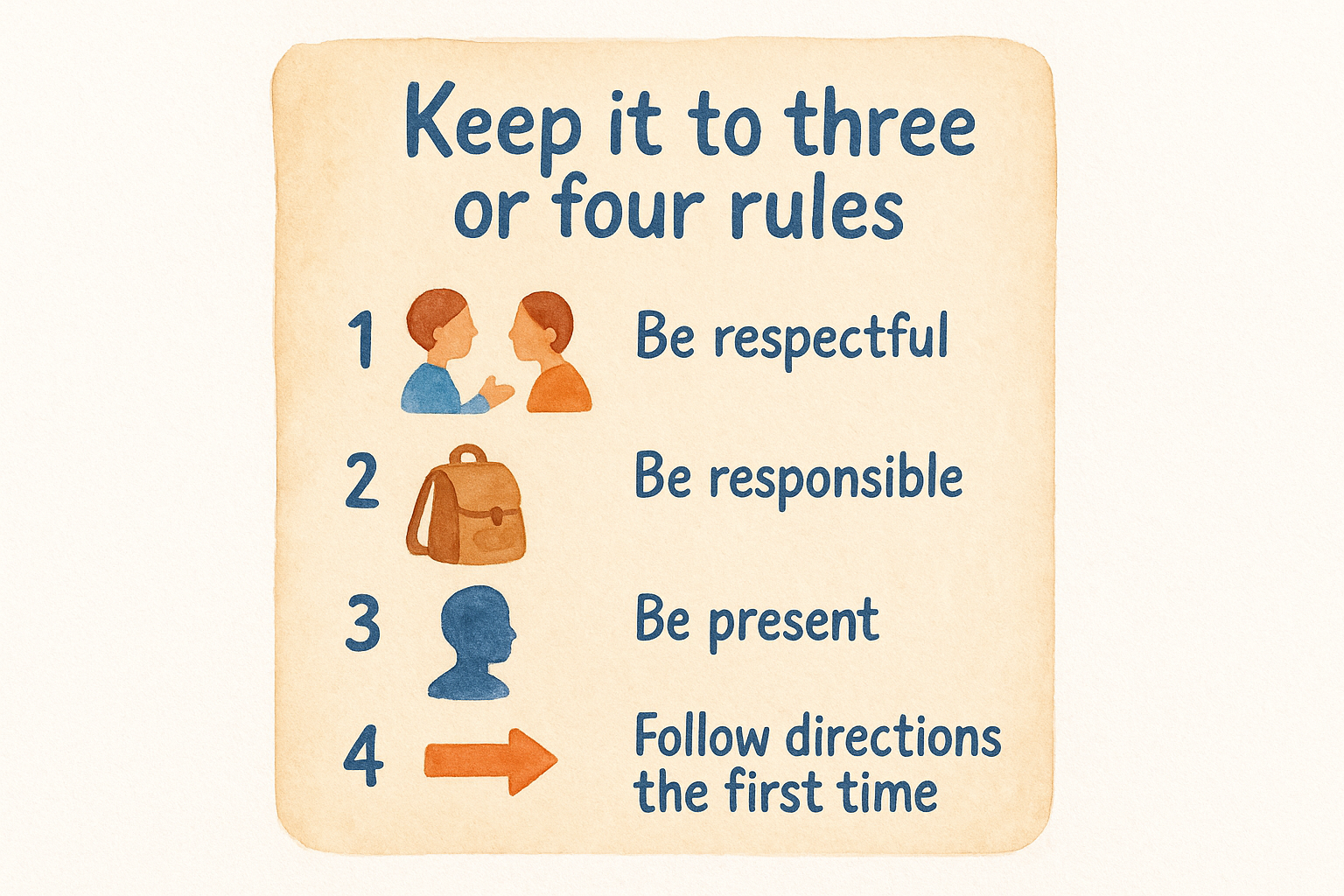
Here’s a simple template you can adapt:
| Rule | What it covers |
|---|---|
| Be respectful | How you speak to and treat others in the room |
| Be responsible | Your materials, your work, your choices |
| Be present | Physically and mentally engaged during class |
| Follow directions the first time | Transitions, instructions, and corrections |
Stick to four rules maximum. If you catch yourself adding a fifth, check whether it already fits under one of the four you have.
Write it in student language
Generic rules like "demonstrate mutual respect" don’t land with a 13-year-old. Rewrite each rule as a direct, concrete action so students know exactly what it looks like in your room. "Be respectful" becomes "speak to classmates and teachers the way you want to be spoken to." "Be responsible" becomes "bring your materials and own your choices."
The clearer your language, the less room there is for students to argue about what the rule actually means.
Once you’ve drafted your rules, test them against three or four real scenarios from your classroom. If a student scrolls through their phone during your lesson, which rule covers it? If two students argue at the start of class, which rule applies? If your rules hold up against those scenarios, they’re specific enough to enforce. If you find yourself stretching to make a rule fit, rewrite it until the connection is obvious. You’ll spend five minutes now and save yourself a dozen uncomfortable conversations later.
Step 2. Teach procedures like content
Teachers often post a routine on the board and assume students will follow it. They won’t, at least not reliably. The cult of pedagogy classroom management approach treats procedures the same way you treat a reading skill or a math concept: you introduce it, model it, practice it, and revisit it when it breaks down. That mindset shift alone makes a bigger difference than any specific routine you choose.
Model the procedure first
Before students can follow a procedure correctly, they need to see exactly what it looks like in action. Walk through it yourself. If your entry routine involves students picking up a warm-up sheet, sitting down, and starting within two minutes of the bell, do it out loud and in real time. Narrate every step: "I walk in, I grab the sheet from the tray, I sit down, I start writing." Students need a clear mental model before they can replicate the behavior on their own.
Use a student volunteer to demonstrate a second time. This gives the class a peer reference and lets you point out what you’re looking for without it feeling like a lecture.
Practice it until it’s automatic
One demonstration is not enough. Run the procedure two or three times in a row during the first week, especially for anything that involves movement, like turning in work, transitioning between activities, or dismissal. Time the practice with a visible countdown. When students see the clock, they self-regulate without you reminding them.
Here’s a simple practice sequence for any new procedure:
- Introduce the procedure and explain why it matters
- Model it yourself, narrating each step
- Have a student model it while you give feedback
- Have the whole class practice it together
- Debrief: ask what went well and what to adjust
Repetition feels slow in week one, but it pays back every single day that follows for the rest of the year.
Re-teach when it breaks down
Procedures erode. After a long weekend, a substitute day, or a stretch of testing, students drift from the routines you established. When that happens, the fix is not a consequence. It’s a re-teach. Stop the class, acknowledge that the procedure has gotten sloppy, and run through the model-practice sequence again in five minutes or less.
Frame the re-teach as a reset rather than a punishment. Saying "let’s sharpen this up because it’s getting loose" signals that you’re paying attention without creating defensiveness. Students accept a correction much more easily when it targets the behavior and not their character.
Step 3. Enforce consistently and calmly
Rules and procedures mean nothing if you apply them only sometimes or only when you’re already at your limit. The cult of pedagogy classroom management framework is clear on this point: inconsistency teaches students that your rules are negotiable. Every time you let something slide because you’re mid-lesson or tired, you send a signal that the boundary shifts depending on your mood. Students read that signal quickly and test it constantly.
Say what you mean, then follow through
When a student breaks a rule, your response needs to match what you said would happen. That doesn’t mean you escalate or make a scene. It means you apply the consequence you described when you set the expectation, calmly, without adding a lecture on top of it. A short, direct correction does more than a long explanation that embarrasses the student in front of their peers.
Here’s a simple correction sequence for low-level disruptions:
- Name the behavior privately if possible: "You’re talking while I’m giving instructions."
- Reference the rule: "That’s not following directions the first time."
- State the consequence: "I’m going to note that. Let’s get back to work."
- Move on immediately.
That sequence takes under 30 seconds and keeps the lesson moving without turning one student’s choice into a classroom-wide event.
Consistency isn’t about being rigid. It’s about being predictable so students can trust that the classroom works the same way every day.
Keep your tone flat when things escalate
Your voice is the most powerful tool you have when a situation heats up. Dropping your volume rather than raising it forces students to pay attention and signals that you are in control of yourself, which matters more than being in control of them. A teacher who stays regulated under pressure communicates authority far more effectively than one who reacts with visible frustration.
Practice a neutral delivery before you need it. If a student pushes back on a consequence, your response can be as simple as: "I understand you’re frustrated. The consequence stays." Then look away and resume the lesson. Refusing to argue doesn’t mean you ignore the student’s perspective. It means you won’t let the moment pull you off course. Students who test you this way are usually checking whether the boundary actually holds, and a calm, consistent response is the clearest answer you can give them.
Step 4. Balance approachable and credible presence
Your physical presence in the classroom does more work than most teachers realize. The cult of pedagogy classroom management philosophy places heavy emphasis on this: how you carry yourself, where you stand, and how you speak sends students a constant signal about whether this room has structure or whether it’s up for negotiation. Approachable means students feel comfortable asking questions and taking risks. Credible means they don’t test your authority every ten minutes. You need both, and they aren’t opposites.
The teacher who is warm but firm gives students exactly what they need: safety and structure at the same time.
Read the room before you enter it
Your presence actually starts before you cross the threshold. Stand at the door as students arrive and greet them by name. This single habit does two things simultaneously: it signals that you notice everyone who walks in, and it lets you spot who’s already agitated, tired, or off before the period even begins. A student who gets a calm, personal acknowledgment at the door is less likely to act out thirty minutes into the lesson.
Pay attention to your posture during this time. Standing upright with relaxed shoulders and steady eye contact reads as confident without being aggressive. Crossing your arms or hovering over students creates distance. Keep your body language open, and you signal that the room is safe, not adversarial.
Adjust your positioning and movement
Where you stand during instruction shapes how students perceive your authority. Teachers who anchor themselves to the front board give students in the back rows permission to disengage. Move through the room during independent work, pause near students who tend to drift, and position yourself so that every corner of the room sees you regularly. Proximity alone corrects low-level behavior without you saying a word.
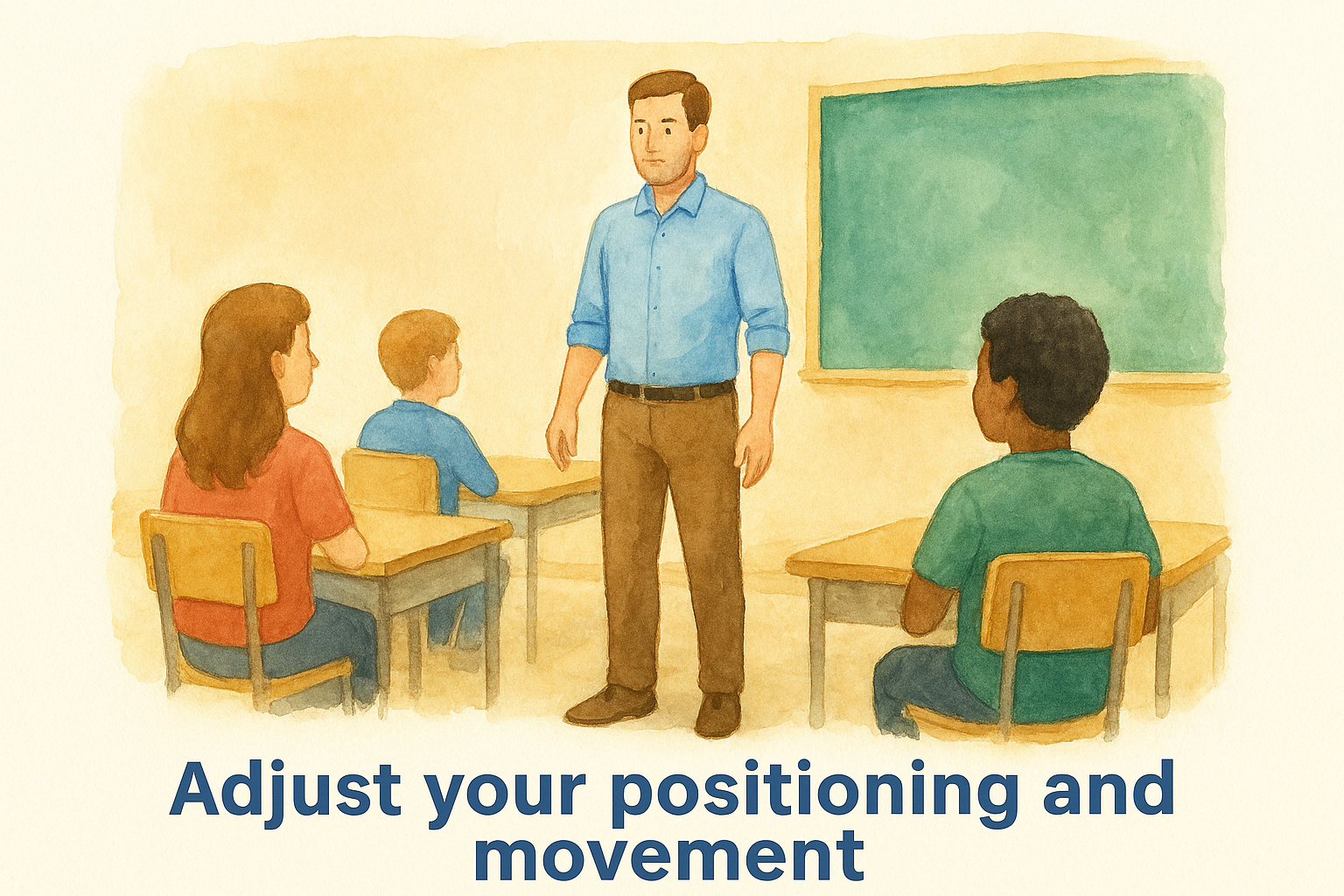
Use this positioning guide as a starting point:
| Phase of class | Where to position yourself |
|---|---|
| Direct instruction | Front and center, then move to sides |
| Independent or group work | Circulate through all zones of the room |
| Discussion | Stand to the side or back to shift focus to students |
| Transitions | Near the area where disruptions tend to cluster |
Adjust based on your room layout, but the principle stays consistent: movement communicates engagement. A teacher who never leaves the front of the room signals passivity. A teacher who shows up everywhere signals that the whole room matters, and students respond to that presence whether they realize it or not.
Step 5. Reset expectations when things slip
Every classroom hits a point where the wheels come loose. After a holiday break, a run of assemblies, or a stretch of disrupted schedules, you’ll notice that students are louder at transitions, slower to start work, and quicker to push back on basic requests. This isn’t a sign that your management has failed. It’s a normal part of the school year, and the cult of pedagogy classroom management approach treats it as a predictable problem with a straightforward fix: you reset deliberately and early, before the drift becomes your new normal.
Identify exactly what has slipped
Before you do anything else, get specific about which routines have broken down rather than addressing "behavior" as a vague category. Vague resets don’t stick because students don’t know what you’re actually asking them to change. Walk through your day mentally and pinpoint the exact moments where things are going sideways.
Here are the most common slip points to check:
- Entry routine: Are students settling within the first two minutes of the bell?
- Transitions: Is time between activities stretching beyond what you planned?
- Work time: Are off-task conversations increasing during independent work?
- Dismissal: Are students packing up early and moving toward the door before you’ve released them?
Once you name the specific breakdown, your reset becomes targeted and fast.
Run a short, direct reset conversation
When you’re ready to address the slip, keep your reset conversation under three minutes and frame it as a practical fix rather than a lecture. Students shut down when they hear a long disappointment speech. A brief, direct acknowledgment followed by a re-model works better every time.
The reset lands better when it focuses on what you’re adjusting, not on how frustrated you are.
Use this reset script as a starting point and adjust the language to match how you naturally speak:
| Step | What to say |
|---|---|
| Name the slip | "Our entry routine has gotten off track this week." |
| State the standard | "The expectation is materials out and warm-up started before the bell stops." |
| Re-model it | "Watch me, then we’re going to practice it together." |
| Practice once | Run the routine in real time with the class. |
| Move on | Return to the lesson immediately after. |
After the practice run, drop it completely and get back to your content. Revisiting the slip again mid-lesson undermines the reset by signaling that you’re still in reaction mode. One clean, focused reset followed by a return to normal tells students that the standard is back in place and you’re moving forward.
Step 6. Keep routines strong at the end of term
The end of a semester is where classroom management systems go to die. Students are mentally checked out, the schedule fills with assemblies and testing days, and teachers often relax their routines because the finish line is close. The cult of pedagogy classroom management approach pushes back against that instinct directly: the end of term is exactly when you need to hold your structure tightest, because the moment you signal that routines are optional, students treat everything as optional.
Expect the end-of-term slide
The slide is predictable, which means you can prepare for it rather than react to it. Students get louder, slower, and more distracted as grades close out and anticipation of a break builds. Knowing this in advance lets you adjust your delivery and activities without abandoning your expectations. You’re not lowering the bar; you’re choosing content and tasks that keep students engaged enough to stay within the structure you’ve built.
Watch for these specific warning signs that the slide is starting:
- Students stop bringing materials without prompting
- Transition times stretch by two to three minutes compared to earlier in the term
- Off-task conversations during work time become the norm rather than the exception
- Students challenge basic instructions they followed without question in September
Catching one or two of these early lets you address the slip before it spreads across the whole class.
The end of term doesn’t give students permission to stop; it gives you a chance to finish the year the same way you started it.
Hold the line on your core routines
When energy drops, your most valuable move is narrowing your focus to the routines that matter most: entry, transitions, and dismissal. Those three moments shape how the rest of the period goes. If students walk in and start the warm-up, the lesson launches cleanly. If they pack up when you release them, you keep control of the room until the final bell. Letting those anchor routines erode is what turns the last two weeks into a management problem.
Keep your correction sequence exactly the same as it was in week three of the school year. A consequence that held in October still holds in December. Changing how you respond at the end of term teaches students that your rules were conditional all along, and that message carries into the next semester or the next school year. Finish with the same expectations you started with, and your class ends on your terms.
Step 7. Use quick energy regulation tools
Energy in a classroom is not static. By third period on a Wednesday, your students might be crawling through their seats. By the last block on a Friday, they’re ricocheting off the walls. The cult of pedagogy classroom management approach recognizes that you can’t teach effectively into the wrong energy state, and the fix doesn’t have to eat ten minutes of your lesson. A handful of quick, repeatable tools lets you shift the room’s energy in under two minutes and get back to your content without losing momentum.
The goal isn’t to suppress energy. It’s to redirect it so the room is ready to learn.
Read the room before you intervene
Before you pull out any tool, take fifteen seconds to name what you’re actually dealing with. Low energy and high energy are different problems that need different responses. A class that’s sluggish after lunch needs activation. A class that’s wound up after a fire drill needs to decelerate. Applying the wrong fix makes things worse, not better. Scan the room, check body language, and decide whether you need to raise the energy or bring it down before you do anything else.
Watch for these specific signals to guide your read:
- Low energy: heads down, slow responses, minimal eye contact, one-word answers
- High energy: side conversations spiking, students out of seats, unable to transition cleanly
- Mixed energy: a few students checked out while others are overactivated, usually after a disrupted schedule
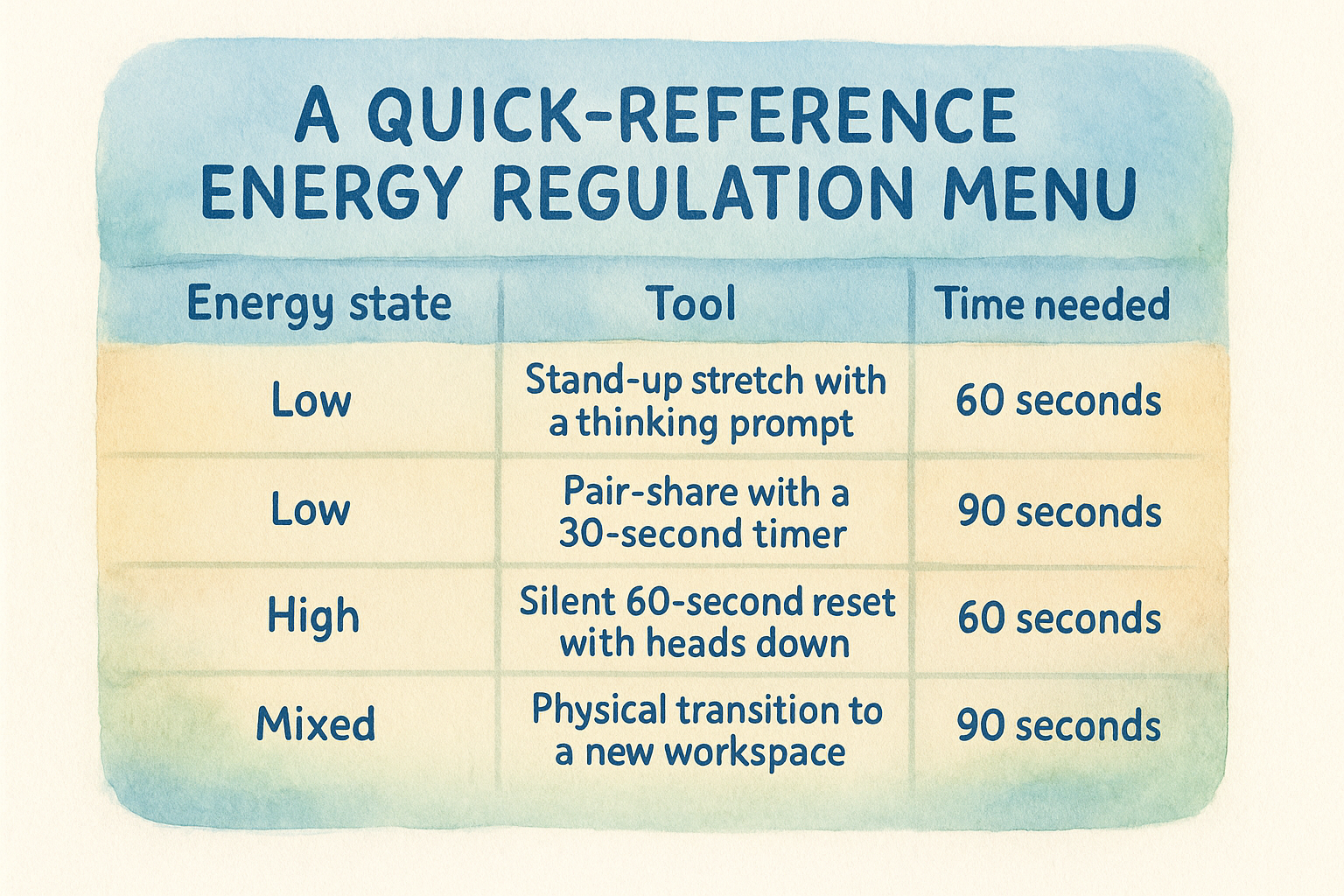
A quick-reference energy regulation menu
Once you’ve identified the energy state, match your tool to the problem. Use the menu below as a starting reference and adjust based on what your students respond to over time.
| Energy state | Tool | Time needed |
|---|---|---|
| Low | Stand-up stretch with a thinking prompt | 60 seconds |
| Low | Pair-share with a 30-second timer | 90 seconds |
| High | Silent 60-second reset with heads down | 60 seconds |
| High | Written brain dump before returning to task | 2 minutes |
| Mixed | Physical transition to a new workspace | 90 seconds |
Keep this list somewhere visible and accessible to you, not buried in a binder. When the room shifts unexpectedly, you need to act within thirty seconds of noticing the problem. The longer you wait, the harder the correction becomes.
Rotate your tools across the week so students don’t tune them out. A stretch that works on Monday loses its effect by Thursday if it becomes predictable background noise. Treat your energy regulation tools the same way you treat your instructional strategies: vary them, and your students stay responsive to them.
Scripts, checklists, and troubleshooting guide
Everything in the cult of pedagogy classroom management approach works better when you don’t have to invent your response in real time. When a situation gets tense, your brain is already managing several things at once. Having a short script ready and a checklist to run through at the end of each week removes the guesswork and keeps you consistent even when you’re running on empty.
Ready-to-use scripts for common moments
The scripts below cover the moments that trip most teachers up. Adapt the language to match how you naturally speak, but keep the structure: name the behavior, reference the expectation, state the next step, and move on. Anything longer than three sentences risks turning a minor correction into a debate.
| Situation | Script |
|---|---|
| Low-level disruption | "You’re talking while I’m giving instructions. That’s not following directions the first time. Please stop and I’ll check in with you after class." |
| Student pushback on a consequence | "I hear you. The consequence stays. Let’s get back to work." |
| Whole class off-task | "We’ve drifted. I need everyone to reset: materials out, eyes forward, starting now." |
| Re-teaching a procedure | "This routine has gotten loose. Watch me, we’ll practice once, and then we move on." |
| Persistent low energy | "I need you on your feet for sixty seconds. Stand up, stretch, then tell your partner one thing you remember from yesterday’s lesson." |
Scripts feel stiff at first, but after you use them a few times, they become automatic, which is exactly the point.
End-of-week behavior checklist
Run through this five-minute checklist on Friday afternoon before you leave. It takes less time than you think, and it surfaces problems before they compound over a weekend break.
- Entry routine: Did students settle and start the warm-up within two minutes of the bell at least four out of five days?
- Transition times: Did activity switches stay within your planned window?
- Correction consistency: Did you apply consequences the same way on Friday as you did on Monday?
- Positioning: Did you circulate through all areas of the room at least once per period?
- Reset needed: Is any specific routine showing signs of erosion?
Troubleshooting common problems
When a specific problem keeps recurring, the issue is almost always one of three things: the expectation wasn’t clear enough, the consequence wasn’t applied consistently, or the relationship with that student needs direct attention.
| Problem | Most likely cause | Fix |
|---|---|---|
| Students ignore instructions the first time | Consequence hasn’t been applied consistently | Return to your correction sequence every single time without exception |
| Entry routine keeps slipping | Procedure was never fully practiced | Re-teach using the model-practice sequence from Step 2 |
| One student repeatedly disrupts | Relationship gap or unmet need | Schedule a two-minute private check-in before or after class |
| Class energy tanks mid-period | Task length or pacing issue | Break work into shorter chunks with a visible timer |
Wrap it up and start tomorrow
The cult of pedagogy classroom management approach works because it’s built on a small number of ideas you can actually apply tomorrow: write clear rules, teach your procedures until they’re automatic, enforce your expectations every time, hold your presence in the room, reset before problems compound, and regulate energy before it works against you. None of these steps require a full classroom overhaul or a free weekend. Each one builds on the previous, and the cumulative effect over a few weeks is a room that runs without constant intervention.
Pick one step from this guide and start there. If your entry routine is falling apart, go back to Step 2. If your energy is off, pull the regulation menu from Step 7. Small, targeted adjustments compound faster than you expect. When you’re ready to take your classroom practice further, explore more teaching strategies and tools at The Cautiously Optimistic Teacher and put the next idea to work.