
Establishing Classroom Norms And Expectations: How-To Guide
You’ve arranged the desks, printed the syllabi, and rehearsed your opening-day speech. But here’s the thing most veteran teachers will tell you: none of that matters much if students don’t feel ownership over how the classroom operates. Establishing classroom norms and expectations isn’t just a box to check during the first week, it’s the foundation that either supports or undermines everything else you build throughout the year.
The difference between norms that stick and norms that get ignored usually comes down to one factor: whether students helped create them. When you hand down a list of rules from on high, you get compliance at best and resentment at worst. When you co-create expectations with your students, you get buy-in, accountability, and a classroom culture that practically runs itself. That’s the kind of outcome worth planning for, and it’s exactly what we focus on here at The Cautiously Optimistic Teacher, practical strategies that actually work with real students in real classrooms.
This guide walks you through the full process, from understanding why norms matter to facilitating student-driven discussions, drafting agreements, and keeping those expectations alive well past September. You’ll find step-by-step frameworks, example norms, and tips for handling the inevitable moments when things go sideways. Whether you’re a first-year teacher or a veteran looking to refresh your approach, you’ll leave with a clear plan you can use this week.
What classroom norms and expectations are and why they work
Classroom norms and expectations are the shared agreements that define how everyone in the room treats each other, engages with learning, and handles disagreement. Unlike posted rules, which are one-way directives issued by the teacher, norms are statements of collective intention. They describe the kind of environment your class actively chooses to maintain together. That distinction sounds minor, but it changes everything about how students relate to those expectations when things get hard.
Norms vs. rules: why the difference matters
Most teachers grew up with classroom rules displayed on a poster near the board: raise your hand, stay in your seat, respect others. Those rules aren’t wrong, but they put compliance at the center instead of community. Students follow them to avoid consequences, not because they’ve internalized the reasoning behind them.
Norms shift the frame entirely. Instead of "raise your hand," a norm might read "we make space for everyone’s voice." Both address the same behavior, but the norm gives students a reason to care. It connects the behavior to a shared value rather than a teacher preference, and that kind of anchor holds even when you’re not watching.
When students understand the "why" behind an expectation, they’re far more likely to hold themselves and their peers accountable to it.
The research on student ownership
Decades of classroom research support what most experienced teachers already know: student ownership over classroom agreements produces more prosocial behavior and fewer incidents. Work grounded in self-determination theory, built on foundational research by Deci and Ryan, consistently shows that students engage more deeply when they feel autonomy and genuine relatedness within their environment. Norms that students help shape satisfy both needs at once.
Establishing classroom norms and expectations through a co-creation process also builds what researchers call psychological safety, the sense that it’s okay to ask questions, take risks, and recover from mistakes without fear of embarrassment. When students trust that the class has agreed to standards of care and respect, they participate more openly, stay in productive struggle longer, and bounce back from setbacks faster.
What effective norms look like in practice
Strong norms share a few clear features. They’re positive and forward-looking, describing what to do rather than what to avoid. They’re broad enough to apply across a wide range of situations, and short enough for students to actually remember. Below is a quick comparison that shows what separates a weak norm from a strong one:
| Weak Norm | Strong Norm |
|---|---|
| Don’t interrupt others | We listen to understand, not just to respond |
| No phones out | We give our full attention to whoever has the floor |
| Be kind | We assume good intentions and speak with care |
| Do your own work | We support each other’s growth honestly |
| Don’t be disrespectful | We disagree with ideas, not with people |
You’ll notice that strong norms use "we" language, and that’s deliberate. That single pronoun signals collective ownership rather than imposed authority. It also makes it far easier to address a behavioral issue without singling out a student. You can say "our norm says we…" instead of "you’re breaking a rule," which keeps the focus on the agreement the class made together rather than on individual blame. That small shift in language does a lot of heavy lifting throughout the year.
Prep work before you co-create norms
Walking into a norms conversation without preparation often produces vague, surface-level agreements that nobody remembers by week three. Before you sit down with students, you need to clarify your own limits, think through your class’s specific context, and prepare the questions that will spark meaningful dialogue. The prep work you do now is what allows establishing classroom norms and expectations to feel genuine rather than performative.
Identify your non-negotiables
Every teacher has behaviors they genuinely cannot work around. Safety, honesty, and basic respect typically fall here. Before you involve students, write these down privately so you’re clear on where student input shapes the norms and where you hold a firm line regardless. You don’t need to announce this list ahead of time, but knowing it prevents you from accidentally agreeing to something you can’t actually accept.
Being transparent about one or two non-negotiables during the conversation is fine. Students respect honesty, and saying "this one isn’t negotiable, but here’s why" builds trust rather than eroding it.
Knowing your limits before the conversation starts means you can give students genuine freedom everywhere else, and that freedom is what makes the process feel real to them.
Survey students before the conversation
A quick written survey, even a simple half-page, gives you insight into what students already value and what past classroom experiences have left them wanting. Ask questions like: "Describe a class where you felt comfortable taking risks" or "What makes it hard to participate in group discussions?" A few open prompts on a notecard work perfectly.
Reading responses before the norms discussion lets you anticipate recurring themes and frame prompts around what your students actually care about. It also signals that their perspective matters before the year even begins.
Prepare two or three anchor questions
Anchor questions are the structured prompts you’ll use to open the conversation. They focus student thinking without pushing students toward a predetermined answer. Strong anchor questions ask students to reflect on past experience rather than generate abstract ideals.
Here are three you can use directly:
- "Think of a time you did your best learning. What made that environment different?"
- "What do you need from classmates to feel comfortable sharing your ideas?"
- "What’s one thing that usually gets in the way of a productive class?"
Having these questions ready means you spend facilitation time listening and building on student ideas rather than scrambling to keep the conversation moving.
Step 1. Launch the norms conversation with students
The first conversation you have with students about how the class will operate sets the real foundation for establishing classroom norms and expectations together. Students pick up immediately on whether this is a genuine dialogue or a scripted exercise where you already have the answers. Your goal in this opening moment is to signal real openness and get students talking before you introduce any structure.
Set the context before you ask anything
Before you pose your first anchor question, give students a brief, honest explanation of why you’re doing this at all. Tell them you want the class to feel like a place where everyone can do real work, and that means deciding together what that requires. Two or three sentences is plenty. Avoid a long speech about the importance of community, because students tune it out quickly. Clarity is more persuasive than enthusiasm here.
The moment students believe you actually want their input, the conversation shifts from performance to problem-solving.
Once you’ve framed the purpose, use one of the anchor questions you prepared during your prep work. Put it on the board or slide so students can read it while they think. Give them one to two minutes of silent writing before any discussion starts. That quiet processing time produces richer responses from students who need a moment to gather their thoughts, and it keeps the same three voices from dominating the opening.
Use structured discussion to surface real ideas
After the silent write, move into paired or small-group sharing before you open the full-class conversation. Ask pairs to identify one idea from their notes that both of them connect with. This structure gives quieter students a lower-stakes way to test their ideas, and it consolidates the conversation before it reaches the full group, which keeps things focused.
When you bring the discussion to the whole class, your job is to listen and capture, not to evaluate. Write student ideas on the board exactly as students say them. Resist the urge to rephrase their language in the moment, because students notice when their words get edited, and it undercuts the sense that this is genuinely their process. You can refine the language collaboratively later, during the drafting stage.
Ask follow-up questions that push for specificity: "What would that actually look like during a group project?" or "How would we know if we were doing that well?" Those kinds of probing questions move the conversation from abstract values to observable behaviors, which is exactly where you need it to go before Step 2.
Step 2. Co-create a short list of shared commitments
Once you’ve gathered student ideas from the opening conversation, the next challenge is turning a messy list of responses into four to six norms your class can actually use. This step is where establishing classroom norms and expectations moves from discussion into something concrete. Most classes surface ten to fifteen distinct ideas during the launch conversation, and your job here is to help students find the common threads without steamrolling their input.
Narrow student ideas into themes
Start by reading the collected ideas aloud or displaying them on a screen where everyone can see them. Ask students to look for patterns or overlaps across the list. You’ll almost always find that separate ideas point back to the same underlying value. Phrases like "don’t talk over people," "let everyone finish their thoughts," and "stop side conversations during discussions" are all saying the same thing in different words.
When students spot those connections themselves, they feel ownership of the final norms rather than receiving a distilled version handed down to them.
Group the overlapping ideas into clusters, then give each cluster a working label based on the language students used most. A simple whiteboard chart works fine for this:
| Student Ideas | Working Theme |
|---|---|
| Listen without interrupting, let people finish, no side talk | We listen fully |
| Help each other, explain your thinking, don’t do work for someone | We support real growth |
| Say when you’re confused, ask for help, be honest about mistakes | We’re honest with each other |
| Disagree respectfully, challenge ideas not people | We separate ideas from identity |
Keep the total number of norms between four and six. Fewer than four often leaves gaps; more than six means students can’t remember them without looking at a poster, which defeats the purpose.
Draft the norms as a class
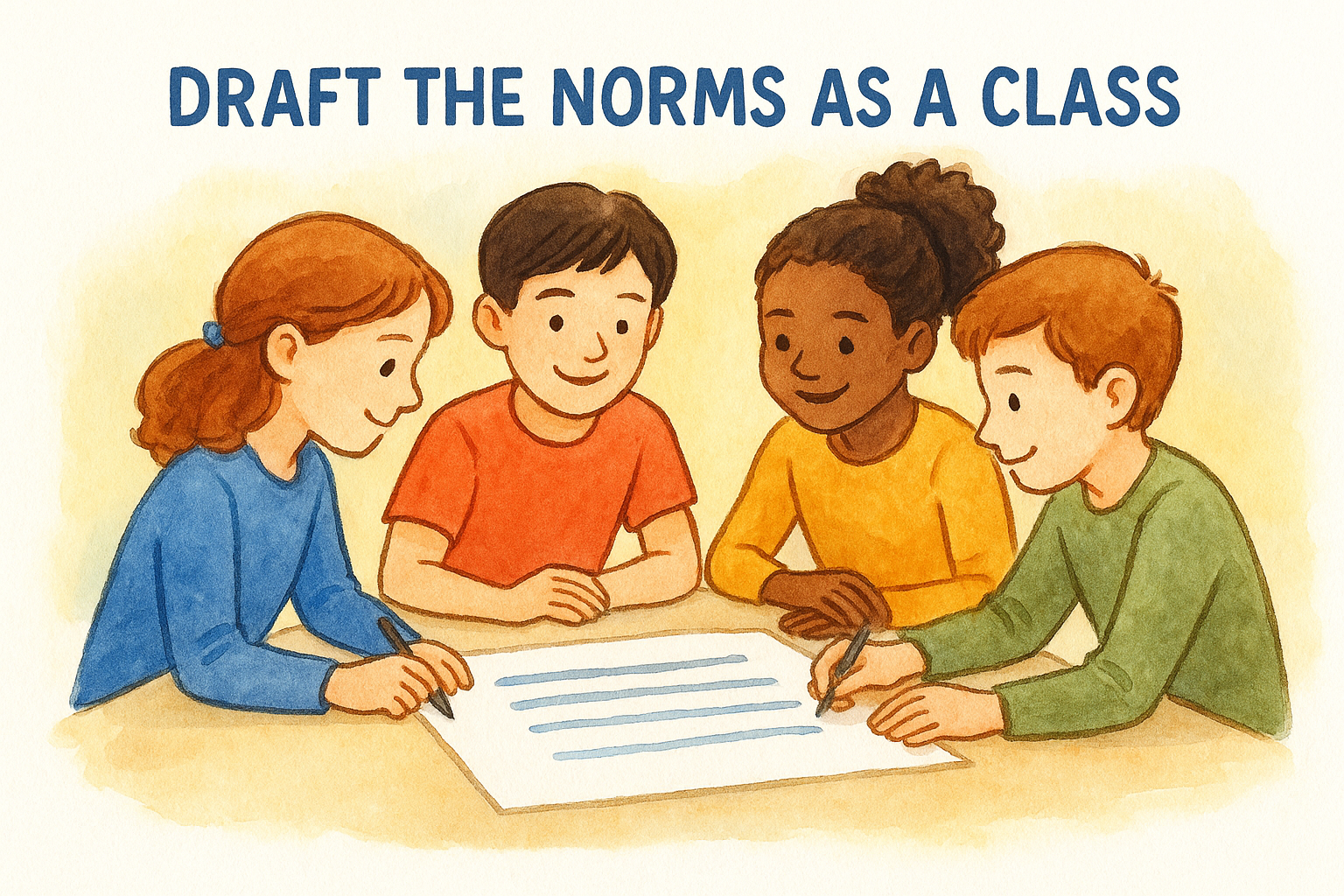
With your themes identified, invite students to write a first draft of each norm in their own words. Small groups work well here: assign one theme to each group and give them three minutes to write a single sentence using "we" language. Then share the drafts with the full class and invite light revisions.
Here’s a drafting template you can give each group:
We [action verb] + [what that looks like] + because/so that + [shared purpose].
Example: "We ask questions openly because that’s how all of us get better."
This structure keeps every norm positive, specific, and connected to a reason students care about, which makes it far easier to reference when behavior slips later in the year.
Step 3. Define what each norm looks and sounds like
A norm written on a poster does very little on its own. Students need a concrete picture of what each commitment actually looks like in practice, not just the abstract language you drafted together in Step 2. This step is where establishing classroom norms and expectations moves from aspiration into daily behavior. Without it, you spend the rest of the year having the same vague conversation about what a norm like "be respectful" was supposed to mean in the first place, and those conversations drain time and trust fast.
Break each norm into visible behaviors
Your job here is to help students translate each norm into specific, observable actions. Bring the class back together and take one norm at a time. Ask: "If someone walked into our room and saw this norm in action, what would they see? What would they hear?" That question forces students to move past the feeling of a norm and describe the actual behaviors that produce it. Push for specifics. "Being kind" isn’t a behavior; "not laughing when someone gives a wrong answer" is.
The more concrete the behavior description, the easier it becomes to recognize the norm in action and to notice when it’s slipping.
Capture student responses in two columns: what you would see and what you would hear. This works for nearly every norm and gives you a ready-made reference point for later conversations with students who need a reminder. Here’s an example using one common norm:
Norm: "We listen to understand, not just to respond."
| You Would See | You Would Hear |
|---|---|
| Eye contact with the speaker | "Can you say more about that?" |
| Phones face down, notebooks closed | "I hadn’t thought of it that way." |
| Body turned toward whoever is talking | Wait time before responding |
| No side conversations during sharing | "I think I see what you mean." |
Use a T-chart to anchor student understanding
Once you’ve worked through each norm with the full class, give students a structured template to complete individually or in pairs. This processing step matters because it confirms that every student, not just the most vocal ones, can articulate what the norms mean in real terms.
Here’s a template you can copy directly into a handout or slide:
| What It Looks Like | What It Sounds Like |
|---|---|
| (write one visible behavior) | (write specific language or tone) |
| (write one visible behavior) | (write specific language or tone) |
Collect these charts and scan them before your next class. Students who struggle to fill in the columns are telling you they need the norm explained more concretely, and catching that gap early saves you significant time later in the year.
Step 4. Teach procedures that make norms easy to follow
Norms describe what your class values; procedures describe how to act on those values in specific, recurring situations. Without procedures, students face constant judgment calls about what a norm actually requires in a given moment, and that cognitive load is often what causes breakdowns. When you [pair each norm with a clear, repeatable routine](https://teachers-blog.com/clear-classroom-expectations/), you make the right behavior the path of least resistance rather than an ongoing act of interpretation. This is the step that transforms establishing classroom norms and expectations from a wall display into a lived daily practice.
Connect each procedure to the norm it supports
Don’t introduce procedures as a separate administrative list. Instead, anchor every procedure back to the norm it serves so students see the direct link between the agreement they made and the routine you’re asking them to follow. That connection is what transforms a procedure from a teacher preference into a logical extension of a shared commitment.
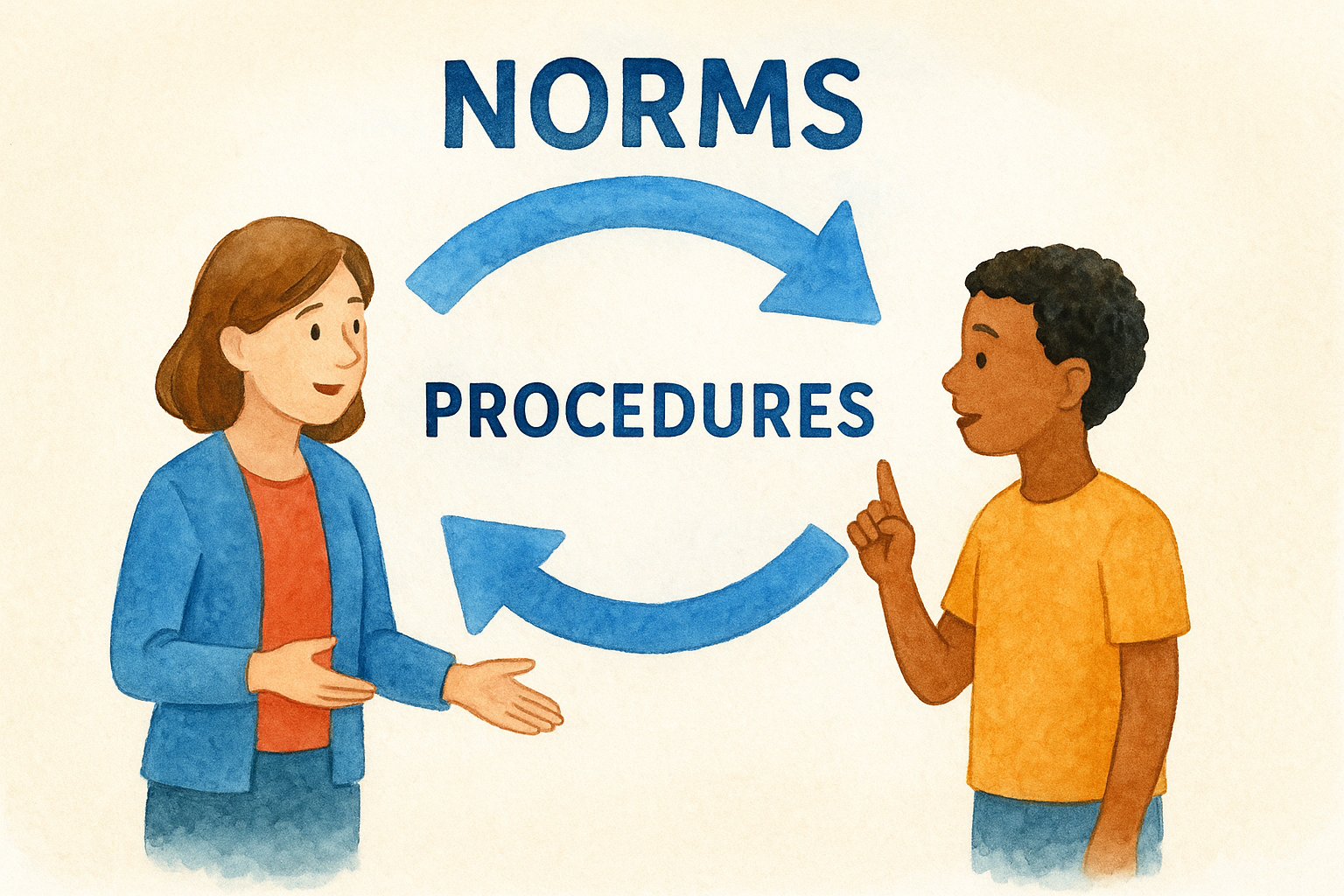
When students understand that a procedure exists because the class agreed to a norm, following that procedure feels like keeping a promise rather than obeying an order.
Here are norm-procedure pairings you can adapt directly for your class:
| Norm | Procedure |
|---|---|
| We listen to understand | During discussions, one voice at a time; use a talking object if the group needs help |
| We support real growth | Peer feedback follows this format: one strength, one specific suggestion |
| We’re honest with each other | When stuck, raise two fingers; teacher checks in before the class moves on |
| We assume good intentions | When a conflict starts, both students write privately before talking to a teacher |
Model and practice each procedure explicitly
Telling students a procedure exists does not teach it. You need to model the procedure yourself, then have students practice it with low-stakes content before you need it in a real situation. This is exactly how coaches introduce new plays: explain, demonstrate, practice, then correct.
Walk through each procedure step by step out loud, narrating what you’re doing and why. Then ask a volunteer to demonstrate while the class watches. After that, run the whole group through it once together. This three-part sequence takes five to ten minutes per procedure, and it saves you far more time than it costs. Students who have rehearsed a procedure in advance handle transitions, feedback moments, and disagreements with significantly less friction than students who encounter those situations cold.
Revisit your key procedures any time you return from a break or introduce a new activity format, because brief refreshers prevent drift before it becomes a pattern you have to address.
Step 5. Reinforce, repair, and revisit norms all year
Co-creating norms in September means nothing if you treat them as a one-time event. Establishing classroom norms and expectations requires ongoing attention: you need to reinforce what’s working, repair trust when things break down, and revisit the agreements themselves as the year evolves. Most norm failures aren’t student failures; they’re maintenance failures, moments where the norms went unacknowledged long enough that students stopped treating them as real commitments.
Reinforce norms through regular recognition
Reinforcement doesn’t mean praise for every small behavior. It means pointing students back to their own commitments when you see those commitments in action. When a student waits for a peer to finish before responding, you can say "that’s exactly what we agreed to when we wrote our listening norm" rather than simply "good job." That specificity connects the behavior to the agreement the class made together, which is far more durable than generic approval.
Naming the norm out loud when students follow it keeps the agreement visible without turning the classroom into a reward chart.
Build in brief norm check-ins at the end of class once or twice a week. Ask one question: "Where did you see one of our norms in action today?" A quick pair-share takes three minutes and does significant work keeping the norms present in student thinking without consuming instructional time.
Repair trust when norms break down
Every class will hit a moment where a norm breaks down visibly. How you respond in that moment matters more than the breakdown itself. Resist the impulse to lecture the whole class. Instead, acknowledge what happened plainly, then redirect to the agreement: "We said we disagree with ideas, not people. That didn’t happen just now. Let’s reset."
For more serious incidents, a private restorative conversation works better than a public correction. Use this three-question template with the student involved:
- What happened, and how did it affect others in the room?
- Which of our class norms did this pull against?
- What will you do differently the next time this situation comes up?
Revisit and refresh norms at key moments
Your norms should not stay frozen from September through June. Natural transition points, including the return from winter break, the start of a new unit, and the weeks before high-stakes assessments, are the right times to revisit them as a class. Ask students whether the norms still reflect how they want the room to function, and invite small revisions when the class agrees something isn’t working. That ongoing flexibility signals that the agreements belong to students, not just to you.
Next steps for a smoother classroom
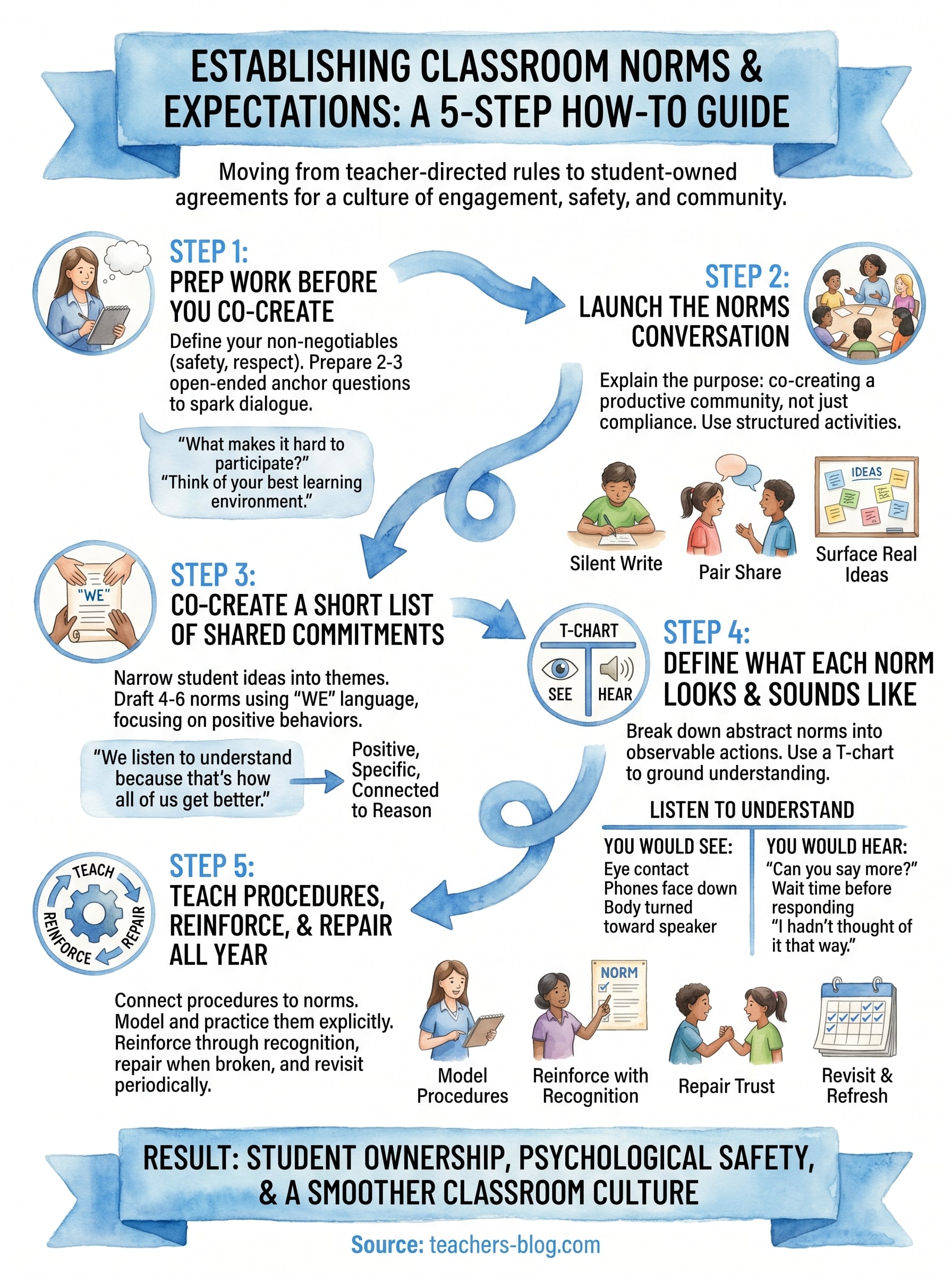
You now have a complete process for establishing classroom norms and expectations that students actually own. The five steps in this guide work together as a system: each one builds on the last, and skipping one weakens the others. Start with the prep work this week, even if your school year is already underway. A mid-year reset conversation can be just as powerful as a September launch when you frame it honestly with students.
The single most important action you can take right now is to write your non-negotiables, prepare your anchor questions, and block time in your next class for the opening conversation. Students respond to teachers who follow through, so the sooner you begin, the faster trust builds. For more practical strategies that save time and improve outcomes, visit The Cautiously Optimistic Teacher and explore tools built specifically for educators like you.