
A Simple Classroom Management Blueprint Template (That You Can Use Tomorrow)
A classroom management blueprint serves as a daily operating system that prioritizes proactive structure over reactive discipline. By organizing your approach into five core pillars—Relationships, Structure, Clarity, Consistency, and Response—you create a predictable environment that fosters behavioral fluency. This simple, one-page plan reduces teacher decision fatigue and ensures that management remains sustainable and effective even on the most challenging days.
This is Lesson 3 of Module 11: The Classroom Management Blueprint | Full Course Outline
Mindset Shift: From Firefighting to Operating
| The “Firefighting” Teacher | The “Blueprint” Teacher |
| Approach: Reacting to disruptions as they happen. | Approach: Preventing disruptions through design. |
| Mental State: High stress and decision fatigue. | Mental State: Calm, regulated, and prepared. |
| Clarity: Expectations are implied or assumed. | Clarity: Expectations are explicitly taught. |
| Response: Emotional and inconsistent. | Response: Neutral and predictable. |
| Result: Survival mode. | Result: Behavioral Fluency. |
Most classroom management advice sounds great… until you’re standing in front of 30 students at 9:02 a.m. on a Monday. That’s why this isn’t another list of strategies.
This is a simple, practical classroom management plan template—one that’s built on everything we’ve covered in this course:
Relationships over rules
Prevention over reaction
Structure over control
Think of this as your daily operating system.
The 5-Part Classroom Management Blueprint
Research shows that strong classroom management is not built on one strategy but on a small set of interacting foundations that work together over time. When relationships, structure, clarity, consistency, and thoughtful responses are all in place, classrooms become more predictable, supportive, and easier to manage day after day.
If you remember nothing else from this course, remember this:
Strong classroom management =
Relationships + Structure + Clarity + Consistency + Response
Let’s break it down.
1. Relationships: Your Foundation For A Classroom Management Blueprint
Before any strategy works, students need to feel:
Known
Safe
Respected
Your Blueprint Moves:
Greet students at the door (every day if possible)
Use names constantly
Have 2–3 “connection moves” daily (quick check-ins, humor, noticing effort)
If students feel connected, you prevent half your “management problems” before they start.
2. Structure: Reduce Decision Fatigue
Students don’t misbehave because they’re bad.
They misbehave because the environment is unclear.
Your Blueprint Moves:
Predictable entry routine (what do students do immediately?)
Posted daily agenda
Clear transition procedures (what happens between activities?)
Structure removes uncertainty—and uncertainty is where behavior issues live.
3. Clarity: Teach Expectations Like Content
If you didn’t teach it, you can’t expect it.
Your Blueprint Moves:
Model expectations (don’t just say them)
Practice routines early (yes, even in high school)
Give feedback like you would for academic work
“Be respectful” is vague.
“When someone is speaking, eyes forward and voices off” is teachable.
4. Consistency: Calm, Predictable Responses
Students don’t need perfect teachers.
They need predictable teachers.
Your Blueprint Moves:
Use the same language for the same behaviors
Address issues early (before escalation)
Keep tone neutral, not emotional
Inconsistency creates anxiety.
Predictability creates safety.
5. Response: Correct Without Escalating
Not every behavior needs a consequence.
But every behavior needs a response that teaches.
Your Blueprint Moves:
Redirect privately when possible
Use neutral language (“What should you be doing right now?”)
Follow up after class for patterns
The goal is not compliance.
The goal is growth.
The “Weekly Blueprint Audit”
The Friday Blueprint Audit
Every Friday afternoon, take 3 minutes to ask yourself these four questions. This ensures your blueprint stays sustainable and doesn’t gather dust.
The Success: Which of my 5 pillars felt the most “automated” and easy this week?
The Friction: Which routine or expectation caused the most “firefighting” moments?
The Relationship Check: Did I make at least one positive connection move with my “high-need” students?
The Micro-Adjustment: What is one small change I will make to the blueprint for Monday morning to reduce next week’s friction?
Putting Your Classroom Management Blueprint All Together: Your One-Page Plan
Here’s your simple classroom management plan template: Click here for a free, downloadable version of the Classroom Management Blueprint.
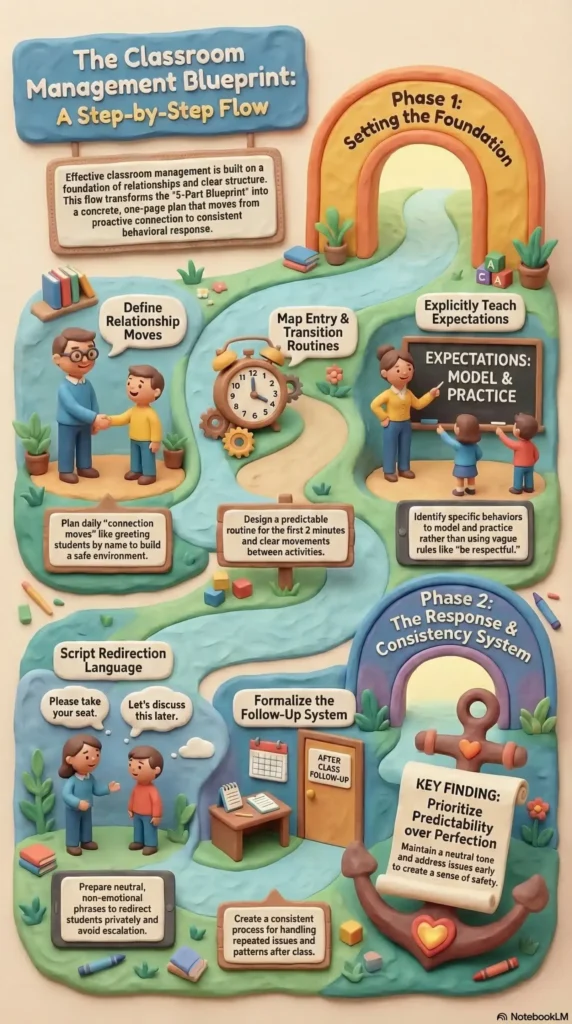
Your Classroom Blueprint
1. Relationship Moves
How will I connect with students daily?
2. Entry Routine
What do students do in the first 2 minutes?
3. Transition Plan
How will I move between activities smoothly?
4. Expectations I Will Explicitly Teach
What behaviors need modeling and practice?
5. My Go-To Redirection Language
What will I say when things go off track?
6. My Follow-Up System
How will I handle repeated issues?
What The Classroom Management Blueprint Is NOT
Let’s clear this up:
❌ Not about controlling students
❌ Not about having perfect compliance
❌ Not about eliminating all disruptions
It is about:
✔ Creating conditions where students succeed
✔ Reducing friction in your classroom
✔ Making your job sustainable
Final Thought: Keep It Simple
You don’t need 25 strategies.
You need a few that you use well.
Start small:
One routine
One expectation
One relationship move
Build from there.
Because great classroom management isn’t built in a day—
It’s built in the small, repeatable moves you make every day.
Classroom Management Blueprint FAQ
What is a classroom management blueprint? A classroom management blueprint is a concise, one-page plan that outlines a teacher’s daily routines, relationship moves, and response strategies. It acts as a guide to keep classroom operations consistent and predictable.
How do you create a simple classroom management plan? Start with five pillars: 1. Relationship moves, 2. Predictable entry routines, 3. Transition procedures, 4. Explicitly taught expectations, and 5. Neutral redirection language. Keep it simple enough to follow on your most tired day.
Why is structure more important than control? Control relies on teacher energy and compliance, which is exhausting and temporary. Structure relies on routines and environment, which creates permanent habits and reduces the need for teacher intervention.
Reflection
I remember realizing at one point that I was trying to manage too many small issues individually instead of building routines that prevented them in the first place. When I began focusing more intentionally on relationships, clear expectations, and consistent responses—as outlined in this blueprint—the classroom started to feel more predictable for both my students and me. That shift helped me see that strong classroom management isn’t about reacting faster; it’s about designing conditions where fewer problems appear in the first place.
- Which part of the five-part blueprint (relationships, structure, clarity, consistency, or response) is currently strongest in your classroom?
- Which part would make the biggest difference if you strengthened it over the next two weeks?
- What is one small routine or expectation you could implement tomorrow that would make your classroom more predictable for students?
Continue the Classroom Management Course
In the final lesson, you will learn how reflective classroom management turns everyday teaching experiences into actionable insights by helping you identify patterns, adjust strategies intentionally, and build a classroom system that improves over time instead of relying on trial and error.
Next Lesson: Reflecting on Classroom Management and What Works
Module 11 Progress:
- Creating Your Personal Management Philosophy
- Selecting Strategies That Fit You
- A Simple Classroom Management Blueprint
- Reflecting on Classroom Management and What Works
Back to Module 11 Overview
Return to Full Course Outline