
Marzano Standards-Based Grading: Step-by-Step For Teachers
If your school is moving toward Marzano standards-based grading, or you’re exploring it on your own, you probably have questions. How do proficiency scales actually work? What happens to the traditional gradebook? And how do you explain any of this to parents who grew up with letter grades? These are real concerns that deserve straight answers, not just theory.
Robert Marzano’s approach flips the script on how we measure student learning. Instead of averaging points across homework, participation, and tests, it tracks where each student stands on clearly defined skills. That shift sounds simple on paper, but putting it into practice takes deliberate planning. The good news: once the system clicks, it gives you and your students far more useful information than a percentage ever could.
Here at The Cautiously Optimistic Teacher, we build resources that help educators work smarter without losing what matters, actual learning. This guide walks you through Marzano’s framework step by step, from building your first proficiency scale to converting scores for report cards. Whether you’re piloting this in one class or rolling it out department-wide, you’ll leave with a clear path forward.
What Marzano standards-based grading is
Marzano standards-based grading replaces the traditional points-and-percentages model with a structured system built around specific learning targets. Rather than asking "how many points did this student earn?", it asks "how well does this student understand this skill right now?" Robert Marzano developed this framework around the idea that grades should communicate learning status, not effort, behavior, or assignment completion.
Grades in this system always reflect what students know and can do, never how much work they turned in.
The four-point proficiency scale
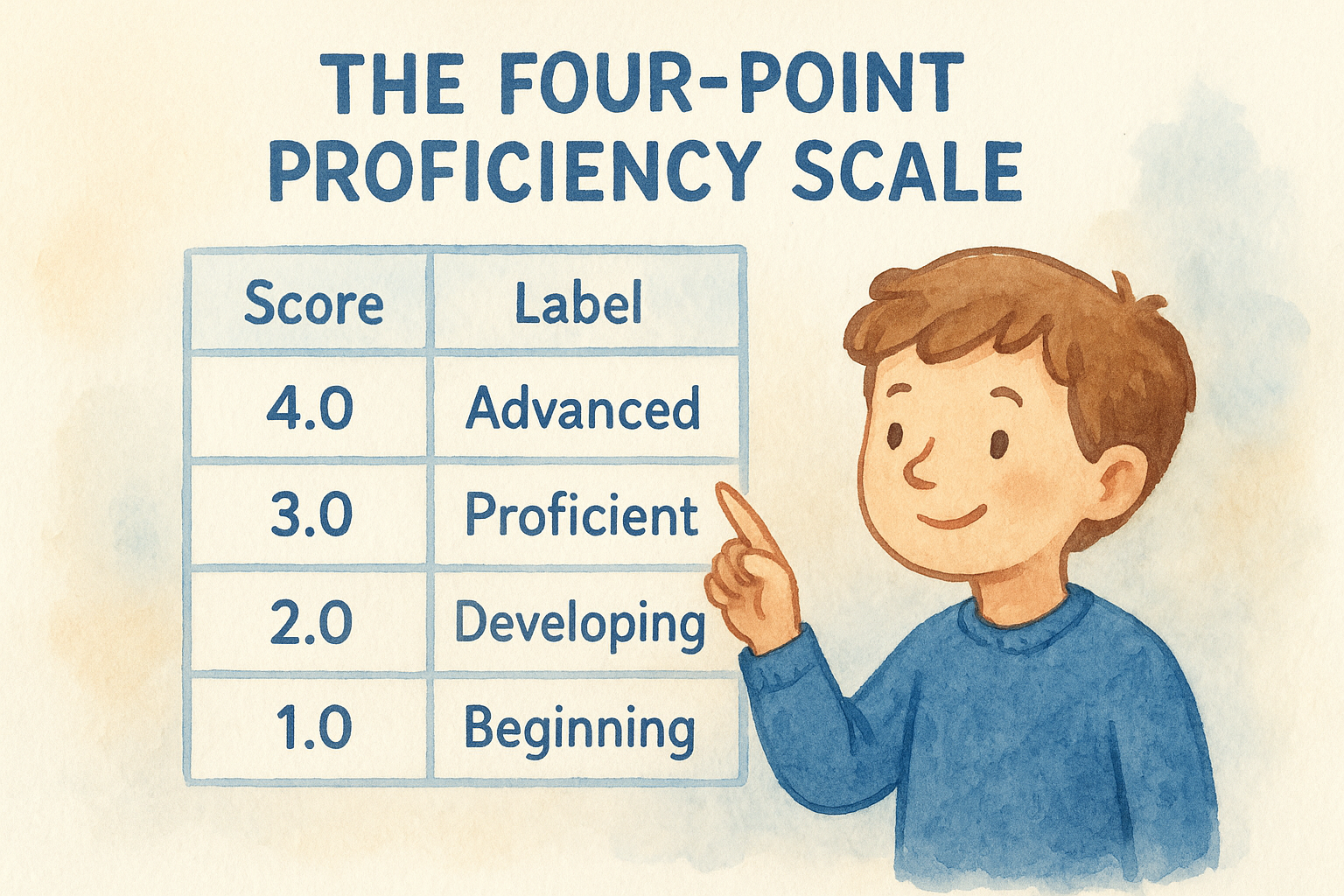
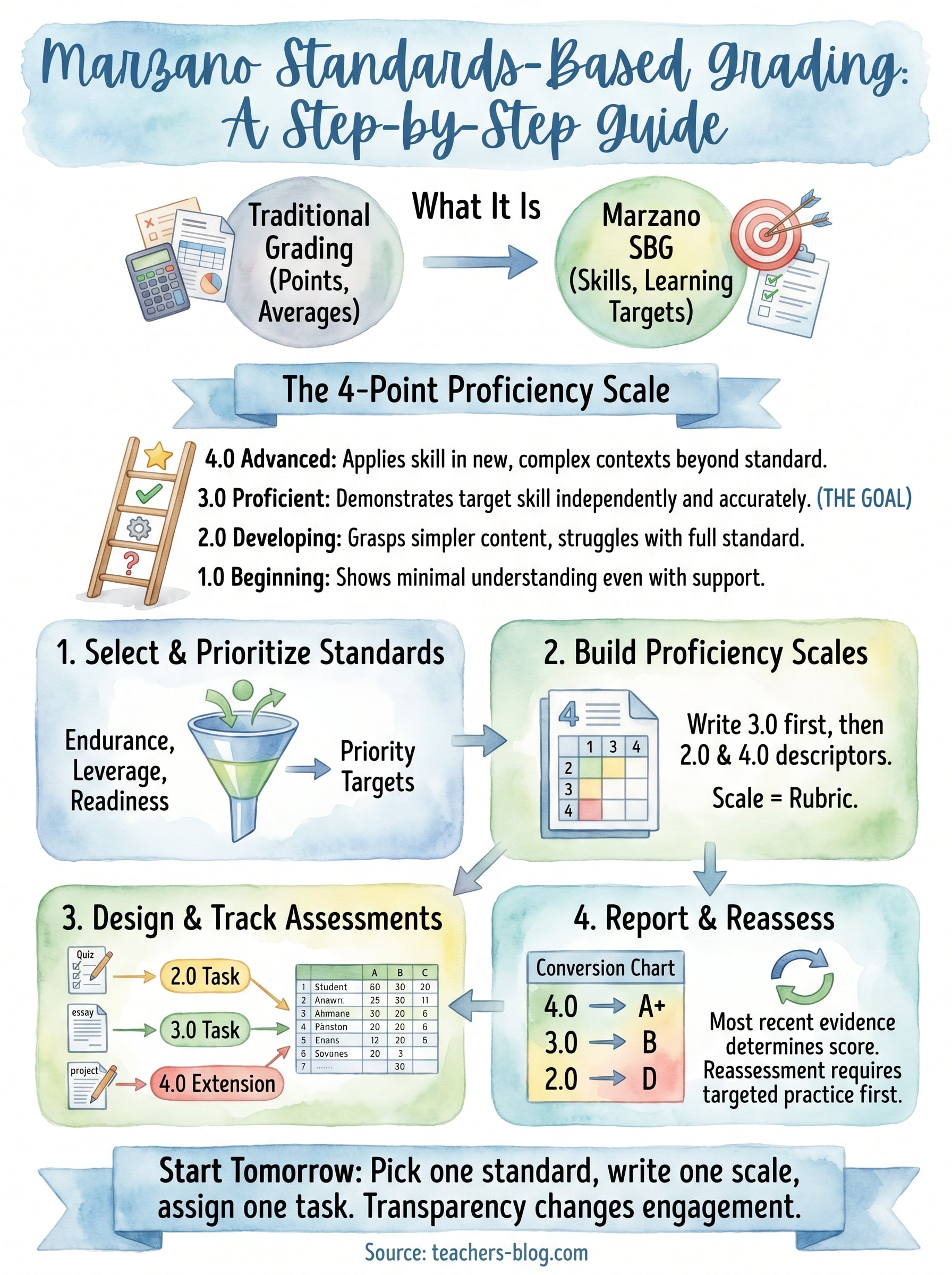
The backbone of Marzano’s framework is a four-point scale that describes distinct levels of understanding for every learning target. Each level carries a precise definition, which means you can tell a student, a parent, or an administrator exactly what a score communicates without any guesswork.
| Score | Label | What it means |
|---|---|---|
| 4.0 | Advanced | Student applies the skill in new, complex contexts beyond the standard |
| 3.0 | Proficient | Student demonstrates the target skill independently and accurately |
| 2.0 | Developing | Student grasps simpler content but struggles with the full standard |
| 1.0 | Beginning | Student shows minimal understanding even with direct teacher support |
How it differs from traditional grading
Traditional grading blends attendance, homework, participation, and test scores into a single letter grade. Marzano standards-based grading separates those entirely, reporting only on demonstrated academic performance for each standard. A student who masters every skill but rarely submits homework still earns a high score, because the score reflects what they know, not what they handed in.
Removing that blend also eliminates the averaging penalty. If a student scores a 1.0 in week one and a 3.0 by week four, the final score reflects where they landed, not where they started. That one shift changes how students experience failure and recovery inside your classroom.
Step 1. Select and prioritize standards
You cannot build proficiency scales for every standard in your curriculum, so the first job is narrowing your list. Priority standards are those with the greatest leverage for future learning, the highest frequency across grades, and the strongest connection to real-world application. Marzano standards-based grading only works well when you focus on the skills that matter most rather than trying to track every benchmark your course touches.
Trying to scale every standard at once leads to burnout. Pick fewer targets and build them well.
How to identify and sort your standards
Start by pulling your state or district standards for your subject and grade level. Then run each one through three filters: endurance (will this skill serve students beyond this course?), leverage (does it support learning in other subjects?), and readiness (do students need it to access the next grade level?). Standards that pass two or three filters become your priority targets for proficiency scales.
Use this sorting framework to organize what you find:
| Category | Filter criteria | Action |
|---|---|---|
| Priority standard | Passes 2-3 filters | Build a proficiency scale and grade it |
| Supporting standard | Passes 1 filter | Teach it, but do not score it separately |
| Prerequisite skill | Background knowledge only | Scaffold it without a formal target |
Step 2. Build proficiency scales and rubrics
Once you have your priority standards, you need to translate each one into a four-point proficiency scale that clearly defines what mastery looks like at every level. This is where Marzano standards-based grading becomes practical: write each descriptor in plain language your students can actually read and understand. Each scale then becomes your scoring guide for all assessments tied to that standard.
Write your 3.0 descriptor first, since it defines the target, then work outward to 2.0 and 4.0.
Writing a scale for a real standard
Here’s a concrete example using an 8th-grade writing standard focused on argument and evidence:
| Score | Descriptor |
|---|---|
| 4.0 | Student uses evidence from multiple sources and addresses counterarguments independently |
| 3.0 | Student writes a claim supported by relevant textual evidence with clear reasoning |
| 2.0 | Student identifies a claim but provides weak or unclear evidence |
| 1.0 | Student struggles to state a clear claim even with direct teacher support |
Once your scale exists, your rubric is already built. Each row in the scale becomes a rubric level. You score student work by matching it to the best-fit descriptor, not by counting points. If a student’s response sits between two levels, assign a half-point like 2.5 to capture that accurately.
Step 3. Design assessments and track evidence
In Marzano standards-based grading, your assessments need to target specific scale levels rather than just general topic knowledge. Every task you assign should produce clear evidence of where a student lands on your four-point scale, so build each assessment with that intention before you hand it out.
Your assessment is only useful if it can distinguish a 2.0 response from a 3.0 response.
Align each task to a scale level
Build at least two assessment tasks per priority standard: one targeting 2.0 content and one targeting 3.0 content. A separate extension prompt pushes students toward a 4.0 performance. Quizzes, writing samples, verbal explanations, and lab demonstrations all count as valid evidence, as long as they map directly to a descriptor on your scale.
Use this evidence-tracking template to log results over time:
| Student | Standard | Date | Score | Notes |
|---|---|---|---|---|
| [Name] | Argument Writing | 5/1 | 2.5 | Needs stronger evidence |
| [Name] | Argument Writing | 5/15 | 3.0 | Meets target independently |
Track every assessment attempt in a separate row, not just the most recent one. Multiple data points let you see growth patterns clearly and make confident decisions when it’s time to report a final score.
Step 4. Report grades and manage reassessment
Reporting in Marzano standards-based grading requires a clear conversion system so your scores translate to whatever format your district’s report card demands. Most schools still require a letter grade or percentage, so you need a consistent bridge between your four-point scale and that traditional output.
Use the most recent evidence, not an average, to determine the score you report.
Converting scores for report cards
Your gradebook should reflect the student’s most demonstrated level, which typically means the most recent consistent score across multiple assessments. Use this conversion guide as your starting point, then adjust to match your school’s scale:
| Proficiency Score | Letter Grade | Percentage Equivalent |
|---|---|---|
| 4.0 | A+ | 100% |
| 3.5 | A | 95% |
| 3.0 | B | 85% |
| 2.5 | C | 75% |
| 2.0 | D | 65% |
| 1.0 | F | 50% |
Handling reassessment requests
Reassessment is not a loophole; it is built into the design of this system. When a student requests a retake, require them to complete targeted practice on their weak descriptors first. Set a clear policy: one reassessment per standard per grading period, scheduled within two weeks of receiving feedback. This keeps the process manageable without closing the door on genuine growth.
A simple way to start tomorrow
Pick one priority standard from your current unit and write a four-point scale for it tonight. That single scale gives you everything you need to test marzano standards based grading in your own classroom without overhauling anything else. Assign one task this week that maps to your 2.0 and 3.0 descriptors, score it using your scale, and record the results. That is the whole system in miniature.
Share your scale with students before they start the task. When they can see exactly what a 3.0 response looks like, they stop guessing and start working toward a clear target. That transparency alone changes how students engage with feedback.
Once you run one full cycle, the rest of the steps in this guide will feel much more concrete. For more practical tools and strategies built for real classrooms, visit The Cautiously Optimistic Teacher and explore resources designed to help you work smarter every day.