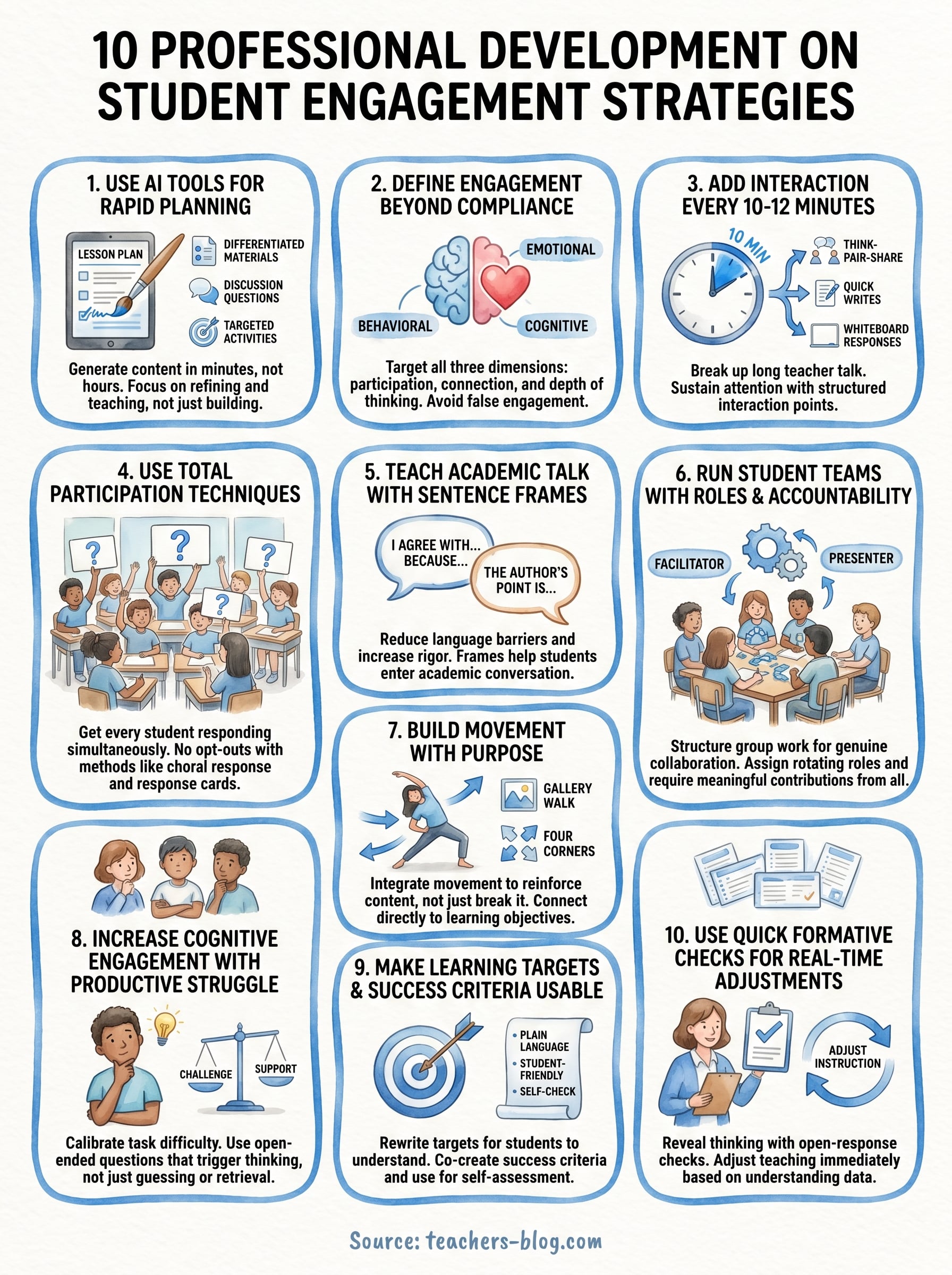
10 Professional Development On Student Engagement Strategies
You’ve sat through the PD sessions where someone reads bullet points off a slide for two hours and calls it "training." We all have. But here’s the thing, professional development on student engagement actually matters when it’s done right. The gap between a disengaged classroom and an electric one often comes down to whether teachers get meaningful support in building those skills, not just a binder full of theory they’ll never open again.
Research consistently shows that student engagement drives everything from academic achievement to classroom behavior. Yet most teachers report that their professional development doesn’t give them practical tools they can use the next day. That disconnect is exactly why we built The Cautiously Optimistic Teacher, to bridge the space between what educators need and what they actually receive, with strategies, resources, and AI-powered tools designed for real classrooms.
This article breaks down 10 professional development strategies focused specifically on boosting student engagement. These aren’t vague suggestions or recycled education jargon. Each one is something you can advocate for in your school, pursue independently, or start implementing on your own terms. Whether you’re a veteran teacher looking to shake things up or a newer educator still building your instructional toolkit, you’ll walk away with concrete approaches that translate directly to stronger student participation and motivation.
1. Use AI tools to plan engagement fast
Planning engaging lessons takes time, and time is the one thing teachers never have enough of. AI tools change that equation by letting you generate differentiated materials, discussion questions, and targeted activities in minutes rather than hours. When your school includes AI-assisted planning in professional development on student engagement, it shifts the focus from building resources from scratch to reviewing, refining, and actually teaching.
What you build during PD
During a well-designed PD session, you don’t just watch a demo. You create actual classroom materials you can use the following week. A session centered on AI tools might have you produce a complete set of critical thinking questions from a reading passage, a differentiated worksheet for three readiness levels, and a formative check-in, all in under 45 minutes.
Here’s what a focused AI planning block can produce:
- Higher-order discussion questions tied to your current text or unit
- Differentiated practice tasks at two or three levels
- A quick exit ticket with answer indicators
How to use The Cautiously Optimistic Teacher tools
The Cautiously Optimistic Teacher offers several free AI tools built for this kind of rapid planning. The Question Generator takes any text you paste in and produces higher-order questions instantly, cutting the time it normally takes to craft prompts that push student thinking. The Worksheet Maker generates customized practice activities from a keyword or topic, and the Differentiated Instruction Helper tailors content to different learning needs without requiring you to rebuild lessons from scratch.
These tools work best when you treat the output as a strong first draft, then add your own context, student examples, and adjustments before class.
What it looks like in class
When you walk in with AI-generated materials you’ve reviewed and personalized, students notice the difference. Activities fit the actual content you’re teaching. Differentiated options are ready before the lesson starts, so no student sits waiting while you adapt on the fly, and your energy stays focused on the room instead of the resource.
How to check if it worked
Track two things after you use AI-planned materials: student task completion rates and the quality of responses on your formative checks. If more students attempt the work and their answers show real thinking rather than one-word guesses, the planning approach is working. Adjust your prompts and tool settings based on what you see, and share what works with your colleagues.
2. Define engagement beyond compliance
When a student sits quietly and completes the worksheet, that looks like engagement. It often isn’t. Professional development on student engagement needs to start with a clear, shared definition, because without one, teachers optimize for compliance instead of actual learning.
The three dimensions to use in PD
Researchers identify three distinct dimensions of engagement: behavioral (on-task participation), emotional (connection to content and community), and cognitive (depth of thinking and reasoning). When your PD addresses all three, teachers stop settling for quiet rooms and start designing for real intellectual investment.
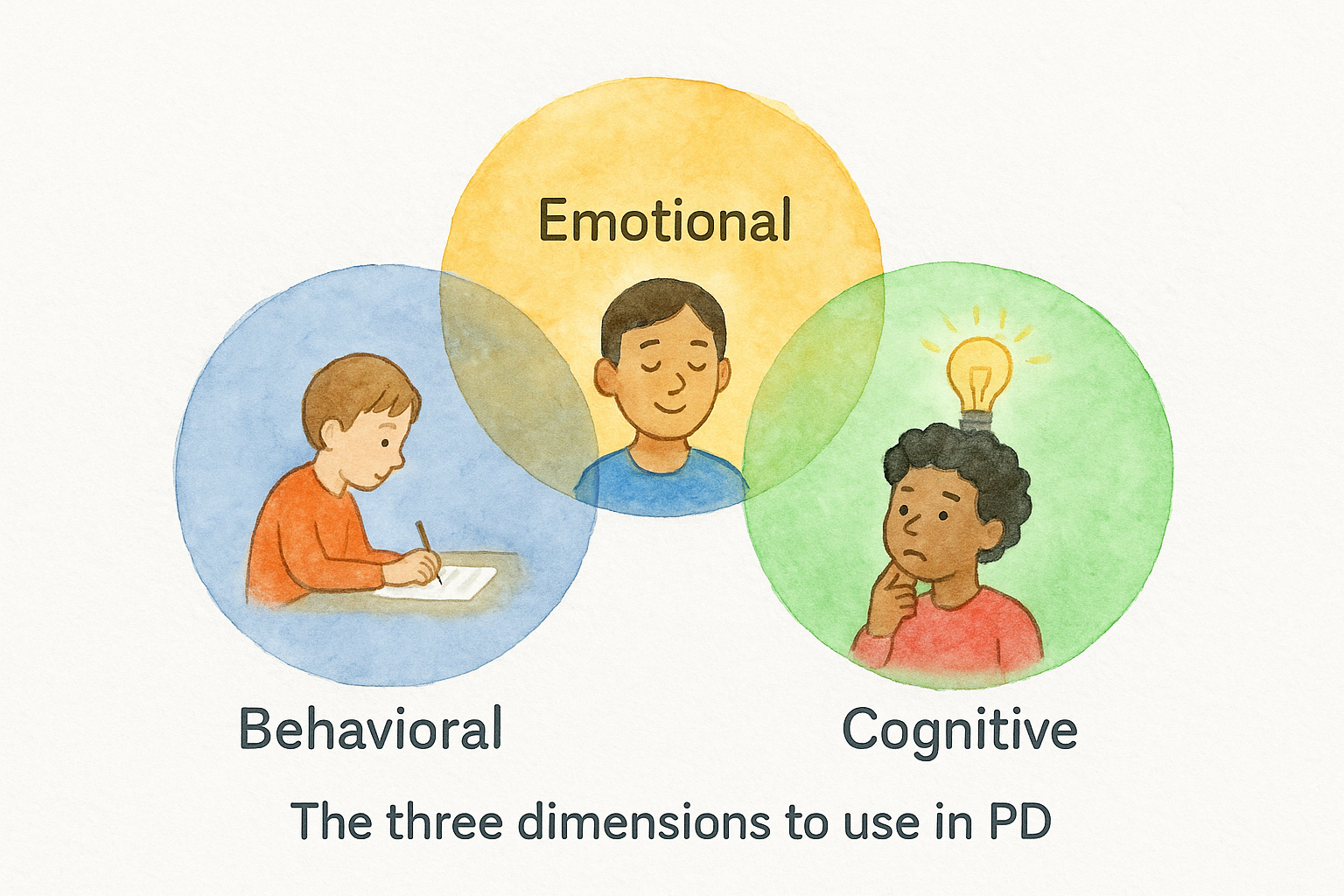
Targeting only behavioral engagement is the most common mistake schools make during instructional improvement efforts.
What engaged students do and say
Cognitively engaged students revise their thinking, push back on ideas, and explain their reasoning out loud. Emotionally engaged students ask follow-up questions and connect material to their own lives. Look for these specific behaviors to gauge real engagement:
- Unprompted questions about the content
- Willingness to revise work after feedback
- Peer discussion that extends beyond the assigned task
How to spot false engagement
False engagement looks cooperative but produces shallow thinking. Students who nod along without processing or copy answers fit this pattern. Watch for these warning signs in your classroom:
- One-word responses to open-ended questions
- Zero revision on drafts or self-assessments
- Task completion with no visible evidence of reasoning
How to set a shared staff definition
Your team needs one agreed-upon definition before any PD session moves forward. Build it together by sorting real student behaviors into the three dimensions, then write one sentence everyone will actually use during observations and lesson planning.
3. Add an interaction every 10 to 12 minutes
Every professional development on student engagement session should address one of the most common classroom mistakes: teacher talk that runs too long without a break. Building structured interaction points into your lessons keeps students mentally present and gives you real-time feedback on what they’re actually understanding.
Why attention drops during long teacher talk
The brain doesn’t sustain focused attention indefinitely. Research on cognitive load consistently shows that students begin to disengage after 10 to 12 minutes of passive listening, even when they appear on-task. Without a shift in activity, new information stops encoding and attention drifts to whatever competes for it in the room.
Planning interaction points in advance is more effective than improvising them when you sense the room is losing focus.
How to redesign a lesson with interaction points
Map your lesson in 10-minute blocks and assign one interaction type to each transition. This doesn’t require starting over; it means inserting a turn-and-talk, a written response, or a quick pair-share at natural pauses between direct instruction and independent practice.
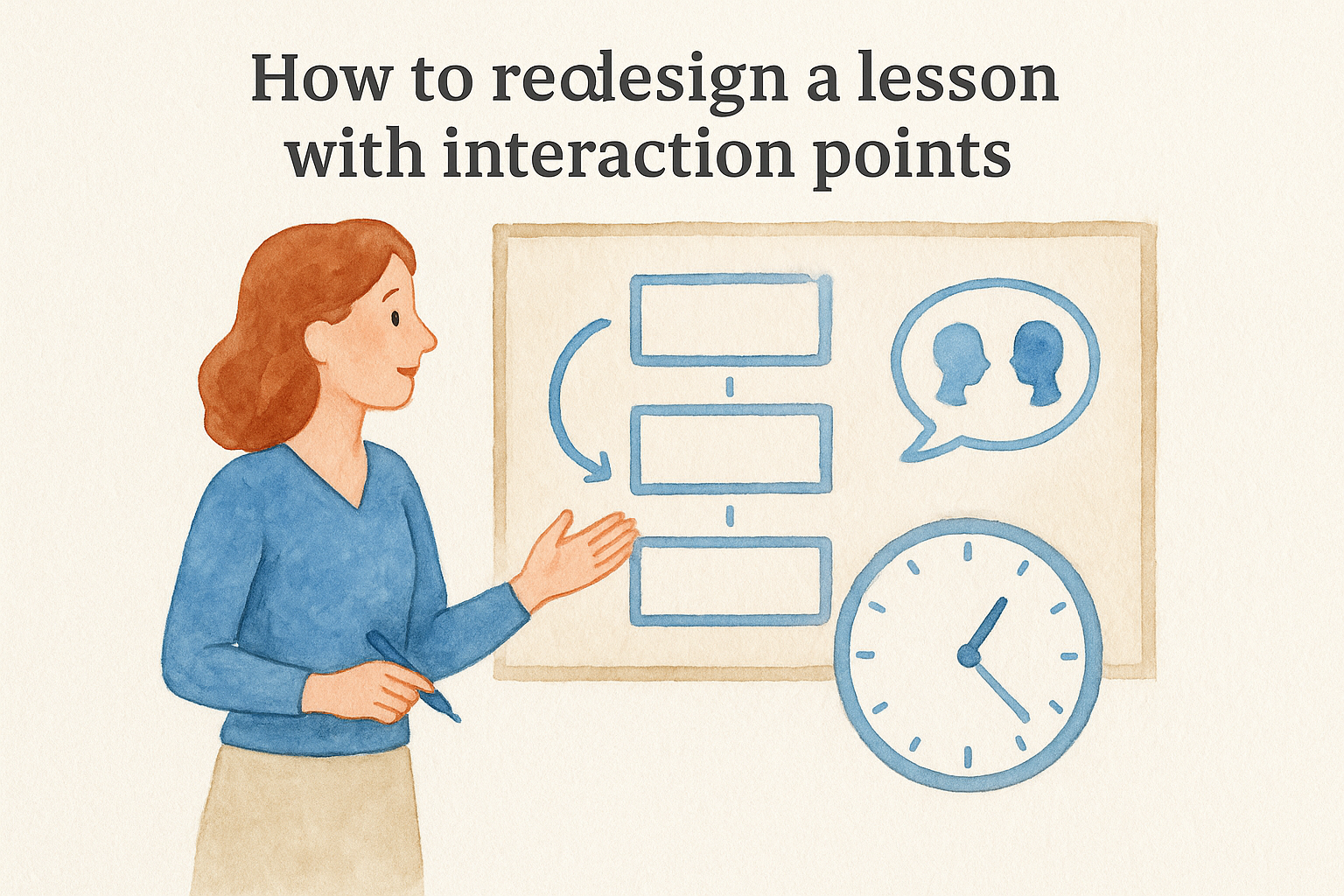
Fast structures to rotate all period
Rotating simple structures prevents the routine from going stale. Effective options include think-pair-share, quick writes, whiteboard responses, and numbered heads together. Vary which structure you use so students stay alert to what the prompt asks them to do.
How to make it work in any subject
Every subject has content that can support brief interaction, whether that’s a math problem, a historical source, or a vocabulary term. The subject doesn’t limit you; your question design does. Anchor each interaction to a specific learning target and the structure will hold.
4. Use total participation techniques
Total participation techniques are instructional strategies designed to get every student responding at the same time, rather than waiting on the one hand that goes up. When professional development on student engagement includes structured practice with these methods, teachers stop running lessons where only a handful of students carry the cognitive load.
Why cold calling alone does not fix participation
Cold calling puts one student on the spot while the rest of the class relaxes. It creates anxiety without increasing thinking. What you actually want is a structure where every student must produce a response simultaneously, so no one can opt out by staying invisible.
The goal isn’t more hands in the air; it’s more minds actively working at the same time.
Methods that get every student to respond
Several techniques accomplish simultaneous response without chaos. Whiteboards let students write answers and hold them up together. Response cards work the same way for multiple-choice checks. Choral response fits lower-stakes factual recall, while think-pair-share handles open-ended prompts where every student formulates a position before anyone speaks aloud.
How to manage pacing and noise
Set clear signals for when students respond and when they stop. A simple hand signal or a countdown keeps transitions tight. Noise during pair discussions is productive as long as it stays focused on the prompt, so train students to start and stop on cue rather than eliminating talk altogether.
How to support reluctant speakers
Give processing time before any verbal response is expected. Sentence starters reduce the blank-page feeling that shuts quieter students down. Pairing students strategically, so a hesitant speaker works with a patient partner rather than a dominant one, builds confidence before whole-class sharing happens.
5. Teach academic talk with sentence frames
Most students who stay quiet during discussion aren’t disengaged; they simply don’t know how to enter an academic conversation. Sentence frames give students a concrete starting point so that participation becomes accessible, not just expected.
What sentence frames do for participation and rigor
Sentence frames reduce the language barrier that prevents students from sharing real thinking. When you provide a prompt like "I agree with ___ because ___," you’re not lowering the cognitive demand, you’re removing the social anxiety that blocks access to it. Students produce more rigorous responses when they aren’t also managing the pressure of finding the right words.
Frames don’t limit thinking; they redirect student energy from "how do I say this" to "what do I actually think."
How to choose frames that match the standard
Match your frames to the specific skill the standard demands. Analyzing an author’s argument calls for different language than comparing two historical events. During professional development on student engagement, teachers should practice writing frames tied to their actual standards rather than pulling generic templates that don’t connect to the content.
How to practice talk moves in PD
Your PD session should require teachers to use the frames themselves before they introduce them to students. Run a short text-based discussion where staff respond using only the provided sentence starters. That 10-minute exercise builds empathy for what students experience and reveals which frames feel natural versus clunky.
How to fade supports without losing access
Start with full frames, then shift to partial frames where students complete more of the sentence independently. Eventually, post only a word bank or remove the support entirely for students who demonstrate consistent use. Track which students still need scaffolding and keep frames available without making them feel remedial.
6. Run student teams with roles and accountability
Unstructured group work often benefits one or two students and lets everyone else coast. Professional development on student engagement should address this directly by giving you a clear framework for designing team tasks that require every member to contribute meaningfully, not just sit in proximity to people who do the work.
How to structure group work so it stays rigorous
Rigorous group work starts with a task that genuinely requires multiple perspectives or steps to complete. Assign tasks that fall apart without each member’s input, so the group structure isn’t decorative; it’s functional. Your task design determines whether students collaborate or merely tolerate each other.
Roles that prevent passengers and dominance
Assign specific, rotating roles such as facilitator, recorder, questioner, and presenter. Rotating roles across tasks prevents any one student from defaulting to the same position and ensures every student practices different thinking and communication skills throughout the unit.
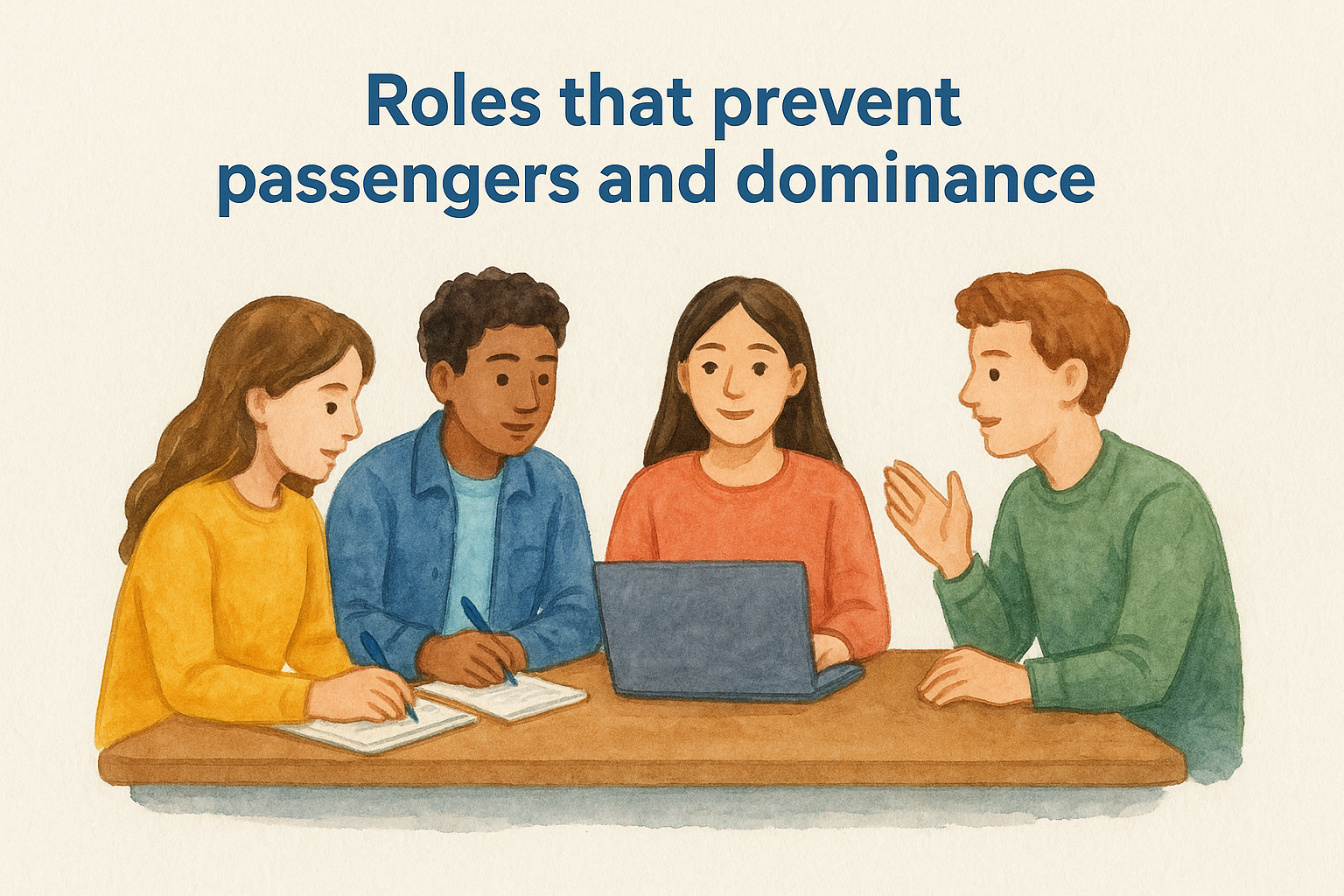
Roles only work when students understand what each one requires, so build in time to model the expectations before group work begins.
How to teach collaboration explicitly
Collaboration is a skill, not a natural tendency. Model what productive disagreement looks like by running a fishbowl discussion during PD where staff practice the same talk moves you expect from students. Give students sentence frames for navigating conflict within their teams before problems arise.
How to grade and assess without killing teamwork
Combine individual accountability measures like exit tickets or role logs with a shared group product grade. That split prevents the frustration of shared grades while still rewarding genuine collaboration and keeping each student responsible for their own contribution.
7. Build movement into instruction with purpose
Movement isn’t a break from learning; it’s a tool for deepening it. When professional development on student engagement addresses physical activity as an instructional strategy, teachers learn to integrate movement in ways that reinforce content rather than simply interrupt a lesson.
When movement helps most
Movement works best right before a complex task or after a sustained period of seat work. Research shows that brief physical activity increases blood flow and sharpens focus, giving you a practical reason to build it into your lesson pacing rather than treat it as a reward for finishing early.
Movement routines that stay controlled
Consistent routines and clear expectations prevent movement from turning into chaos. Gallery walks, four-corners debates, and stand-to-share protocols all require students to move with a purpose. Teach the routine once, practice it twice, and it runs smoothly for the rest of the year.
The structure of the movement activity matters more than the movement itself.
How to connect movement to learning targets
Every movement activity should tie directly to a specific learning objective. A gallery walk reviewing primary sources isn’t exercise; it’s a content task that happens to involve walking. Keep your learning target visible during the activity so students stay anchored to the goal instead of treating it as free time.
How to adapt for space, mobility, and safety
Not every classroom has open floor space, and not every student can move the same way. Offer seated alternatives for students with mobility needs and modify any activity so no student is excluded. Small adjustments, like a hand-raise version of four corners, keep participation universal without disrupting the flow of the lesson.
8. Increase cognitive engagement with productive struggle
Productive struggle is what happens when students work hard on something just beyond their current comfort zone without shutting down. Including this concept in professional development on student engagement helps you distinguish between the frustration that builds capacity and the confusion that stops students from trying altogether.
How to calibrate challenge and support
The right level of challenge sits just above what students can do independently but within reach when you provide the right scaffolding. Task complexity and support structures need to work in balance, so your students are genuinely stretching their thinking without feeling abandoned by the instruction.
Question types that trigger thinking, not guessing
Questions that start with "why" or "what would happen if" force students to construct an answer rather than retrieve one. Open-ended prompts and hypothesis questions push students to reason through content rather than scan their memory for a single correct word.
Design questions that have no single right answer, and watch students lean in instead of shut down.
How to coach without rescuing
When students struggle, your instinct is to step in and fix it fast. Resist that pull and ask a question that redirects their thinking instead. Coaching sounds like "what do you know so far" rather than "let me show you how."
What to do when struggle turns unproductive
Unproductive struggle looks like a student who has stopped trying rather than one who is working hard. Re-engage them with a smaller entry point or a brief peer conversation before the frustration locks into avoidance.
9. Make learning targets and success criteria usable
Learning targets posted on a board mean nothing if students can’t explain what they’re actually supposed to accomplish. Professional development on student engagement needs to address this gap directly, because vague or jargon-heavy targets are one of the most reliable ways to lose students before a lesson even begins.
How to write student-friendly targets
Rewrite your targets in plain, specific language that a student can read and immediately understand without a translation. Replace "Students will analyze author’s craft" with "You will explain why the author chose this specific word and how it changes the meaning." Concrete language gives students a direction, not just a topic.
How to co-create or unpack success criteria
Hand students the target and ask them to describe what success looks like before you tell them. This process reveals what students already understand and builds genuine ownership over the goal. Even a two-minute unpacking conversation produces more buy-in than any posted objective ever will.
When students can describe their own success criteria, they monitor their own progress instead of waiting for you to evaluate them.
How students self-check during work time
Build in brief, structured self-assessment moments mid-task where students rate their progress against the criteria using a simple scale or checklist. These checkpoints keep students anchored to the target and reduce the number of off-task detours that happen when students aren’t sure what finishing well looks like.
How to keep targets from becoming wallpaper
Refer back to the target at least twice during the lesson: once at the start and once before the closing task. Asking students to connect their work directly to the target turns a posted sentence into an active reference point rather than classroom decoration.
10. Use quick formative checks to adjust in real time
Waiting until the end of a unit to discover that students missed a core concept is one of the most avoidable problems in teaching. Quick formative checks give you real-time data about what students actually understand, so you can adjust your instruction while it still matters rather than reteaching content after a failed assessment.
Checks that reveal thinking, not just correctness
A multiple-choice exit ticket tells you what students chose, not why they chose it. Open-response checks, even a single sentence explaining reasoning, reveal the thinking behind the answer. During professional development on student engagement, practice designing checks that expose misconceptions rather than just sort correct from incorrect responses.
The most valuable formative check is one that surprises you with what students don’t understand yet.
How to respond when data shows confusion
When your checks show widespread confusion, stop and reteach before moving forward. If only a small group is struggling, pull them for a brief targeted conversation while the rest of the class extends the concept independently. Sorting students by their responses before you respond makes your next move more precise.
How to keep feedback fast and actionable
Feedback that arrives a week later helps no one. Return responses the same day, even if it’s a quick verbal summary of what you noticed. Students adjust their thinking when the connection between their work and your response is immediate.
How to track growth over weeks
Save a sample of formative checks from the beginning, middle, and end of each unit. Comparing responses over time shows both student growth and the impact of your instructional adjustments, giving you concrete evidence of what your teaching actually produced.
What to do next
Professional development on student engagement doesn’t require waiting for your district to schedule a training. You can start with one strategy from this list, practice it for two weeks, and measure what changes in your classroom data. Pick the approach that fits your current unit and build from there rather than trying to overhaul everything at once.
Your next step is to get your hands on tools that make implementation faster and less exhausting. The Cautiously Optimistic Teacher gives you free AI-powered resources, including a question generator, a worksheet maker, and a differentiated instruction helper, all designed to cut your planning time and increase the quality of what students actually experience. Browse the blog for subject-specific strategies and unit plans that connect directly to the engagement work you’re already doing. Small, consistent changes to your instruction compound quickly, and the right resources make that process a lot more manageable.