
11 Printable Classroom Activities for Any Subject & Grade
You need a lesson for tomorrow, your planning period got swallowed by a fire drill, and the copier is somehow still jammed from last week. Sound familiar? Printable classroom activities are the quiet heroes of moments like these, ready to download, easy to adapt, and useful whether you teach sixth-grade science or twelfth-grade English.
The trick is finding ones that actually work across subjects and grade levels without feeling like busywork. That’s something we care about here at The Cautiously Optimistic Teacher, where every resource is built with real classroom use in mind, not just cute formatting. We want activities that get students thinking, talking, and engaging with content meaningfully.
Below, you’ll find 11 printable activities you can use in virtually any subject or grade. Each one includes a quick overview, tips for differentiation, and suggestions for making it your own. Grab what you need, hit print, and get back to the part of teaching that actually matters, working with your students.
1. RankYak Worksheet Maker Prompts
The RankYak Worksheet Maker lets you generate custom worksheets from any keyword or topic in seconds. Instead of hunting through generic printable classroom activities that may not match your curriculum, you type in exactly what your class is studying and get a worksheet built around it. That specificity saves you significant prep time.
What to print
Once you run your keyword through the tool, you can print the resulting worksheet directly or save it as a PDF for later. The output typically includes a mix of question types, so you get variety on one page without having to build it yourself. Print one copy first to check formatting before you run the full class set.
A worksheet tailored to your exact unit covers the content you actually taught, which generic templates simply cannot replicate.
How it works in class
You hand out the worksheet and students work through it independently, in pairs, or in small groups depending on your goal for that day. Because the content connects directly to what you’ve been teaching, students engage with it instead of treating it as filler. Use it as a practice activity, a formative check, or a structured review before a quiz or test.
How to adapt for grades and subjects
The keyword you enter determines the difficulty and content, so adapting is straightforward. For younger students or struggling learners, enter a narrower or more foundational topic. For advanced classes, enter a more complex concept or add a note in your prompt asking for higher-order thinking questions. The tool works across subjects: plug in "cell division," "figurative language," or "the causes of World War I" and it builds around that topic.
- Elementary: focus on single concepts like "addition with regrouping"
- Middle school: try broader topics like "theme in fiction"
- High school: push into analysis with prompts like "evaluating primary sources"
Time and materials
Generating the worksheet takes under two minutes, and printing takes whatever your copier allows. You need standard 8.5×11 paper and a printer. No laminating, no cutting, no prep beyond hitting print. The total setup time from idea to printed copy is genuinely about five minutes on a busy morning.
2. Exit tickets and quick checks
Exit tickets are short, focused prompts that students complete in the last few minutes of class. They give you immediate feedback on what landed and what needs reteaching, without grading a full assignment.
What to print
A single exit ticket fits four to a page, so one sheet covers a full class set and keeps paper use low. Print them with a simple format: one to three questions, a name line, and a date. Many teachers keep a stack of blank templates on hand that they write questions on each day with a marker, which makes them reusable across units.
Exit tickets work best when the question directly mirrors your lesson objective, not just the activity students completed.
How it works in class
You distribute these printable classroom activities in the final three to five minutes and students answer before they leave. Collect them at the door so you read the room as students exit. Sort the responses into three piles: got it, almost, and not yet. That quick sort shapes your next day’s opening more effectively than any end-of-unit test.
How to adapt for grades and subjects
For younger grades, one question with a drawing option works well. For middle and high school, ask students to explain their reasoning in one to two sentences. Switch the format by subject: math gets a sample problem, ELA gets a sentence-completion prompt, and science gets a claim-and-evidence frame.
Time and materials
Printing takes under a minute for a class set. You need one sheet of paper and a copier. Students need a pencil and about three minutes of class time.
3. Bell ringers and do-now sheets
Bell ringers are short, self-directed tasks that students begin the second they sit down. These printable classroom activities give you a structured opening routine that settles the room while you take attendance, handle logistics, or meet briefly with individual students.
What to print
A basic do-now sheet includes a prompt area, a name line, and the date. You can print these four to a page and cut them, or print one per student with space to write. Many teachers keep a weekly version that lists Monday through Friday in five rows, so students use one sheet all week and you copy less.
How it works in class
Students pick up their sheet at the door or find it on their desk and start immediately without instruction from you. That independence is the point. The prompt should be short enough to complete in three to five minutes and directly connected to prior learning or a preview of the day’s lesson.
A bell ringer that reviews yesterday’s key concept does double duty: it settles the class and reinforces content before you even begin.
How to adapt for grades and subjects
For younger students, use sentence starters or fill-in-the-blank formats. Older students can handle open-ended prompts that ask them to connect, predict, or evaluate. Swap the format by subject: math uses a warm-up problem, science uses a vocabulary review, and ELA uses a quick grammar or analysis question.
Time and materials
You need one sheet and a pencil. Students need three to five minutes of independent work time to complete it.
4. Task cards for stations and small groups
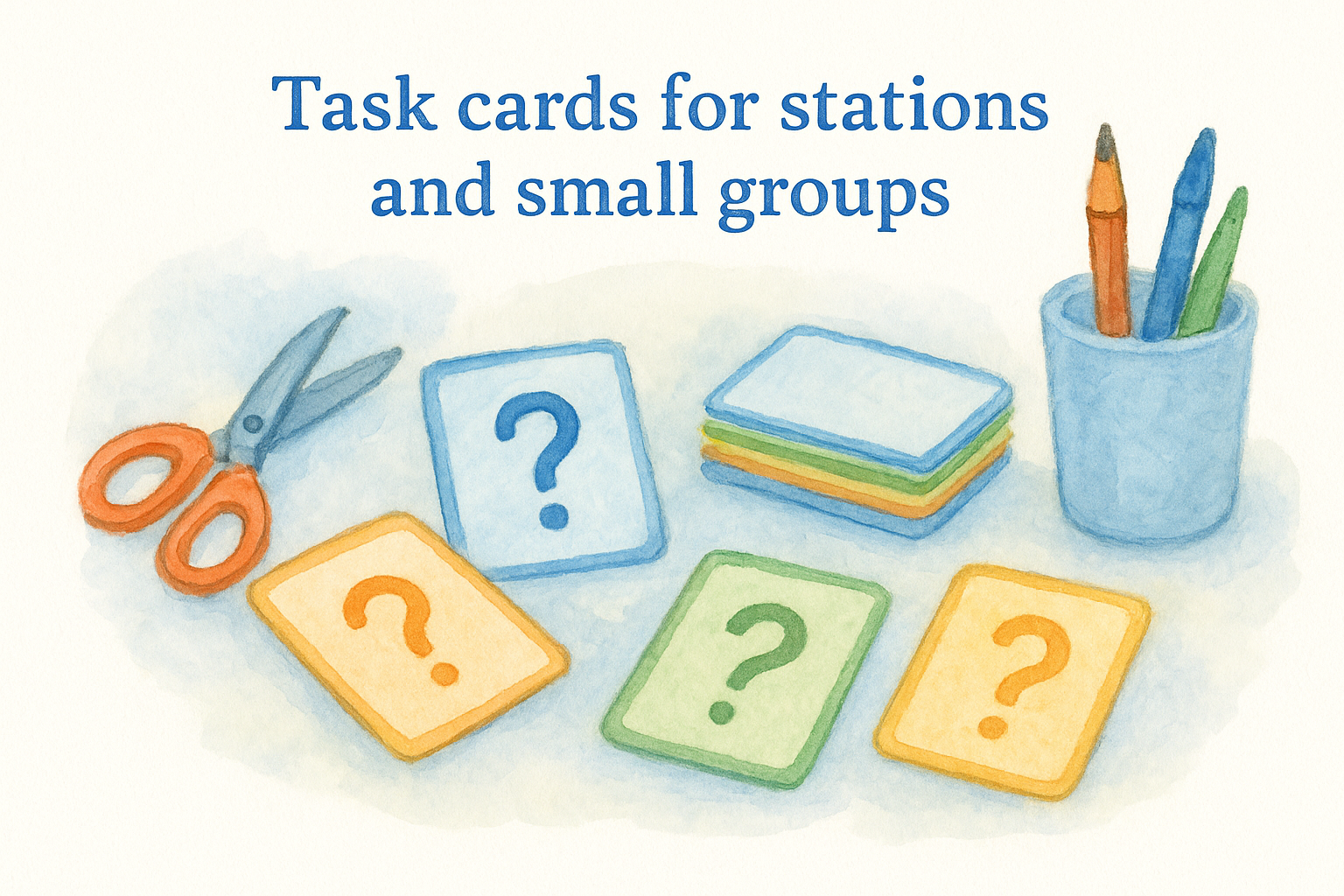
Task cards are individual cards, each containing a single question or prompt, that students rotate through during stations or tackle in small groups. They break a larger practice set into bite-sized chunks, which keeps students more focused than staring down a full worksheet.
What to print
Print task cards on cardstock if possible, since they get handled repeatedly. A standard set runs eight to twenty cards per page before cutting, depending on your layout. Laminating a class set takes extra time upfront but means you use the same set for multiple classes or school years without reprinting.
A laminated set of task cards pays for itself in paper savings after just two or three uses.
How it works in class
You set up four to six stations around the room, each with a small stack of cards. Students rotate on a timer or work through cards at their own pace. Because each card stands alone, students who struggle with one question can skip ahead and return, which reduces the frustration that comes with traditional worksheets where one missed step derails everything.
How to adapt for grades and subjects
Color-code cards by difficulty level to run differentiated groups without making the tiering obvious to students. These printable classroom activities scale across subjects easily: use vocabulary definitions in ELA, equation practice in math, or cause-and-effect scenarios in social studies.
Time and materials
You need cardstock, a printer, and scissors. Setup takes about ten minutes the first time. Students need fifteen to twenty minutes at stations.
5. Graphic organizers for any text or topic
Graphic organizers give students a visual structure for thinking, which is especially useful when you introduce a complex text, a new unit, or an abstract concept. Having a pre-built framework on paper helps students organize ideas before writing or discussing, rather than staring at a blank page.
What to print
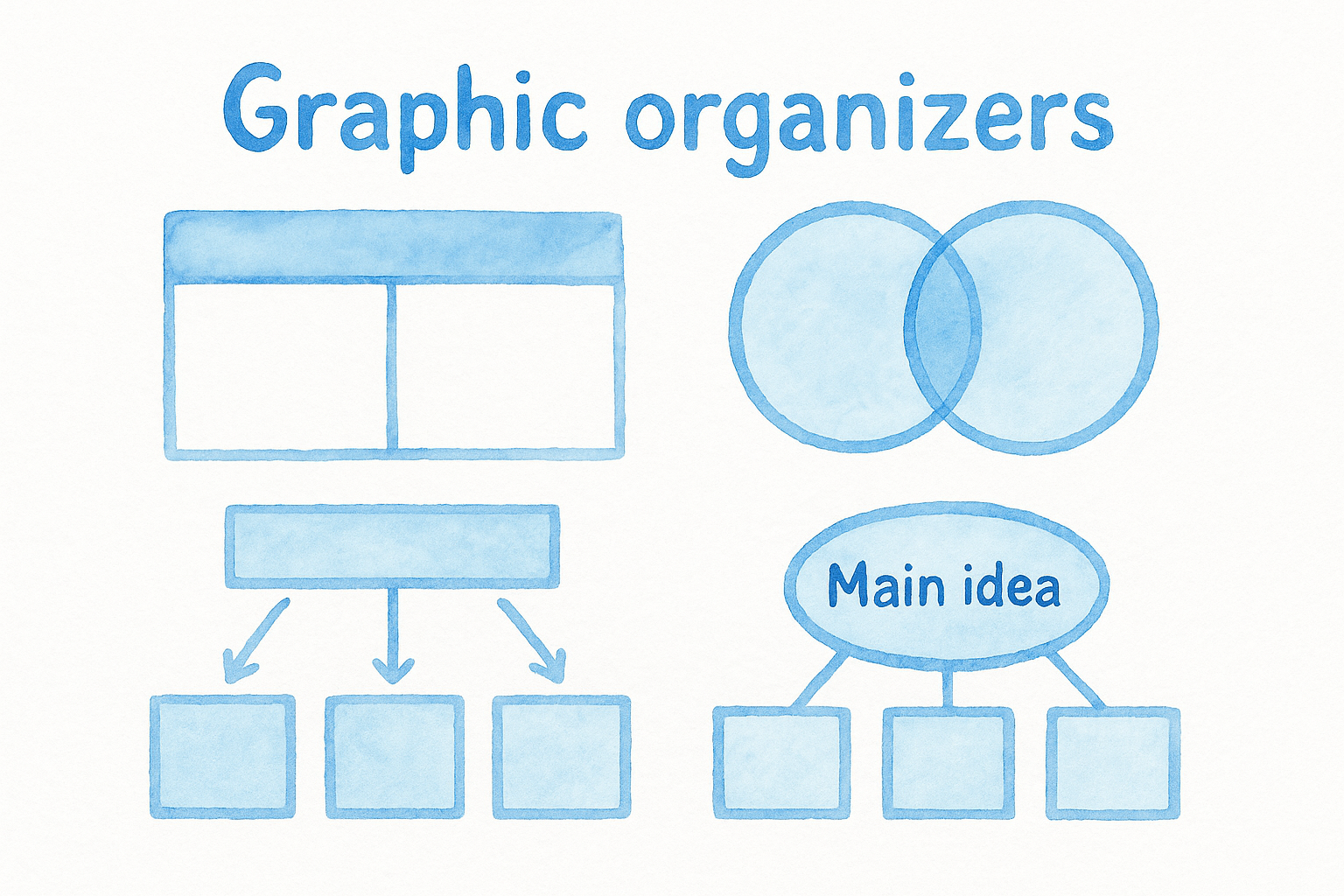
Keep a folder of four or five versatile organizer templates: a T-chart, a Venn diagram, a cause-and-effect map, a main idea web, and a sequencing chart. These printable classroom activities cover the majority of thinking tasks across subjects without requiring you to redesign anything from scratch.
A single two-column T-chart can handle compare-contrast, pro-con, claim-evidence, and problem-solution tasks depending on how you label the headers.
How it works in class
You hand out the organizer before students read, research, or listen to a lecture. Students fill it in as they go rather than trying to reconstruct their thinking afterward. This keeps them engaged during the activity and gives you something concrete to collect and review.
How to adapt for grades and subjects
For younger students, pre-fill some sections or reduce the number of boxes so the task feels manageable. Older students can work with more complex multi-level organizers that require synthesis across sources. Every subject fits: use a timeline in history, a labeled diagram in science, or a story map in ELA.
Time and materials
You need one printed sheet per student and a pencil. Students typically need five to fifteen minutes, depending on how much content they’re organizing.
6. Vocabulary practice menus
A vocabulary practice menu gives students a list of activity options at different complexity levels, and they choose how to demonstrate their understanding of new words. This format puts low-stakes choice in students’ hands, which increases buy-in compared to a single mandatory drill.
What to print
Print a one-page menu that lists eight to twelve short activities organized by difficulty, such as write a definition in your own words, draw a visual, use the word in a sentence, or compare two vocabulary terms. Leave response space below each option so students write directly on the sheet without needing a separate notebook.
A menu with tiered options naturally differentiates without sorting students into labeled groups.
How it works in class
You hand out the menu and set a point target, say ten points, where easier tasks are worth two points and harder ones are worth four. Students select their own path to reach the goal. These printable classroom activities run well as independent work, homework, or early-finisher tasks because students self-direct without needing constant redirecting.
How to adapt for grades and subjects
For younger students, cut the menu to six options and include a visual next to each prompt. Older students handle more abstract tasks like writing analogies or analyzing connotation. Swap vocabulary sets by subject: science uses content-specific terms, math uses operational vocabulary, and ELA uses literary terms or word roots.
Time and materials
You need one sheet per student and a pencil. Students typically finish in fifteen to twenty minutes, making this a solid single-period activity.
7. Reading response and discussion stems
Discussion stems give students sentence-level scaffolding to talk and write about texts without freezing up. A printed set of stems keeps the focus on the content of the conversation rather than the logistics of how to start a sentence.
What to print
Print a single reference card listing ten to fifteen stems organized by purpose: agreeing, disagreeing, adding on, citing evidence, and asking a clarifying question. You can also print a full response sheet that pairs a reading passage with three to four sentence starters students complete in writing. Both formats work as standalone printable classroom activities or as companions to a shared text.
Stems that ask students to connect evidence to a claim push thinking further than stems that only ask for opinions.
How it works in class
You hand out the stems before discussion begins so students read through their options and mentally prepare. During discussion, students reference the card when they get stuck rather than going silent or waiting for you to redirect. In writing tasks, the stems give lower-confidence students a way in without removing the cognitive work of forming a response.
How to adapt for grades and subjects
For younger students, limit the card to five simple starters and model each one before releasing them to work independently. Older students benefit from more nuanced academic language like "the author’s word choice suggests" or "a counterargument would be." Stems work in any subject where students discuss or analyze text, including history, science, and literature.
Time and materials
You need one card or sheet per student and a pencil. Students reference the card throughout a twenty to thirty-minute discussion or writing block.
8. Math problem-solving routines
Math problem-solving routines give students a structured format for working through problems step by step, which helps them slow down and show their thinking instead of just writing an answer. These sheets build mathematical habits of mind over time because students practice the same process repeatedly until it becomes automatic.
What to print
Print a four-step template that walks students through reading the problem, identifying what they know, selecting a strategy, and checking their answer. Add a scratch work section alongside each step so students have space to draw, estimate, or write equations without crowding their final response.
How it works in class
You hand out the sheet at the start of a problem-solving task and students work through each step in order. This format runs well as independent practice or a think-pair-share activity, where pairs compare their strategies before sharing with the class. Because the structure stays the same every time, students spend less energy wondering what to do and more time actually solving.
A consistent problem-solving format reduces math anxiety because students always know where to start.
How to adapt for grades and subjects
For younger students, reduce the steps to two or three and use simple visual prompts alongside each one. Older students can handle a more demanding version that asks them to justify their strategy choice in writing. These printable classroom activities also translate into statistics, algebra, and geometry with minimal adjustments to the template.
Time and materials
You need one sheet per student and a pencil. Students typically work through one problem set in fifteen to twenty minutes.
9. Science observation and claim sheets
Science observation and claim sheets give students a structured format for recording what they notice during an experiment or demonstration and then building a scientific argument from that evidence. Without a printed guide, many students skip directly to conclusions without documenting their observations carefully, which undermines the scientific thinking you’re trying to develop.
What to print
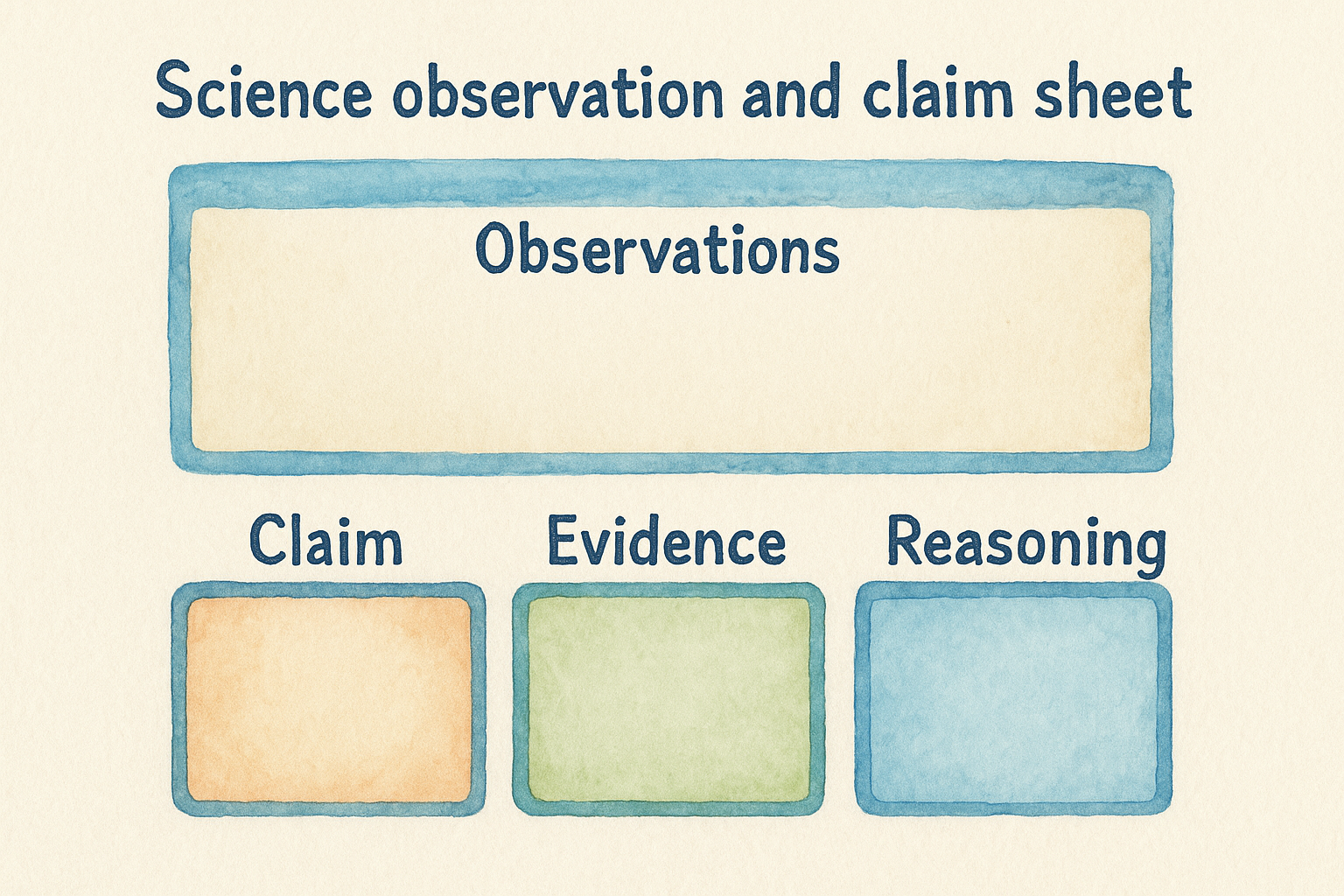
Print a sheet with two labeled sections: one for raw observations (what students see, measure, or record during the activity) and one for the claim-evidence-reasoning (CER) frame. A simple three-box layout handles most lab or demonstration scenarios without modification.
A CER frame trains students to separate observation from interpretation, which is one of the core skills in scientific reasoning.
How it works in class
You hand out the sheet before the activity begins so students record observations in real time rather than reconstructing them after the fact. Once the activity ends, students move to the claim section and use their notes to build an argument. These printable classroom activities pair naturally with labs, video clips, or teacher demonstrations of any length.
How to adapt for grades and subjects
For younger students, pre-label the observation boxes with specific prompts like "What do you see?" or "What do you measure?" Older students can work with open-ended observation sections that require them to decide what matters enough to record. The format also adapts to earth science, biology, chemistry, and physics without requiring you to redesign the template each time.
Time and materials
You need one sheet per student and a pencil. Students typically complete both sections in twenty to thirty minutes.
10. Social studies source analysis guides
Source analysis guides give students a structured framework for examining primary and secondary sources instead of just reading them passively. Without a printed guide, many students either summarize the surface content or skip straight to opinion, missing the historical thinking skills you’re trying to build.
What to print
Print a one-page guide with labeled sections for source type, author and context, main argument, evidence used, and a bias or perspective check. A simple five-row layout covers most document analysis tasks across history, civics, and geography units without requiring a redesign each time you assign a new source.
A source analysis guide that asks students to identify the author’s purpose before reading the argument trains them to approach all texts more critically.
How it works in class
You hand out the guide alongside the primary or secondary source and students complete each section in order. This sequence forces them to slow down and examine context before jumping to conclusions. These printable classroom activities work well as paired reading tasks, small group discussions, or individual formative assessments after a document-based lesson.
How to adapt for grades and subjects
For younger students, pre-fill the source type and author fields so they focus only on content and perspective. Older students handle fully open-ended versions that ask them to evaluate reliability and compare multiple sources. The format adapts across civics, world history, geography, and economics with minimal label changes.
Time and materials
You need one sheet per student and a pencil. Students typically finish in fifteen to twenty minutes.
11. SEL check-ins and reflection pages
SEL check-ins and reflection pages give students a structured, low-stakes way to process emotions, set goals, or reflect on their learning. These short printable classroom activities work equally well as morning openers, end-of-day closers, or quick breaks between demanding tasks.
What to print
Print a half-page check-in sheet that includes a simple feelings scale, one open-ended reflection prompt, and a brief goal or intention box. A half-page format means two sheets per page, which keeps paper use minimal and makes the activity feel approachable rather than overwhelming for students who find longer tasks stressful.
How it works in class
You hand out the sheet and give students three to five minutes of quiet time to complete it. Collect them for a quick read-through or let students keep them in a personal folder they build over the semester. Reading through a class set takes less than ten minutes and gives you an immediate sense of how your students are doing emotionally before you plan your next lesson.
A short weekly reflection gives quieter students a private channel to communicate things they would never raise their hand to say.
How to adapt for grades and subjects
For younger students, replace the written prompt with simple face icons or sentence starters like "Today I feel…" Older students respond well to more reflective prompts that ask them to connect their mindset to their performance or name one thing they want to improve the following day.
Time and materials
You need one half-sheet per student and a pencil. Students finish in three to five minutes.
Next steps
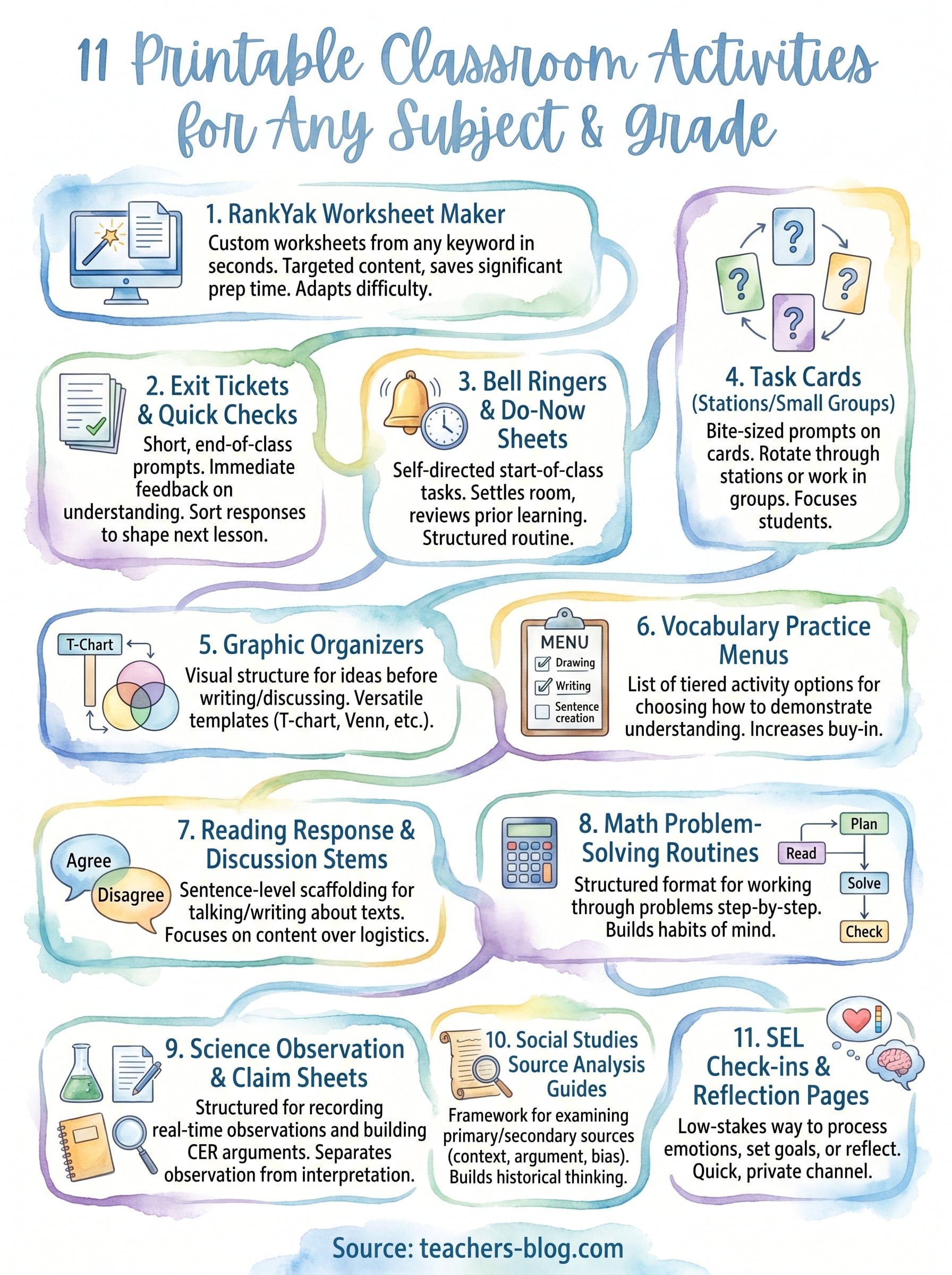
You now have eleven printable classroom activities that work across subjects and grade levels, from quick bell ringers to full source analysis guides. Each one gives your students a structured entry point into the thinking work you want them to do, and each one takes minutes to prepare rather than hours.
Start with one or two that fit your next unit. Pick the format that solves your most pressing problem right now: a bell ringer to settle your class, an exit ticket to check understanding, or a graphic organizer to support a complex reading. Small additions to your routine build up over time into a toolkit you rely on automatically.
When you need a worksheet that fits your exact topic instead of a generic template, the RankYak Worksheet Maker gets you there in under two minutes. Type in your topic, check the output, and hit print. It’s the fastest way to close the gap between what you teach and what you hand out.