
Creating Motivating Learning Environment: 9 Classroom Moves
You already know that creating a motivating learning environment doesn’t happen by accident. It’s built through deliberate choices, the way you arrange your room, respond to mistakes, frame challenges, and hand over ownership to students. Yet even experienced teachers hit stretches where engagement flatlines and the energy in the room just… stalls.
The good news: motivation isn’t a personality trait some students have and others don’t. Research in self-determination theory and educational psychology points to specific conditions, autonomy, competence, and relatedness, that teachers can actively build into their classrooms. When those conditions are present, students show up differently.
That’s exactly the kind of practical, evidence-informed work we focus on here at The Cautiously Optimistic Teacher. Below, you’ll find nine concrete classroom moves that can shift your learning environment from passive to purposeful, no gimmicks, no fluff, just strategies you can start using this week.
What makes a learning environment motivating
Most definitions of motivation in education trace back to self-determination theory (SDT), developed by psychologists Edward Deci and Richard Ryan. Their research identified three core psychological needs that, when met, produce genuine and lasting motivation: autonomy, competence, and relatedness. Understanding this framework changes how you design lessons, respond to students, and structure your day.
Why the physical space matters less than the culture
Physical setup gets a lot of attention, but the actual driver of student motivation is the psychological climate you build. Students need to feel that what they’re learning is relevant, that they can grow through effort, and that they belong in the room. Without those three conditions, even a carefully organized space produces passive compliance rather than genuine engagement. Creating a motivating learning environment starts with how students feel when they walk in, not what they see on the walls.
The research on SDT makes one thing clear: students who feel autonomous, competent, and connected to their peers and teacher are more likely to persist through difficulty and invest in their own learning.
The three conditions you can control
The practical value of SDT is that each need maps directly to specific, repeatable teacher behaviors. You don’t need to rebuild your classroom from scratch. You need to identify which condition is weakest for your students right now and make a targeted adjustment.
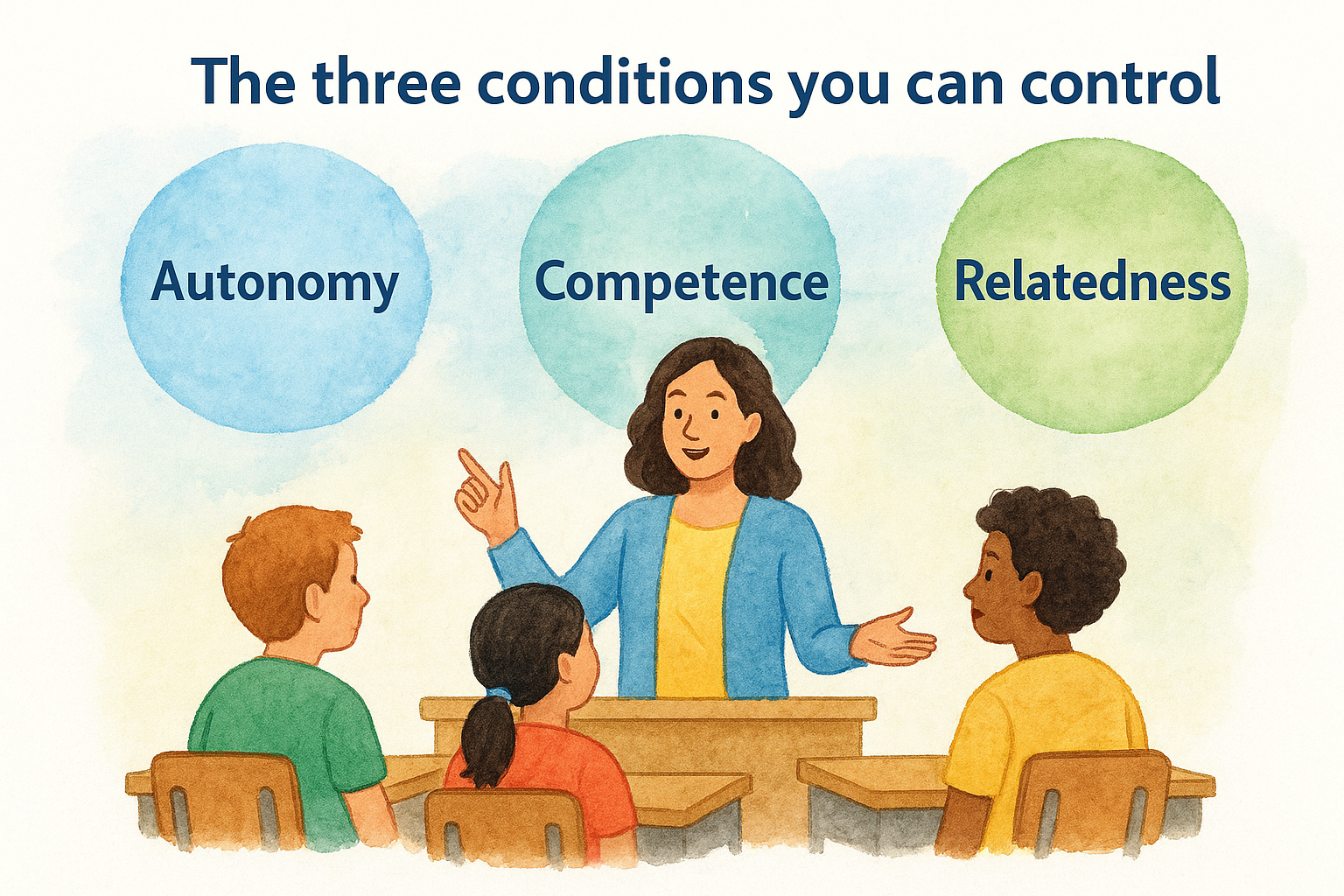
| SDT Need | What students need to feel | Classroom example |
|---|---|---|
| Autonomy | "I have some choice here" | Let students pick their essay topic or the order they complete tasks |
| Competence | "I can get better at this" | Break tasks into steps and celebrate incremental progress |
| Relatedness | "I belong and I’m seen" | Learn names fast, use them often, and respond to errors without shame |
Every one of the nine moves ahead targets at least one of these needs directly. When you understand which need a strategy addresses, you stop guessing and start making deliberate choices that actually shift the energy in your room.
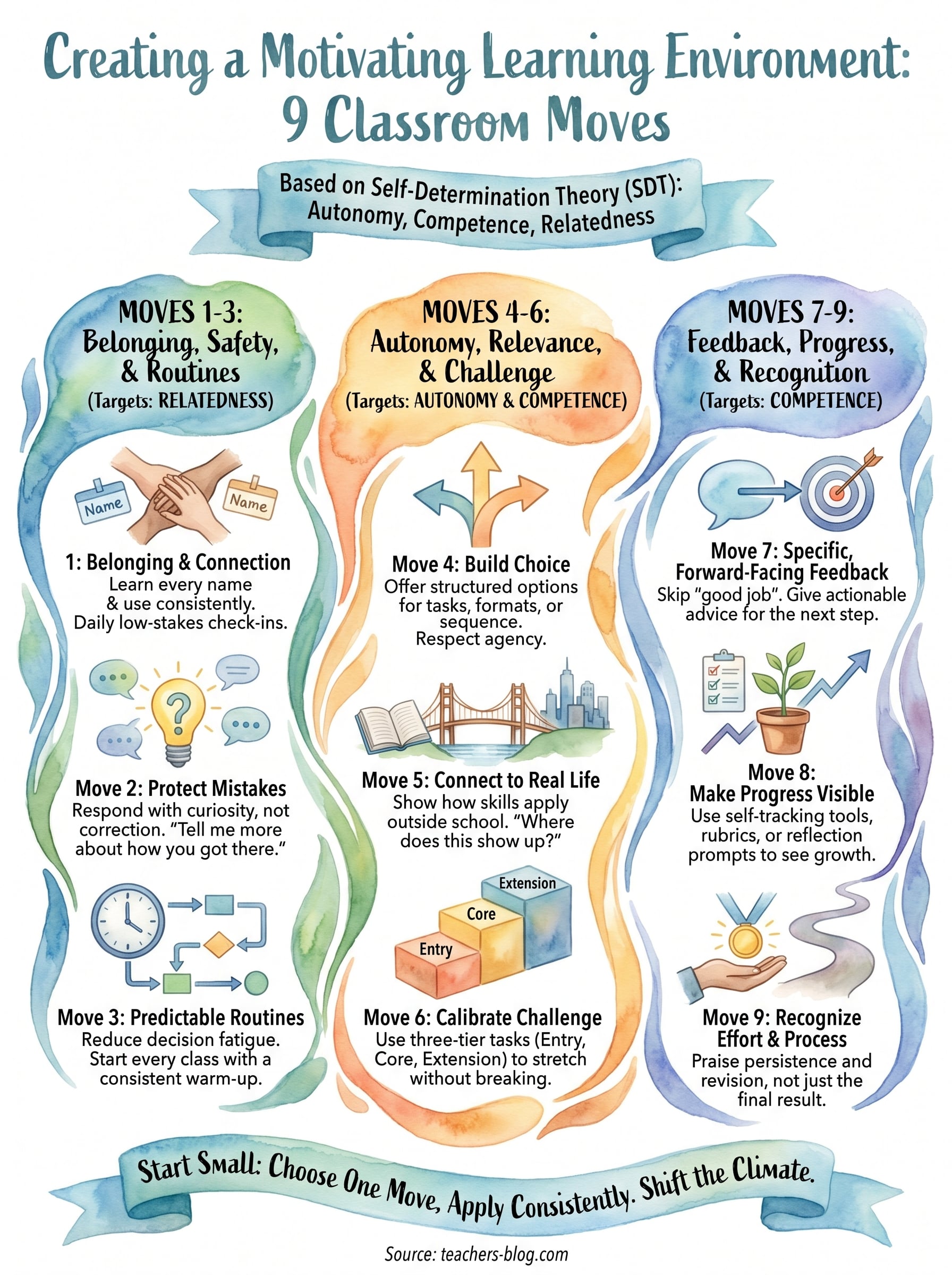
Move 1 to 3: Build belonging, safety, and routines
These first three moves target relatedness, the most foundational SDT need. Without belonging and safety, students spend cognitive energy managing social anxiety instead of focusing on learning. Routines support this by making the environment predictable and calm.
Moves 1-2: Belonging and safety
Move 1 is simple: learn every student’s name within the first week and use it consistently. Pair that with a low-stakes daily check-in, a thumbs-up/down at the door or a brief "how are you today?" at the start of class.
Move 2 is to protect mistakes. When a student gives a wrong answer, respond with curiosity instead of correction. Try saying: "Interesting, tell me more about how you got there." This small habit signals that your classroom is safe for thinking out loud, which sits at the heart of creating a motivating learning environment.
Students who feel psychologically safe take more academic risks, ask more questions, and recover faster from setbacks.
Move 3: Install predictable routines
Routines reduce decision fatigue for both you and your students. Start every class the same way: a warm-up prompt on the board, a two-minute silent read, or a quick review question. Students who know what to expect when they walk in settle faster and spend more time on actual learning.
Move 4 to 6: Give autonomy, relevance, and challenge
These three moves target the autonomy and competence needs from SDT. When students feel ownership over their work and understand why it matters, engagement shifts from compliance to genuine curiosity.
Moves 4-5: Autonomy and relevance
Move 4 is to build choice into your tasks. You don’t need to redesign every lesson, just offer structured options: students pick the format of their final product, the reading text from a short list, or the sequence they work through problems. Small choices signal respect for agency.
Relevance is equally powerful. Move 5 asks you to connect content to students’ real lives. Before introducing a new unit, explicitly answer: "Where does this skill show up outside school?" When students see that connection clearly, they invest more effort in developing it. This is one of the most direct moves in creating a motivating learning environment.
Students who perceive their work as relevant to their lives show significantly higher intrinsic motivation than those who don’t.
Move 6: Challenge that stretches without breaking
Move 6 is about calibrating difficulty. Tasks that are too easy produce boredom and tasks that are too hard produce shutdown. Use this three-tier structure to keep challenge productive:
| Tier | Task type | Purpose |
|---|---|---|
| Entry | All students can access this | Build confidence |
| Core | Grade-level expectation | Develop competence |
| Extension | Above grade level | Stretch and inspire |
Move 7 to 9: Use feedback, progress, and recognition
These final three moves directly target the competence need from SDT. When students see that their effort produces measurable growth and that you notice that growth, intrinsic motivation builds on itself. This is where creating a motivating learning environment shifts from a one-time setup into a daily practice.
Moves 7-8: Feedback and progress
Move 7 is to make feedback specific and forward-facing. Skip "good job" and try: "Your argument in paragraph two is clear. Add one piece of evidence in paragraph three to match that strength." Students act on targeted, actionable feedback far more than vague praise.

Move 8 is to make progress visible. Give students a simple self-tracking tool, a checklist, a skills rubric, or a short reflection prompt at the end of class. When students see concrete evidence of their own growth, their belief in their ability increases.
Students who track their own progress are more likely to attribute success to effort rather than fixed ability, which directly strengthens motivation.
Move 9: Recognition that sticks
Move 9 is to recognize effort publicly and specifically. Call out the process, not just the result. Try: "I noticed you revised your draft three times this week. That persistence is what builds real skill." Avoid hollow compliments and tie recognition to the work students actually did.
Keep motivation high for every learner
One challenge with the nine moves above is applying them consistently across a diverse classroom where students arrive with different histories, needs, and starting points. Creating a motivating learning environment that works for every learner requires you to treat motivation as an ongoing practice, not a fixed setup you launch in September and leave alone.
Adjust for students who opt out
Some students disengage not because they lack ability but because past experiences taught them that effort doesn’t pay off. For these students, prioritize Move 2 (protect mistakes) and Move 7 (specific feedback) before anything else. Trust builds slowly, and you rebuild it one low-stakes interaction at a time. Consistency matters more than any single grand gesture.
The students who appear least motivated are often the ones who tried hardest and got burned.
Build in regular check-ins
Motivation shifts across a school year, so you need a simple monitoring habit to stay ahead of it. Try a brief weekly exit slip with two questions: "What felt manageable this week?" and "What felt too hard?" Use student responses to recalibrate your challenge tiers from Move 6 and sharpen your feedback approach from Move 7. This keeps your classroom responsive rather than static, and it signals to students that their experience genuinely shapes what comes next.
Wrap up and choose your first move
Creating a motivating learning environment doesn’t require a complete overhaul of your practice. It requires picking one move and applying it with consistency until it becomes second nature. The nine strategies in this guide each target a specific psychological need, autonomy, competence, or relatedness, and they build on each other naturally over time.
Start small. Choose the move that addresses your biggest current challenge: if your students feel unsafe making mistakes, go with Move 2. If engagement flatlines mid-unit, try Move 5 to add relevance. If students don’t see their own growth, launch Move 8 this week. One targeted change, applied consistently, shifts the classroom climate more than ten half-hearted attempts spread across the year.
For more practical strategies, tools, and resources built specifically for educators like you, visit The Cautiously Optimistic Teacher and explore what’s there to support your classroom this week.