8 Ways To Boost Student Engagement In Elementary Classrooms
You’ve seen it happen, a lesson you spent hours planning lands with a thud. Half the class is staring out the window, two kids are poking each other, and the rest are giving you that polite-but-vacant smile. If you’re searching for ways to improve student engagement in elementary classrooms, you’re not alone. It’s one of the most common challenges teachers face, and it’s also one of the most solvable ones.
The trick isn’t about being louder or more entertaining. It’s about designing experiences that pull students in rather than pushing content at them. When kids feel curious, connected, and capable, they participate, not because they have to, but because they want to. Research backs this up: engagement rises when students have choice, collaboration, and clear purpose baked into their day.
That’s exactly the kind of practical, classroom-tested thinking we focus on here at The Cautiously Optimistic Teacher. We build resources and strategies that help educators work smarter, not just harder, from AI-powered lesson tools to ready-to-use activity frameworks. This article gives you eight specific strategies you can start using right away to get your elementary students more involved, more motivated, and more excited about learning.
1. Use an AI question generator for better prompts
The questions you ask in a lesson do more work than you might realize. Weak questions shut down thinking, while strong ones open it up. An AI question generator helps you build better, more targeted prompts in far less time than writing them from scratch.
What it looks like in an elementary classroom
You paste in a text excerpt, math concept, or science topic, and the tool produces a set of questions at different thinking levels. Instead of defaulting to "What happened in the story?" you get prompts like "Why do you think the character made that choice?" or "What would you do differently if you were there?"
Here are some examples of what generated questions can look like across subjects:
- Reading: "What clues in the text tell you how the character feels?"
- Math: "Why does that strategy work, and where might it break down?"
- Science: "What do you think would change if we removed one variable?"
Why it increases engagement
Kids disengage when questions feel too easy or too vague. Varied, well-crafted questions hit the sweet spot where students feel challenged but not lost. When a question is genuinely interesting, students want to answer it, and that pull is what drives real participation in any elementary classroom.
The quality of your question determines the quality of thinking your students do.
How to use it without adding prep time
You don’t need to build a new workflow. Paste your existing lesson material into the generator, choose how many questions you want, and copy the output into your slides or discussion guide. Our Question Generator tool at The Cautiously Optimistic Teacher was built for exactly this purpose so teachers get strong prompts without extra planning time.
Best times to use it during a lesson
Opening a lesson with an intriguing question hooks attention before you’ve even started teaching. Mid-lesson checks keep students thinking instead of drifting, and closing questions give students space to consolidate what they just learned. Rotating all three keeps your pacing tight and your students alert throughout the block.
Common mistakes to avoid
The biggest mistake teachers make is generating questions and only ever asking them to the whole group. Mix in written responses, partner talk, and quick hand signals to keep it varied. Also, avoid asking too many questions back to back, which overwhelms younger students and reduces the depth of thinking each question deserves.
2. Ask open-ended questions that feel safe to answer
Not every student stays quiet because they don’t know the answer. Many stay quiet because they’re afraid of saying the wrong thing. When you design questions that have no single correct answer, you lower that barrier and invite more students into the conversation without the threat of being wrong.
What it looks like in an elementary classroom
You’re reading a picture book aloud and you pause to ask, "What do you think will happen next, and why?" There’s no wrong answer. Every student has a valid response based on what they noticed. This kind of question signals that their thinking matters, not just their ability to recall a fact.
Why it increases engagement
Student engagement in elementary classrooms increases when students feel psychologically safe. Open-ended questions remove the fear of failure from participation. When kids know their answer won’t be dismissed, they take risks and think more deeply.
The moment a student feels safe to guess, they start actually thinking.
Question stems that work across subjects
These stems work across reading, math, and science without major adjustments:
- "What do you notice about…?"
- "Why do you think…?"
- "What would happen if…?"
- "How is this similar to…?"
How to use wait time and follow-ups
After asking a question, wait at least five seconds before calling on anyone. Research consistently shows that wait time increases the quality of student responses. Follow up with "Can you tell me more about that?" to push thinking further without adding pressure.
Common mistakes to avoid
One common error is accepting the first answer and moving on. Call on multiple students for the same question to show that different responses are all valid. Avoid immediately rephrasing the question after asking it, which teaches students to wait for an easier version rather than engage with the original.
3. Run turn-and-talk and think-pair-share
Turn-and-talk and think-pair-share are two of the most reliable structures for getting every student talking, not just the handful who always raise their hands. Both routines give students a low-risk space to process ideas before sharing with the whole group.
What it looks like in an elementary classroom
You pause mid-lesson and say, "Turn to your partner and share one thing you noticed." Students talk for 60 to 90 seconds, then you bring the group back together to hear a few responses. Think-pair-share adds a structured thinking step before the partner conversation, giving quieter students time to gather their thoughts first.
Why it increases engagement
Student engagement in elementary classrooms increases when students know a partner conversation is coming before they get called on. That expectation reduces anxiety and raises the quality of responses you hear during whole-group sharing.
When every student talks, every student thinks.
How to teach and practice the routine
Spend five minutes explicitly modeling what a good partner conversation looks, sounds, and feels like before using it academically. Practice with low-stakes content first, such as:
- Sharing a favorite book or game
- Describing what they had for breakfast
How to keep every student accountable
Assign consistent, pre-determined partners so students aren’t wasting time choosing. After partner talk, call on students randomly using sticks or cards rather than only choosing volunteers. This keeps every student preparing to share, not just the ones with their hands up.
Common mistakes to avoid
The most common problem is letting partner talk run too long. Keep it under 90 seconds to maintain energy and limit off-task chatter. Avoid always pairing strong speakers together, since mixed-ability pairs tend to push more students forward.
4. Use stations and movement to reset attention
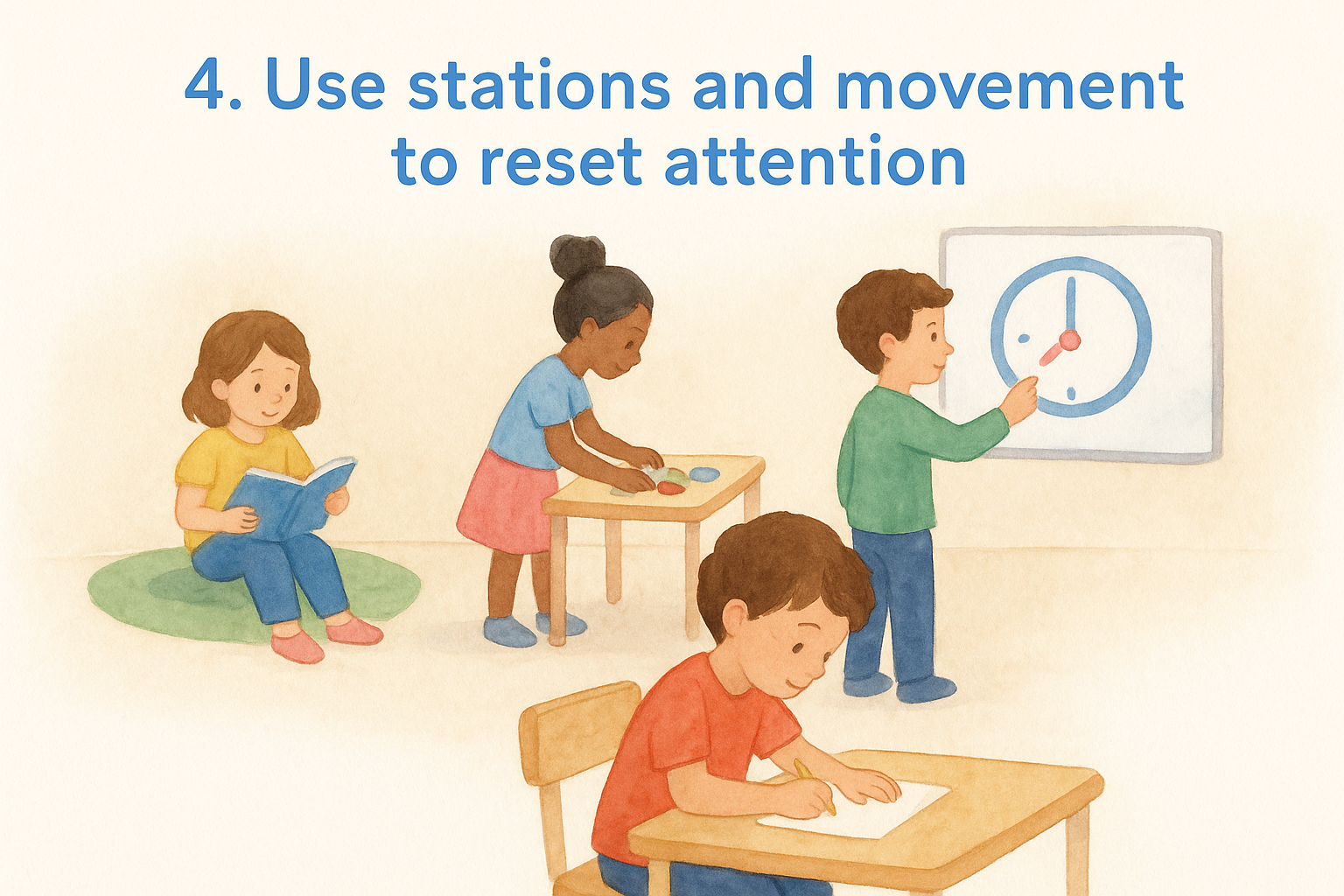
Young students can only sustain focused attention for so long before their brains need a reset. Stations and movement breaks give that reset while keeping learning on track, which is why they show up consistently in research on student engagement in elementary classrooms.
What it looks like in an elementary classroom
You set up three or four small activity spots around the room. Students rotate through each group in short cycles, spending 10 to 15 minutes at each station before moving on. Activities vary by spot: one might involve guided reading, another a hands-on task, and a third an independent written response.
Why it increases engagement
Movement increases blood flow and sharpens focus after long stretches of sitting. When students know a rotation is coming, they stay on task because the end of each station feels within reach.
Physical movement and cognitive engagement work together, not separately.
Simple station models that work in real rooms
You don’t need elaborate setups. Three stations cover most content goals without overwhelming you:
- Teacher-led station for direct instruction or guided practice
- Partner task for collaborative, discussion-based work
- Independent activity for writing or reading response
How to manage materials, noise, and pacing
Use a visible timer on the board so students self-manage transitions without waiting for your cue. Pre-bag any materials students need so setup takes under a minute. Set a clear noise level expectation for each station type before rotations begin.
Common mistakes to avoid
Avoid running too many stations at once. Three rotations is usually the ceiling before the logistics start to overwhelm both you and your students. Keep directions posted visibly at each station to cut down on interruptions during the rotation.
5. Give students meaningful choices in how they learn
When students have no say in what happens to them during a lesson, they disengage fast. Giving students a real choice in how they demonstrate their learning is one of the most direct ways to increase student engagement in elementary classrooms without redesigning your entire curriculum.
What it looks like in an elementary classroom
You finish teaching a concept and instead of assigning one task, you offer two or three options that all meet the same standard. One student draws and labels a diagram, another writes three sentences, and a third explains it to a partner. The content goal stays fixed; the path to get there varies.
Why it increases engagement
Choice signals to students that their preferences matter, which builds investment in the task. When kids pick an option, they take ownership of it rather than going through the motions.
Ownership is the fastest shortcut to effort.
Easy choice menus that still hit the standard
Keep your menus simple by offering options in these three categories:
- Write it: short response, labeled diagram, or list
- Say it: explain to a partner or record a voice memo
- Show it: sketch, build, or act it out
How to keep choice structured, not chaotic
Set a clear time limit before students choose, and post the options visibly so you’re not repeating directions. Limit choices to two or three at most so decision fatigue doesn’t slow everyone down.
Common mistakes to avoid
Avoid making one option significantly easier than the others. When kids catch on, they all pick the easy route and the learning gap widens.
6. Build peer teaching and collaboration into tasks
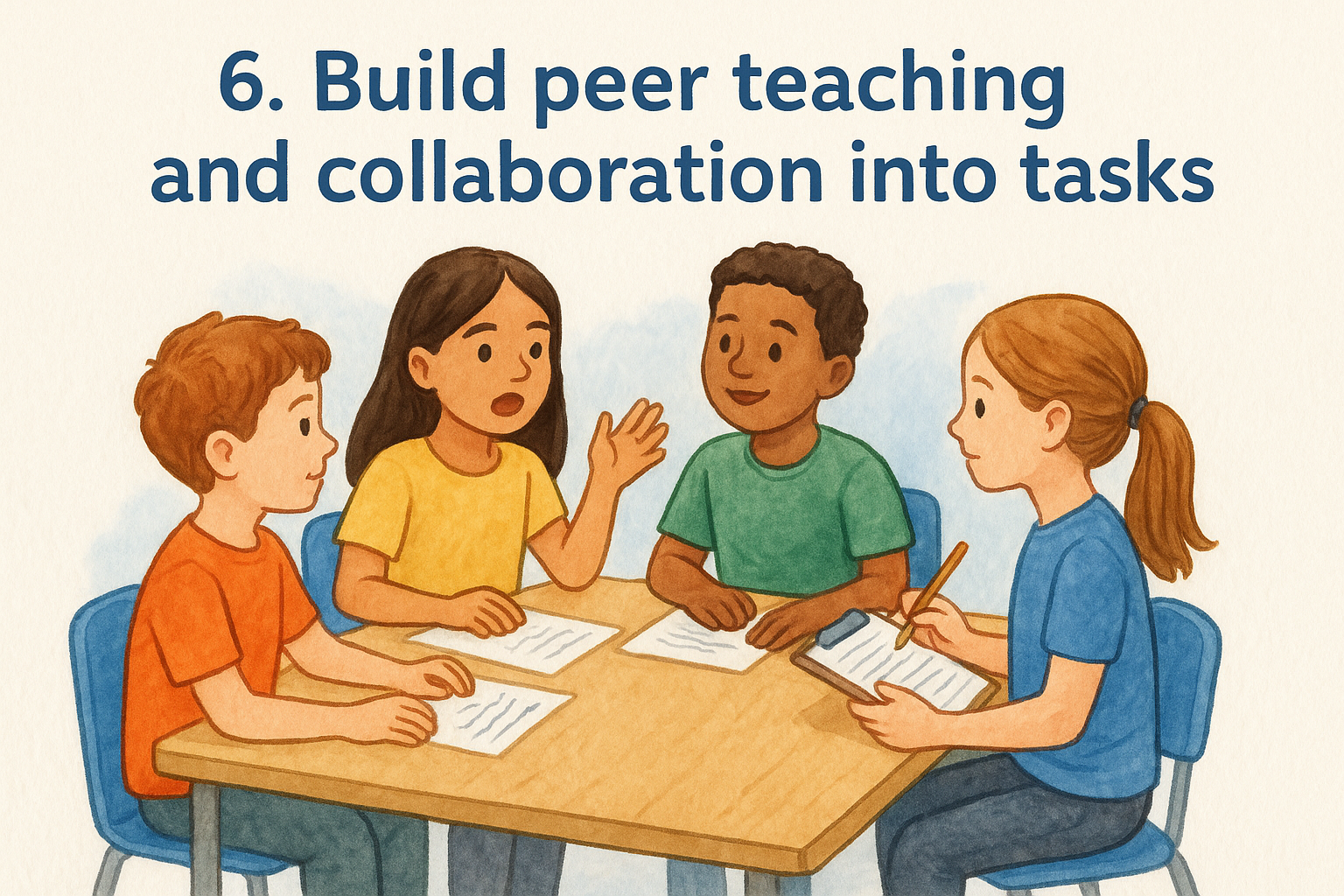
When students explain concepts to each other, they learn more deeply than when they just receive instruction. Peer teaching forces students to organize their thinking, and that process cements understanding in ways that passive listening rarely does.
What it looks like in an elementary classroom
You assign students specific roles within a small group: one person explains the concept, one asks questions, and one records the group’s thinking. Each student is responsible for a distinct job, so no one sits back while others do the work.
Why it increases engagement
Student engagement in elementary classrooms climbs when students feel accountable to a peer, not just a teacher. Kids pay closer attention and participate more consistently when a classmate is counting on their contribution.
Students who teach something remember it better than students who only hear it.
Roles and sentence stems that support teamwork
Give students printed role cards with sentence stems attached so they know what to say when they get stuck:
- Explainer: "The way I understand it is…"
- Questioner: "Can you tell me more about why…?"
- Recorder: "I’m writing down that we agree…"
How to set group norms and reteach them fast
Post three to four clear expectations for group work where every student can see them. When norms break down, stop the class, re-model the expectation in under two minutes, then restart the activity.
Common mistakes to avoid
Avoid letting groups self-select every time. Rotating group assignments prevents social clusters from forming and pushes every student to build collaboration skills with a wider range of peers.
7. Use quick reflection routines to build ownership
Students who regularly reflect on their learning start to see themselves as active participants in their own progress, not just recipients of instruction. Reflection routines turn the end of a lesson into a habit of self-awareness that compounds over time.
What it looks like in an elementary classroom
You stop the lesson two to three minutes early and ask students to respond to a single prompt on a sticky note, index card, or digital form. A simple question like "What’s one thing you understood today and one thing you’re still unsure about?" gives you instant data without taking up class time.
Why it increases engagement
When students know a reflection prompt is coming, they pay closer attention throughout the lesson because they know they’ll need to report back on their own thinking. This habit directly supports student engagement in elementary classrooms by making students feel responsible for their own learning.
Students who track their own learning take more ownership of it.
Exit tickets and self-checks you can grade fast
Keep your exit tickets to one or two questions max so you can scan them quickly. A simple 1-3 rating scale paired with one written sentence gives you both qualitative and quantitative data in under a minute per student.
How to use reflection data the next day
Sort exit tickets into three quick piles: got it, almost there, and needs reteaching. Use that information to open the next lesson with a targeted two-minute review that addresses the most common gaps before moving forward.
Common mistakes to avoid
Avoid making reflection feel like a graded test, which shifts the purpose from self-assessment to performance anxiety. Keep the tone low-stakes and use the data to inform your teaching, not to evaluate students.
Quick wrap-up
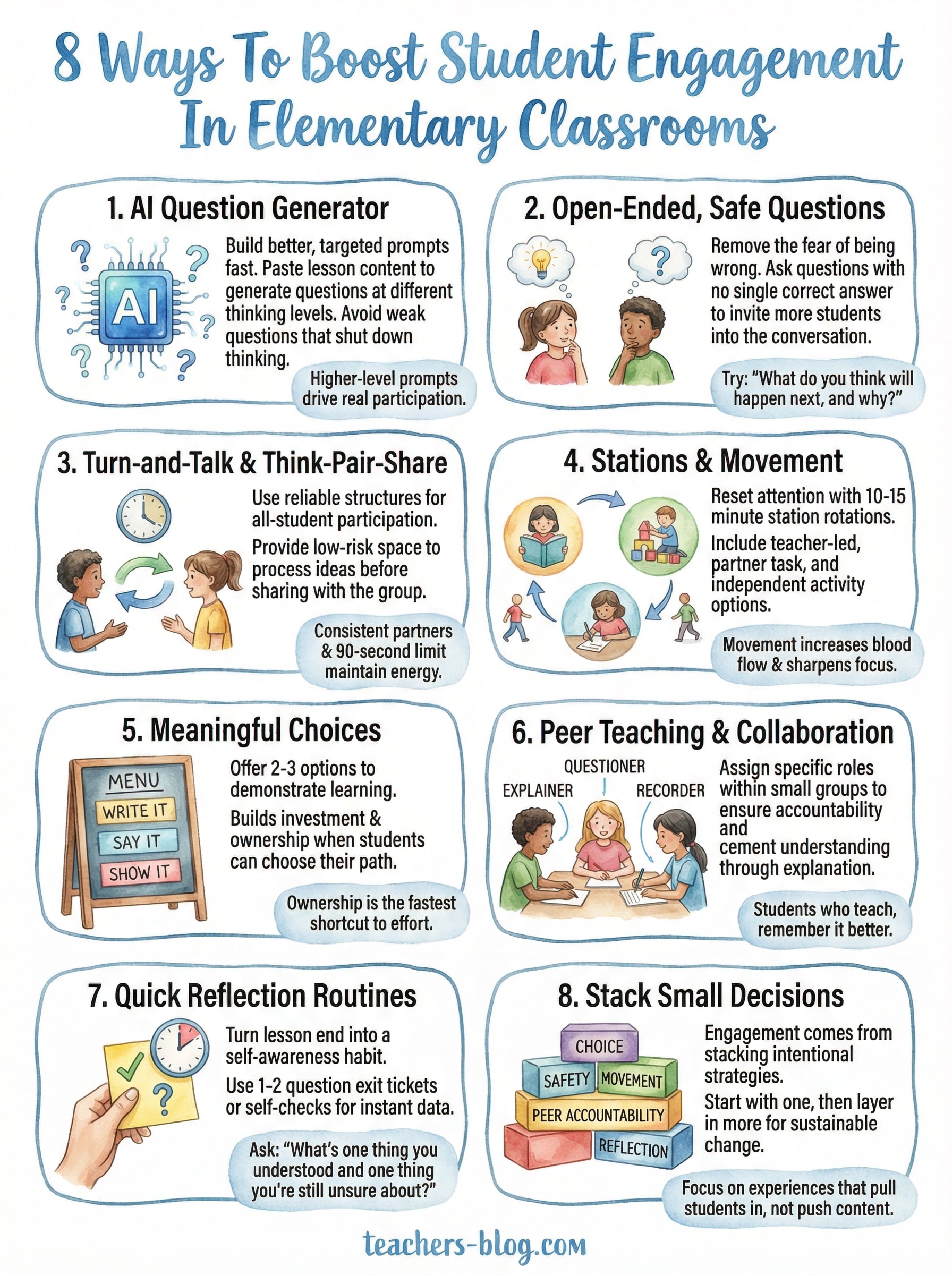
Student engagement in elementary classrooms doesn’t come from one big fix. It comes from stacking small, intentional decisions throughout your lesson: better questions, safer participation structures, movement, choice, peer accountability, and reflection. Each of the eight strategies in this article works on its own, but they compound quickly when you use more than one at a time.
You don’t need to overhaul your entire teaching practice this week. Pick one strategy from this list, try it for three or four days, and notice what shifts. Once it feels like second nature, layer in another. That’s how sustainable change actually happens in real classrooms with real kids.
If you want more practical tools and classroom strategies built for teachers like you, visit The Cautiously Optimistic Teacher. You’ll find AI-powered tools, ready-to-use resources, and no-fluff ideas designed to make your teaching stronger without burning you out.