Selecting Classroom Management Strategies That Actually Fit You
I’ve tried a lot of classroom management strategies over the years.
Some worked beautifully.
Some flopped immediately.
And a few made me feel like I was pretending to be someone else entirely.
That’s when I realized something important:
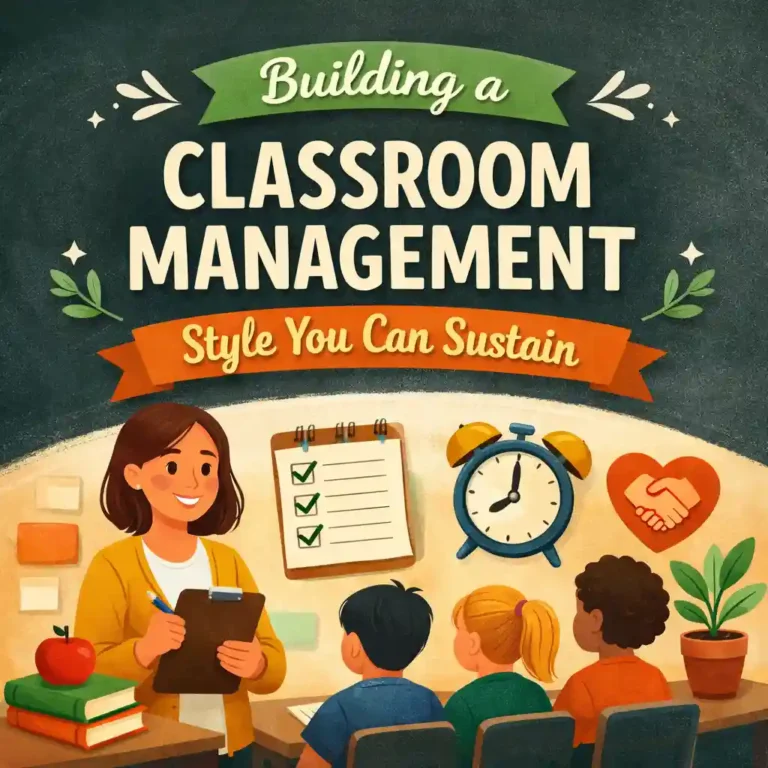
The best classroom management strategy isn’t the “best” one—it’s the one you can actually sustain.
Let’s talk about how to find that.
The Trap: Copying What Works for Someone Else
We’ve all done it.
You see a teacher down the hall who has:
Perfect routines
Silent transitions
Students who seem magically engaged
So you try exactly what they do.
And… it doesn’t work.
Not because the strategy is bad—but because:
👉 It doesn’t fit you.
Classroom management isn’t plug-and-play.
It’s relational, personal, and contextual.
Step 1: Start With Who You Are as a Teacher
Before choosing strategies, ask yourself:
Am I naturally calm and quiet, or energetic and expressive?
Do I prefer structure or flexibility?
Do I lean more relational or task-focused?
What feels authentic when I speak to students?
Because here’s the truth:
👉 Students can feel when you’re being inauthentic.
And inauthentic management breaks trust fast.
Example:
A quiet teacher forcing a loud, high-energy attention signal? Awkward.
A high-energy teacher trying to be ultra-minimal and rigid? Draining.
Instead:
👉 Lean into your strengths. Build from there.
Step 2: Identify Your Non-Negotiables
Every effective classroom has clear boundaries.
Ask yourself:
What behaviors truly disrupt learning?
What do I absolutely need to protect in my classroom?
Where am I willing to be flexible?
This helps you avoid:
❌ Over-managing everything
❌ Creating unnecessary rules
❌ Burning yourself out enforcing things that don’t matter
Instead, you get:
✅ Clear priorities
✅ Consistent responses
✅ Less emotional fatigue
Step 3: Choose Strategies That Match Your Energy
Some strategies require a lot of energy. Others don’t.
Be honest about what you can sustain every single day.
High-energy strategies:
Call-and-response attention signals
Gamified systems
Frequent movement-based resets
Low-energy strategies:
Visual cues and routines
Proximity and non-verbal redirection
Structured procedures
Neither is better.
👉 But one might be better for you.
Step 4: Match Strategies to Your Students (Not Just Yourself)
Here’s where it gets interesting.
It’s not just about you—it’s about the fit between you and your students.
Ask:
Do my students need more structure or more autonomy?
Are they highly social? Easily distracted? Anxious?
What helps this group feel safe and engaged?
A strategy that works in one class might fall apart in another.
👉 Good management is responsive, not rigid.
Step 5: Start Small (Don’t Overhaul Everything)
One of the biggest mistakes teachers make:
❌ Trying to implement 10 new strategies at once
Instead:
👉 Pick one or two moves and implement them well.
For example:
One clear entry routine
One attention signal
One way to respond to disruptions
Build slowly.
Consistency beats complexity every time.
Step 6: Test, Reflect, Adjust (Without Judgment)
This is where growth happens.
Try something → Reflect → Adjust.
Ask yourself:
Did this feel natural to me?
Did students respond positively?
Did it reduce friction—or create more?
And most importantly:
👉 Don’t label something as a failure—label it as data.
A Simple Strategy Filter (Use This Anytime)
Before adopting a new strategy, run it through this quick filter:
1. Does this feel like me?
2. Can I do this consistently?
3. Does this help my students succeed?
If the answer is yes to all three—you’ve got a keeper.
What This Looks Like in Practice
Two teachers. Same goal: quiet transitions.
Teacher A uses a countdown and energetic voice
Teacher B uses a silent hand signal and proximity
Both are effective.
Why?
👉 Because they fit the teacher.
Final Thought: Fit Over Perfection
You don’t need:
The trendiest system
The most complex plan
The strictest rules
You need:
👉 An approach that fits you, your students, and your reality
Because when your management style fits:
You’re more consistent
Students trust you more
The classroom feels calmer
And most importantly…
👉 You can actually sustain it.
Reflection Questions
Which strategies have I tried that didn’t feel like “me”? Why?
What type of classroom energy feels most natural for me?
What is one strategy I can implement consistently starting tomorrow?
Where can I simplify instead of adding more?