
100 Report Card Comments for Reading You Can Use Today
It’s 9 p.m., you’ve got 28 report cards left to finish, and your brain has officially stopped producing original sentences about reading comprehension. If that sounds familiar, you’re in the right place. This list of report card comments for reading gives you specific, classroom-ready language for every kind of reader you’re grading, from the kid who devours chapter books to the one still working on decoding basic text.
You won’t find vague filler here. Each comment below is written to sound like it came from a teacher who actually knows the student, not a template generator. We’ve organized them by skill level and reading behavior, so you can scan for fluency, comprehension, or vocabulary comments and grab what fits, then tweak the name and detail to match your student.
Scroll through and you’ll find comments for strong readers, struggling readers, and everyone in between, plus phrasing for growth over time and areas that still need work. Pair these with our AI-powered Report Card Commentor if you want to speed things up even further, or just copy what you need and get back to your evening.
Looking for more options? Browse our Report Card Comments hub for topic-specific examples, a writing formula, and links to additional comment banks.
Short Positive Reading Comments: Quick Examples
Need a short positive comment about reading? Start with one skill you have observed, and add a clear next step as needed. These examples cover early reading through secondary comprehension:
- “[Student] reads familiar texts with growing accuracy and confidence.”
- “[Student] uses context clues and word parts to work through unfamiliar vocabulary.”
- “[Student] identifies important information and summarizes the main ideas accurately.”
- “[Student] makes thoughtful connections between a text and previous learning.”
- “[Student] supports interpretations of literature with increasingly precise evidence.”
- “[Student] is developing fluency and benefits from regular opportunities to read aloud or reread meaningful passages.”
Choose the statement that reflects what the student can currently demonstrate. For more detail, see the comprehension, fluency, phonics, vocabulary, and independent-reading categories below. You can also compare our general comments for teachers.
1. Generate reading comments instantly with an AI tool
Sometimes the fastest fix isn’t a longer list of pre-written phrases, it’s one of the free online comment generator tools that writes the phrase for you. Our Report Card Commentor takes a few details about a student (their name, reading level, a strength, and a struggle) and produces a polished, personalized comment in seconds. It’s built specifically for teachers drowning in report card season, so the tone matches what administrators and parents actually expect to see, not generic filler pulled from a random phrase bank.
Using it is straightforward. You type in what you know about the student’s reading progress, whether that’s strong inference skills or trouble with multisyllabic words, and the tool generates a few options you can pick from and edit. It works for any grade band, from kindergarten decoding to high school analytical reading, and it saves the most time when you’re staring at comment number 25 with nothing left in the tank.
The right AI tool doesn’t replace your judgment about a student, it just gets you to the first draft faster.
Access is free with a newsletter signup, which also gets you weekly updates on new classroom resources. It suits teachers who want speed without sacrificing quality, especially anyone writing dozens of comments across multiple class periods.
Positive comments
When you feed the tool positive details, like strong reading fluency or a habit of finishing chapter books ahead of schedule, it returns comments that sound specific rather than generic. Here’s an example of what it might generate for a strong reader:
- "Maria reads with impressive fluency and consistently identifies the main idea in complex passages. She’s ready for more challenging texts next quarter."
- "James shows real enthusiasm for independent reading and often recommends books to classmates. His comprehension of theme and character motivation is well above grade level."
These aren’t meant to be copied word for word forever. Feed the tool a slightly different detail, like a specific book title or a reading strategy the student used well, and you’ll get a comment that reads as genuinely observed rather than templated.
Needs improvement comments
Growth-focused comments are trickier to phrase without sounding discouraging, and this is where the tool earns its keep. Tell it the student struggles with decoding multisyllabic words or loses focus during silent reading, and it drafts language that names the issue honestly while pointing toward next steps:
- "Ethan is building his decoding skills and benefits from extra practice with multisyllabic words. Continued repetition at home will support steady progress."
- "Priya’s reading comprehension improves when she slows down and rereads difficult passages. We’re working on this strategy together in class."
Running a few of these through the tool before your grading session gives you a bank of starting points, so you spend your evening editing details instead of inventing sentences from scratch, and there are plenty of other ways to save hours writing report card comments with AI.
2. Reading comprehension comments
Comprehension is the skill parents actually care about most, since it answers the question every parent asks: does my kid understand what they’re reading? If you want a refresher on what reading comprehension actually involves, it helps to name the sub-skills before you grade them. These report card comments for reading comprehension work best when you name a specific skill, like making inferences, identifying theme, or summarizing plot, rather than just writing "reads well." A comment that says a student can explain a character’s motivation tells a parent far more than a generic pat on the back.
Positive comments
Strong comprehension shows up in class discussion long before it shows up on a test, so pull from what you’ve actually observed when writing these.
- "[Name] demonstrates strong comprehension skills and can accurately summarize the main ideas of a text."
- "[Name] makes thoughtful inferences about characters’ feelings and motivations, often supporting ideas with evidence from the text."
- "[Name] connects what we read to prior knowledge and personal experience, which deepens class discussions."
- "[Name] identifies theme and central message with ease, even in more complex texts."
- "[Name] asks insightful questions during reading that show genuine engagement with the material."
A comprehension comment lands best when it names the specific skill, not just the grade.
Needs improvement comments
Gaps in reading comprehension often hide behind decent decoding, so a student can sound fluent while missing the point entirely, which is why teaching comprehension with proven strategies matters as much as tracking accuracy. Naming the specific breakdown, whether it’s literal recall, inference, or sequencing, gives parents something concrete to work on at home instead of just "needs to read more," and pairing it with ways to help students monitor their own reading gives the student a fix to practice.
- "[Name] is working on identifying the main idea independently and benefits from guided questions during reading."
- "[Name] can recall details but struggles to explain how events connect to one another."
- "[Name] would benefit from pausing to check understanding rather than reading straight through without stopping."
- "[Name] is developing the ability to make inferences and needs continued practice using text evidence to support ideas."
- "[Name] understands surface-level content but needs support analyzing deeper meaning and author’s purpose."
3. Reading fluency comments
Fluency is the skill that trips up otherwise strong readers, since a student can decode every word correctly and still read in a choppy, word-by-word way that drains meaning from the page. Reading fluency comments should reference pace, accuracy, and expression separately, because a student might nail two of the three and struggle with the third. Watch for kids who read fast but flat, or slow but accurate, since those are two different problems with two different fixes.
Positive comments
Fluent readers often read aloud with natural phrasing, and that’s worth calling out specifically rather than just saying "reads well."
- "[Name] reads aloud with strong expression and appropriate pacing, making the text easy to follow and engaging to listen to."
- "[Name] recognizes sight words automatically, which allows for smooth, confident oral reading."
- "[Name] adjusts reading pace naturally based on punctuation and sentence structure."
- "[Name] reads with accuracy and rarely needs to self-correct, showing strong word recognition skills."
- "[Name] has made noticeable gains in reading fluency this quarter and now reads grade-level texts smoothly."
Fluency isn’t speed alone, it’s the balance of pace, accuracy, and expression working together.
Needs improvement comments
Slow, halting reading usually points to a decoding gap, while fast, monotone reading often signals a student who’s rushing without processing meaning. Naming which pattern you’re seeing helps parents understand what to actually practice at home.
- "[Name] is working on reading at a steady pace and benefits from practicing familiar texts to build confidence."
- "[Name] would benefit from slowing down to reduce word substitutions and improve accuracy."
- "[Name] reads accurately but in a monotone style; practicing expression during read-alouds would help."
- "[Name] often loses their place during oral reading and benefits from using a finger or bookmark to track text."
- "[Name] is developing automaticity with high-frequency words, which will support smoother reading overall."
Giving specific, repeated practice with a passage the student has already read once tends to build both speed and confidence faster than assigning fresh, unfamiliar text every night, especially when it’s part of a wider plan for improving literacy through tailored instruction.
4. Vocabulary and word knowledge comments
Vocabulary size predicts reading success more reliably than almost any other single factor, so it’s worth calling out specifically rather than folding it into a general comprehension comment. Word knowledge comments should note whether a student uses context clues, applies new words in writing, or just recognizes them on a list. A student who can define a word but never uses it in a sentence is at a different stage than one who drops new vocabulary into class discussion unprompted.
Positive comments
Strong vocabulary usage often shows up outside of vocabulary quizzes entirely, in writing samples and class discussion, so pull examples from there when you can.
- "[Name] has a strong vocabulary for their grade level and uses context clues effectively to determine word meanings."
- "[Name] incorporates newly learned vocabulary into writing and discussion, showing genuine understanding rather than memorization."
- "[Name] asks about unfamiliar words and works to figure out their meaning independently."
- "[Name] recognizes multiple meanings of words and adjusts understanding based on context."
- "[Name] has expanded their vocabulary noticeably this quarter and applies new words confidently in class."
A vocabulary comment matters most when it shows the word being used, not just recognized.
Needs improvement comments
Weak vocabulary skills often masquerade as comprehension problems, since a student who doesn’t know a key word will misread an entire passage around it. Naming vocabulary specifically, rather than lumping it into general reading, gives parents a clearer target for practice, and classroom routines like the four steps of reciprocal teaching make word learning visible during discussion.
- "[Name] is building vocabulary and benefits from discussing unfamiliar words before reading a new text."
- "[Name] can define words in isolation but needs practice applying them in context."
- "[Name] would benefit from using context clues rather than skipping over unfamiliar words."
- "[Name] is developing academic vocabulary and needs continued exposure to grade-level terms."
- "[Name] struggles to retain new vocabulary from week to week and would benefit from more frequent review."
5. Phonics and decoding comments for early readers
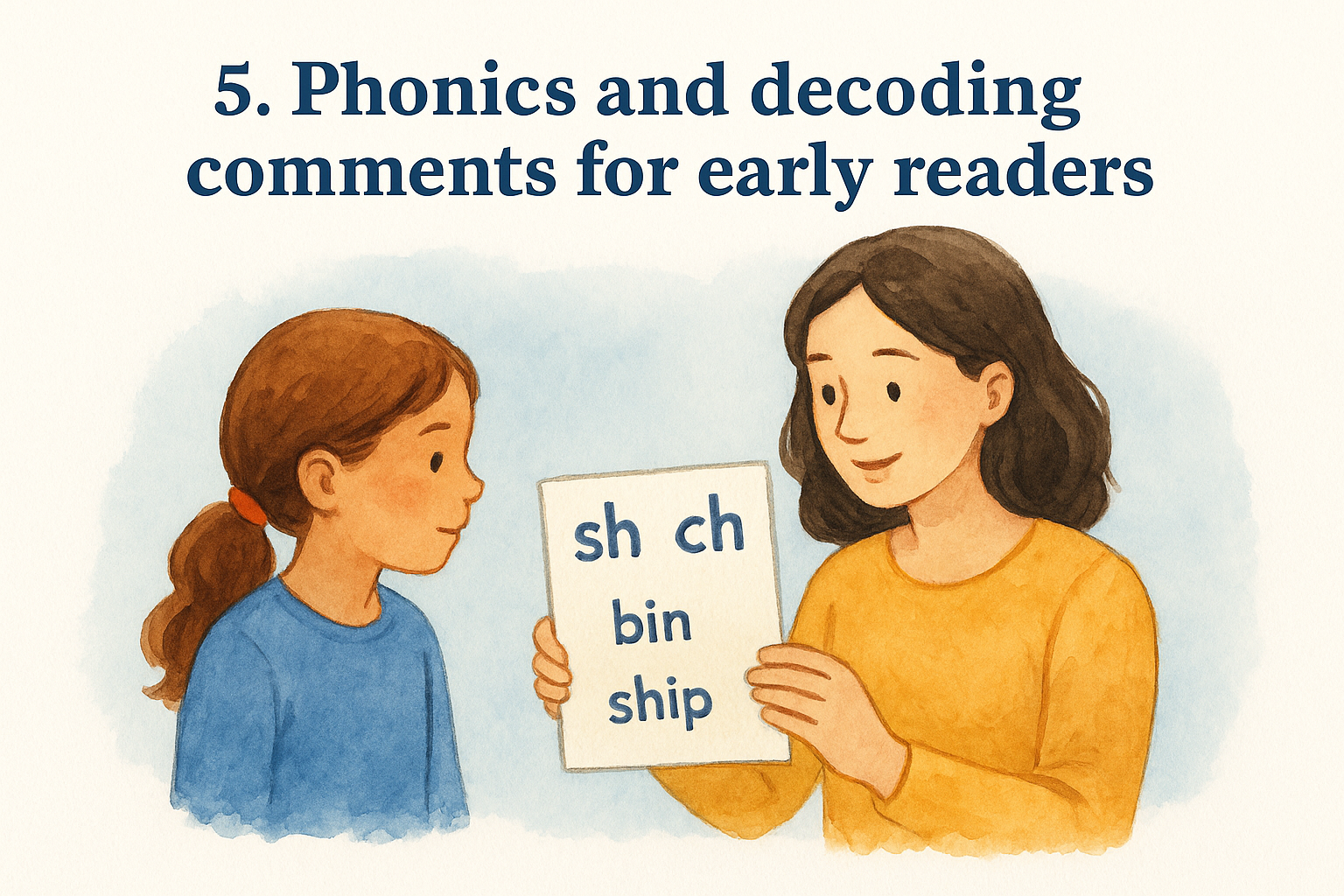
Phonics is the foundation everything else sits on, so kindergarten and first-grade report cards need language that’s specific about letter sounds, blending, and sight word recognition rather than vague statements about "reading readiness." Phonics and decoding comments should tell parents exactly which skill their child has mastered, whether that’s blending consonant-vowel-consonant words or recognizing digraphs like "sh" and "ch," since early reading skills build directly on top of each other. A gap in decoding at this stage tends to snowball into comprehension struggles later, so naming it early and specifically matters more here than in almost any other grade band, which is exactly what diagnostic assessment is designed to surface.
Positive comments
Early readers show growth in small, concrete steps, so these comments work best when they point to an actual skill the student can now do independently.
- "[Name] blends letter sounds smoothly to decode unfamiliar words and shows strong phonemic awareness."
- "[Name] recognizes common digraphs and blends, which supports increasingly independent reading."
- "[Name] has mastered grade-level sight words and reads them automatically without sounding out."
- "[Name] applies phonics rules confidently when reading new words, showing solid decoding skills."
- "[Name] has made excellent progress moving from letter sounds to full word recognition this quarter."
A phonics comment should name the exact skill mastered, since that’s what tells parents what to celebrate.
Needs improvement comments
Decoding gaps at this age respond well to short, targeted practice, so comments should point toward a specific next step rather than a general "needs more reading time."
- "[Name] is working on blending sounds smoothly and benefits from short, daily practice with simple words."
- "[Name] confuses similar letter sounds and would benefit from continued phonics review at home."
- "[Name] is building sight word recognition and needs repeated exposure to high-frequency words."
- "[Name] relies on picture cues rather than sounding out words and needs practice with decoding strategies."
- "[Name] is developing letter-sound correspondence and benefits from consistent phonics practice each week."
Keep home practice short and frequent rather than long and occasional, since five minutes daily builds decoding skills faster than one long session on Sunday night.
6. Reading engagement and motivation comments
Motivation is the quiet variable behind almost every other reading skill on this list, and why motivation drives learning explains it well: a student who wants to read will practice fluency and vocabulary without anyone assigning it. Reading engagement comments should describe what motivation actually looks like in your classroom, whether that’s choosing books during free time, talking about a plot with classmates, or groaning through required silent reading. Parents respond better to specific behavior than to a vague label like "loves reading," so name the moment you noticed it.
Positive comments
Engaged readers tend to show it in small, visible ways, like picking up a book unprompted or asking for a sequel, so pull from those specific moments.
- "[Name] shows genuine enthusiasm for reading and often chooses books above their comfort level just to explore new topics."
- "[Name] talks eagerly about books during class discussions and has encouraged classmates to read favorite titles."
- "[Name] approaches reading time with focus and curiosity, rarely needing redirection to stay on task."
- "[Name] has developed a genuine love of reading this year and consistently seeks out new books independently."
- "[Name] engages thoughtfully with class read-alouds and asks questions that show real investment in the story."
Motivation shows up in behavior long before it shows up on a test score.
Needs improvement comments
Low motivation rarely means a student can’t read; it usually means reading feels like a chore rather than a choice, so comments should point toward proven ways to motivate students rather than just naming the disengagement.
- "[Name] would benefit from more choice in reading material to build genuine interest and motivation."
- "[Name] often rushes through assigned reading without engaging with the content and needs encouragement to slow down."
- "[Name] shows reluctance during independent reading time and would benefit from books matched to personal interests."
- "[Name] participates in reading activities when prompted but rarely chooses to read for enjoyment."
- "[Name] is developing confidence as a reader, which should help build motivation over the coming quarter."
7. Independent reading habits comments
Independent reading habits reveal whether a student can sustain focus and choose material without constant prompting, which matters just as much as any skill measured on a quiz. Independent reading comments should describe what happens during silent reading time or at-home reading logs, since that’s the setting where habits actually show up, and twenty minutes of daily reading is enough to move the needle. Look at whether a student sticks with one book to completion, switches genres, or abandons anything past chapter three, because each pattern points to a different conversation with parents.
Positive comments
Strong independent readers usually show consistency over weeks, not just a single good day, so pull from patterns you’ve tracked across the quarter.
- "[Name] reads independently for sustained periods and consistently finishes books they start."
- "[Name] selects appropriately challenging books and doesn’t shy away from longer texts."
- "[Name] maintains a steady independent reading log and reflects thoughtfully in reading journal entries."
- "[Name] explores a range of genres independently, showing growing confidence as a reader."
- "[Name] uses independent reading time productively and rarely needs redirection."
Independent reading habits show up in what a student does when nobody’s checking, and that’s exactly why they matter.
Needs improvement comments
Inconsistent independent reading habits often trace back to book selection rather than ability, since a student stuck with the wrong book will stall out no matter how strong their skills are. Naming that specifically gives parents something practical to fix at home.
- "[Name] would benefit from support choosing books at an appropriate reading level to sustain independent reading."
- "[Name] frequently abandons books partway through and needs encouragement to finish what they start."
- "[Name] struggles to stay focused during independent reading time and benefits from a quieter reading environment."
- "[Name] rarely completes independent reading logs and would benefit from a consistent home reading routine."
- "[Name] is developing independent reading stamina and benefits from shorter, more frequent reading sessions."
8. Comments for struggling readers
Struggling readers need report card language that acknowledges effort without sugarcoating the gap, and these 120 comment examples for students who are behind show how to name it honestly for parents who already know something is off. Comments for struggling readers work best when they pair a specific difficulty with a specific support, whether that’s a pull-out intervention group, extra decoding practice, or a modified reading level. Vague encouragement like "keep trying" tells a worried parent nothing useful, while a comment naming the exact skill gap and the plan for it builds real trust.
Positive comments
Even a student who’s behind grade level usually has something worth celebrating, and pairing that praise with evidence-based support for struggling learners matters more here than almost anywhere else on this list.
- "[Name] has shown real determination this quarter and is beginning to apply new decoding strategies with more confidence."
- "[Name] works hard during small group reading instruction and is starting to see the payoff in daily practice."
- "[Name] has grown more comfortable asking for help when a text feels difficult, which is a big step forward."
- "[Name] shows steady, if gradual, progress in reading fluency and should keep building on this momentum."
- "[Name] has made meaningful gains in sight word recognition since the start of the year."
A struggling reader needs proof that effort is being noticed, not just proof that the gap exists.
Needs improvement comments
Honesty about the gap, paired with a concrete next step from your plan for reading instruction at mixed levels, gives parents something they can actually act on at home instead of general worry.
- "[Name] continues to work below grade level in reading and would benefit from consistent practice with an intervention specialist."
- "[Name] struggles with both decoding and comprehension and needs a structured, multi-sensory approach to make progress."
- "[Name] reads well below grade level and would benefit from books matched closely to current ability."
- "[Name] needs continued small group support to build foundational reading skills."
- "[Name] is working through a reading intervention plan, and consistency at home will support progress made in class."
9. Comments for advanced readers
Advanced readers create a different kind of report card challenge, since "doing great" isn’t specific enough for a student who’s already reading two grade levels ahead. Comments for advanced readers should push past praise and name what’s next, whether that’s more complex texts, independent research, or leadership in group discussion, all of which come out of strategies that differentiate upward. Parents of gifted readers often want to know their child is being challenged, not just praised, so these comments should point toward growth even when the student is already excelling.
Positive comments
Going beyond "reads above grade level" means naming the specific skill that sets a student apart, like analytical thinking or a willingness to tackle dense material.
- "[Name] reads well above grade level and consistently seeks out challenging texts independently."
- "[Name] analyzes texts with depth and nuance, often noticing symbolism and literary techniques classmates overlook."
- "[Name] leads thoughtful discussions during literature circles and helps peers think more critically about the text."
- "[Name] tackles complex, multi-layered novels with confidence and articulates sophisticated interpretations."
- "[Name] would benefit from opportunities to mentor peers or explore independent reading projects that match their advanced ability."
An advanced reader needs a plan for what’s next, not just confirmation of what they’ve already mastered.
Needs improvement comments
Here, "needs improvement" rarely means a skill gap; it usually means the student is coasting or under-challenged, and comments should reflect that honestly.
- "[Name] completes assigned reading quickly and would benefit from more challenging texts to sustain engagement."
- "[Name] tends to rush through independent reading and would benefit from slowing down to explore deeper analysis."
- "[Name] has strong comprehension but hesitates to share advanced ideas during class discussion."
- "[Name] would benefit from setting more ambitious personal reading goals given their current ability level."
- "[Name] reads at an advanced level but needs encouragement to explore genres outside their comfort zone."
10. Grade-specific reading comments for every level
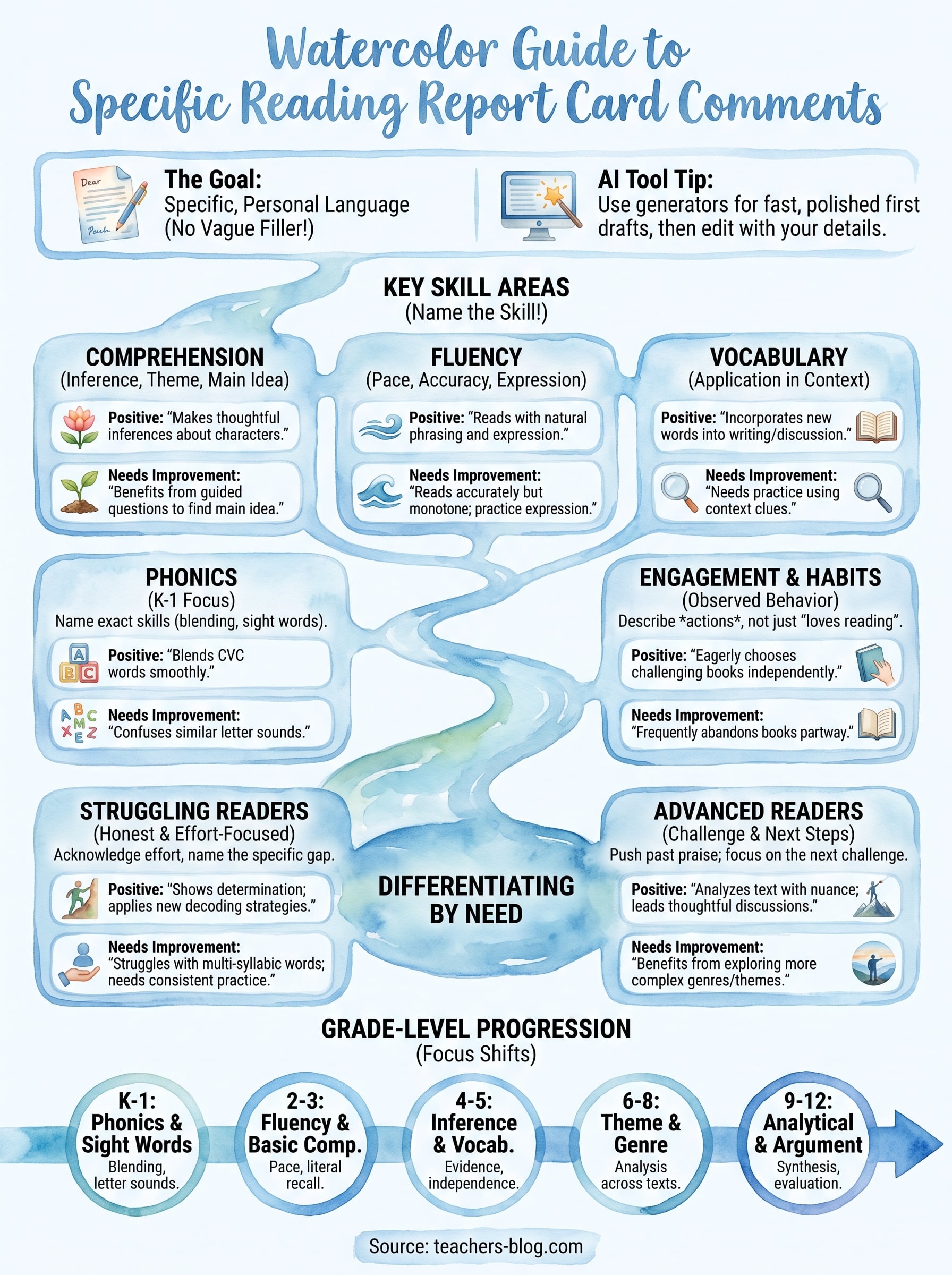
A kindergarten reader and a tenth grader are both "reading," but the skills you’re grading look nothing alike, so a comment bank only works if it flexes with grade level. Grade-specific reading comments should reflect what’s actually being taught at that stage, whether that’s letter recognition in kindergarten or analyzing an author’s argument in high school. Use the table below as a quick reference for which skills matter most at each level, then pull language from the lists throughout this article that matches, or grab reading comprehension worksheets sorted by grade to practice the skill you just graded.
| Grade Band | Core Reading Focus | Sample Comment Angle |
|---|---|---|
| K-1 | Letter sounds, blending, sight words | "[Name] blends CVC words with growing accuracy." |
| 2-3 | Fluency, basic comprehension | "[Name] reads grade-level texts smoothly and answers literal questions with confidence." |
| 4-5 | Inference, vocabulary, independent reading | "[Name] draws inferences from text evidence and reads independently for sustained periods." |
| 6-8 | Theme, character analysis, genre range | "[Name] identifies theme across genres and supports ideas with textual evidence." |
| 9-12 | Analytical reading, argument, synthesis | "[Name] evaluates an author’s argument and synthesizes ideas across multiple texts." |
Grade level should shape the vocabulary of your comment, not just the compliment underneath it.
Positive comments
Older students respond to comments that name analytical skill, while younger students respond to comments naming a concrete milestone they can point to, and an editable comment bank organized by grade keeps both within reach.
- "[Name] has mastered all required sight words for kindergarten and reads simple sentences independently."
- "[Name] reads chapter books at grade level with strong comprehension of plot and character."
- "[Name] writes thoughtful literary analysis that reflects close, careful reading of the text."
Needs improvement comments
Questions to ask before writing these: is the gap typical for this age, or is it lagging behind grade-level expectations?
- "[Name] is still building letter-sound recognition and would benefit from daily practice at home."
- "[Name] reads below grade level and would benefit from more consistent independent reading time."
- "[Name] needs continued practice supporting analytical claims with specific textual evidence."
Making report card season a little easier
Report cards eat up hours you don’t have, and generic phrases only make the stack feel more impersonal. What actually helps is a bank of specific, honest language you can adapt in seconds, whether you’re praising a fluent reader or naming a real gap for a student who’s struggling. That’s the whole point of this list: 100 report card comments for reading you can pull from tonight instead of staring at a blank cursor at 9 p.m.
Start with the category that matches your student, swap in the name and a real detail, and move on. If you’re still burning through comment number 30 with nothing left, let the personalized report card comment generator draft the first pass so you can focus your energy on editing rather than inventing sentences from scratch.
Grading season doesn’t have to drain your whole week. Head over to The Cautiously Optimistic Teacher for more classroom-tested resources, AI tools, and time-saving strategies built for teachers who’d rather spend evenings doing anything else.