Modeling, Practice, and Feedback in the Classroom for Better Management
If there’s one shift that quietly transforms classroom management, it’s this:
We stop announcing expectations and start teaching them.
In this course, we’ve already talked about classroom management as instruction—not discipline. This module is where that idea becomes concrete.
Because if we want students to:
Transition smoothly
Participate respectfully
Regulate their emotions
Collaborate effectively
Follow procedures independently
We have to model it. Let them practice it. And give feedback on it.
That’s what real prevention looks like.
Why Modeling, Practice, and Feedback Matter
1. Students Don’t Automatically Know What “Good Behavior” Looks Like
When we say:
“Line up quietly.”
“Work in groups respectfully.”
“Be responsible.”
“Pay attention.”
We assume shared understanding.
But those phrases require interpretation.
What does “quietly” mean?
What does “respectfully” look like?
What does “responsible” sound like?
Without modeling, students fill in the blanks themselves—and that’s where inconsistency and frustration begin.
2. The Science Behind It
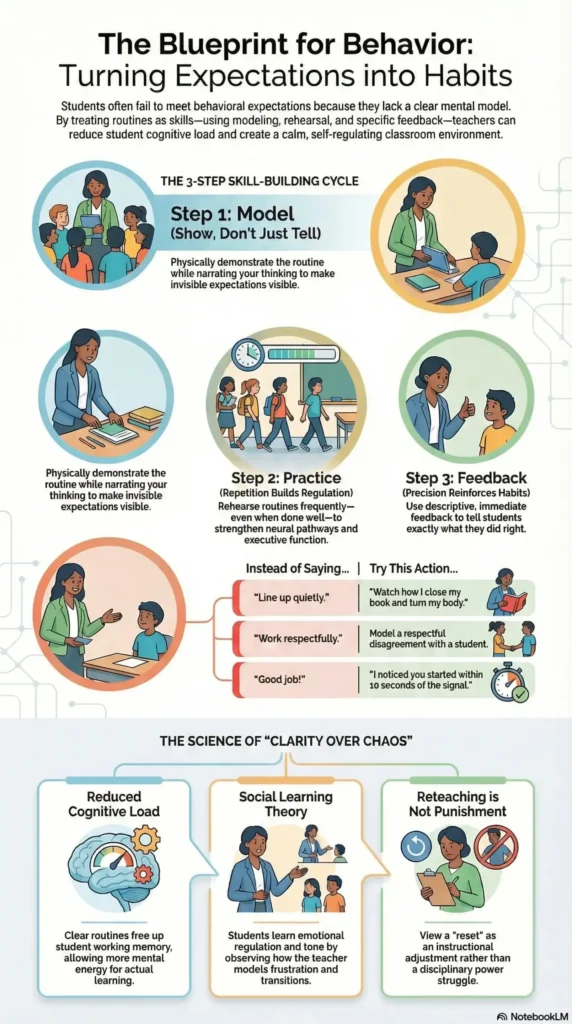
Cognitive Load Theory
When expectations are unclear, students use mental energy trying to figure out:
What am I supposed to do?
Am I doing this right?
Is this acceptable?
That uncertainty increases cognitive load and reduces capacity for self-regulation.
When we model and practice routines:
Decision fatigue decreases
Working memory is freed up
Emotional regulation improves
Behavior becomes automatic
Clarity reduces chaos.
Social Learning Theory
According to Albert Bandura, humans learn through observation.
Students don’t just learn content by watching us.
They learn tone.
They learn emotional responses.
They learn how to handle frustration.
They learn how to transition.
If we want calm classrooms, we must model calm.
If we want respectful discussion, we must model respectful disagreement.
Behavior spreads through modeling faster than through lectures.
Feedback Loops and Skill Development
Executive function skills (especially in adolescents) are still developing. That means:
Impulse control isn’t automatic.
Task initiation is inconsistent.
Emotional regulation fluctuates.
Practice plus feedback strengthens these skills over time.
Without feedback, students guess.
With feedback, students refine.
What This Looks Like in Real Classrooms
Let’s break this into three simple parts.
1. Modeling: Show, Don’t Announce
Modeling means you physically demonstrate what you expect.
Instead of:
“Transition quietly.”
Try:
“Watch how I transition from group work to listening.”
Then demonstrate:
Stop talking.
Put materials away.
Turn body toward front.
Make eye contact.
Sit upright.
Narrate your thinking:
“I’m finishing my sentence. Now I’m closing my notebook. I’m turning my body forward.”
You just made the invisible visible.
Model the Wrong Way (Strategically)
Sometimes it helps to model incorrectly on purpose:
“Let me show you what NOT to do.”
Students laugh.
They notice.
They engage.
Then:
“Okay, what did I do wrong?”
You’ve just increased buy-in.
2. Practice: Repetition Builds Regulation
We often model once and assume it’s done.
But routines need rehearsal—especially early in the year.
Practice:
Entering the classroom
Submitting assignments
Transitioning between tasks
Asking for help
Handling disagreement
And yes—practice even when they do it well.
Because practice isn’t punishment.
It’s skill-building.
Quick Reset Practice Strategy
If a transition goes poorly:
Stay calm.
Pause.
Say neutrally:
“Let’s reset and try that again.”
No lecture.
No sarcasm.
Just repetition.
You are strengthening neural pathways, not winning a power struggle.
3. Feedback: Precise and Immediate
Feedback makes practice meaningful.
Instead of vague praise:
“Good job.”
Use specific feedback:
“I noticed how you turned your body and waited quietly. That helped us start quickly.”
This reinforces the behavior you want repeated.
The 3 Types of Feedback That Improve Classroom Management
Descriptive Feedback
“You started within 10 seconds of the signal.”
Corrective Feedback
“Remember, the expectation is voices off during transitions.”
Private Feedback
“Let’s talk about how that group interaction went.”
Neutral tone. Clear message. Move on.
The goal isn’t shame.
The goal is adjustment.
Common Mistakes Teachers Make (No Judgment — We’ve All Done These)
Explaining instead of modeling
Modeling once and assuming mastery
Only giving feedback when something goes wrong
Correcting publicly when it should be private
Getting emotional during reteaching
Remember:
If we treat routines like instruction, we stay calm.
If we treat them like defiance, we escalate.
A Practical Implementation Plan
Here’s how to apply modeling practice and feedback in the classroom tomorrow.
Step 1: Choose One Routine
Don’t overhaul everything.
Pick one:
Entry routine
Transition to independent work
Group discussion norms
Step 2: Model It Explicitly
Demonstrate it.
Narrate it.
Ask students what they noticed.
Step 3: Have the Class Practice It
Run it once.
Give feedback.
Run it again.
Yes—even if it feels awkward.
Especially if it feels awkward.
Step 4: Reinforce for 2 Weeks
Consistency builds independence.
After enough repetition, the routine becomes automatic—and behavior improves without constant reminders.
Actionable Teacher Checklist
Use this to audit your classroom management approach:
☐ I model new routines instead of just explaining them
☐ I narrate my thinking during demonstrations
☐ I allow students to practice procedures multiple times
☐ I reset transitions neutrally when needed
☐ I give specific feedback, not vague praise
☐ I correct privately when possible
☐ I view reteaching as instruction, not discipline
☐ I reinforce routines consistently for at least two weeks
If you checked most of these, you’re already shifting toward preventative management.
Final Reflection
When routines fail, we often assume students aren’t trying.
But more often, they haven’t practiced enough.
Modeling.
Practice.
Feedback.
That’s how we turn expectations into habits.
And when habits form, classroom management becomes quieter—not because students are controlled…
…but because they’re skilled.