
5 Methods for Effective Teaching in Every Classroom
You know the feeling: one lesson lands perfectly with third period and falls flat with fifth, even though you taught it the exact same way. That gap is exactly why so many teachers go searching for methods for effective teaching instead of just another list of activities. The good news is that effective teaching isn’t a mystery or a personality trait some educators are born with. It’s a set of learnable techniques, the kind researchers like Burden and Byrd have spent careers documenting and refining.
If you want strategies that actually hold up across different grade levels, subjects, and student needs, you need approaches grounded in how learning really works, not just what looks good on paper. That means combining solid classroom management with instruction flexible enough to reach struggling readers and advanced students in the same room.
In this article, we break down five teaching strategies you can start using this week, drawn from the wider range of types of teaching strategies, from differentiated instruction to formative assessment techniques that tell you what’s actually sinking in. Each method includes practical ways to adapt it for your specific classroom, whether you’re teaching middle school English or high school science.
1. Differentiated instruction
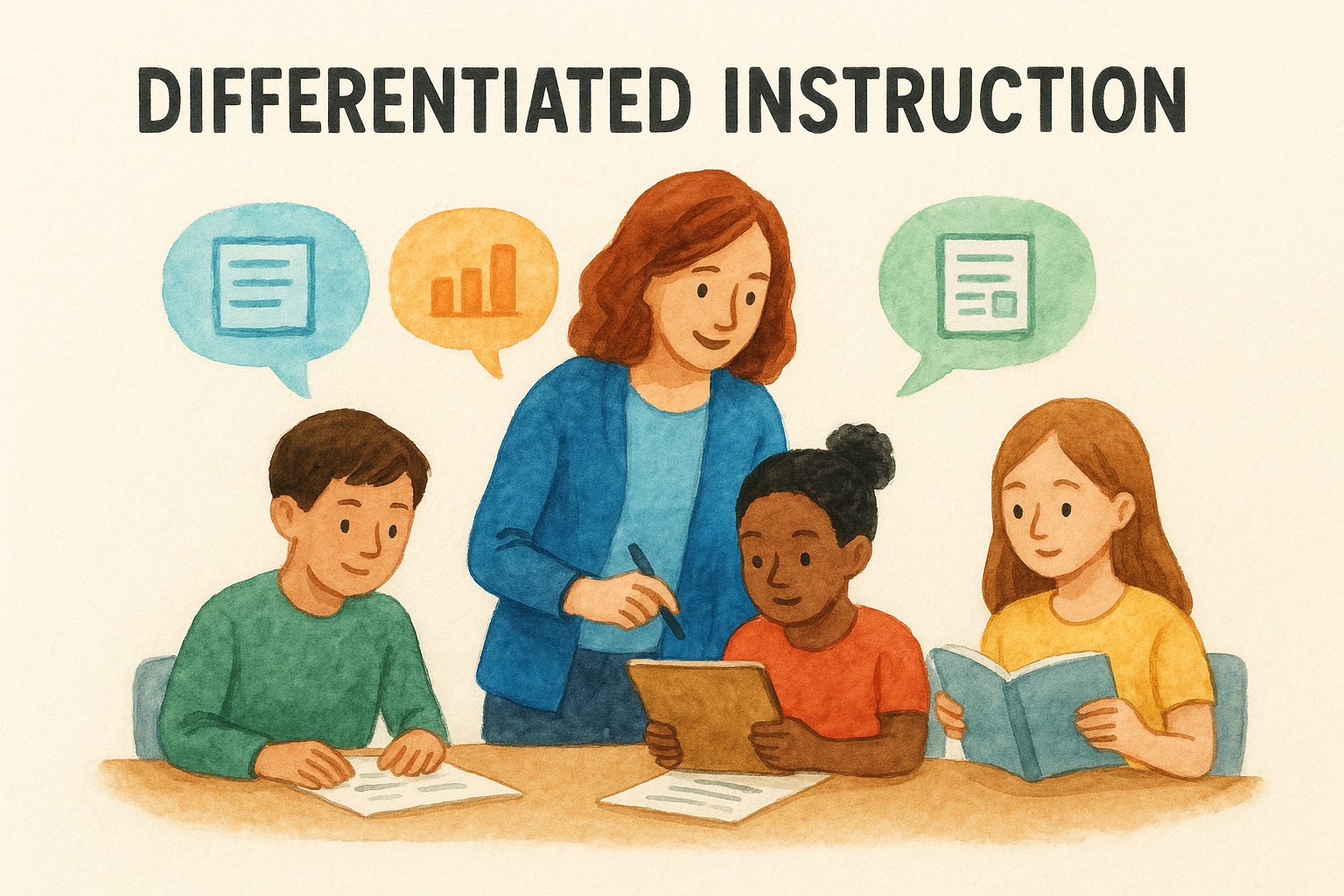
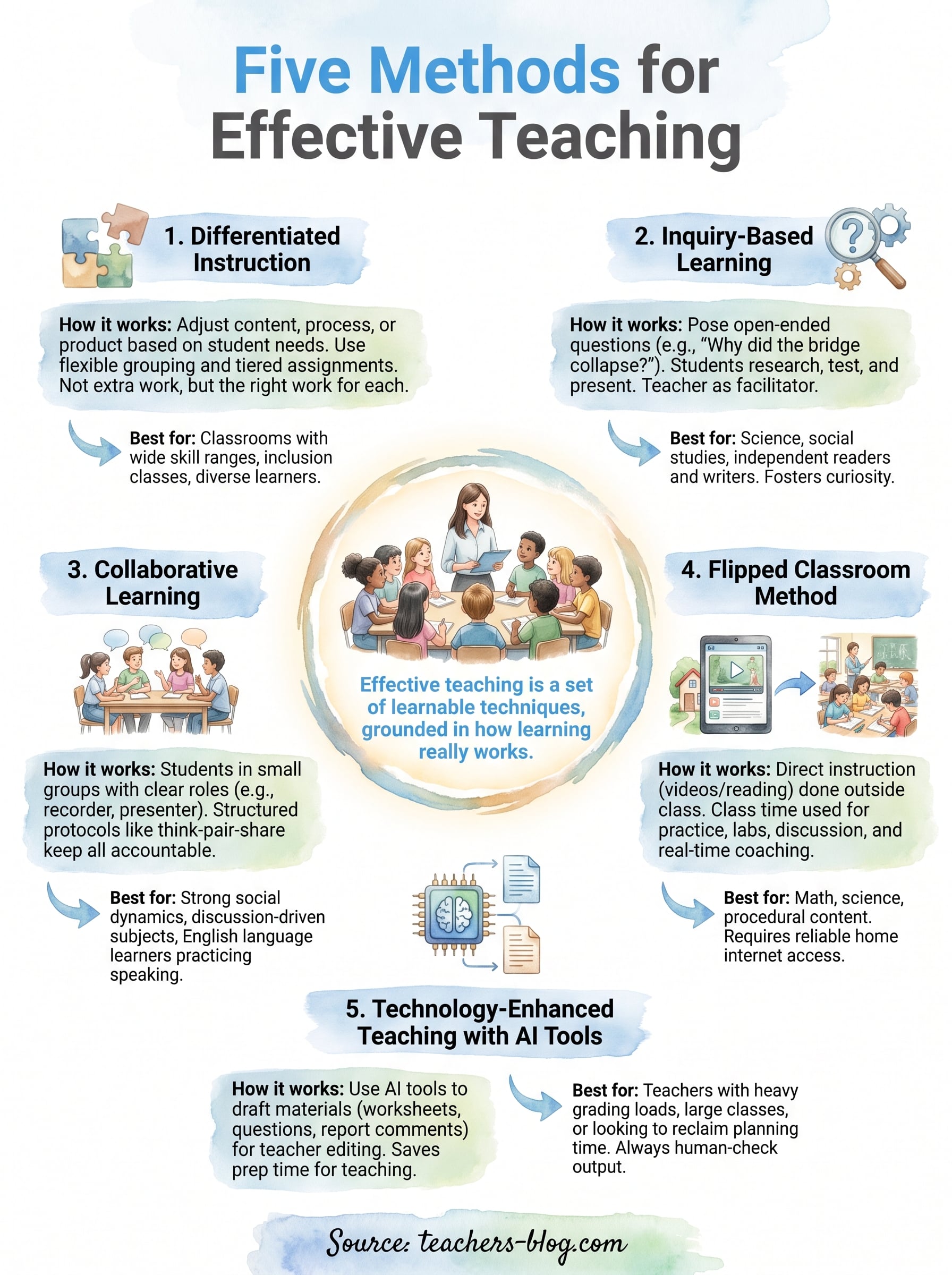
Differentiated instruction means adjusting content, process, or product based on where each student actually is, not where the pacing guide says they should be. This method of effective teaching asks you to plan for variance instead of pretending a single lesson fits every learner in the room.
How it works
You start with the same learning goal for everyone, then change how students reach it. A struggling reader might get a graphic organizer and a shorter text, while an advanced student tackles primary sources and writes an argumentative response. Flexible grouping and tiered assignments in the classroom let you keep the whole class moving toward the same standard without forcing identical work.
Differentiation isn’t extra work for every student; it’s the right work for each one.
Who it’s best for
This approach shines in classrooms with a wide skill range, think inclusion classes, mixed-ability middle school sections, or any group with IEPs and 504 plans mixed in with gifted learners. If your roster spans several reading levels or you’re teaching multilingual learners alongside native English speakers, differentiated instruction ideas for diverse learners give you a framework instead of a scramble.
How to get started
You don’t need to differentiate everything at once. Start small:
- Pick one unit and identify three readiness levels among your students
- Adjust the text complexity or scaffold, not the actual learning target
- Offer choice in how students demonstrate mastery (writing, presenting, visual project)
- Use exit tickets to see who needs more support tomorrow
Tools like our Differentiated Instruction Helper can cut your planning time significantly by generating tiered versions of a single lesson.
Challenges to watch for
Without planning, differentiation turns into three or four separate lesson plans, which burns you out fast. Grading also gets trickier when products vary, so build your rubric around the shared learning target rather than the format students chose.
2. Inquiry-based learning
Inquiry based learning methods flip the usual script: instead of delivering facts first, you hand students a question or problem and let them build understanding through investigation. This is one of the methods of effective teaching that trades passive note-taking for genuine curiosity, which sticks longer than anything memorized for a Friday quiz.
How it works
You pose an open-ended question, like "why did the bridge collapse" or "what causes seasons," and students research, test hypotheses, and present findings. Your role shifts from lecturer to facilitator, guiding students toward evidence rather than handing them conclusions.
Students remember what they discover far longer than what they’re told.
Who it’s best for
Science and social studies classrooms benefit most, though English teachers use it for literary analysis too. It suits students who already read and write independently, since the method demands more self-direction than a traditional lecture.
How to get started
Begin with a single unit:
- Choose one essential question tied to your standard
- Give students research time before any direct instruction
- Build in checkpoints so nobody drifts off track
Challenges to watch for
Without structure, inquiry becomes aimless browsing. Pair it with clear rubrics and checkpoints so exploration stays productive.
3. Collaborative learning
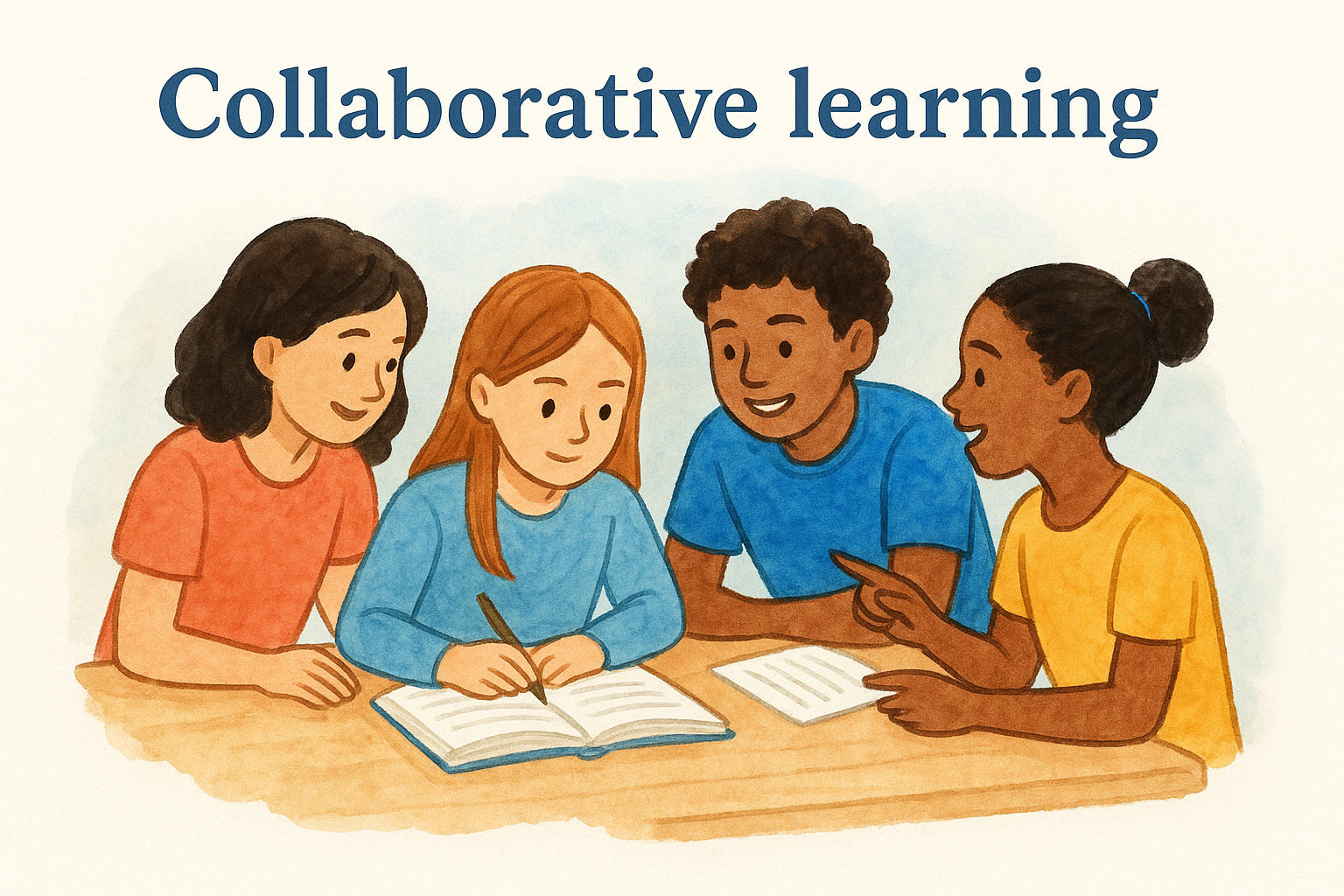
Collaborative learning puts students in small groups to solve problems, discuss texts, or build projects together, trading isolated seatwork for shared accountability. This is one of the methods of effective teaching that leans on peer explanation, since students often understand a concept better once a classmate walks them through it in their own words.
How it works
You assign groups clear roles, like recorder, presenter, or fact-checker, so nobody coasts while others do the thinking. Structured protocols like think-pair-share or jigsaw give every student a specific job, which keeps group work from turning into one kid doing everything.
Group work only teaches teamwork when every student has a job that matters.
Who it’s best for
This method suits classrooms with strong social dynamics already in place, plus subjects where discussion drives understanding, like literature circles or lab-based science. It also helps English language learners practice speaking in lower-stakes settings than whole-class discussion.
How to get started
- Assign roles before the activity begins, not during it
- Keep groups to three or four students
- Build in individual accountability, like a personal reflection after group work
Challenges to watch for
Free riders are the biggest risk, so grade individual contributions alongside the group product. Personality clashes also surface fast in small groups, so rotate group membership regularly.
4. Flipped classroom method
Flipped classroom teaching moves direct instruction outside class, usually through short videos, so class time gets spent on practice, discussion, and problem-solving. This method of effective teaching trades the traditional lecture-then-homework order for something closer to homework-then-application, which puts you in the room when students actually hit the hard part.
How it works
Students watch a recorded lesson or read assigned material before class, then arrive ready to apply it. You spend class time on labs, worked problems, or small-group coaching instead of talking at the whole room for forty minutes. This frees you to catch misconceptions in real time rather than discovering them on a graded test.
Save your class time for the questions students actually get stuck on.
Who it’s best for
Math and science classrooms adapt easily, since procedural content translates well to video. It also works for students with reliable home internet access and enough independence to complete pre-class work without a parent hovering.
How to get started
- Record one short lesson (five to eight minutes) for a single topic
- Pair it with a quick comprehension check due before class
- Use class time for the messiest, most confusing part of the lesson
Challenges to watch for
Equity gaps show up fast if some students lack devices or reliable internet at home. Build in class time or library access as a backup plan.
5. Technology-enhanced teaching with AI tools
Technology-enhanced teaching means using AI tools to handle the repetitive parts of your job, worksheet creation, question generation, report card comments, so you spend more time actually teaching. This method of effective teaching doesn’t replace your judgment; it just clears the busywork blocking you from using it.
How it works
You feed a tool your topic, grade level, or student work, and it generates a draft you edit rather than a lesson plan you build from scratch. An AI worksheet generator turns keywords into a ready practice sheet in minutes, while a Question Generator pulls critical thinking prompts straight from your reading material.
AI won’t teach your class, but it will give you back the hours you’d spend prepping for it.
Who it’s best for
This fits any teacher juggling heavy grading loads or large class counts, especially during report card season when writing thirty individualized comments eats an entire weekend. New teachers building their first unit plans benefit just as much as veterans looking to reclaim planning time.
How to get started
- Try our Report Card Commentor and these AI report card comment tips for your next comment cycle
- Generate one worksheet with the Worksheet Maker before writing your next by hand
- Always review AI output for accuracy before it reaches students
Challenges to watch for
AI drafts need a human check for factual errors and tone. Treat every output as a starting point, not a finished product.
Choosing the right method for your classroom
None of these five methods work as a silver bullet, and you don’t need to run all of them by Friday. Effective teaching usually looks like picking one approach that matches your students’ current needs, testing it on a single unit, and adjusting before you scale it up. A mixed-ability English class might lean on differentiated instruction one semester and collaborative learning the next, while a science teacher juggling lab time might flip the classroom for procedural units only.
Questions matter more than trends here. Ask what your students struggle with, what your schedule actually allows, and what you can sustain without burning out by October. Small experiments beat sweeping overhauls every time. If you want ready-made tools to shrink your prep time while you test these strategies, browse our list of essential apps to save teachers time and start with whichever one solves your biggest headache this week.