
Flipped Classroom Research: The Surprising Equity Finding Teachers Should Know
The flipped classroom has an appealing logic. Move direct instruction outside class, free up valuable face-to-face time, and use that time for discussion, coaching, practice, and problem-solving. In theory, students get more individual support exactly when they need it.
That is why one finding from a large randomized trial is so surprising: the flipped classroom improved short-term math performance, but the gains were concentrated among students who were already more advantaged academically—and the achievement gaps actually grew.
This flipped classroom research does not prove that teachers should abandon flipped learning. It does, however, challenge a very common assumption: an instructional model can look more interactive, more student-centered, and more supportive while still benefiting some students much more than others.
The Study: What Changed—and What Stayed the Same?
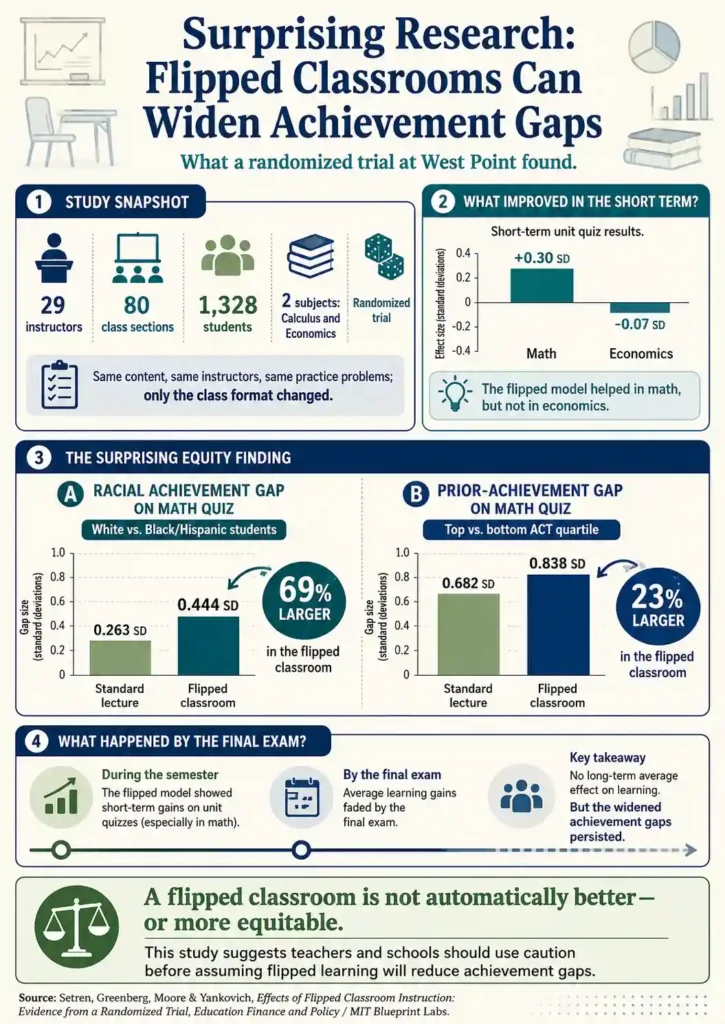
Researchers Elizabeth Setren, Kyle Greenberg, Oliver Moore, and Michael Yankovich conducted a randomized controlled trial at the United States Military Academy at West Point. The study included 29 instructors, 80 course sections, and 1,328 students in introductory calculus and economics.
What makes the design especially useful is how much the researchers held constant. Students in the flipped and traditional sections received the same course content, worked with the same instructors, and were assigned the same practice problems. The major difference was when and where students encountered the lecture and practice.
In the traditional sections, students received the lecture during class and completed practice outside class. In the flipped sections, students watched a standardized lecture before class and used class time for interactive problem-solving.
That gives the study more weight than a simple comparison between two different teachers, courses, or schools. The researchers were trying to isolate the effect of the flipped format itself.
The First Result Looked Like a Win
In math, students in the flipped sections scored about 0.30 standard deviations higher on the short-term unit quiz than students in the standard lecture sections. In education research, that is large enough to get attention.
But the effect did not appear across subjects. Economics students in flipped sections did not show a meaningful improvement. Their scores were slightly lower on the short-term assessment, but the researchers treated the economics result as essentially a null effect after statistical adjustments.
Already, that is a useful reminder for teachers: instructional strategies are rarely universal. A model that helps students in one subject, unit, or type of task may not transfer automatically to another.
This fits with a broader principle behind effective teaching methods: the question is not whether a strategy is fashionable or even research-supported in general. The more useful question is whether it improves learning for these students, in this context, for this kind of learning.
The Surprising Conclusion: The Gap Got Wider
The equity findings are what make this study especially interesting.
The short-term math gains were driven primarily by white students, male students, and students with stronger prior academic performance. Female students, Black and Hispanic students, and students with lower baseline ACT scores did not experience the same benefits.
On the math quiz, the gap between white students and Black or Hispanic students was 0.263 standard deviations in traditional lecture sections. In the flipped sections, that gap increased to 0.444 standard deviations—a 69% larger gap.
The pattern also appeared when researchers compared students by prior achievement. The gap between students in the highest and lowest ACT quartiles was 0.682 standard deviations in standard classes and 0.838 in flipped classes, a 23% increase.
That is the counterintuitive part. The flipped classroom is often promoted as a way to make class time more responsive and personalized. Yet in this trial, the format did not reduce disparities. It increased them.
Why Might Flipped Learning Help Some Students More?
The study cannot give us a single definitive cause, but it highlights several possibilities teachers should think about.
Flipped learning places more responsibility on students before class. They need to watch, process, and engage with material independently enough to arrive prepared for application. Students with stronger study habits, better prior knowledge, or greater confidence may be better positioned to take advantage of that structure.
Meanwhile, students who do not fully understand the pre-class material can arrive at the interactive portion without the foundation they need. Instead of class time becoming more supportive, it can become more cognitively demanding.
This is why strong student-centered teaching strategies still require careful scaffolding. Giving students more active responsibility is not the same thing as giving every student equal access to success.
The Short-Term Gain Did Not Last
The second surprising result came later. By the final exam, the researchers found no significant average long-term learning advantage from the flipped format. The early math gains had faded.
Yet the widened achievement gaps remained.
That combination matters. If teachers looked only at the immediate unit assessment, the flipped model could appear successful. If they looked at the distribution of gains and the longer-term results, the picture becomes much more complicated.
This is a useful reminder for any instructional innovation: measure more than the class average. Ask who improved, who did not, and whether the improvement lasted.
What Teachers Should Take From This Study
The safest conclusion is not “never flip your classroom.” The study took place at West Point, a selective postsecondary institution with small classes averaging roughly 16 students. Its students, course structures, and institutional expectations are not identical to a typical middle school or high school classroom.
But the study does give teachers a powerful set of questions to ask before assuming that a flipped model is automatically more equitable:
- Can every student reliably access and understand the pre-class material?
- What happens when a student arrives without the foundational understanding?
- Are lower-achieving students receiving additional scaffolds before the active task begins?
- Are we measuring subgroup outcomes, not just the class average?
- Do the gains persist beyond the immediate quiz?
Those questions apply far beyond flipped learning. They are useful whenever teachers introduce a new technology, instructional routine, or classroom structure. An approach can increase engagement or even average achievement while still producing uneven benefits.
For more ways to compare instructional approaches thoughtfully, see these instructional strategies for teaching.
The Bigger Lesson: “Better” Depends on Who Benefits
One of the easiest mistakes in education is to ask only, “Did the strategy work?”
This flipped classroom research suggests a better question: For whom did it work?
In the West Point trial, the flipped format did produce a meaningful short-term math gain. If researchers had stopped there, the headline could have been strongly positive. But when they examined different student groups and followed performance to the final exam, the conclusion changed.
The strategy helped some students more than others. The average benefit faded. The achievement gaps persisted.
That is not a reason to fear innovation. It is a reason to evaluate innovation more carefully.
The best teaching is rarely about choosing between “traditional” and “new.” It is about using evidence to decide which elements of an approach help students, identifying who may need additional support, and being willing to modify the model when the outcomes are not as equitable as the intentions.
Research Sources
The primary study is Elizabeth Setren, Kyle Greenberg, Oliver Moore, and Michael Yankovich, Effects of Flipped Classroom Instruction: Evidence from a Randomized Trial, published in Education Finance and Policy. A research summary is also available through MIT Blueprint Labs.
Featured photo by Mikhail Seleznev via Unsplash.