Day 56-60 Culminating Activity Lesson Plan: A Multi-Day Assessment for Any Novel
By this point in the novel study, students have done the heavy lifting: reading closely, discussing ideas, tracking themes, and practicing key skills. This culminating activity is designed to bring all of that thinking together in a clear, structured, and fair way. For me, this will act as a course culminating activity, but you could use it however you like!
Over five class periods, students will complete three individual assessments:
An individual reflection essay (completed in class)
An individual presentation based on the essay
A short test that assesses overall understanding of the novel
This structure ensures that students demonstrate:
Deep thinking about their novel
The ability to organize and explain ideas
Independent understanding (no group marks, no hiding)
Everything is scaffolded so expectations stay consistent—even when students are reading different books. Please, feel free to choose any or all parts of this culminating!
Overview: Days 56–60 at a Glance
Day 56:
Introduce the culminating task
Review expectations for essay, presentation, and test
Students select a topic
Day 57:
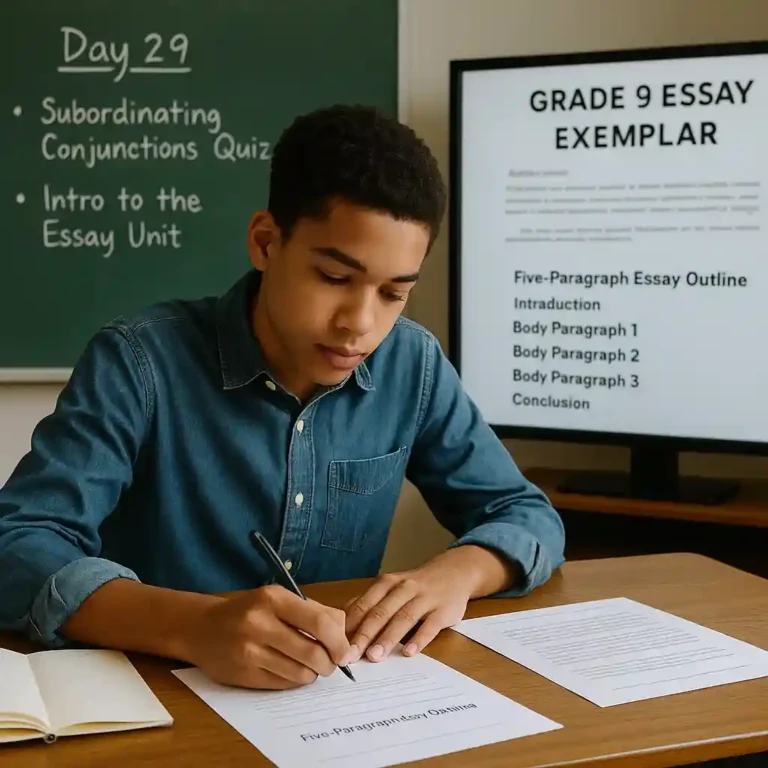
Complete the essay planning outline (point form only)
Teacher check-in and feedback
Day 58:
In-class writing: final reflection essay
Day 59:
Individual presentations (or begin presentations)
Day 60:
Complete presentations (if needed)
Write the short culminating test
Resources
Culminating Components (Individual Work)
1. Individual Reflection Essay (In-Class)
Students will write a formal reflection essay based on one open-ended topic (chosen from the list below).
Key rules:
Essay is written in class
Students must complete the planning outline first
Planning notes must be point form only
Direct quotations from the novel are allowed in full sentence form
Each body paragraph must include:
One direct quote from the novel
An explanation of how the quote supports the student’s idea
2. Individual Presentation
Students will create a 5-slide presentation that explains the ideas from their essay.
Important:
This is not a book report. The presentation mirrors the thinking in the essay, not the plot.
Presentations must:
Be completed individually
Use the same quotes as the essay
Follow the slide-by-slide structure below
3. Short Test (Separate Assessment)
The short test will be different from the essay and presentation.
It will focus on:
Key events
Characters
Important ideas from the novel
This ensures students understand the text as a whole—not just their chosen topic.
Open-Ended Culminating Topics (Choose ONE)
These topics are broad enough to work with any novel:
A lesson the novel teaches about growing up
A moment where a character is forced to change
A decision that reveals who a character truly is
How relationships shape the main character
A conflict that drives the story forward
The role of fear, courage, or confidence in the novel
How power or control affects characters
A moment that changed the direction of the story
What the novel suggests about belonging or isolation
What readers are meant to remember after finishing the book
Essay Planning Outline (Point Form Only)
Students must complete this outline before writing.
Introduction
Novel title and author
Chosen topic
Clear opinion or insight about the topic
Body Paragraph 1
Main idea (point form)
Quote #1 from the novel
Explanation: how the quote supports the idea
Body Paragraph 2
Main idea (point form)
Quote #2 from the novel
Explanation: how the quote supports the idea
Body Paragraph 3
Main idea (point form)
Quote #3 from the novel
Explanation: how the quote supports the idea
Conclusion
What the novel ultimately suggests about the topic
Final reflection or takeaway
Presentation Structure (5 Slides – Required Format)
Slide 1: Introduction
Novel title and author
Chosen topic
Overall insight or message
Slide 2: First Key Idea
Main idea from body paragraph 1
Quote from the novel
Brief explanation
Slide 3: Second Key Idea
Main idea from body paragraph 2
Quote from the novel
Brief explanation
Slide 4: Third Key Idea
Main idea from body paragraph 3
Quote from the novel
Brief explanation
Slide 5: Final Reflection
What the novel teaches readers
Why this idea matters
Introduction to the Short Test
The culminating test is designed to assess overall understanding, not memorization.
Students can expect:
Short-answer questions
Questions about characters, events, and meaning
A focus on big-picture understanding
The test ensures that students:
Read the novel carefully
Understand the story beyond their chosen topic
Conclusion
This multi-day culminating activity gives students multiple ways to show what they know—through writing, speaking, and independent thinking. Because the structure is clear and the topics are flexible, it works smoothly even when students are reading different novels.
Most importantly, this culminating task rewards thinking, not just completion—and gives students a strong, meaningful ending to the novel study.