A Simple Classroom Management Blueprint (That You Can Use Tomorrow)
Let’s be honest.
Most classroom management advice sounds great… until you’re standing in front of 30 students at 9:02 a.m. on a Monday.
That’s why this isn’t another list of strategies.
This is a simple, practical classroom management plan template—one that’s built on everything we’ve covered in this course:
Relationships over rules
Prevention over reaction
Structure over control
Think of this as your daily operating system.
🧩 The 5-Part Classroom Management Blueprint
If you remember nothing else from this course, remember this:
👉 Strong classroom management =
Relationships + Structure + Clarity + Consistency + Response
Let’s break it down.
1. Relationships: Your Foundation
Before any strategy works, students need to feel:
Known
Safe
Respected
Your Blueprint Moves:
Greet students at the door (every day if possible)
Use names constantly
Have 2–3 “connection moves” daily (quick check-ins, humor, noticing effort)
👉 If students feel connected, you prevent half your “management problems” before they start.
2. Structure: Reduce Decision Fatigue
Students don’t misbehave because they’re bad.
They misbehave because the environment is unclear.
Your Blueprint Moves:
Predictable entry routine (what do students do immediately?)
Posted daily agenda
Clear transition procedures (what happens between activities?)
👉 Structure removes uncertainty—and uncertainty is where behavior issues live.
3. Clarity: Teach Expectations Like Content
If you didn’t teach it, you can’t expect it.
Your Blueprint Moves:
Model expectations (don’t just say them)
Practice routines early (yes, even in high school)
Give feedback like you would for academic work
👉 “Be respectful” is vague.
👉 “When someone is speaking, eyes forward and voices off” is teachable.
4. Consistency: Calm, Predictable Responses
Students don’t need perfect teachers.
They need predictable teachers.
Your Blueprint Moves:
Use the same language for the same behaviors
Address issues early (before escalation)
Keep tone neutral, not emotional
👉 Inconsistency creates anxiety.
👉 Predictability creates safety.
5. Response: Correct Without Escalating
Not every behavior needs a consequence.
But every behavior needs a response that teaches.
Your Blueprint Moves:
Redirect privately when possible
Use neutral language (“What should you be doing right now?”)
Follow up after class for patterns
👉 The goal is not compliance.
👉 The goal is growth.
🧱 Putting It All Together: Your One-Page Plan
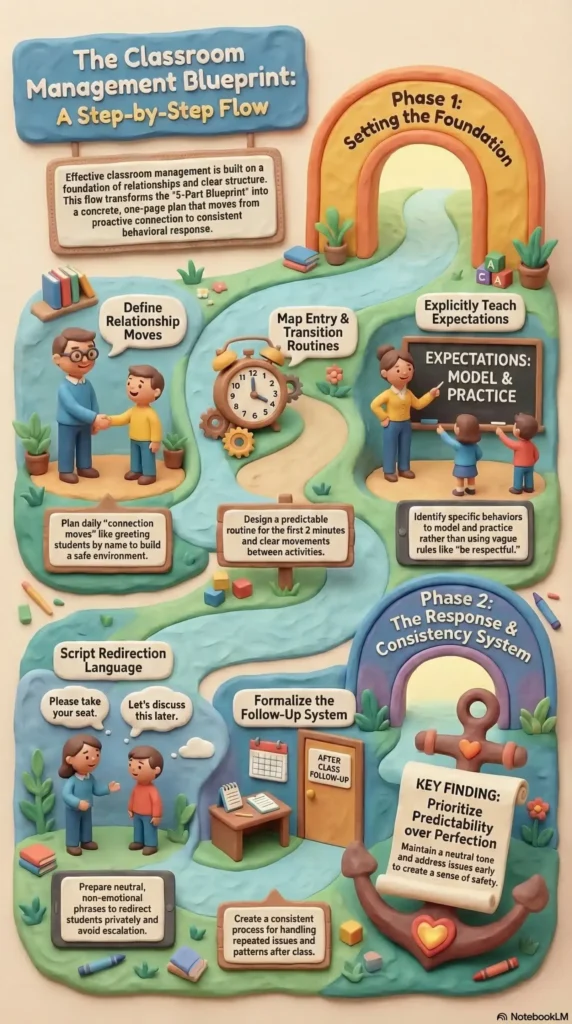
Here’s your simple classroom management plan template:
📝 Your Classroom Blueprint
1. Relationship Moves
How will I connect with students daily?
2. Entry Routine
What do students do in the first 2 minutes?
3. Transition Plan
How will I move between activities smoothly?
4. Expectations I Will Explicitly Teach
What behaviors need modeling and practice?
5. My Go-To Redirection Language
What will I say when things go off track?
6. My Follow-Up System
How will I handle repeated issues?
What This Blueprint Is NOT
Let’s clear this up:
❌ Not about controlling students
❌ Not about having perfect compliance
❌ Not about eliminating all disruptions
It is about:
✔ Creating conditions where students succeed
✔ Reducing friction in your classroom
✔ Making your job sustainable
💬 Final Thought: Keep It Simple
You don’t need 25 strategies.
You need a few that you use well.
Start small:
One routine
One expectation
One relationship move
Build from there.
Because great classroom management isn’t built in a day—
👉 It’s built in the small, repeatable moves you make every day.
🎯 Reflection Question
What is one part of this blueprint you could implement tomorrow—and stick with for a full week?
Next: Reflecting on Classroom Management and What Works