
How to Make an AI Review Game from English Lesson Notes
Making an AI review game from English lesson notes is a practical way to prepare a classroom review without writing every question from scratch. The key is to give the tool a focused learning target, a trustworthy source, and clear expectations for the kinds of thinking students should demonstrate. In this walkthrough, you will turn a short set of literary-device notes into a review game for Grades 6–12, then check the questions before you play.
The same process works for grammar, short stories, novel studies, vocabulary, reading strategies, and argument writing. You do not need a huge document or a perfect prompt. Start small, use what you already teach, and make the assessment choices yourself.
Start with the lesson goal, not the technology
Suppose your class has learned simile, metaphor, personification, dramatic irony, and theme. A weak goal is “make a fun English quiz.” A useful goal is: “Students will identify devices in unfamiliar examples and explain how word choices affect meaning or reader expectations.”
That goal changes the questions you should accept. A definition question can check basic knowledge, but the real test is whether students can apply that knowledge to a new passage. An AI generator may produce fluent but superficial questions unless the instructions explicitly require reasoning and evidence.
Step 1: Collect a small, accurate set of lesson notes
Gather a page or two of your actual teaching materials: definitions, your own examples, anchor-chart notes, a short text excerpt you are permitted to use, and the main misconceptions you have already observed. Use plain teaching notes or an appropriate digital file. You can also work from a short text description rather than uploading a document.
Example note set: A simile explicitly compares using “like” or “as.” A metaphor makes a direct comparison without those words. Personification gives human traits or actions to nonhuman things. Dramatic irony occurs when the audience knows something a character does not. A theme is a broader idea developed about human experience; it should be expressed as a meaningful statement, not just a single topic word.
Include an example for each idea, but ask the game to generate new examples so students cannot succeed through memorization alone.
Step 2: Tell the AI exactly what to assess
A clear instruction might read: “Create a Grades 8–9 English review game about simile, metaphor, personification, dramatic irony, and theme. Use the supplied notes for accuracy. Include definition recall, identification in original sentences, correction of common mistakes, and questions that require students to explain their reasoning. Give concise teacher-facing answers. Avoid ambiguous labels unless the question explicitly invites multiple supported interpretations.”
For Grade 6, ask for shorter sentences and fewer concepts in each question. For Grade 12, ask students to analyze purpose, nuance, and competing interpretations. Specify any reading accommodations or vocabulary restrictions you need.
Step 3: Build from lesson materials, but protect privacy
Never upload identifiable student work, IEPs, grades, or private learner information unless the tool is expressly approved by your school for that data. Use your teaching notes, teacher-created examples, or anonymized materials instead. If using a novel or article, respect copyright and any restrictions on uploading third-party texts.
If the lesson notes are inconsistent—for example, one slide incorrectly defines a metaphor—the generated questions may repeat the error. Review your source material first, and always verify generated answers before class.
Step 4: Use a balanced mix of questions
The most useful game asks different types of questions. Plan for approximately one-third quick retrieval, one-third application, and one-third reasoning or interpretation. That is a practical planning heuristic, not a research-mandated ratio. An English review game needs both fast entry points and questions worth discussing.
Sample recall prompts
Question: What is personification? Expected answer: Describing something nonhuman using a human trait or action.
Question: How is a theme statement different from a topic? Expected answer: A topic names a subject such as loyalty, while a theme statement expresses an idea about it, such as “Loyalty can create difficult choices.”
Sample application prompts
Question: Identify the device in “The wind tugged impatiently at the curtains.” Expected answer: Personification because the wind is given the human-like action or attitude of being impatient.
Question: Rewrite “The room was loud” as a metaphor. Acceptable example: “The room was a thunderstorm of voices.” Other clear direct comparisons also work.
Question: The reader knows the bridge is unsafe, but a character crosses it believing it is secure. What type of irony creates suspense? Expected answer: Dramatic irony.
Sample reasoning prompts
Question: How does “The corridor swallowed every whisper” affect mood? Expected answer: The personification may make the setting feel threatening, empty, or secretive; students should refer to the word “swallowed.”
Question: A student claims that “hope” is a complete theme statement. Explain the problem and revise it. Expected answer: “Hope” is a topic; an improved statement might be “Hope can help people endure uncertainty.”
Question: Two students interpret a storm as a symbol of conflict. What evidence would strengthen or weaken that interpretation? Expected answer: Repetition, placement, character reactions, and contrast across the text; a storm alone is not proof of symbolism.
Question: Explain why “The bus was as slow as a turtle” is not a metaphor. Expected answer: It is a simile because the comparison is explicitly signalled by “as.”
Question: Which is stronger evidence that a character feels trapped: “The window stood open” or “A fence divided the sky beyond the window”? Explain your choice. Expected answer: The second can more clearly suggest restriction, but a thoughtful answer should acknowledge context.
Step 5: Review the questions with an English-teacher checklist
Accuracy: Does each answer match the lesson notes and the text? Clarity: Is the prompt understandable at the intended grade level? Fairness: Could more than one reasonable interpretation be correct? Depth: Does the question sometimes require evidence or explanation, not just selecting a label? Variety: Are you repeating the same definition ten times in disguise?
Revise weak questions before class. If the tool gives a single “correct” answer to an interpretive literature question, consider changing it to “Give one defensible interpretation and support it with the text.” For grammar, distinguish a rule-based correction from a stylistic preference.
Step 6: Run the game with meaningful participation
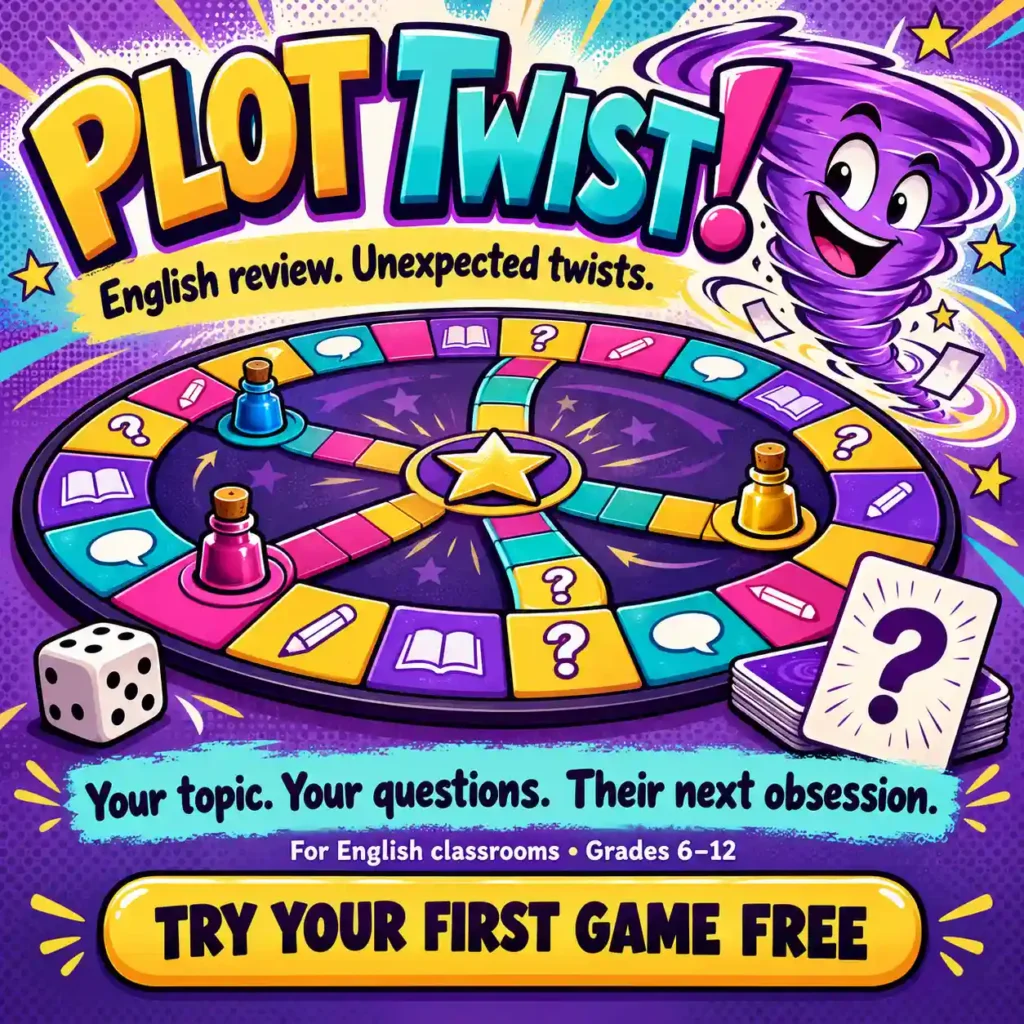
For a classroom board-game experience, Plot Twist! lets a teacher enter a topic with notes or upload instructional materials. The teacher names between two and seven teams, sets the ink goal, and starts the game. The generated questions feed into a shared-screen competition in which teams collect ink, encounter unexpected events, and work toward the final challenge.
Plot Twist! offers the choice of teacher marking or AI-assisted evaluation. For open-ended analysis or cases with multiple plausible interpretations, teacher judgment is particularly valuable. You can prompt students to explain a choice aloud before awarding credit. Students play as teams; they do not each need their own login.
Sample Plot Twist! setup text: “Grade 9 English. Review simile, metaphor, personification, dramatic irony, and theme. Use a mixture of recognition, original examples, and explanation. Require evidence or reasoning for at least half the questions. Keep wording concise. Allow multiple defensible answers on interpretation questions. Avoid repeating identical prompts.”
Step 7: Use the exit ticket to see what students learned
Even if every team has a good time, the game should end with individual evidence of learning. Give students a fresh sentence such as “The empty chairs stared back at us.” Ask them to name the technique and explain the effect of the wording. Follow with a short misconception check: “Why is this not a simile?”
Sort responses into secure, developing, and needs reteaching. A two-minute exit ticket tells you much more about next lesson’s needs than the winning score alone.
What if the AI produces weak or repetitive questions?
Problem: too many definition questions. Revise the prompt to require application in new sentences and explanation of effect. Ask for fewer concepts in a batch.
Problem: confident but inaccurate answer keys. Reduce the source scope, verify against the original notes, and choose teacher marking when interpretation is involved. Do not treat AI wording as an authority.
Problem: questions are too difficult. Specify the grade, reading level of prompts, number of concepts per question, and whether students may use their text.
Problem: all questions feel alike. Specify different cognitive actions: identify, compare, correct, arrange, defend, or create an example. Changing fonts or adding trivia categories does not create meaningful variety.
Problem: the game takes too long. Reduce the review scope, target fewer concepts, and choose shorter rounds or a smaller game goal. The goal is useful practice, not finishing every possible question.
A practical 45-minute English review lesson using AI questions
Minutes 0–5: Independent warm-up: students define metaphor and give an example. Take quick note of misconceptions.
Minutes 5–10: Introduce teams and model a complete, evidence-based answer. Explain that a persuasive explanation matters more than shouting first.
Minutes 10–30: Run the teacher-selected questions with a mix of retrieval, application, and analysis. Pause occasionally for clarification and model improved answers.
Minutes 30–40: Revisit two questions teams struggled with. Ask groups to revise answers in writing and explain what changed.
Minutes 40–45: Use the independent exit ticket. Compare it with the warm-up to decide what to review next class.
Why explanation and feedback matter
The Institute of Education Sciences practice guide recommends quizzing to revisit learned content and asking deep explanatory questions. The Education Endowment Foundation emphasizes using discussion and feedback to correct misconceptions during retrieval practice. Digital games can make repeated practice more inviting, but a good question and timely feedback still do the teaching work.
About the free game and memberships
Plot Twist! currently offers a first game free. Teacher memberships are listed at US$5 per month or US$25 per year, with current limits of four new games per day and ten per week for standard memberships. Check the billing screen for the latest access details. You can try the format with one small English topic before deciding whether it fits your classes.
Related teacher resources
For more lesson-ready activities, browse the English Classroom Review Games hub, the retrieval-practice guide for ELA, and the literary devices glossary.
Frequently asked questions
Can I create an AI review game from a PDF or lesson notes?
If your chosen platform accepts uploaded teaching materials, you can supply permitted documents and ask it to create questions from those sources. Alternatively, paste a focused summary of your notes. Always review the generated questions and confirm supported file types in the tool itself.
Should I let AI grade literary analysis answers?
AI-assisted evaluation can be useful for simple responses, but interpretive English questions often support more than one defensible answer. Teacher judgment and a transparent explanation of the marking criteria remain important.
What topics work best for a first AI classroom review game?
Start with a narrow, familiar unit such as five literary devices, sentence punctuation, vocabulary from one text, or the first chapters of a novel. A small scope is easier to verify and easier for students to understand.
Do students need separate accounts to play Plot Twist!?
No. Plot Twist! is designed as a teacher-led game projected on one screen, with students playing together in teams.
The goal is better questions, not just faster preparation
AI can shorten the time between your lesson notes and a playable set of questions. Your professional judgment makes those questions worth answering. Start with a clear goal, test the material, encourage student reasoning, and make the next lesson better because of what you learned.