5 Effective Teaching Strategies with Real Classroom Examples
You know the feeling: you plan a lesson, deliver it well, and still watch half the class check out by minute ten. The problem usually isn’t your content, it’s your teachers teaching strategies toolkit. Most educators default to whatever worked in student teaching and never revisit it, even as their classes and curriculum shift year to year.
This article gives you five teacher teaching strategies that actually hold up in a real classroom, not just in theory. Each one comes with a concrete classroom example so you can see exactly how it looks with students in front of you, whether you’re teaching middle school science or high school English. No vague advice about "engaging learners," just methods you can adapt this week.
We’ll walk through techniques for differentiation, discussion, and formative feedback, pulling from the kind of unit plans and lesson structures we build for subjects like literature and writing. If you’re looking for examples of teaching strategies that fit diverse learners and don’t require a total overhaul of your lesson plans, you’re in the right place, and if you want a broader menu, here are 14 teaching strategies you can compare.
1. Differentiated instruction
How it works
Differentiated instruction means you adjust content, process, or product based on what each student actually needs, not a one-size-fits-all lesson. Instead of teaching the same worksheet to 30 kids, you group students by readiness, interest, or learning profile, then give each group a task pitched at the right level of challenge. This is one of the most researched teaching strategies because it directly addresses the reality that students in any given class read three or four grade levels apart, and there are eight differentiation strategies for teachers worth borrowing here.
Differentiation isn’t extra work for every student, it’s the right work for each student.
Real classroom example
Say you’re teaching a unit on persuasive writing. You split the class into three tiers based on a quick diagnostic: one group drafts a full essay independently, a second group works from a sentence-starter scaffold with guided transitions, one of several scaffolding strategies you can build into a lesson, and a third group builds an argument using a graphic organizer before writing a single sentence. All three groups practice the same skill, persuasive reasoning, but the entry point matches where each student actually is.
Best for
This strategy suits classrooms with a wide skill range, which describes most public school classrooms by default. It works especially well in:
- Mixed-ability English and reading classes
- Math courses with students who missed foundational units
- Any class with IEP or 504 accommodations built into daily instruction
- Writing units where output varies wildly by student
Tips to try it tomorrow
Start small. Pick one lesson this week and create just two versions instead of three, that’s manageable and still gives you real data on what works. Use exit tickets from the prior day to sort students into groups quickly, rather than guessing.
Building three versions of every lesson by hand isn’t sustainable, which is why we built the Differentiated Instruction Helper, an AI tool that generates tiered versions of a lesson from your original material in minutes. Feed it your lesson plan and it outputs leveled tasks so you can spend your prep time on delivery, not duplication.
2. Direct instruction
How it works
Direct instruction puts you at the front of the room, teaching a skill explicitly, step by step, before students practice it alone. You model the thinking out loud, break the process into clear chunks, and check understanding before releasing students to work independently. This is the opposite of discovery learning, and that’s the point: some content, like grammar rules or math procedures, teaches faster and sticks better when you just show students how it’s done.
Some skills don’t need discovery, they need a clear model and enough practice to make it stick.
Real classroom example
Teaching the comma splice fix in an 8th-grade writing class works well here. You put three broken sentences on the board, fix the first one while narrating your reasoning, fix the second one together as a class, then hand students five sentences to fix solo. That gradual release, from I do to we do to you do, is direct instruction in its cleanest form.
Best for
This approach suits skill-based content with a right answer: math procedures, grammar conventions, lab safety protocols, or any new tool or format students haven’t seen before.
Tips to try it tomorrow
Keep your modeling under five minutes. Students lose focus fast once you start narrating your own thinking, so:
- Model one example, not three
- Ask a quick comprehension check before releasing students
- Build in immediate independent practice, not homework, for the harder skills
3. Collaborative learning
How it works
Collaborative learning puts students in small groups where they solve a problem, discuss a text, or build something together instead of working alone. You design the task so it genuinely requires multiple perspectives, not just four kids doing the same worksheet side by side. The real work happens in how you structure roles and accountability with structured collaboration strategies, because group work without structure just becomes one student doing everything while three others watch.
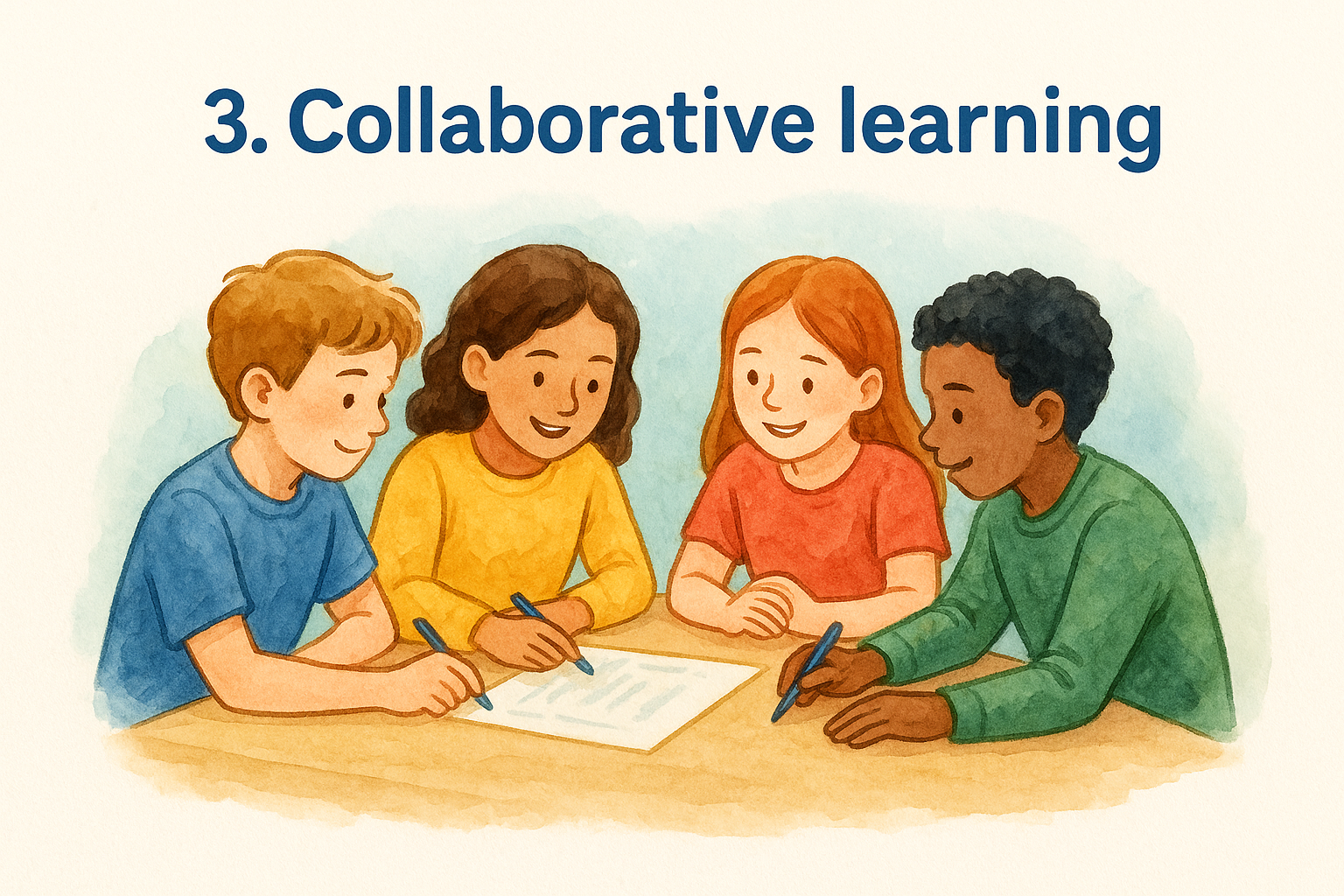
Group work only teaches teamwork when every student has a job that matters.
Real classroom example
During a Lord of the Flies unit, you might assign literature circles with rotating roles: a discussion leader, a passage picker, a connector who links the text to current events, and a summarizer. Each student prepares their piece before class, then the group builds a shared analysis none of them could’ve reached solo. You circulate, drop in questions, and grade the group’s synthesis alongside individual contribution notes.
Best for
This strategy fits discussion-heavy content like literature, history debates, and science labs where multiple data points need comparing. It also works well for building soft skills like listening and compromise, which most report cards don’t measure but every employer wants.
Tips to try it tomorrow
Assign roles explicitly instead of letting groups self-organize, since that’s where uneven participation starts. Keep groups at three or four students, cap the task at 15 minutes, and require a written or verbal product from every member before you accept the group’s work as done.
4. Inquiry-based learning
How it works
Inquiry-based learning flips the usual order: instead of explaining a concept and then letting students apply it, you hand them a question or a puzzling scenario and let them build understanding through investigation. You act as a guide, asking probing questions and pointing students toward resources, but you resist giving the answer outright. This is one of the teacher teaching strategies that trades speed for depth, since students who wrestle with a problem retain the concept longer than students who just hear it explained, and the types, steps, and examples of inquiry learning show how far you can take it.
Students remember what they had to figure out far longer than what they were simply told.
Real classroom example
Greek mythology units lend themselves naturally to this approach. Rather than lecturing on the traits of Greek gods, you give students a set of primary source excerpts and ask them to figure out what values ancient Greeks prized based on how their gods behaved. Groups present their conclusions with textual evidence, then you fill gaps only where their reasoning missed something important.
Best for
Inquiry works best in science labs, historical case studies, and literature units where multiple valid interpretations exist. It struggles with content that has one correct procedure, like solving equations.
Tips to try it tomorrow
Start with a single guiding question instead of an open-ended unit. Give students a time limit, a small set of sources, and a clear product to produce, like a claim backed by two pieces of evidence.
5. Formative assessment
How it works
Formative assessment means you check for understanding constantly, not just at the end of a unit. You’re gathering quick evidence with fast daily check-in routines, an exit ticket, a thumbs-up poll, a one-question quiz, then using that data to adjust tomorrow’s lesson before small gaps become big ones. Unlike a final test, the point isn’t to grade students, it’s to catch confusion early while you still have time to fix it.
If you only find out students are lost on the unit test, you already lost three weeks.
Real classroom example
After teaching thesis statements, you hand out index cards and ask students to write one thesis sentence for a prompt you give on the spot. You sort the cards into three piles while students work on something else: solid, shaky, and off-track. The next day, you regroup students based on those piles instead of assuming everyone’s ready to move on.
Best for
This approach works in every subject and grade level, since checking understanding before moving forward is universal. It matters most in sequential content like math, grammar, and writing, where each skill builds on the last.
Tips to try it tomorrow
End every lesson with a two-minute check, not a review question you already know the answer to. Vary the format so students don’t tune it out:
- Exit tickets with one specific question, drawn from a bank of quick exit ticket prompts
- Quick polls using whiteboards or hand signals
- A single problem solved cold, no notes
Our Question Generator can pull quick check questions straight from your material when you’re short on prep time.
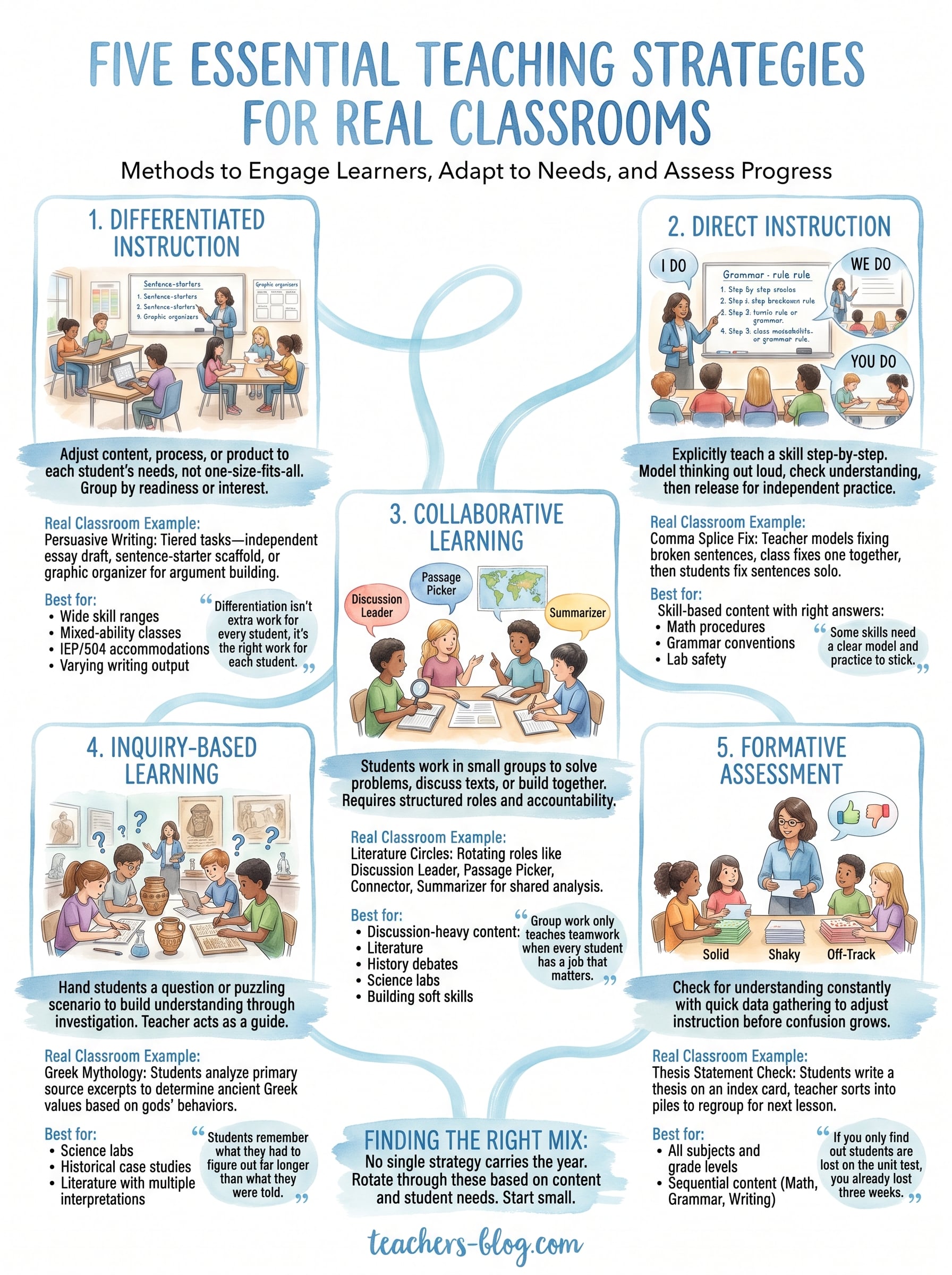
Finding the right mix for your classroom
No single strategy carries a whole school year. The best classrooms rotate through differentiated instruction for skill gaps, direct instruction for new procedures, collaborative work for discussion-heavy units, inquiry for content with room to explore, and formative checks running underneath all of it. Pick one strategy from this list, try it for a week, and watch what actually changes in student output before you add another.
What trips teachers up isn’t knowing these teaching strategies, it’s finding time to build the tiered materials, questions, and feedback loops each one requires. That’s the gap our tools close. Between the Differentiated Instruction Helper, the Question Generator, and the Worksheet Maker, you can turn one lesson into the leveled, discussion-ready version your students need without staying at school until 6pm. If you’re ready to put these strategies into practice without rebuilding every lesson from scratch, browse the AI apps that cut your planning time and start with whichever one fits next week’s unit.