Student Motivation: What It Is and Why It Matters
You’ve watched it happen in your own classroom: two students with the same ability, same assignment, same deadline, and completely different results. The difference usually isn’t skill. It’s motivation. What is student motivation, really? It’s the internal and external drive that determines whether a student engages with learning, pushes through difficulty, or checks out entirely.
At its core, student motivation splits into two categories: intrinsic motivation, where students learn because they find the material genuinely interesting or satisfying, and extrinsic motivation, where grades, rewards, or approval drive the behavior. Neither one is inherently better, but understanding which one is at play in your classroom changes how you plan lessons, give feedback, and respond to disengaged students. Motivation also shifts based on factors like autonomy, relevance, and a student’s sense of competence.
This article breaks down exactly what student motivation looks like, walks through the difference between intrinsic and extrinsic types, and covers the specific classroom and psychological factors that either build or kill a student’s drive to learn. By the end, you’ll have a clearer framework for spotting motivation issues before they show up as failing grades.
Why student motivation matters for learning
Walk into any staff meeting and you’ll hear the same complaint: "They’re capable, they just won’t do the work." That gap between ability and effort is exactly why student motivation deserves more attention than it usually gets. Motivation isn’t a soft, feel-good add-on to your curriculum. It’s the mechanism that decides whether a well-designed lesson actually lands or falls flat, regardless of how much content knowledge or classroom management skill you bring to the table.
It predicts effort more than ability does
Grades often get treated as a proxy for intelligence, but research consistently shows that effort and persistence explain more variance in academic outcomes than raw aptitude. A student who’s moderately skilled but highly motivated will out-produce a gifted student who’s checked out, semester after semester. This is why two kids with identical test scores in September can end up on completely different trajectories by June. The motivated one asks questions, redoes the sloppy paragraph, and shows up for extra help. The unmotivated one turns in the bare minimum and disappears the moment the bell rings.
A student’s drive to learn shapes their outcomes more reliably than their raw ability ever will.
It shapes behavior before it shows up in grades
Before motivation problems ever show up on a report card, they show up as behavior. Disengaged students don’t usually announce it; they act it out through side conversations, phone-checking, refusal to start work, or quiet withdrawal. Teachers who read these signals as pure discipline issues often miss the underlying cause, which is why it helps to understand what actually drives student behavior. Addressing the root, a lack of relevance, autonomy, or confidence, does more to fix classroom management than another consequence ever will. This connects directly to the work we cover in the Brain Builders Workshop, which focuses on building the mindset skills that keep students engaged before disengagement turns into a behavior problem.
It compounds, for better or worse
Motivation isn’t static, and it doesn’t stay contained to a single unit or semester. A student who feels successful and engaged in September builds momentum that carries into October. One who struggles and loses interest early tends to fall further behind, because low motivation to learn reduces practice, and less practice widens skill gaps, which then erodes motivation further. This spiral is one of the biggest reasons early intervention matters so much. Catching a dip in engagement in week three is far easier than trying to rebuild a student’s confidence in week twenty, after months of low grades have convinced them they’re just "not a math person" or "bad at writing."
What low motivation costs in real classrooms
When academic motivation drops, you lose the academic, social, and behavioral benefits of student engagement, and the effects show up in predictable, measurable ways:
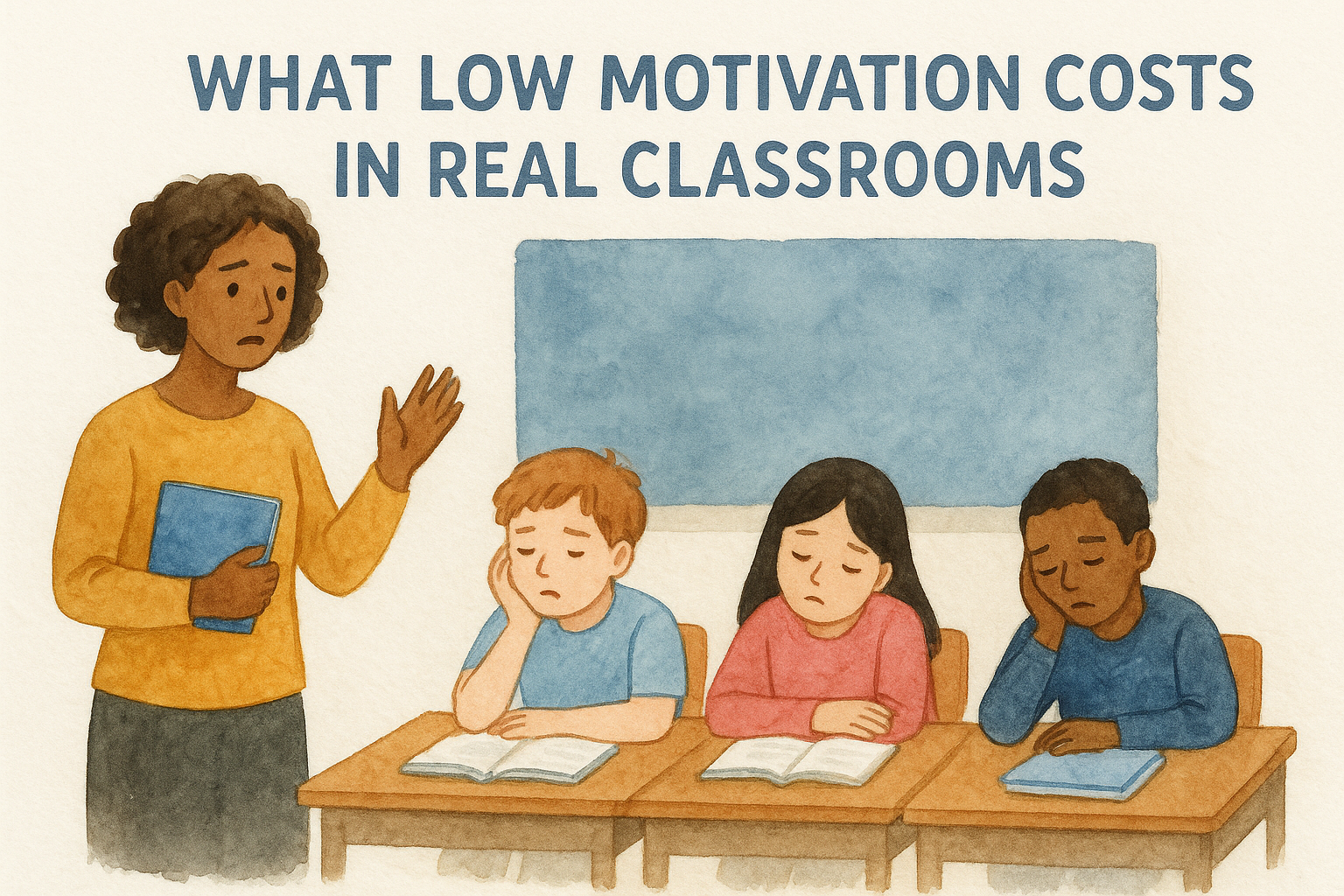
- Lower assignment completion rates, especially on work that requires sustained effort over multiple days
- Increased absenteeism, since students disengaged from content often disengage from attendance too
- Higher behavior referrals, as boredom and frustration get expressed through disruption
- Weaker retention, because information learned without genuine engagement rarely makes it to long-term memory
- Reduced help-seeking, as unmotivated students are less likely to ask questions or attend office hours
Understanding these downstream effects reframes how you should think about motivation. It’s not a personality trait some students have and others don’t. It’s a responsive, changeable state that you influence every day through the tasks you assign, the feedback you give, and the relationships you build. The Institute of Education Sciences has published research tying engagement interventions directly to improved achievement scores, reinforcing what most veteran teachers already sense from experience: fix the motivation problem, and the academic problems tend to follow. That’s the case for treating motivation as a core part of your instructional planning, not an afterthought you address only when a student starts failing.
What shapes a student’s motivation to learn
Psychologists Edward Deci and Richard Ryan built their self-determination theory around three needs that drive human behavior: autonomy, competence, and relatedness. Students need to feel they have some choice in their work, they need to feel capable of succeeding at it, and they need to feel connected to the people around them, whether that’s you or their classmates. Strip out any one of these and motivation starts to erode, even in a well-run classroom with strong content, which is exactly what drives student motivation in the classroom day to day.
When students feel no choice, no chance of success, and no connection, motivation doesn’t fade slowly. It disappears fast.
Intrinsic vs extrinsic drivers
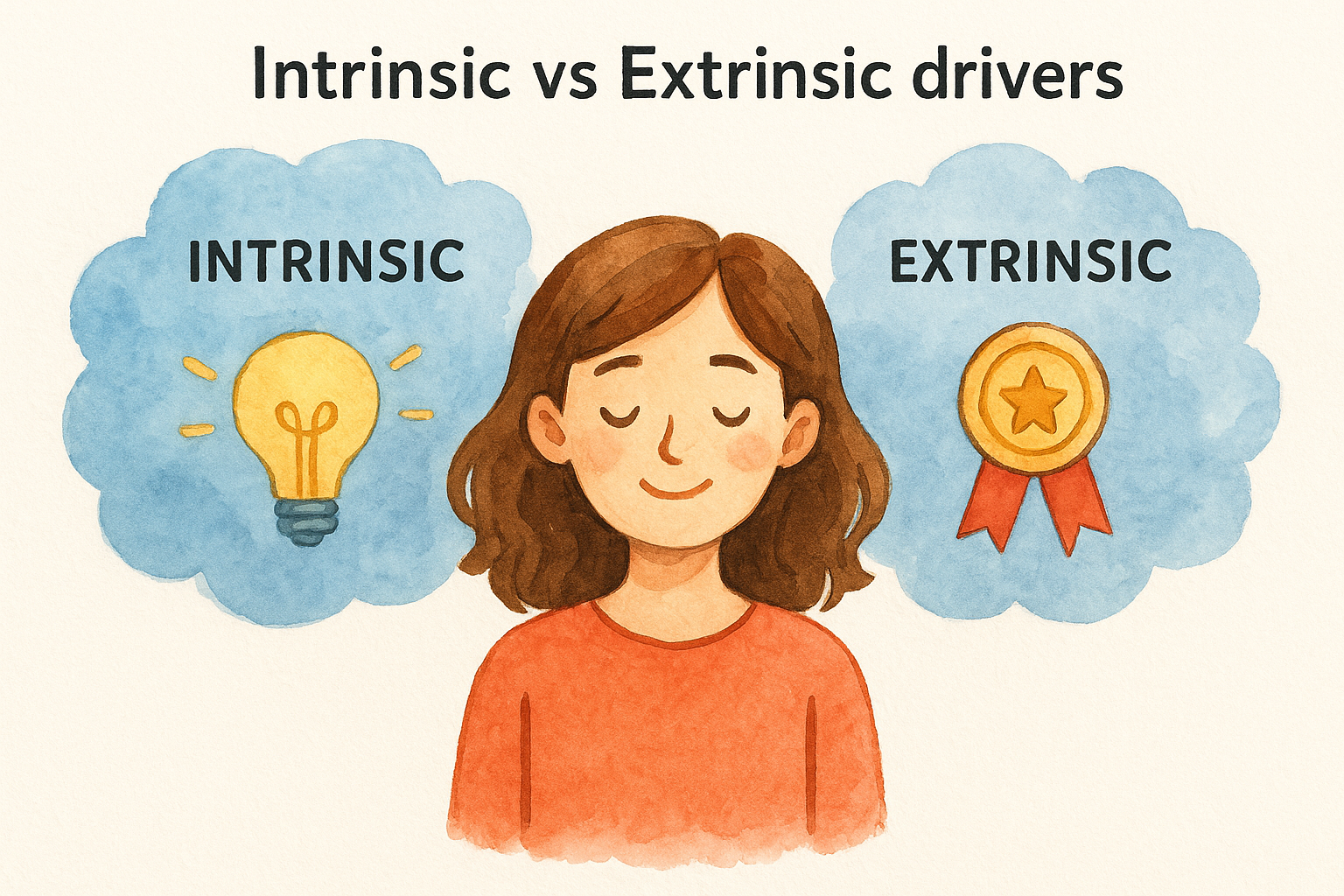
Understanding what motivates students to learn means separating what comes from inside the student from what comes from outside pressure. Both types matter, but they behave differently over time. Extrinsic rewards can jumpstart effort quickly, but they tend to fade once the reward disappears. Fostering intrinsic motivation takes longer to build but produces more durable engagement.
| Factor type | Examples | Typical effect |
|---|---|---|
| Intrinsic | Curiosity, personal interest, sense of mastery | Long-lasting, self-sustaining engagement |
| Extrinsic | Grades, prizes, praise, avoiding punishment | Fast but short-term compliance |
| Mixed | Competition, social recognition, career goals | Depends heavily on framing and follow-through |
Grasping this table helps you decide when a sticker chart or other positive reinforcement technique is the right tool and when it’s actually undermining the deeper interest you’re trying to build.
Outside factors that quietly shape drive
Outside the classroom, plenty of forces shape whether a student walks in ready to work. Home stability, sleep, nutrition, and family attitudes toward school all color how much energy a student has left for academics. A kid who’s up until midnight babysitting siblings isn’t lacking drive; they’re lacking bandwidth. Recognizing this distinction keeps you from mislabeling exhaustion as apathy.
Peer culture matters just as much. Students calibrate effort based on what’s socially acceptable in their friend group, and a classroom where trying hard is seen as uncool will suppress even a naturally curious student’s visible engagement. You can’t control what happens at home or in the hallway, but you can control the classroom culture you build, and that culture either reinforces or counteracts those outside pressures.
Past experience and self-efficacy
Finally, a student’s history with a subject shapes their current motivation more than most teachers realize. Repeated failure in math, for example, teaches a student that effort doesn’t pay off, showing how learned helplessness takes hold alongside what psychologist Albert Bandura called low self-efficacy. Reversing that belief takes more than one good grade; it takes a string of small, visible wins that rebuild the student’s trust in their own ability to improve.
How to build motivation in your classroom
Building student motivation isn’t about one big speech or a flashy project once a semester, and there are 14 proven ways to motivate students that prove it. It’s about small, repeatable design choices that give students a reason to engage every single day. The three needs from self-determination theory, autonomy, competence, and relatedness, translate directly into concrete classroom moves you can start using tomorrow.
Give students real choices
Start by handing over small decisions that don’t compromise your learning goals. Offer a choice of three essay prompts instead of one, let students pick between a written or recorded response, or allow them to choose their own novel from a curated list, all examples of how choice works in differentiated lessons. Genuine autonomy doesn’t mean chaos; the science behind autonomy and motivation shows it means students feel some ownership over how they demonstrate understanding. Tools like the Differentiated Instruction Helper make this easier, since you can generate varied task options for the same standard without spending your planning period building each version from scratch.
Build in visible, frequent wins
Competence grows through evidence, not encouragement. Break big assignments into smaller checkpoints so students see progress in real time instead of waiting three weeks for a single grade. Use low-stakes quizzes, quick exit tickets, or peer feedback rounds to give students proof they’re improving.
Students don’t believe they’re capable because you tell them so; they believe it because they see it happen.
A quick way to structure this:
- Chunk the assignment into 3 to 4 checkpoints with clear success criteria
- Check progress at each checkpoint, even briefly
- Celebrate specific improvement, not just completion
- Correct early, before a small gap becomes a big one
The Question Generator tool works well here, since it can produce quick critical-thinking checkpoints from whatever material you’re already teaching, giving you a fast way to measure understanding mid-unit instead of only at the end.
Strengthen relationships and relevance
Relatedness often gets overlooked, but it’s one of the fastest levers you have. Greeting students by name at the door, referencing their interests in examples, and building in short partner-talk moments are simple ways to build stronger relationships with students, signaling that the classroom is a place where they’re known, not just managed. Connecting content to students’ actual lives matters just as much: a persuasive writing unit tied to something they already care about will out-motivate the same skill taught through a generic prompt.
Finally, treat feedback as a motivation tool, not just an evaluation tool. Feedback that drives improvement names specific strengths and next steps and builds momentum toward mastery, while vague or purely numerical feedback tends to shut engagement down. Small shifts in how you phrase feedback often move the needle on effort more than any single lesson redesign will.
Helping unmotivated students re-engage
Every classroom has at least one student who’s checked out completely: no homework, no participation, no visible reaction to praise or consequences. Re-engaging a student like this takes a different approach than preventing disengagement in the first place, because you’re not building motivation from scratch, you’re rebuilding trust that’s already been damaged by repeated failure or disinterest. Unmotivated students rarely respond to more pressure; reengaging apathetic learners depends on changing what learning feels like for them.
Spot the difference between "won’t" and "can’t"
Before you can re-engage a student, you need to diagnose why they’ve stopped trying. Some students disengage because the work feels pointless or too easy, a motivation problem. Others disengage because the work feels impossible, which is closer to a skill gap wearing a motivation costume. Confusing the two leads to wasted effort: pep talks won’t fix a decoding problem, and remedial worksheets won’t fix boredom. Ask a few direct questions, look at recent work samples, and watch where a student stalls out before assuming you know the cause.
Treat every disengaged student as a diagnosis problem first, and a motivation problem second.
Rebuild small wins before big ones
For a student who’s convinced they’re bad at a subject, one strong grade won’t undo months of frustration. What works instead is a string of small, low-risk wins aimed at rebuilding student confidence and self-efficacy. Lower the stakes temporarily, shrink the task, and make success genuinely achievable before you raise the bar again.
A practical sequence for re-engagement:
- Shrink the task to something the student can finish in one sitting
- Remove the grade temporarily so effort feels safe again
- Name the specific skill they used well, not just "good job"
- Gradually restore normal length and stakes over two to three weeks
The Worksheet Maker is genuinely useful here, since you can generate a shorter, targeted practice set from the same keywords you’re already teaching, without watering down the actual content.
Reconnect through relationships, not lectures
Often, the fastest way back to engagement is a private, low-stakes conversation rather than a public correction. Asking "What’s making this class hard right now?" signals curiosity instead of judgment, and students who feel judged rarely open up. Pair that conversation with one small accommodation, extra time, a modified format, or a check-in schedule, and you’ve given the student a concrete reason to try again.
Related resources like the Report Card Commentor and these comment examples for struggling students can also help here, since specific, individualized comments show a student you’ve actually noticed their progress rather than copy-pasting generic praise. That specificity, more than any single intervention, is often what convinces a disengaged student that trying again is worth the risk.
Motivation in action: classroom examples
Theory only helps if you can see it working in a real classroom. Below are three scenarios pulled from common teaching situations, each showing how student motivation shifts when a teacher changes one specific variable rather than overhauling the whole unit.
A literature unit built around choice
Picture a ninth-grade class working through the To Kill a Mockingbird unit plan, where half the students are dragging through discussion questions and the other half are actually invested. The teacher notices the disengaged half all have the same complaint: they don’t see the point of analyzing a book from 1960. Instead of forcing the same essay prompt on everyone, she offers three options: a courtroom-focused analysis, a modern parallel case comparison, or a character study told from a minor character’s perspective. Completion rates jump almost immediately, not because the content got easier, but because students finally had a stake in which angle they explored.
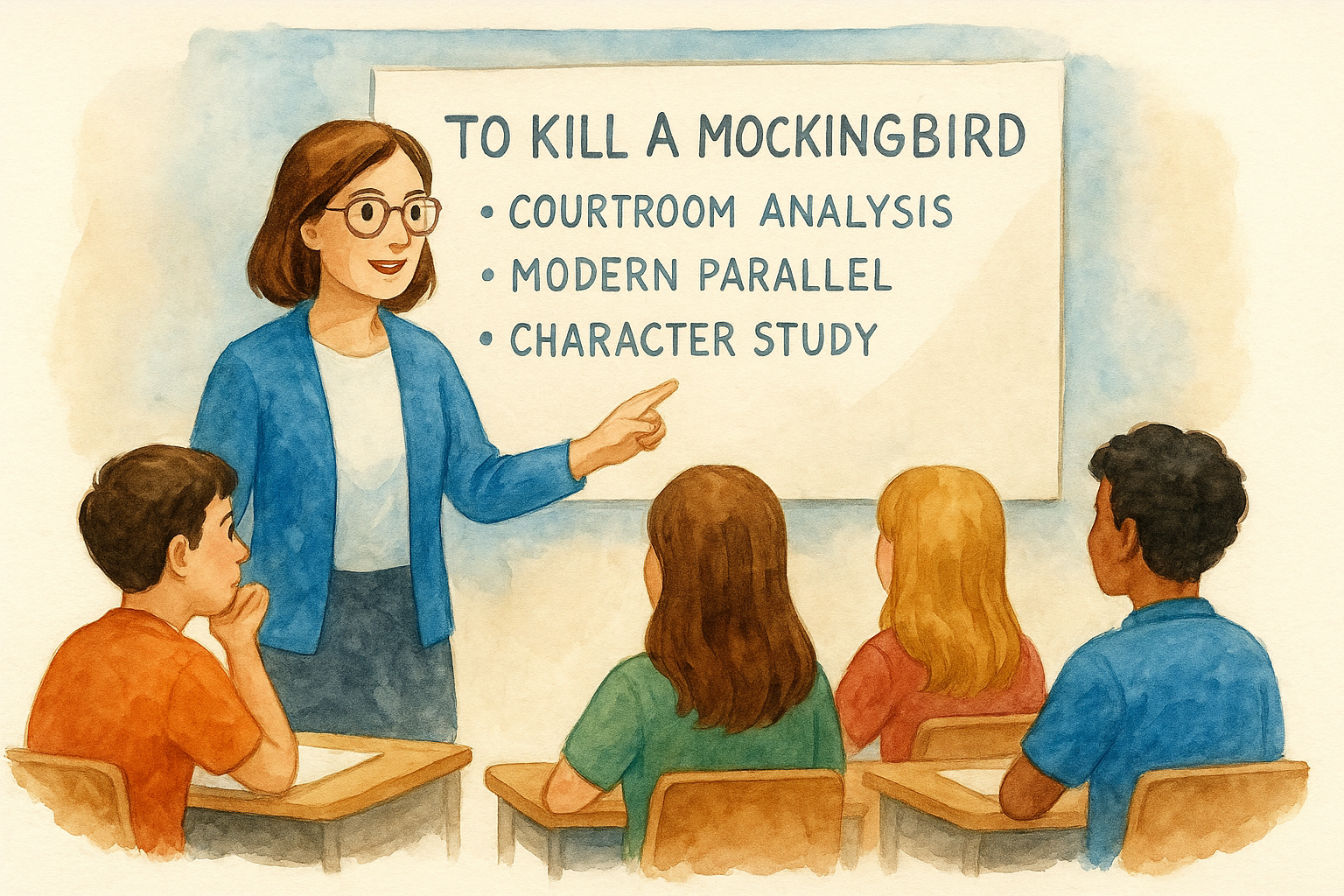
Give students a reason to care about the material, and effort follows almost automatically.
An essay unit that shifts from reward to ownership
Consider an eighth-grade writing teacher using the opinion essay unit, who starts the year offering small prizes for finished drafts. Submission rates go up, but the quality stays flat, students write just enough to collect the reward. Midway through the semester, she switches strategy: instead of prizes, she has students choose their own topic from a list of real debates happening in their school, then publishes the strongest essays on a class blog. Motivation research would predict exactly what happens: engagement moves from compliance to genuine investment, because the payoff shifted from external to something closer to pride in their own work.
A quick fix for one disengaged student
Finally, take a single case: a tenth grader who stopped turning in homework two weeks into the term. Rather than another warning, his teacher runs a private check-in and learns the student feels behind and embarrassed to ask questions in front of peers. She shrinks his next assignment to a single paragraph, skips the grade, and gives him specific, private feedback praising one strength she noticed. Within a week, he’s back to full-length assignments. Nothing about the curriculum changed, only the size of the task and the safety of the feedback loop.
Seeing motivation shift in real time like this makes the abstract concept concrete. These aren’t dramatic interventions. They’re small, deliberate adjustments to choice, feedback, and task size, the same three levers covered earlier in this article, applied to specific students in specific moments.
Keeping the spark alive in your classroom
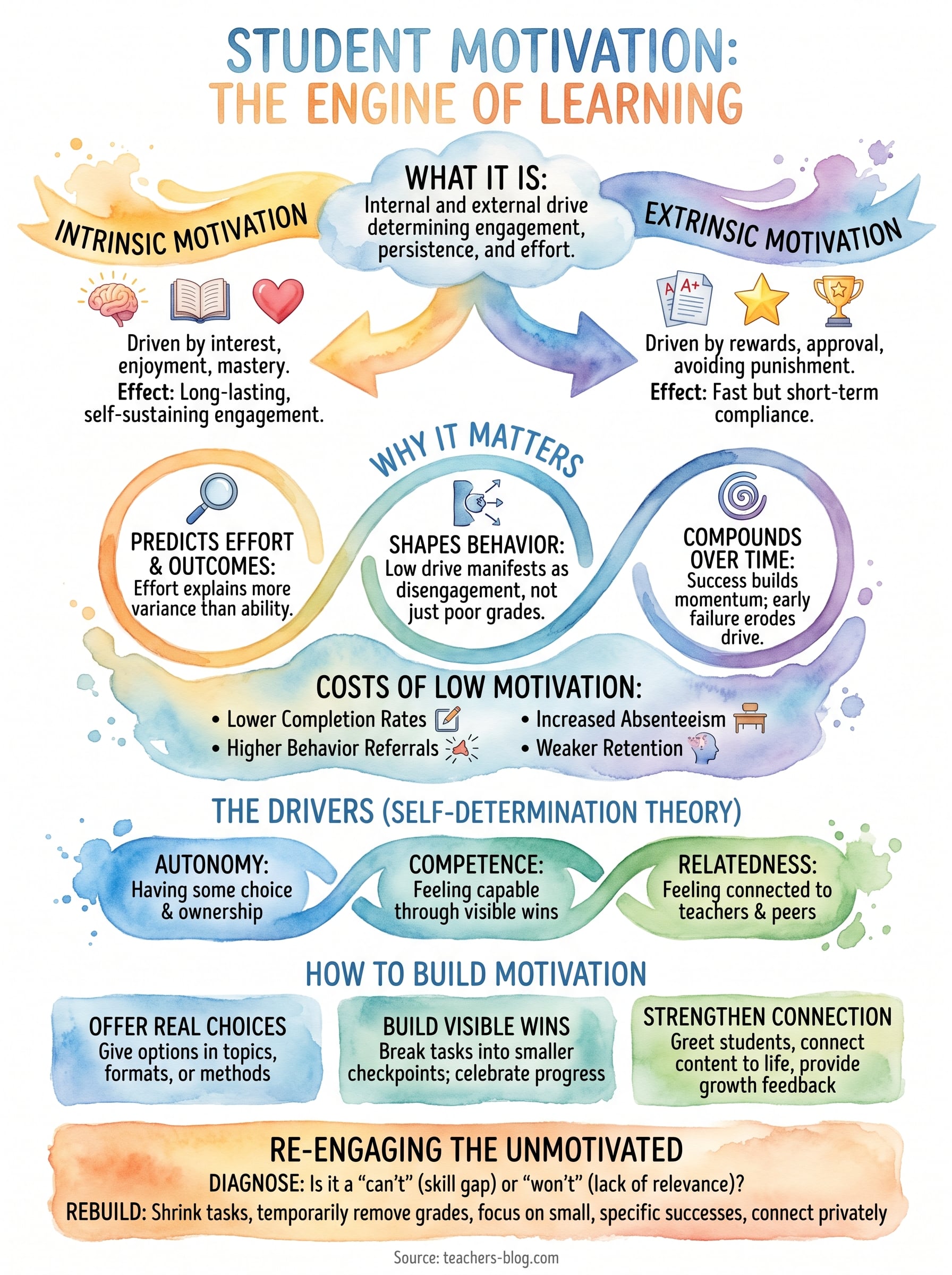
At this point, student motivation should feel less like a mystery and more like a set of levers you already control. Choice, competence, and connection drive engagement far more reliably than any single reward or punishment ever will. Every example in this article, from the ninth-grade choice essay to the tenth grader who just needed a shorter task and a private conversation, comes down to the same idea: motivation responds to how you design the work, not to how hard a student tries to want it.
Don’t wait for a full semester of failing grades to start addressing engagement. Watch for the early signs, adjust one variable at a time, and treat re-engagement as a diagnosis, not a discipline problem. If you want more ready-to-use strategies and tools for building this into your daily teaching, start with these classroom-proven tips for student motivation and apply a few this week.