
15 Student Engagement Strategies PDF Guide for Teachers
You need something you can actually print, annotate, and stick on your desk between classes. Scrolling through fifteen browser tabs of teaching blogs isn’t practical when you have five minutes before the bell rings. That’s why so many teachers search for a student engagement strategies pdf, something concrete, scannable, and ready to use without extra formatting or guesswork.
This guide gives you exactly that. Below you’ll find 15 classroom-tested strategies, each explained in plain language with quick implementation notes, packaged into a downloadable PDF format you can grab and use today. No fluff, no theory-heavy detours, just moves that work whether you’re teaching freshman English or a packed sixth-period science class.
We’ll walk through techniques for warming up disengaged students, structuring group work that doesn’t fall apart, and using quick formative checks that keep kids accountable. You’ll also see how a few of these pair naturally with tools like differentiated instruction helpers or worksheet generators, so planning stays fast and your lessons stay sharp.
1. Use AI-powered tools to personalize engagement
Every class has students working three grade levels apart on the same assignment, and no teacher has time to write five versions of every worksheet by hand. This is where AI-powered classroom tools earn their keep. Instead of treating differentiation as an extra task tacked onto lesson planning, you fold it into the planning process itself, cutting prep time while actually reaching more kids in the room.
How it works
Start with whatever content you already teach and run it through a tool built for the job. The Differentiated Instruction Helper takes a single lesson and adjusts reading level, scaffolding, and complexity for different learners in minutes, the same way differentiated instruction activities work in a mixed-ability room. Pair it with the Worksheet Maker to generate practice sets from keywords, or the Question Generator to build critical thinking prompts straight from your source material. None of this replaces your judgment as the teacher; it just removes the grunt work so you can spend your planning period thinking about instruction instead of formatting.
Why it boosts engagement
Students disengage fastest when work feels either too easy or completely out of reach, which is why ways to improve student engagement usually start with the fit of the material. Personalized materials close that gap without singling anyone out, since every student gets a version that matches their entry point while covering the same core content. This matters most for a student engagement strategies pdf you plan to reuse across a unit, because differentiated versions built once can be printed and adapted for every class period without redoing the work each time.
Students stay engaged when the work in front of them actually fits where they are.
Teachers who use these tools consistently report that struggling students spend less time stuck and more time producing actual work, which alone changes the energy in a room. Meanwhile, advanced students get extension questions instead of busywork, so nobody’s coasting through the period waiting for the bell.
Quick tip to try tomorrow
Take tomorrow’s lesson and run it through the Differentiated Instruction Helper before you leave school today. Generate three versions: one scaffolded, one on-level, one extended. Print all three, but don’t announce which is which. Hand them out based on quick observation of who’s struggling that day, not a fixed label from a folder. This single adjustment often reveals engagement problems that were never about ability in the first place, just mismatched material sitting on the wrong desk.
2. Establish clear routines and classroom procedures
Chaos kills engagement faster than boring content ever could. When students don’t know where to put finished work, how to ask for help, or what happens the second they walk in, mental energy goes toward figuring out logistics instead of learning. Clear classroom procedures free up that bandwidth so kids can actually focus on the task in front of them.
How it works
Pick the five or six moments in your class period that repeat every single day: entering the room, turning in work, transitioning between activities, asking for help, and packing up. Script exactly what each one looks like, then teach it explicitly the same way you’d teach a math concept. Practice it, correct it gently, and repeat until it’s automatic. A printable list of classroom routines and procedures to teach from day one works well here, since you can post it near the door as a visual reminder until the habit sticks.
Why it boosts engagement
Routines remove the friction that causes off-task behavior in the first place. Students who know exactly what’s expected spend less time negotiating with you and more time working, which is the whole point of a solid student engagement strategies pdf. Predictability also lowers anxiety for students who struggle with transitions, and it explains how routines reduce behavioral load, giving kids one less thing to worry about before they can engage with content.
Consistent routines buy you the classroom time engagement actually needs.
Quick tip to try tomorrow
Choose just one transition, like moving from independent work to group discussion, and time how long it currently takes. Teach a tighter version tomorrow, practice it twice, then time it again. Shaving even ninety seconds off a daily transition adds real instructional minutes back into your week.
3. Use quick attention signals to refocus the class
Some days you lose the room mid-activity, and yelling over twenty-five talking students never actually works. Quick attention signals solve this without burning your voice or your patience, giving you a fast, consistent way to pull focus back before a small distraction turns into five wasted minutes.
How it works
Pick one of the classroom attention signals that work without yelling and stick with it for the whole year: a raised hand, a call-and-response phrase, a countdown, or a light switch flick. Teach it explicitly on day one, practice it like a fire drill, and use it the same way every single time so students don’t have to guess what’s coming next. Keep a copy of your chosen signal in your student engagement strategies pdf so substitutes and student teachers can use the same cue without confusing the class.
Why it boosts engagement
Signals work because they interrupt without shaming. Nobody gets singled out, nobody loses face in front of classmates, and the whole class resets together in seconds rather than minutes. This matters for a classroom attention strategy you want to use daily, since a signal that feels punitive stops working within a week while one that feels routine keeps working all year.
A good attention signal costs you nothing but saves you minutes every single class.
Quick tip to try tomorrow
Tomorrow, introduce a five-second countdown signal before you actually need it. Practice it once during a calm moment, not during chaos, so students associate it with a habit rather than a scolding. Use it consistently for a full week before judging whether it’s working, since new signals always feel awkward before they feel automatic.
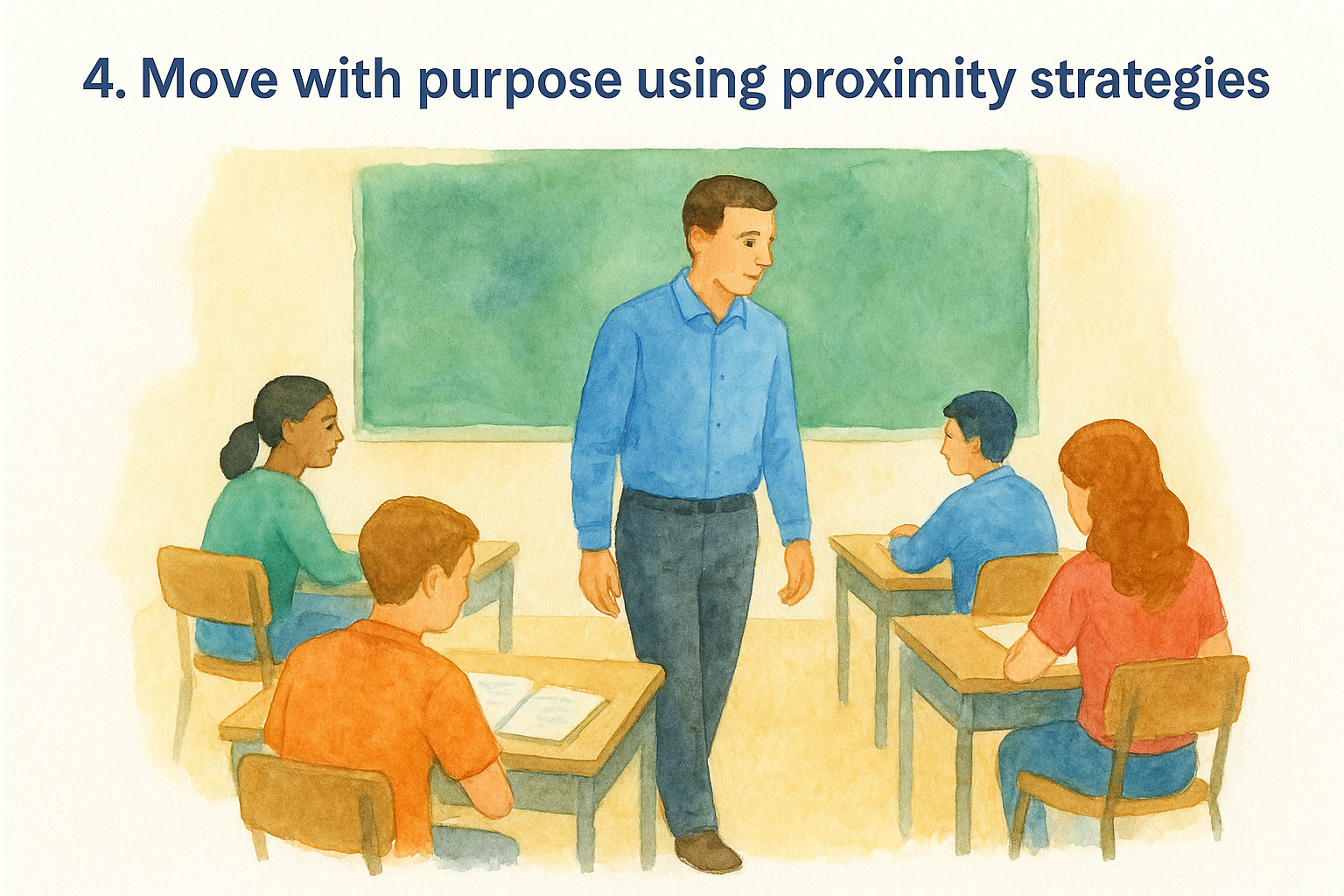
4. Move with purpose using proximity strategies
Standing at the front of the room for an entire period is one of the fastest ways to lose the back rows. Proximity strategies fix this by putting you physically closer to where attention tends to drift, without saying a word or stopping the lesson to redirect anyone.
How it works
Walk a deliberate loop through the room while you teach, lecture, or monitor independent work, rather than parking yourself at the whiteboard. Move toward students who are drifting off task before they fully check out, and linger near known hot spots for chatter or distraction. You don’t need to say anything most of the time; your presence alone resets focus. Map out a rough path in your student engagement strategies pdf so you have a default route on days when you’re too busy teaching to think about where to stand.
Why it boosts engagement
Proximity works because it signals awareness without confrontation. Students who know you might walk by at any moment stay on task more consistently than students who know exactly when your back is turned. This effective classroom management technique costs nothing and requires no prep, which makes it one of the easiest additions to any engagement plan you’re already running.
Just moving closer to a distracted student often fixes the problem before you say a single word.
Unlike a verbal warning, physical presence doesn’t interrupt the flow of the lesson or single anyone out in front of peers, so the correction feels almost invisible.
Quick tip to try tomorrow
Teach tomorrow’s lesson from three different spots in the room instead of standing at the front the whole time. Notice which students sit up straighter or put phones away as you approach. That reaction tells you exactly where your daily loop needs to include a stop.
5. Deliver specific, positive feedback in the moment
Generic praise like "good job" bounces off most students without changing a thing about what they do next. Specific, in-the-moment feedback works differently because it names the exact behavior worth repeating, so students know precisely what earned the response and can reproduce it on purpose.
How it works
Instead of a vague compliment, name the action: "You cited the text three times in that paragraph, that’s exactly the evidence-based writing we practiced." Deliver it right when you see the behavior, not at the end of class when the moment has passed and the connection is lost. Keep a short bank of feedback phrases inside your student engagement strategies pdf so you’re not scrambling for words while circulating during independent work.
Why it boosts engagement
Feedback timed close to the behavior reinforces it while the student can still act on it, unlike a graded paper handed back three days later. Positive reinforcement in the classroom also builds a stronger picture of what success actually looks like than a stamped smiley face ever could, which keeps students trying the same move again instead of guessing at what worked.
Feedback that names the exact behavior teaches faster than any grade ever will.
Students who hear precise feedback regularly start self-correcting before you even circulate back around, since they’ve internalized what "good" actually means in your classroom.
Quick tip to try tomorrow
During one activity tomorrow, give five pieces of feedback that each name a specific action rather than a general judgment. Skip "nice work" entirely for the period and force yourself to describe what you saw. Watch whether students repeat that named behavior again before class ends.
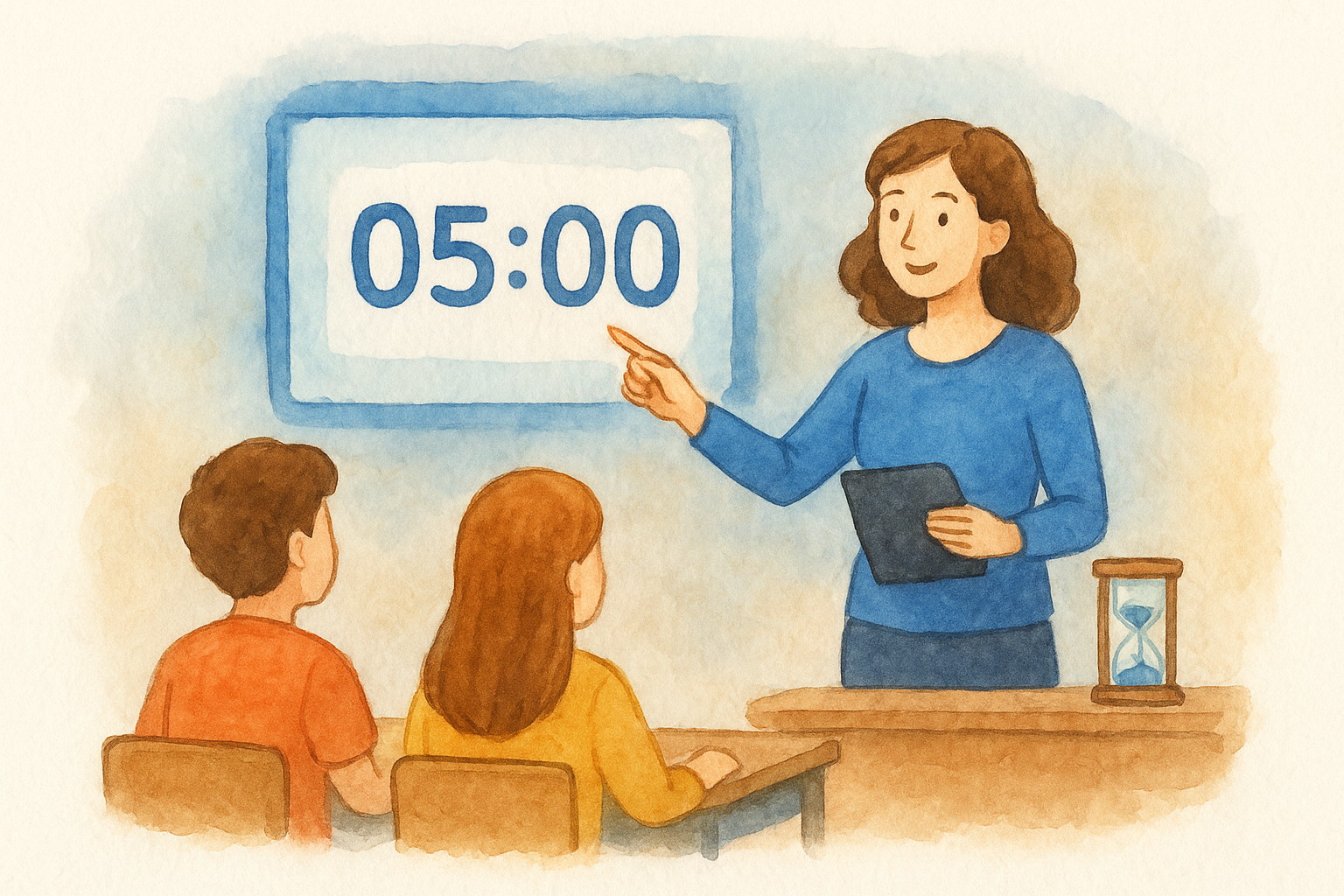
6. Set clear time limits for tasks and transitions
Open-ended work time invites drift. When students don’t know how long they have, some rush through in two minutes and spend the rest of the period distracting neighbors, while others stall indefinitely waiting for a deadline that never arrives. Visible time limits remove that ambiguity and give every task a natural sense of urgency.
How it works
Announce a specific time before starting any task, then display a countdown timer where the whole class can see it, whether that’s a projector clock or a simple sand timer on your desk. Keep the limit tight enough to require focus but realistic enough that most students can actually finish. Note your go-to time allotments for common tasks inside your student engagement strategies pdf, so you’re not guessing fresh numbers every period.
Why it boosts engagement
A visible countdown turns an open-ended task into a small challenge, and most students respond to that pressure by working faster instead of slower. Transitions benefit the same way, and it is one of the simplest time-saving classroom management strategies: give students ninety seconds to move from desks to the carpet instead of an unspoken expectation, and the room moves with far less wandering.
A visible timer turns dead time into a small challenge students actually want to beat.
Students who finish early also get a natural cue to check their work rather than sitting idle, which keeps the whole room productive until the timer runs out.
Quick tip to try tomorrow
Pick one task tomorrow you’d normally leave open-ended, set a visible timer for it, and announce the limit before students start. Compare how quickly the room settles into work versus your usual pace, and adjust the number up or down the next day based on what you saw.
7. Vary your voice to capture attention
A flat, monotone delivery lulls even motivated students into a half-listening state within minutes. Vocal variety interrupts that drift without you doing anything extra beyond how you already talk, making it one of the cheapest engagement tools you own.
How it works
Shift your pace, pitch, and volume on purpose as you teach, rather than defaulting to the same steady tone for forty-five minutes straight, since teacher voice and body language carry more of a lesson than most of us assume. Slow down and drop your voice for a key point you want remembered, then speed up through routine directions students already know. Whisper an important instruction instead of repeating it louder, and watch the room lean in to catch it. Jot a few go-to vocal cues into your student engagement strategies pdf so you remember to use them even on tired days when defaulting to monotone feels easier.
Why it boosts engagement
The brain naturally tunes into change and tunes out sameness, so a shift in your voice acts like a built-in alert system that something worth hearing just happened. This classroom engagement technique requires zero prep and zero materials, which makes it one of the few strategies you can start using in the middle of a lesson you’re already teaching.
A change in your voice tells the brain something worth hearing just happened.
Students who might tune out a lecture entirely often re-engage the moment your delivery breaks its usual rhythm, buying you back attention you’d otherwise lose to daydreaming.
Quick tip to try tomorrow
Pick one key sentence in tomorrow’s lesson and deliver it as a whisper instead of your normal volume. Notice how many heads turn toward you compared to your usual delivery, then repeat the trick anywhere you want a point to stick.
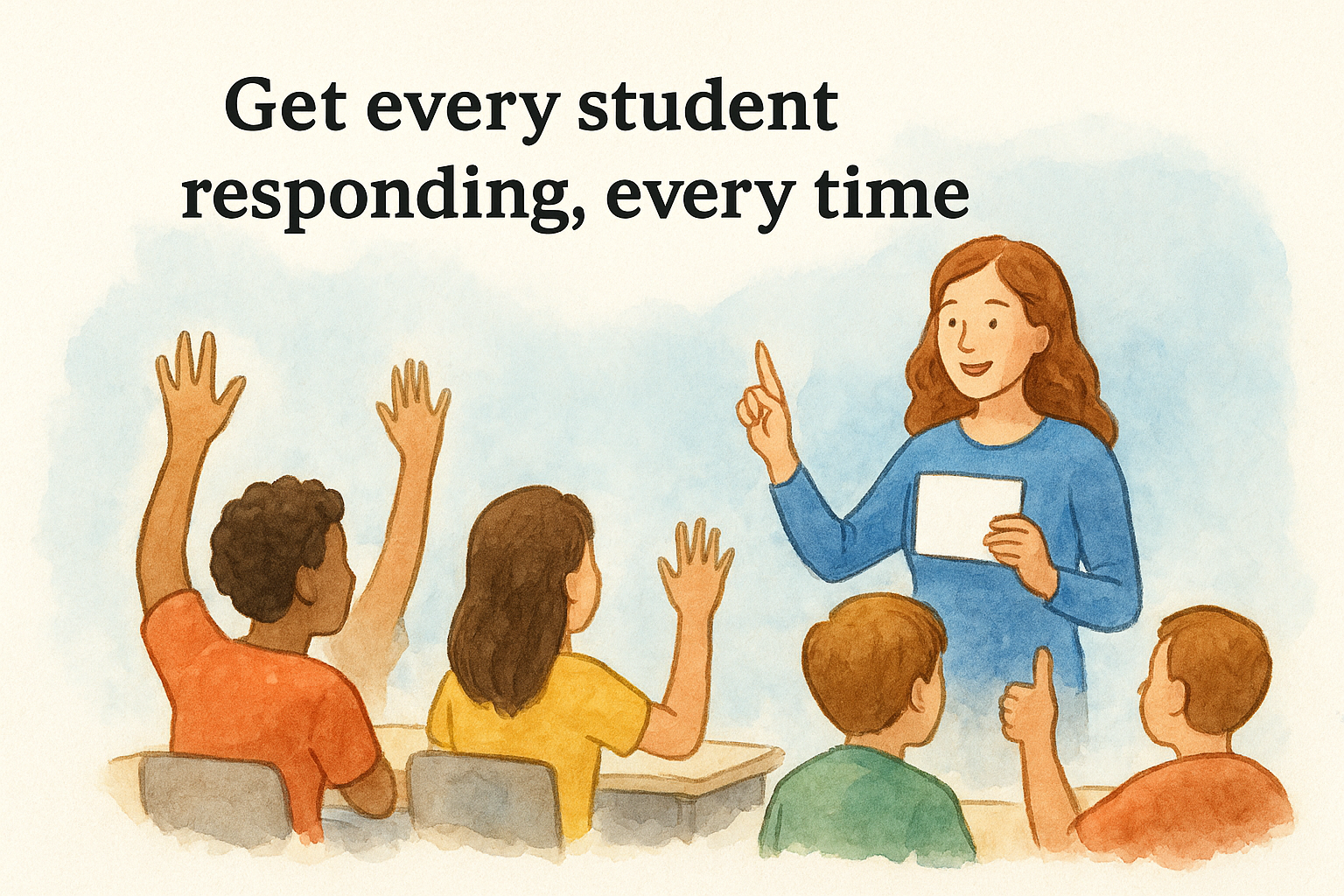
8. Get every student responding, every time
Calling on one raised hand leaves twenty-nine other students off the hook, and most of them know it. Whole-class response techniques fix that by making every student answer every question, not just the kid eager to shout out first.
How it works
Swap out hand-raising for methods that require a response from everyone at once: mini whiteboards held up on your count, thumbs up or down against your chest, or a quick turn-and-talk before you cold-call. Ask the question first, give think time, then signal for the answer so nobody blurts before classmates finish thinking. Keep a rotating list of these formats inside your student engagement strategies pdf, since variety keeps the routine from going stale by week three.
Why it boosts engagement
Accountability shifts the second every student knows they might have to answer. Nobody coasts on the assumption someone else will handle it, which is exactly the gap most approaches to improving student participation are trying to close. You also get instant formative data, which is what the best checks for understanding deliver, since one glance across a room of whiteboards tells you who’s lost far faster than grading exit tickets that night.
When every student has to answer, nobody gets to hide.
Quick tip to try tomorrow
Try mini whiteboards for just one lesson segment tomorrow. Ask a question, give fifteen seconds of silent think time, then say "show me" and scan the room in one sweep. You’ll spot misconceptions instantly, often from students who never would have raised a hand to admit confusion in the first place.
9. Help students track and own their progress
Students disengage when grades feel like something that happens to them rather than something they’re building. Student-tracked progress flips that dynamic, handing kids ownership over their own data so learning stops feeling like a mystery graded behind closed doors.
How it works
Give students a simple tracker, whether that’s a student goal setting worksheet, a spreadsheet, or a folder of dated quiz scores, and have them log their own results after every assessment or major assignment. Pair the number with a short reflection line: what worked, what didn’t, what to try next time. Include a blank version of this tracker in your student engagement strategies pdf so you can print it fresh for every new unit without rebuilding the format each time.
Why it boosts engagement
Ownership changes how students relate to setbacks. A kid who tracks their own scores over six weeks sees a trend line instead of one bad grade in isolation, which reframes a rough week as a blip rather than proof they’re bad at the subject. This kind of student self-monitoring, one of several ways to measure engagement in the classroom, also cuts down on the "why did I get this grade" conversations, since the data’s been sitting in front of them the whole time.
When students track their own numbers, a bad grade becomes a data point instead of a verdict.
Teachers who build this habit early in the year often notice students asking better questions about their own learning, since they’ve already spotted the gap before you mention it.
Quick tip to try tomorrow
Hand back tomorrow’s graded work with a blank tracker attached and five minutes of class time to fill it in. Ask students to write one sentence about what they’ll do differently before the next assessment.
10. Build in celebration and recognition moments
Work that never gets acknowledged starts to feel pointless, even to students who care about doing well. Celebration moments give effort somewhere to land, turning small wins into visible proof that progress actually happened instead of disappearing into a stack of graded papers.
How it works
Build short, predictable moments into your week where progress gets named out loud: a shoutout board, a class cheer for a hard problem solved, or thirty seconds at the end of Friday to name one thing that went well. Keep it quick and specific rather than turning it into a production that eats instructional time. Add a simple classroom celebration ideas list to your student engagement strategies pdf so you’ve got a rotation ready instead of relying on the same tired "good job" every time.
Why it boosts engagement
Recognition sticks longer when it’s public and specific, one of the student motivation techniques worth repeating, since students see exactly what earned the moment and want to earn it again. Celebrating growth rather than only final scores also pulls in the kids who rarely hit the top of the grade book but consistently improve, which keeps a wider slice of the class invested in showing up and trying.
A quick, specific celebration tells a student their effort actually landed.
Students who see classmates recognized for improvement, not just perfection, start taking more risks with harder work themselves.
Quick tip to try tomorrow
End tomorrow’s class with sixty seconds of "shoutouts," naming two students for something specific they did well that period. Keep it fast, keep it concrete, and watch whether more hands go up the next day from students hoping to be named next.
11. Turn passive questions into active prompts
Most questions teachers ask invite a single right answer, and once one student says it, everyone else stops thinking. Active prompts flip that pattern by asking students to predict, defend, or build on an idea instead of just retrieving a fact, which keeps the rest of the room mentally in the game.
How it works
Swap closed questions like "What year did the war start?" for prompts like "Which side do you think had the stronger argument, and why?" Open-ended prompts don’t have one correct answer, so students can’t just wait for a classmate to say it first. Build a short bank of these reworked questions into your student engagement strategies pdf, organized by unit, so you’re not inventing them cold in the middle of a lesson.
Why it boosts engagement
Active prompts force actual thinking instead of memory recall, which naturally pulls in students who tune out closed questions because they already assume someone faster will answer. This kind of questioning, central to teaching critical thinking skills, also surfaces reasoning you’d never see from a one-word answer, giving you a clearer read on who actually understands the material versus who’s just guessing well.
A question with no single right answer keeps the whole room thinking, not just the fastest hand.
Students also start defending their thinking to each other, which extends engagement past your question and into peer discussion you didn’t have to script.
Quick tip to try tomorrow
Rewrite three questions from tomorrow’s lesson plan into open-ended versions before class starts. Ask one, then wait a full ten seconds before calling on anyone. Notice how many more hands go up compared to your usual closed-question pace.
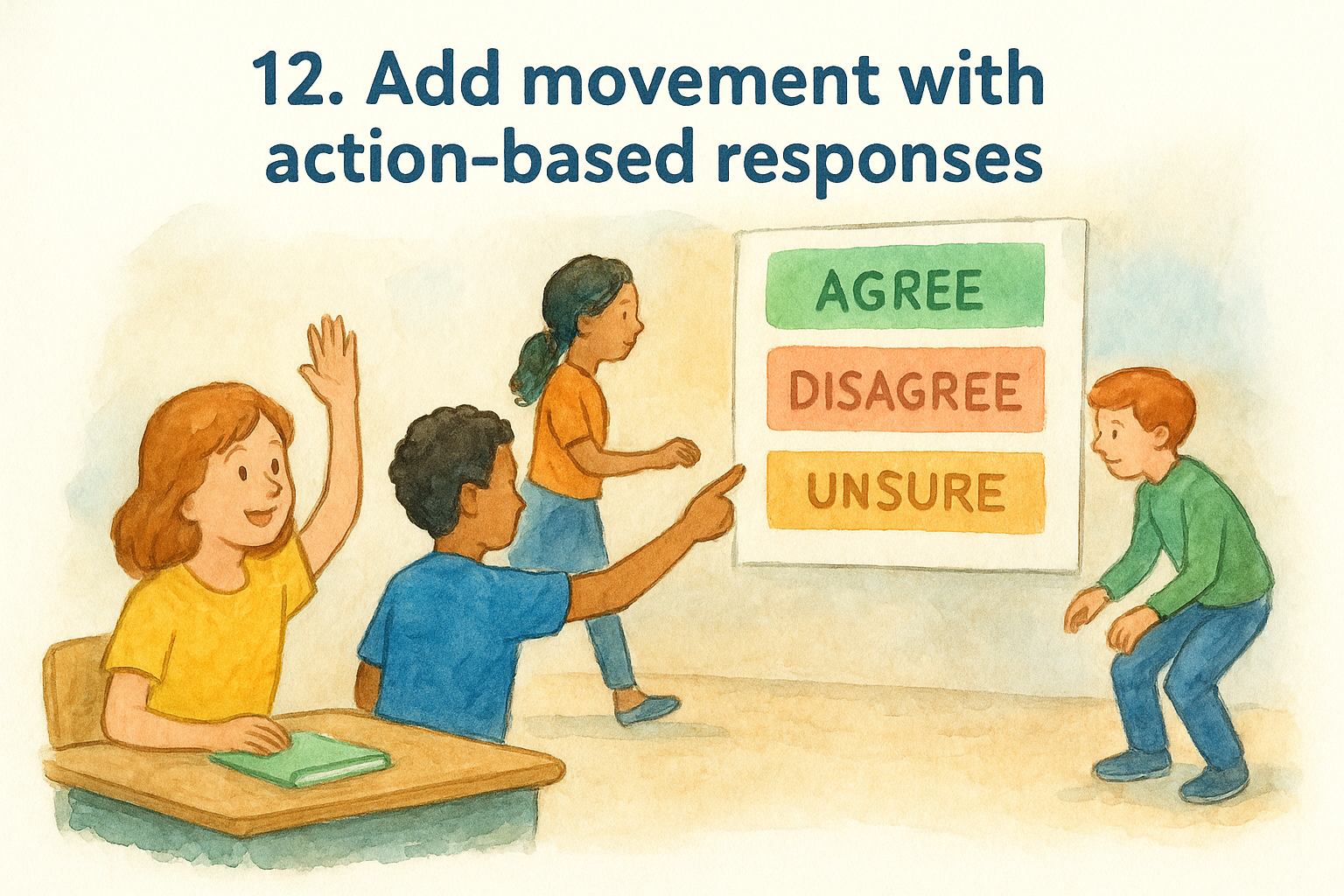
12. Add movement with action-based responses
Sitting still for forty-five minutes asks more of a developing brain than most students can actually deliver, and the fidgeting you see is often just the body demanding what the lesson isn’t giving it. Action-based responses solve this by building physical movement directly into how students answer questions, instead of treating movement as a break from learning.
How it works
Replace a verbal or written answer with a physical one: corners of the room labeled agree, disagree, and unsure for students to walk toward, or a stand-up-sit-down vote on a true or false statement. Charades-style vocabulary review works the same way, turning a word list into something students act out rather than recite. Keep a rotating set of these formats in your student engagement strategies pdf so movement stays fresh instead of becoming its own routine that loses novelty.
Why it boosts engagement
Movement wakes up students who’ve mentally checked out from sitting too long, and kinesthetic teaching strategies give those learners a format that finally matches how they process information best. This kind of kinesthetic learning strategy also makes thinking visible fast. One glance at which corner of the room a class walked toward tells you more than a written poll ever could.
Movement doesn’t distract from learning, it often is the learning for kids who think with their bodies.
Quick tip to try tomorrow
Turn one review question tomorrow into a room-corner vote instead of a raised-hand poll. Watch how many previously quiet students physically commit to an answer they’d never have volunteered out loud.
13. Build peer connections through collaboration
Students who feel isolated in a classroom disengage even when the content interests them, because learning starts to feel like a solo task nobody else cares about. Peer collaboration changes that by giving students a reason to talk to each other about the work itself, not just about weekend plans while you’re not looking.
How it works
Structure group work so every student has a defined role, like recorder, presenter, or fact-checker, instead of tossing four kids together and hoping they self-organize. Rotate partners regularly so students build working relationships across the whole class, not just with the two friends they always sit near. Keep a few reliable group work protocols listed in your student engagement strategies pdf so you can drop into a structure fast without reinventing group rules every unit.
Why it boosts engagement
Collaboration works because students often explain ideas to each other more plainly than you can, and hearing a concept from a peer sometimes lands where your explanation didn’t. This kind of cooperative learning strategy also builds social investment in the classroom itself, since students who’ve worked productively with most of their classmates feel less alone and more willing to take risks in front of them.
Kids who feel connected to their classmates take more risks with hard work.
Students paired with rotating partners throughout the year also develop stronger listening habits, since they can’t rely on one familiar friend to fill every gap.
Quick tip to try tomorrow
Assign tomorrow’s group task with clear roles printed on index cards, one per student, rather than leaving group dynamics to chance. Rotate the roles halfway through so everyone experiences more than one job.
14. Make content relevant with real-world ties
Students check out fast when a lesson feels like it exists only for a test. Real-world relevance fixes that by connecting whatever you’re teaching to something students already care about outside your classroom, so the work stops feeling like an isolated academic exercise.
How it works
Before teaching a concept, ask yourself where it shows up outside school: a math ratio in a recipe, a persuasive essay structure in an actual ad campaign, a historical pattern echoed in current events, the same real-world framing behind project based learning. Bring in that connection explicitly rather than assuming students will spot it themselves. Keep a running list of these real-world connections by unit inside your student engagement strategies pdf, since finding a fresh tie-in cold, mid-lesson, rarely works as well as one you planned ahead of time.
Why it boosts engagement
Relevance answers the question every disengaged student is quietly asking: why does this matter to me? Once students see a lesson connect to something they already value, whether that’s a hobby, a career interest, or a headline they saw that morning, the content stops feeling arbitrary. This kind of contextual learning also improves retention, since students remember concepts tied to something concrete far longer than ones taught in isolation.
A lesson tied to real life answers the question students are always silently asking: why does this matter?
Students who see the point of an assignment beyond the grade also push through difficulty more willingly, since the payoff feels bigger than a single score.
Quick tip to try tomorrow
Open tomorrow’s lesson with one real-world example before you introduce the concept itself. Ask students to guess the connection before you explain it, then teach the lesson with that hook already active in their heads.
15. Give students choice and voice in learning
Students tune out fast when every assignment feels handed down with zero input from them. Student choice fixes that by giving kids some control over how they show learning, even in small ways, so the work feels partly theirs instead of something imposed from the front of the room.
How it works
Offer options wherever the standard allows it, since the benefits of choice in differentiated instruction show up fast: a choice of essay topic, a pick between a poster or a written response, or a menu of three novels covering the same theme. Voice in learning also means asking students what they want to explore within a unit, then building part of your plan around real answers instead of guessing. Keep a bank of ready-made choice boards inside your student engagement strategies pdf so you can swap one in without redesigning an assignment from scratch every time.
Why it boosts engagement
Choice triggers ownership the same way it does for adults picking a project at work, which is why autonomy changes student behavior. Students who select their own format or topic invest more effort protecting that decision, since they chose it rather than had it assigned. This kind of student voice strategy also surfaces interests you’d never catch from a seating chart, giving you material to reference in future lessons.
Kids protect the choices they make far more than the assignments handed to them.
Quick tip to try tomorrow
Before your next assignment, offer just two format options instead of one fixed requirement. Ask students which they picked and why, then note the split. That single data point often reveals more about your class than a full week of observation.
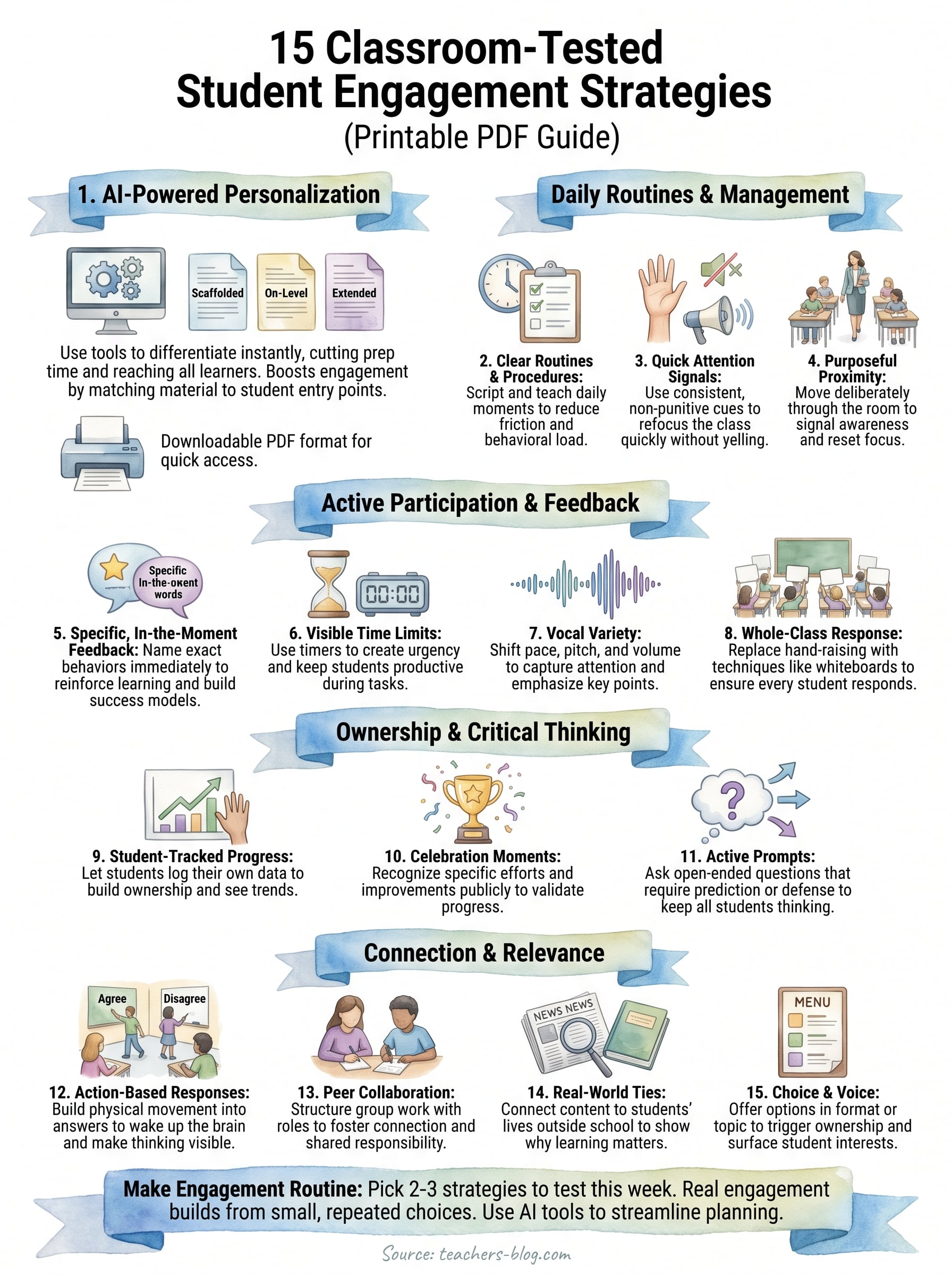
Making engagement part of your daily routine
You don’t need all fifteen strategies running by Monday. Pick two or three that match your biggest pain point right now, whether that’s a chatty fourth period or a group of students who’ve mentally checked out by lunch. Test them for a full week before judging the results, since new routines always feel clumsy before they feel natural. Print this student engagement strategies pdf, tape the ones you’re trying to your desk, and adjust as you go.
Real engagement builds from small, repeated choices, not one dramatic overhaul of your teaching style. A tighter transition here, a sharper question there, and pretty soon the whole room feels different without you having rebuilt a single lesson from scratch. If you want the planning side to move just as fast as the classroom side, explore the AI tools for student engagement built for teachers and let them handle the prep work while you focus on what happens once the bell rings.